
Email marketing software helps businesses automate customer communication, segment audiences, and track performance across campaigns. The right platform transforms scattered email sends into revenue-driving sequences that work while you sleep.
This page may contain affiliate links.
Some links on this page are affiliate links, meaning I may earn a commission if you sign up (at no extra cost to you). This never influences my ratings or recommendations.
Overview
The landscape
I track 32 tools in this category. Prices range from €4/mo (Zoho Campaigns) to $299/mo (Keap). The median starting price is $18/mo, so anything below that is a good deal.
22 tools offer free plans: Zoho Campaigns, Sender, Selzy, Mailjet, and 18 more.
This roundup covers the 10 I consider worth a serious look. Each one is ranked with real pricing data, aggregated user ratings, and my honest take.
Audience
Who is this guide for?
- ✓Ecommerce store owners who need automated cart abandonment and customer lifecycle emails
- ✓SaaS companies building onboarding sequences and feature announcement campaigns
- ✓Content creators monetizing newsletters and building subscriber relationships
- ✓Marketing agencies managing email campaigns for multiple clients
Which one is right for you
The right pick depends on who you are
Four buyers, four answers, all within Ecommerce Email. I ranked every tool here against each of them, and the reason under each pick is mine rather than the vendor's.
For an agency
3 to 30 people, multiple client accounts

from $9/mo
Solid choice for agencies having ecommerce + service businesses and not trying to get multiple software for each segments.
For a consultant
solo, juggling 5 to 15 clients

from $16/mo
Best for small / mid size ecommerce businesses.
For a solo builder who lives in AI
wires tools into Claude Code or Cursor
from $16/mo
Best for small / mid size ecommerce businesses.
For a solo builder who wants it simple
one tool, no wiring
from $16/mo
Best for small / mid size ecommerce businesses.
Exclusive reader deal
30% off Omnisend for 3 months
Affiliate link. I may earn a commission at no extra cost to you.
Quick verdict
Omnisend leads for ecommerce with built-in SMS and automation workflows. MailerLite offers the strongest free plan for general use, while ActiveCampaign dominates advanced automation at $15/month.
Overview
Quick comparison
| # | Tool | Price |
|---|---|---|
| 1 | $16/mo | |
| 2 | $45/mo | |
| 3 | $15/mo | |
| 4 | $13/mo | |
| 5 | $10/mo |
Show all 10 tools
| 6 | €19/mo | |
| 7 | $39/mo | |
| 8 | $9/mo | |
| 9 | $9/mo | |
| 10 | Free up to 10,000 emails/month, then $1 per 1,000 emails |
Rankings
My Top Picks

Omnisend
Ecommerce-focused email and SMS marketing platform with powerful automation and 160+ integrations
Why I like it
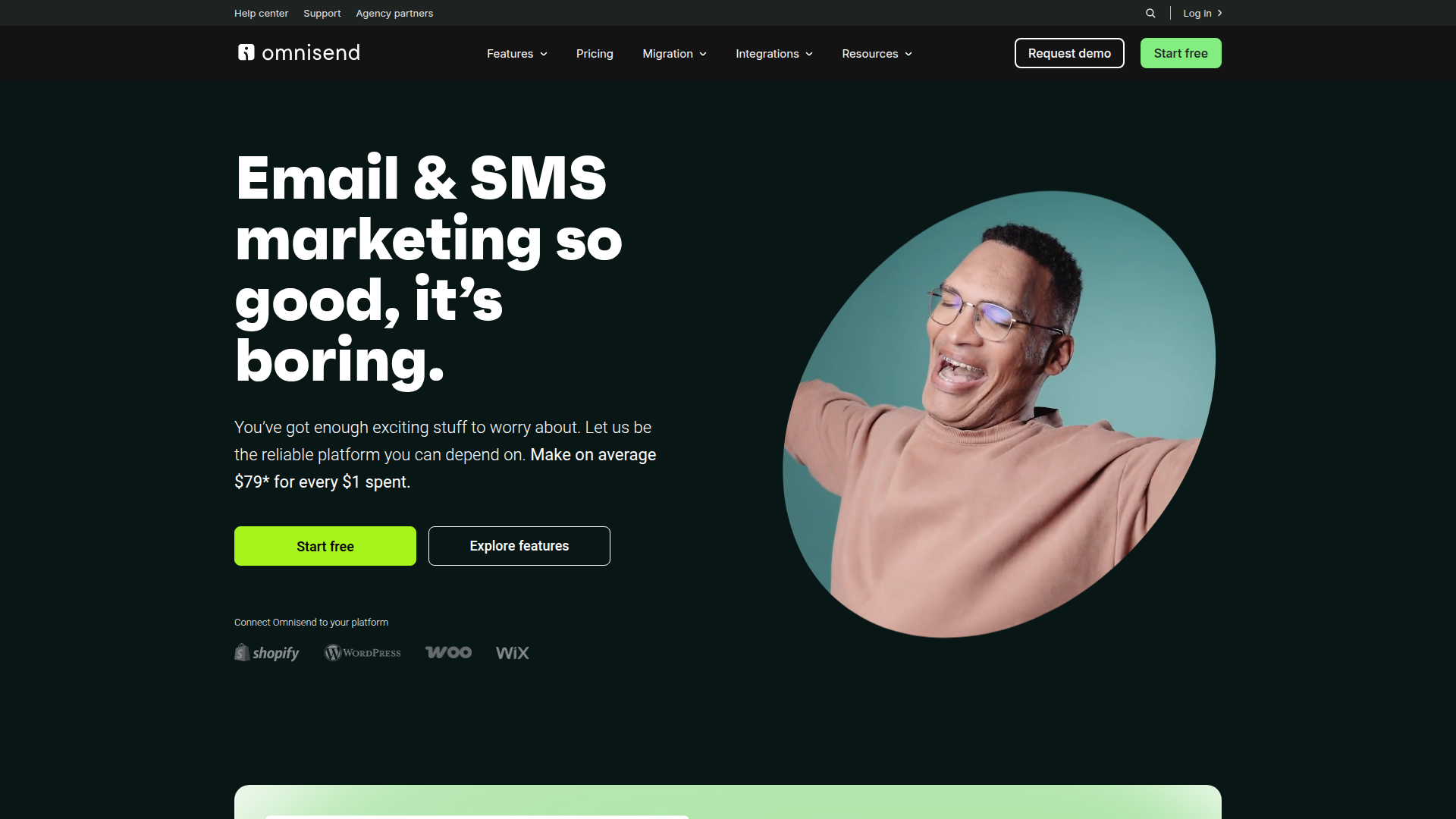
Omnisend is built specifically for ecommerce and it shows in every feature. The platform includes product recommendation blocks, discount code generation, and pre-built workflows for cart abandonment, browse abandonment, and post-purchase sequences. what makes it different is the generous free plan that includes automation, segmentation, and even SMS messaging for up to 250 contacts. The $16/month Standard plan adds unlimited emails and removes branding, making it competitive with general email tools while offering specialized ecommerce features. The Omnisend MCP server enables AI agents to manage campaigns programmatically. The learning curve is steeper than basic email tools, but that's the cost of having actual ecommerce intelligence.✓ Pros
- Generous free plan with automation included
- Built-in SMS and push notifications
- Ecommerce-specific templates and workflows
✗ Cons
- More complex setup than basic email tools
- Advanced reporting only on higher tiers
Scorecard
Solid agent fit with a first-party MCP server and a clean REST API. Omnisend hosts an official MCP server at mcp.omnisend.com/mcp, authenticated over OAuth, so an agent can create campaigns, build automations, recommend and edit segments, and pull revenue reporting from Claude or ChatGPT. The REST API (api.omnisend.com/api) is date-versioned via an Omnisend-Version header, uses cursor pagination and RFC 9457 error bodies, and spans contacts, events, products, campaigns, segments, automations, and reports. It sits below the GA-official tier because the one-click Claude connector is still coming soon (custom connector for now), there are no official SDKs, and webhooks are an automation-workflow action rather than a subscription API.

Klaviyo
AI-powered marketing automation platform for ecommerce businesses with unified customer data and omnichannel campaigns
Why I like it
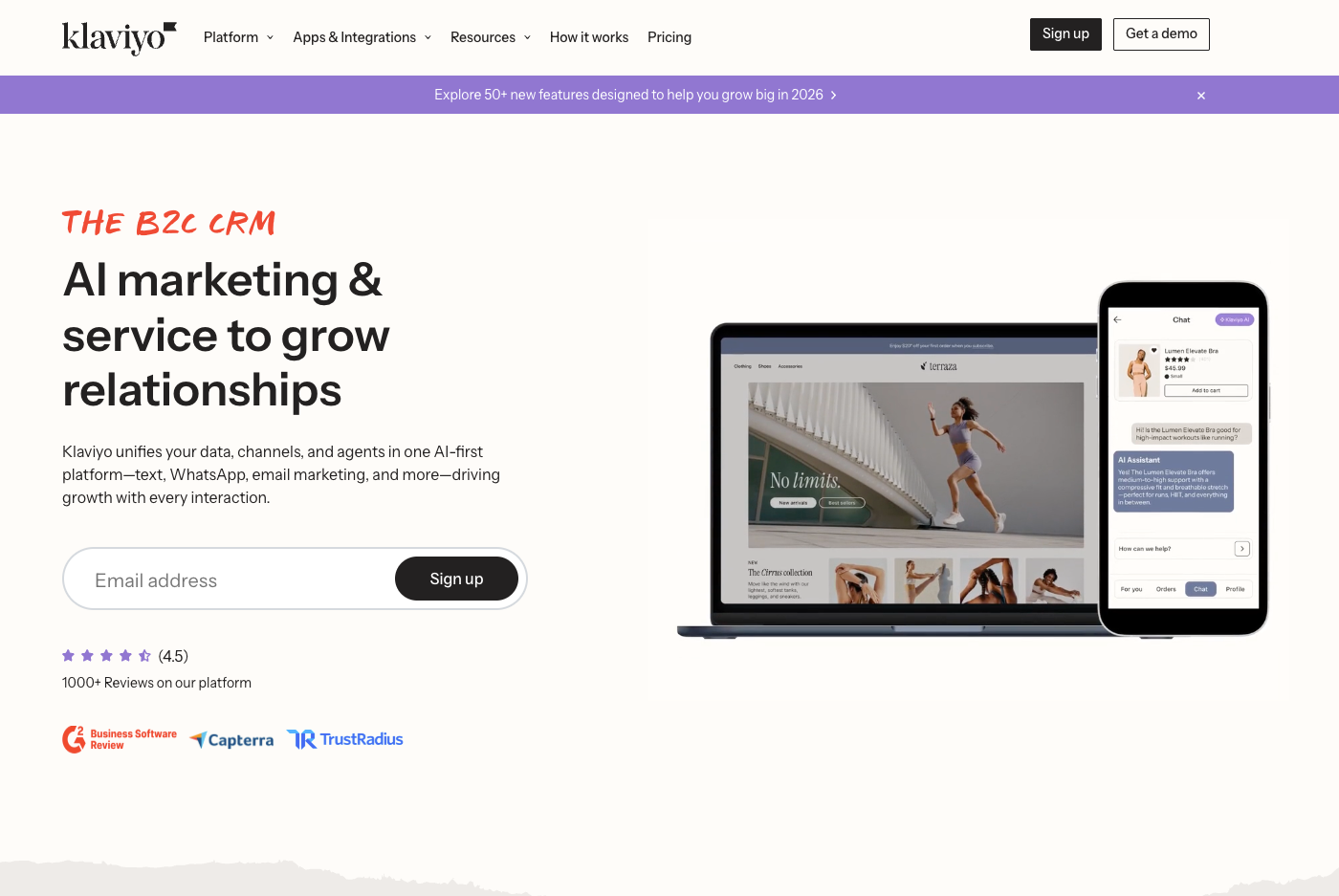
Klaviyo excels at turning customer data into targeted campaigns. The platform automatically creates behavioral segments based on purchase history, browsing patterns, and engagement levels. You can build audiences like 'customers who bought Product A but haven't purchased in 60 days' without touching a filter. The free plan supports up to 250 contacts with full automation features, and paid plans start at $45/month for email-only or $60/month for email plus SMS. The Klaviyo API is capable for custom integrations. Klaviyo's strength is also its weakness, the interface can overwhelm smaller stores that just need basic email marketing.User ratings
✓ Pros
- Segmentation without manual setup
- Strong Shopify and BigCommerce integrations
- Predictive analytics for customer lifetime value
✗ Cons
- Can be overwhelming for simple email needs
- Pricing jumps quickly as list grows
Scorecard
Good agent fit with official MCP support. Klaviyo offers an official MCP server and documented public API with native Claude and ChatGPT integration, making it straightforward to add to agentic workflows. The missing OpenAPI spec and lack of webhooks limit some automation patterns, but the MCP availability handles most agent use cases.

ActiveCampaign
AI-powered email marketing and automation platform for businesses serious about personalized campaigns
Why I like it
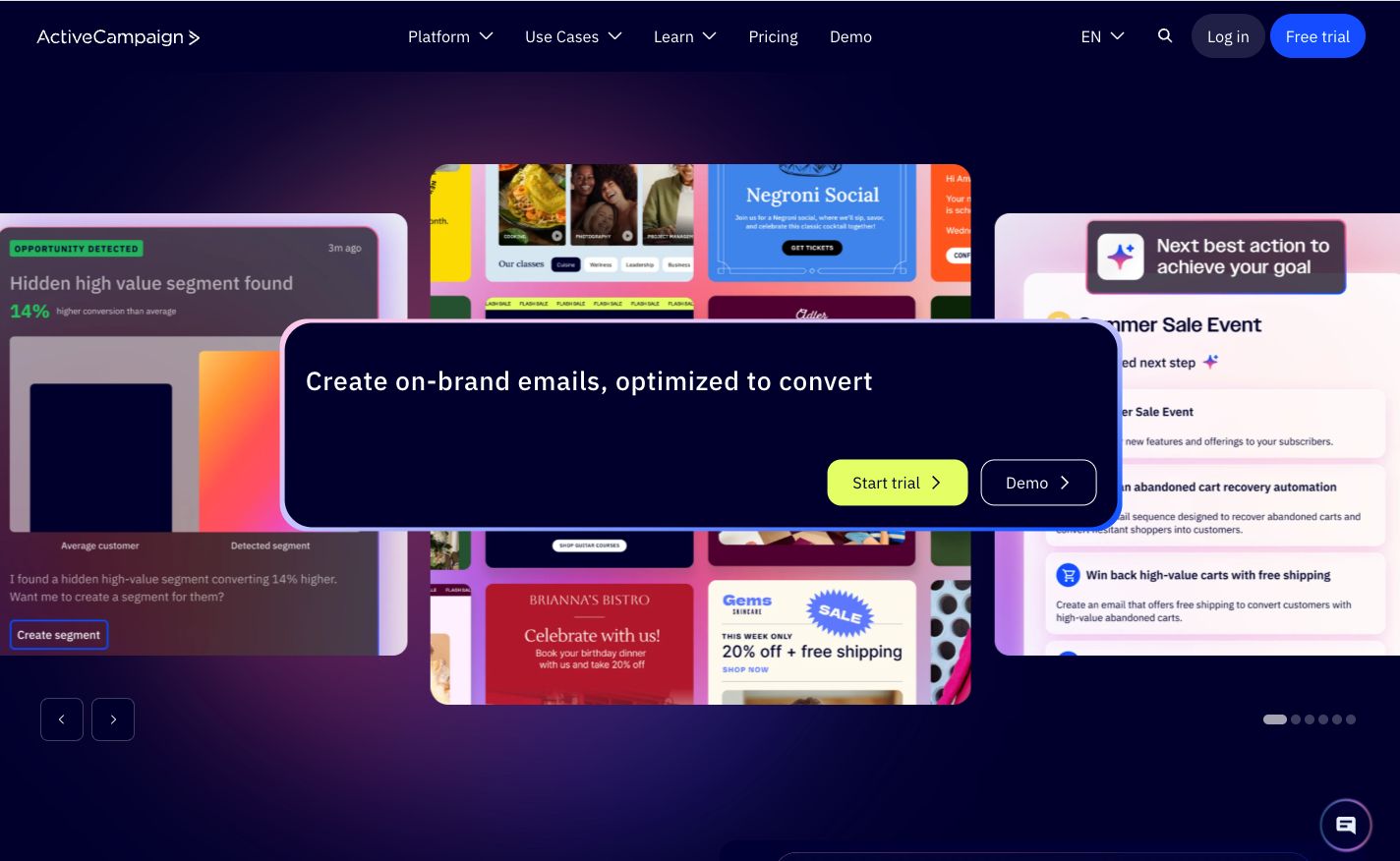
ActiveCampaign offers over 900 integrations and the most flexible automation builder in this price range. You can create conditional workflows that respond to website visits, app usage, deal stage changes, and custom events. The visual automation builder lets you map complex customer journeys with if/then logic, wait conditions, and goal tracking. Plans start at $15/month for 500 contacts with full CRM features included. The ActiveCampaign MCP server makes it excellent for AI agent workflows. The platform requires more setup time than simpler tools, but that investment pays off when you need multi-step automation logic.User ratings
✓ Pros
- Most flexible automation workflows
- CRM included at entry level
- Excellent integration ecosystem
✗ Cons
- Steeper learning curve than simpler tools
- Can be overkill for basic newsletters
Scorecard
Solid agent-fit with official MCP support and documented API access. ActiveCampaign's official MCP server and native Claude integration create a direct path for agents to manage email campaigns and automation workflows. The lack of published OpenAPI specs and structured outputs will require more manual prompt engineering to ensure reliable data handling.

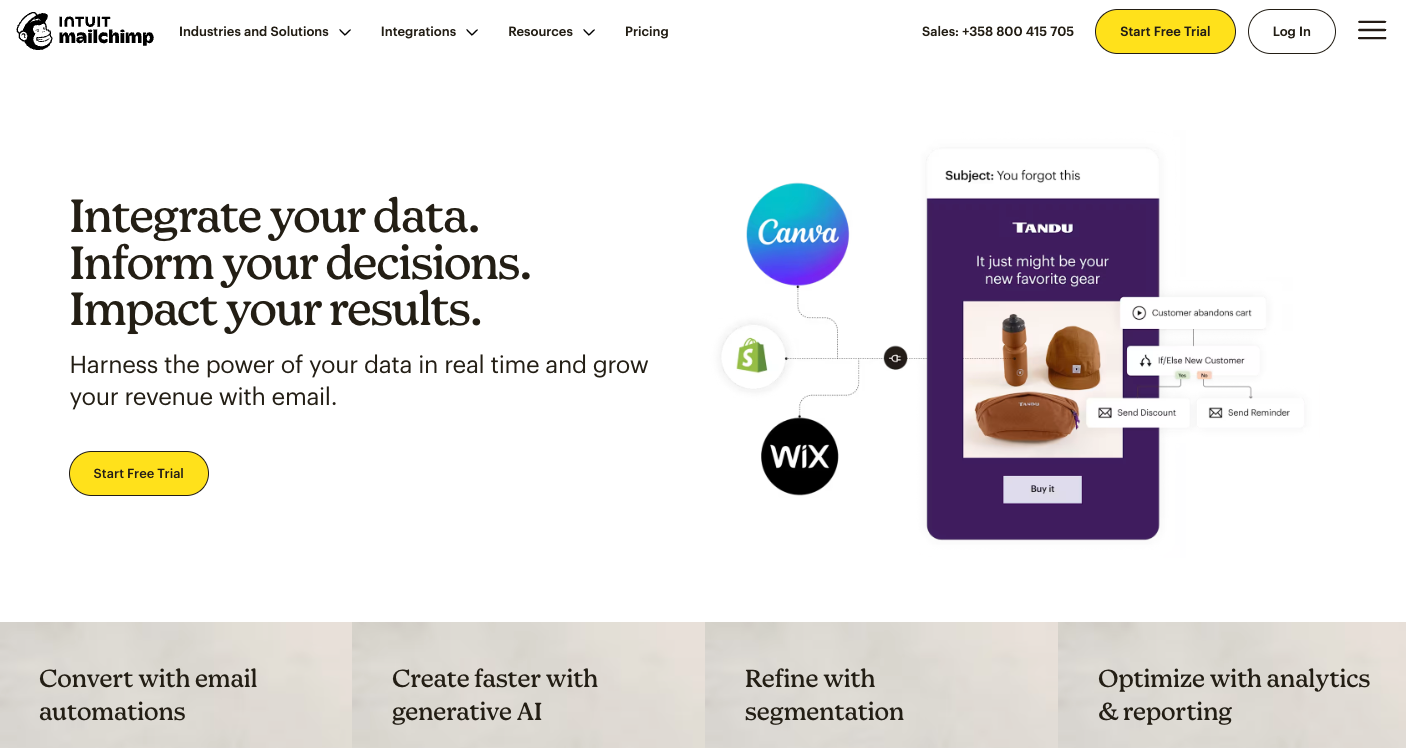
Mailchimp
Popular email marketing platform that's become overpriced with declining value for most users
Why I like it
Mailchimp remains the most recognizable name in email marketing, and for simple campaigns, it still works well. The drag-and-drop email builder is intuitive, and the free plan supports 500 contacts with basic automation. Templates are well-designed and mobile-responsive. Paid plans start at £9.68/month for the Essentials tier. However, there are better and cheaper alternatives like MailerLite and Moosend that offer more features for less money. Mailchimp's pricing becomes expensive quickly, and advanced features are locked behind higher tiers.User ratings
✓ Pros
- User-friendly interface
- Well-known brand with good support
- Integrates with most major platforms
✗ Cons
- Expensive compared to alternatives
- Limited features on lower tiers
Scorecard
Moderate agent fit, held back by community dependency. Mailchimp has public API docs, OpenAPI spec, and a community MCP server, but lacks official MCP support and structured outputs. The bigger constraint: no native integrations with Claude or ChatGPT, meaning you'll need custom orchestration to get reliable agentic behavior.

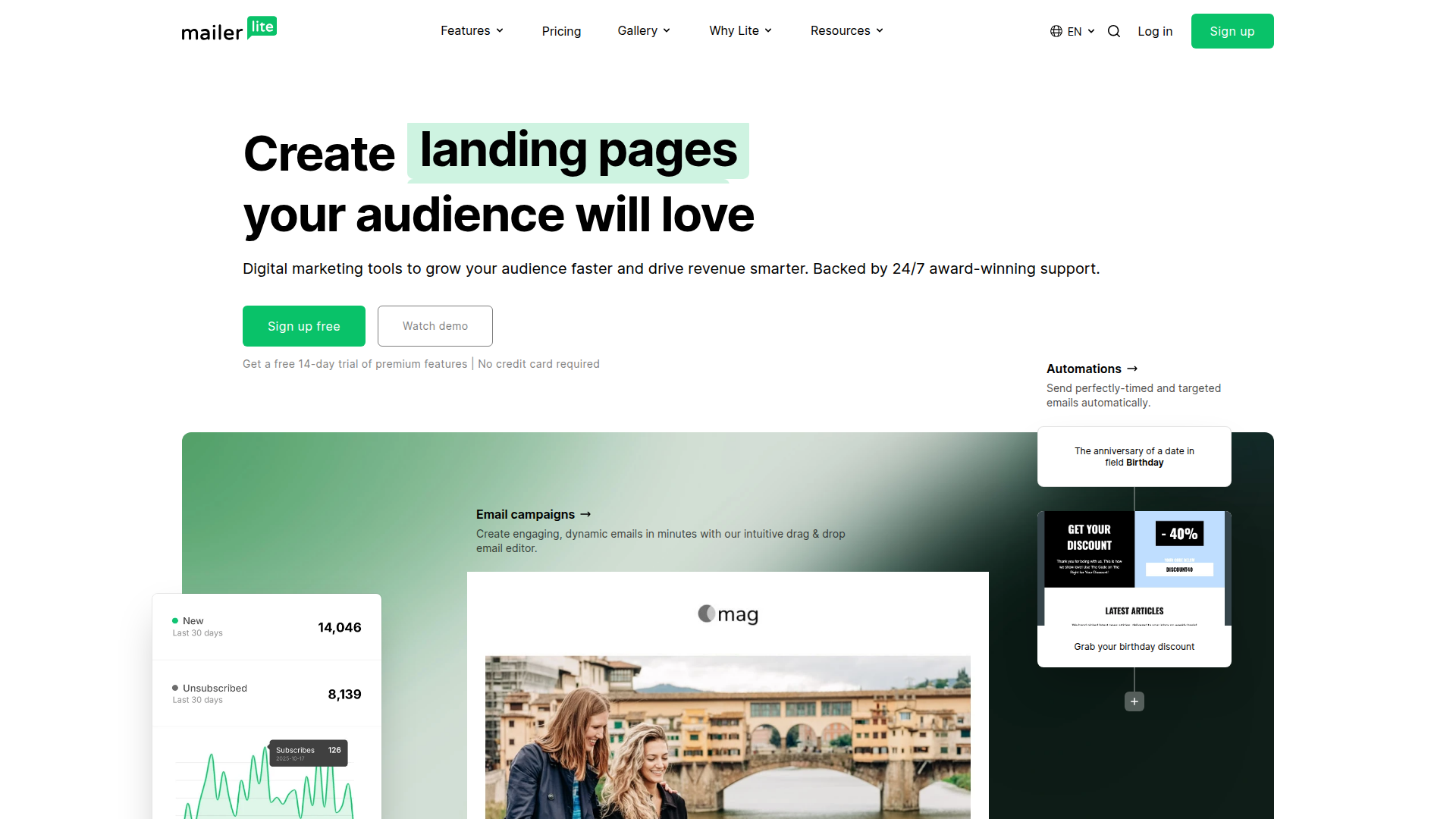
MailerLite
Affordable email marketing with surprisingly powerful features and stellar support
Why I like it
MailerLite delivers professional email marketing at budget pricing. The free plan supports 1,000 subscribers with automation, landing pages, pop-ups, and even a basic website builder. Paid plans start at just $10/month for the Growing Business tier, which includes unlimited emails, advanced segmentation, and priority support. The platform scores 8.8/10 in my reviews for good reason, it combines ease of use with powerful features. The MailerLite API enables custom integrations and automation workflows. The only limitation is that advanced ecommerce features aren't as deep as specialized platforms like Omnisend or Klaviyo.User ratings
✓ Pros
- Generous free plan limits
- Excellent value for money on paid tiers
- Clean, intuitive interface
✗ Cons
- Limited advanced ecommerce features
- Fewer integrations than premium platforms
Scorecard
Moderate agent-fit with community support. MailerLite has a public API with docs and a working community MCP server, plus native Claude integration, but lacks official MCP hosting, OpenAPI spec, and webhooks for event-driven workflows. The missing structured outputs and single-language SDK options limit automation complexity.

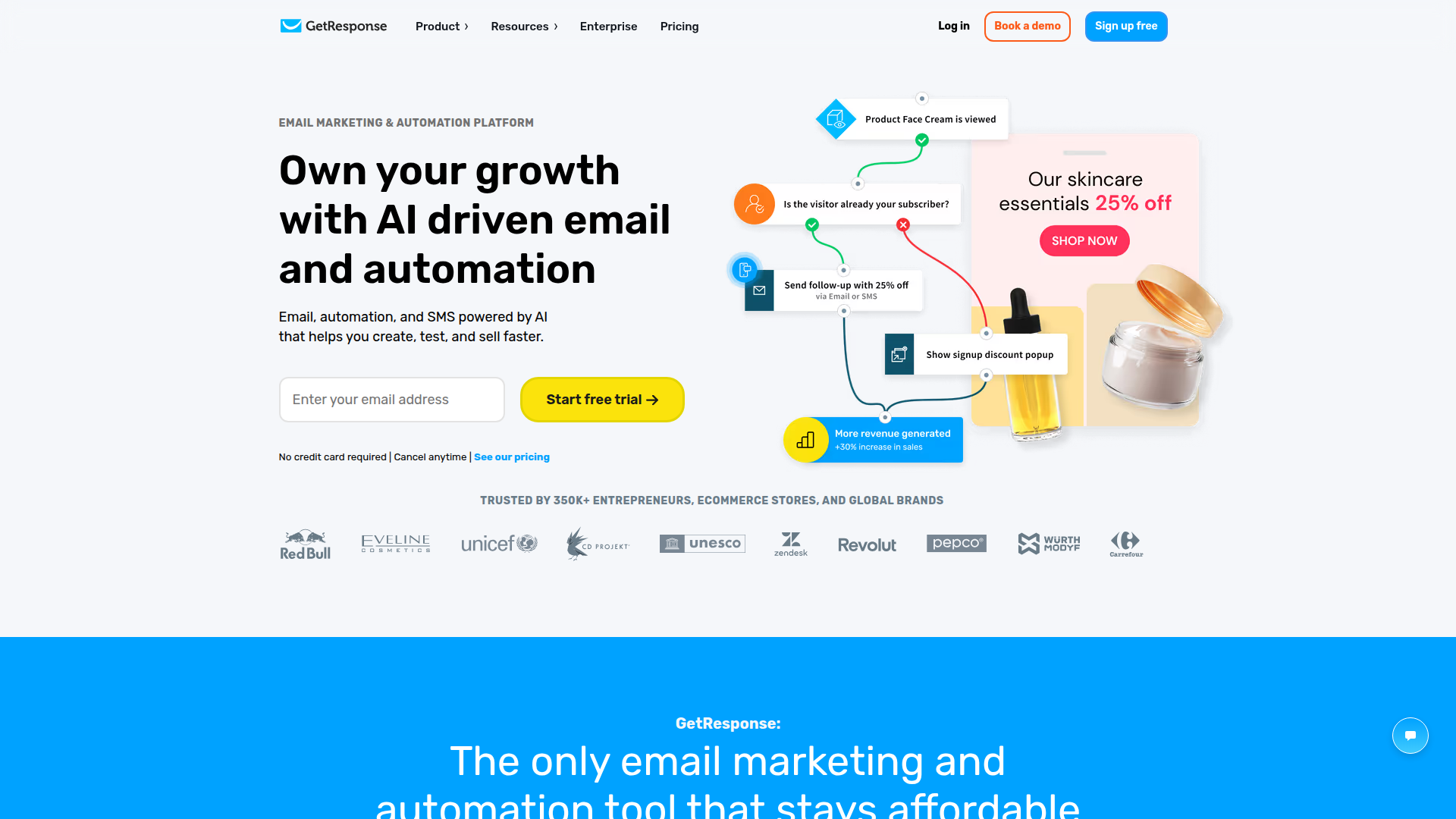
GetResponse
AI-powered email marketing platform with automation, landing pages, and webinars starting at $19/month
Why I like it
GetResponse goes beyond email to include webinar hosting, landing pages, and sales funnels. This makes it unique among email platforms, you can run a complete marketing campaign without additional tools. The email automation features are solid, and the $19/month Starter plan includes webinars for up to 100 attendees. The platform also includes a decent CRM and ecommerce tools. The GetResponse API supports custom integrations. The downside is that while GetResponse does many things, specialized tools often do each individual function better.User ratings
✓ Pros
- Webinars included at entry level
- All-in-one approach reduces tool sprawl
- Good automation capabilities
✗ Cons
- Interface can feel cluttered
- Individual features not as advanced as specialists
Scorecard
Limited agent-fit without official backing. GetResponse has a community MCP server and documented public API, but lacks OpenAPI specs, SDKs, and native integrations with Claude or ChatGPT. The missing structured outputs and webhook support make it harder to build reliable agent workflows compared to platforms with first-party MCP implementations.

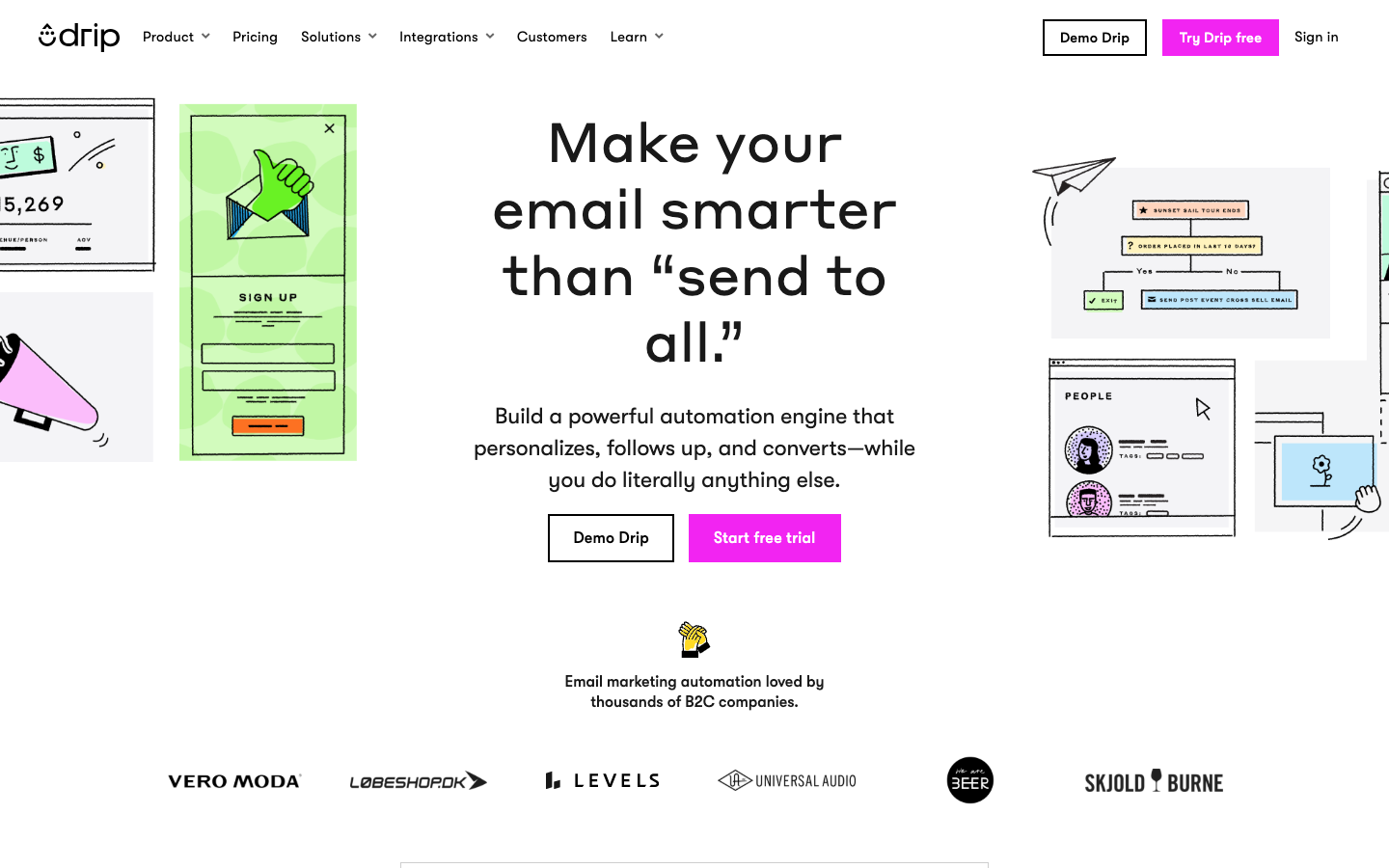
Drip
Advanced email marketing automation for B2C businesses with powerful segmentation and workflows starting at $39/mo
Why I like it
Drip positions itself as an ecommerce CRM rather than just an email tool, and that focus shows in its automation capabilities. The platform excels at creating complex customer journeys based on purchase behavior, product views, and engagement patterns. Visual workflow builder makes it easy to map multi-step campaigns with conditional logic. Plans start from $39/month , which is higher than general email tools but competitive for specialized ecommerce platforms. The Drip API enables deep integrations with ecommerce platforms. Drip requires more setup investment than simpler tools, but delivers automation that can significantly impact revenue.User ratings
✓ Pros
- Automation capabilities
- Strong ecommerce focus and integrations
- Detailed revenue attribution
✗ Cons
- Higher entry price than general email tools
- Can be complex for simple needs
Scorecard
Moderate agent-fit with community support. Drip has a public API with documentation and a community MCP server, plus Node SDK support, but lacks an official MCP on its own domain and OpenAPI spec for seamless integration. The absence of webhooks and structured outputs limits real-time automation and reliable data parsing in agent workflows.

Brevo
All-in-one email marketing platform with SMS, automation, and AI features at competitive prices
Why I like it
Brevo (formerly Sendinblue) offers one of the most generous free plans in email marketing. You get unlimited contacts with a daily sending limit of 300 emails , plus basic automation and SMS credits. The $9/month Starter plan removes daily limits and adds advanced features. This pricing structure works well for businesses with large lists but infrequent sending needs. The platform includes transactional email capabilities and a basic CRM. The Brevo API is solid for developers. The interface feels less polished than premium competitors, but the value proposition is strong for budget-conscious users.User ratings
✓ Pros
- Generous free plan with unlimited contacts
- SMS included across all plans
- Good transactional email features
✗ Cons
- Interface could be more modern
- Daily sending limits on free plan
Scorecard
Weak agent-fit without official tooling. Brevo has a community MCP server and documented public API, but lacks OpenAPI specs, SDKs, and native integrations with Claude or ChatGPT. The missing structured outputs and webhook support make it difficult to build reliable agent workflows that require real-time triggers or predictable JSON responses.

Moosend
Email marketing platform with powerful automation, landing pages, and forms at budget-friendly pricing
Why I like it
Moosend punches above its weight in automation capabilities. The visual workflow builder rivals platforms costing 3x more, and you can create multi-step campaigns with behavioral triggers. The free plan supports 1,000 subscribers with full automation features, and paid plans start at just $9/month . The platform includes landing pages, forms, and even basic website analytics. What impressed me is the 30-day free trial on paid plans, much longer than the industry standard 14 days. The Moosend API enables custom integrations. Interface design feels dated compared to newer platforms, but the feature depth at this price point is remarkable.User ratings
✓ Pros
- Powerful automation at budget pricing
- 30-day free trial period
- No setup fees or contracts
✗ Cons
- Interface design could be modernized
- Fewer third-party integrations
Scorecard
Skip for agent workflows. Moosend has public API docs but no MCP server, OpenAPI spec, or SDKs, leaving little for Claude or Cursor to grip. You'd be building integrations from scratch against undocumented auth and no structured outputs.

Shopify Email
Native email marketing tool built into Shopify for ecommerce stores.
Why I like it
Shopify Email integrates seamlessly with Shopify stores because it's built by Shopify. You get free access up to 10,000 emails per month , then pay $1 per 1,000 additional emails . The platform automatically syncs customer data, purchase history, and product catalogs. Pre-built automation templates cover abandoned cart recovery, welcome series, and post-purchase follow-ups. Setup is incredibly simple if you're already using Shopify. However, the feature set is basic compared to specialized email platforms, no advanced segmentation, limited automation logic, and basic reporting. It's perfect for Shopify stores that want simple email marketing without another monthly subscription.✓ Pros
- Seamless Shopify integration
- Very affordable usage-based pricing
- No learning curve for Shopify users
✗ Cons
- Limited to basic email marketing features
- Only works with Shopify stores
Price landscape
How prices compare
Starting prices across all 32 tools in this category.


At scale
How prices change as you grow
Pricing at 1K, 5K, and 10K contacts for tools reviewed in this guide.
| Tool | 1K | 5K | 10K |
|---|---|---|---|
| MailerLite | $15/mo | $39/mo | $73/mo |
| Moosend | $16/mo | $48/mo | $88/mo |
| GetResponse | €16/mo | €48/mo | €69/mo |
| Omnisend | $20/mo | $70/mo | $130/mo |
| Mailchimp | – | $75/mo | $110/mo |
| ActiveCampaign | $15/mo | $79/mo | $149/mo |
| Drip | – | $89/mo | – |
| Klaviyo | $30/mo | $100/mo | $150/mo |
Methodology
How I chose these
I evaluated 23 email marketing platforms on three core criteria: feature depth (automation, segmentation, ecommerce integrations), pricing value (free plan limits, paid tier progression, money-back guarantees), and AI-stack readiness (API quality and MCP server support for agent workflows).
Deliverability reputation comes from independent testing services and user-reported inbox placement, and setup friction from G2 and Capterra reviews. Mailchimp and Brevo are the two I use myself. I prioritized platforms that do one job well over those trying to be everything.
FAQ
Frequently Asked Questions
Email marketing software focuses on automation, segmentation, and customer journey mapping for businesses. Newsletter platforms like beehiiv and Substack emphasize content publishing and monetization for creators. Most businesses need the automation capabilities of dedicated email marketing software.
It depends on volume and complexity. Small businesses can often use one platform for both. High-volume senders or those needing advanced deliverability should consider dedicated transactional services like Mailgun or SendGrid alongside their marketing platform.
Free plans work for small lists (under 1,000-2,500 contacts). Budget options like MailerLite and Moosend cost $10-15/month for growing businesses. Advanced platforms like ActiveCampaign start around $15-20/month. Ecommerce-focused tools typically cost $15-45/month.
Abandoned cart recovery, product recommendation blocks, purchase behavior segmentation, and revenue attribution tracking. Platforms like Omnisend and Klaviyo specialize in these ecommerce features, while general tools may require workarounds.
Yes, most platforms support CSV import/export for contact lists. However, you'll lose automation workflows, email templates, and historical data. Plan the migration carefully and expect some setup time to rebuild automations on the new platform.
Critical. Even the best content fails if emails land in spam. Established platforms like ActiveCampaign, MailerLite, and AWeber have strong deliverability reputations. Avoid platforms with poor sending practices or shared IP issues.
Specialized email tools often excel at their core function and cost less. All-in-one platforms reduce tool complexity but may compromise on individual features. Consider your team's bandwidth for managing multiple tools versus accepting feature limitations.
MailerLite offers the most generous free plan with 1,000 subscribers, full automation, and landing pages. Brevo provides unlimited contacts but limits daily sends. Most businesses outgrow free plans quickly and should budget for paid tiers.
Continue reading





10+ years in digital marketing. I review SEO and AI visibility software for small business owners and solo operators: what each plan really costs, which one actually covers the job, and where a tool stops being worth it. Checked against vendor documentation and real user feedback, and against my own use where I have it.