
Newsletter platforms and email marketing tools are not the same thing. Email marketing tools (ActiveCampaign, Brevo, HubSpot) are built for businesses running campaigns, automations, and CRM workflows. Newsletter platforms are built for creators, writers, and publishers who want to build an audience, publish content, and often monetize through paid subscriptions or ads.
This guide covers the newsletter-first platforms. I've included a few crossover tools that handle both well, but the focus is on platforms designed for the newsletter use case: write, send, grow, monetize.

This page may contain affiliate links.
Some links on this page are affiliate links, meaning I may earn a commission if you sign up (at no extra cost to you). This never influences my ratings or recommendations.
Overview
The landscape
I track 10 tools in this category. Prices range from $9/mo (Moosend) to $49/mo (beehiiv). The median starting price is $18/mo, so anything below that is a good deal.
7 tools offer free plans: Buttondown, EmailOctopus, MailerLite, Flodesk, and 3 more.
This roundup covers the 11 I consider worth a serious look. Each one is ranked with real pricing data, aggregated user ratings, and my honest take.
Audience
Who is this guide for?
- ✓Independent writers and journalists building a subscriber base
- ✓Content creators who want to monetize through paid newsletters or ads
- ✓Publishers and media companies looking for newsletter-first platforms
- ✓Bloggers who want email distribution alongside their website
- ✓Developers and technical writers who prefer minimal, Markdown-based tools
- ✓SaaS founders who want billing-triggered lifecycle emails alongside their newsletter
Which one is right for you
The right pick depends on who you are
Four buyers, four answers, all within Newsletter Platforms. I ranked every tool here against each of them, and the reason under each pick is mine rather than the vendor's.
For an agency
3 to 30 people, multiple client accounts

from $19/mo
Does the job for newsletters, but better for full email marketing suite.
For a consultant
solo, juggling 5 to 15 clients

from $49/mo
best options for newsletter focused businesses.
For a solo builder who lives in AI
wires tools into Claude Code or Cursor
from $49/mo
best options for newsletter focused businesses.
For a solo builder who wants it simple
one tool, no wiring
from $49/mo
best options for newsletter focused businesses.
Quick verdict
beehiiv is the strongest all-around newsletter platform for creators who want to monetize. It has a built-in ad network, referral system, and charges 0% on paid subscriptions. If you just want to write and let the platform handle everything else, Substack is the simplest option (but takes a 10% cut). For full ownership and a proper website alongside your newsletter, Ghost is the best choice.
Overview
Quick comparison
| # | Tool | Price | Rating |
|---|---|---|---|
| 1 | $49/mo | 8.6/10 | |
| 2 | $39/mo | 8.6/10 | |
| 3 | Free (10% of paid revenue) | 7/10 | |
| 4 | $10/mo | 8.8/10 | |
| 5 | $19/mo | 8.5/10 |
Show all 11 tools
| 6 | $18/mo | 7.5/10 | |
| 7 | $9/mo | 8/10 | |
| 8 | $19/mo | 8.2/10 | |
| 9 | $9/mo | 8.6/10 | |
| 10 | $10/mo | 7.2/10 | |
| 11 | 25 | 7.4/10 |
Rankings
My Top Picks

beehiiv
All-in-one newsletter platform with built-in website builder and monetization tools for creators
Why I like it
beehiiv was built by the team behind Morning Brew, and it shows. The ad network, Boosts (paid cross-promotions), and referral program are all built in. No integrations, no workarounds. The free plan covers 2,500 subscribers with no feature gating, and paid subscriptions have a 0% platform fee. That last part is significant: Substack takes 10%, and Kit charges 3.5% plus transaction fees. beehiiv takes nothing. For creators serious about turning a newsletter into a business, nothing else comes close right now.User ratings
✓ Pros
- Best monetization toolkit of any newsletter platform
- Generous free plan with no feature restrictions
- 0% revenue cut on paid subscriptions
- Strong growth tools (referrals, recommendations, SEO)
✗ Cons
- Learning curve is steeper than Substack
- No built-in community features yet
- Email editor could be more flexible
Scorecard
Moderate agent fit with an official MCP server and documented API, but limited by missing OpenAPI specs and lack of SDK support. The MCP bridge helps with Claude workflows, though you'll need custom auth handling and manual JSON parsing for structured data extraction. Skip this if you need webhooks or native integration with other LLM platforms.

Kit
Creator-focused email marketing platform with powerful automations and integrated monetization tools
Why I like it
Kit has been the creator economy's email tool since before "creator economy" was a buzzword. The free plan covers 10,000 subscribers, which is unusually generous. Kit combines newsletter, digital product sales, and paid subscriptions in one platform. The sponsor network lets you sell ad placements directly in your newsletter. If you're a creator who sells courses, ebooks, or memberships alongside your newsletter, Kit handles the entire stack. The 3.5% transaction fee on paid subscriptions is lower than Substack's 10% but higher than beehiiv's 0%. I ran the numbers plan by plan in my Kit pricing breakdown.User ratings
✓ Pros
- Extremely generous free plan (10K subscribers)
- All-in-one for newsletter + product sales
- Strong automation capabilities
- Creator-focused sponsor network
✗ Cons
- 3.5% + $0.30 transaction fee on paid subs
- Email templates are basic compared to Flodesk
- Interface can feel cluttered with all the features
- Rebranding from Kit still causing confusion
Scorecard
Official MCP at app.kit.com/mcp verified 2026-07-07: OAuth, full v4 surface incl. writes w/ safety annotations, ChatGPT+Claude+Cursor, paid plans, 120rpm. Second Developer Docs MCP at developers.kit.com/mcp. llms.txt live. Score 7->8 (Joonas approved).

Substack
Free newsletter platform that takes 10% of paid subscription revenue, built for writers who want simple monetization.
Why I like it
Substack is the platform most people think of when they hear "newsletter." It's free to use, takes about five minutes to set up, and has a built-in discovery network with 35+ million active subscriptions. The trade-off is clear: you give up customization and pay a 10% revenue cut on paid subscribers (plus Stripe fees). If you want to just write and have the platform handle everything else, Substack is hard to beat. If you want control over design, branding, or monetization terms, look elsewhere.User ratings
✓ Pros
- Zero setup friction, write and publish in minutes
- Built-in audience discovery network
- Free to use until you monetize
- Strong community features
✗ Cons
- 10% revenue cut on paid subscriptions
- Very limited design customization
- Weak analytics compared to beehiiv
- You don't fully own your platform
Scorecard
Limited, and what exists is not Substack's doing. Substack publishes no public API documentation and no official MCP server, so there is nothing first-party for an agent to connect to. What fills the gap is a community server at github.com/marcomoauro/substack-mcp, which drives Substack's internal API for things like drafting and publishing posts. It has 65 stars, 12 forks and active commits, so it is a real option rather than an abandoned experiment. It is still an unofficial client against an undocumented API, which means it can break whenever Substack changes something, and no support exists when it does.

MailerLite
Affordable email marketing with surprisingly powerful features and stellar support
Why I like it
MailerLite sits right between newsletter platforms and email marketing tools, and it does both well. The free plan covers 1,000 subscribers, and paid plans start at $9/month. You get a clean drag-and-drop editor, website builder, paid subscription support, and solid automation. It's the platform I'd recommend to anyone who wants more features than Substack without beehiiv's complexity or Ghost's technical requirements. The one caveat: MailerLite has been known to freeze accounts that hit certain spam or bounce thresholds, so keep your list clean.User ratings
✓ Pros
- Excellent value for money at every tier
- Clean, intuitive interface
- Good balance of newsletter and marketing features
- Paid subscription support included
✗ Cons
- Account freezing for borderline engagement metrics
- Free plan limited to 1,000 subscribers
- Fewer monetization tools than beehiiv or Kit
- Support can be slow on lower plans
Scorecard
Moderate agent-fit with community support. MailerLite has a public API with docs and a working community MCP server, plus native Claude integration, but lacks official MCP hosting, OpenAPI spec, and webhooks for event-driven workflows. The missing structured outputs and single-language SDK options limit automation complexity.

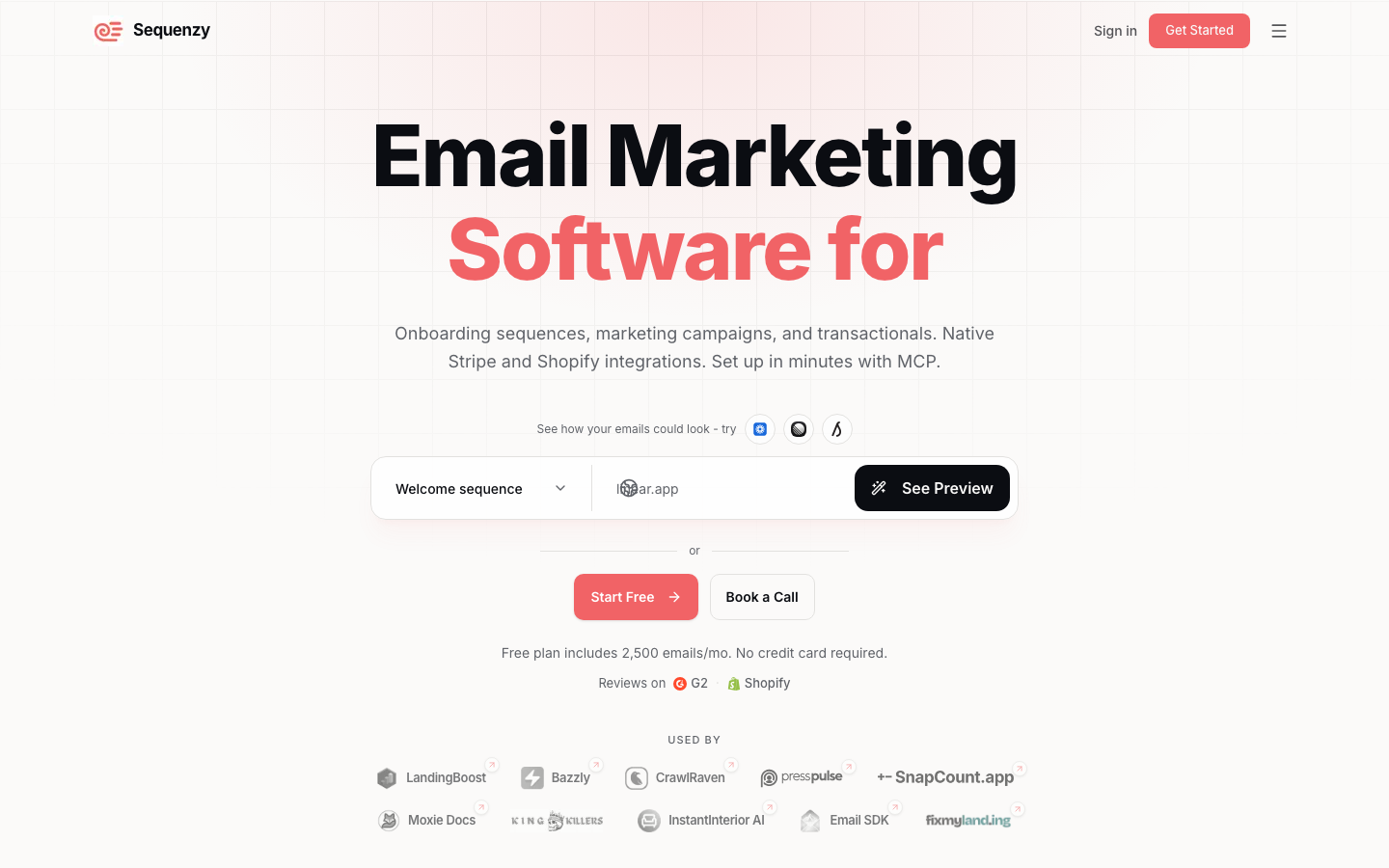
Sequenzy
Email marketing built for AI-native workflows, with a 120-tool MCP server, native Stripe billing triggers, and 2,500 free emails a month.
Why I like it
I use Sequenzy for my own projects, and the reason it earns a slot here is the native Stripe integration: a failed payment or plan upgrade triggers a sequence without me building the automation logic myself. The AI sequence generator turns a plain-English prompt into a working campaign in minutes, and the free plan runs 2,500 emails a month with unlimited contacts, which is generous for an early list. The catch is that it's built specifically around subscription billing. If your newsletter isn't attached to a SaaS product, the dunning sequences and MRR segmentation that make it worth using are dead weight, and you'd get more from a general-purpose platform.✓ Pros
- Billing events trigger emails without building custom automation
- Generous free tier for an early-stage list
- AI sequence generation cuts setup time from hours to minutes
- MCP server and REST API for developer-first teams
✗ Cons
- Built around subscription billing, most of the value disappears if your newsletter isn't tied to a SaaS product
- Newer platform than Mailchimp or ActiveCampaign, smaller template library
- No enterprise-tier controls like advanced team roles or compliance certifications
- No built-in landing pages, it's email-only
Scorecard
Strong agent fit, top tier for an email tool. Sequenzy ships an official MCP server exposing 120 tools on its own domain, offered both as a hosted Streamable HTTP endpoint (api.sequenzy.com/v1/mcp) and a local stdio server (npx @sequenzy/mcp). Every tool carries structured outputs (outputSchema plus readOnlyHint, destructiveHint and openWorldHint annotations), so an agent gets typed, safe results instead of raw JSON. Webhooks (create, test, replay) and a documented REST API with an llms.txt index round it out, authenticated by API key. The only gaps versus a perfect score are a published OpenAPI spec and an official REST SDK, and the 120-tool MCP already covers most of what those would give you.

Ghost
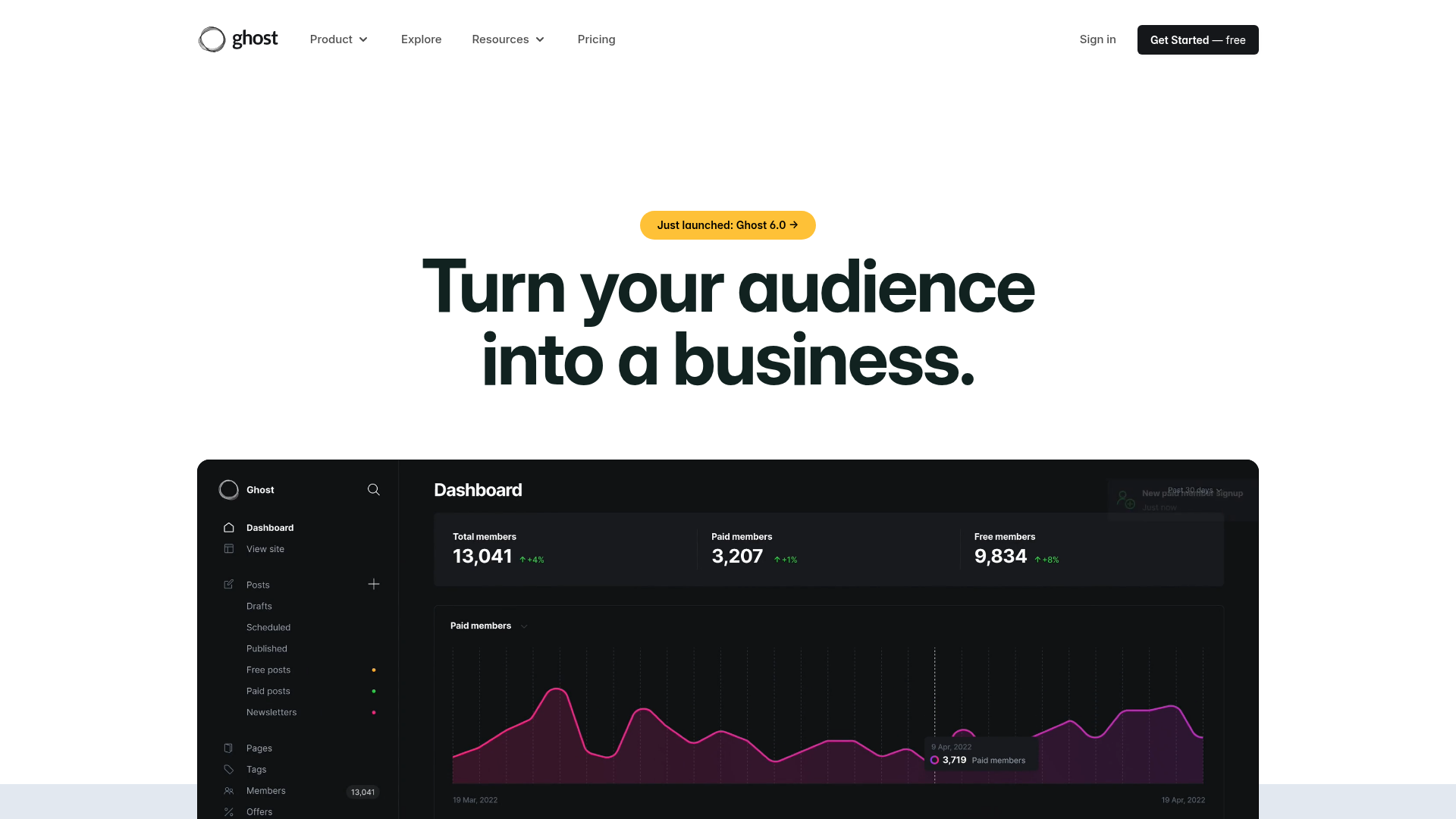
Publishing platform with built-in newsletter and membership monetization. No platform fees on revenue.
Why I like it
Ghost is an open-source publishing platform that combines a CMS, blog, newsletter, and membership system in one package. Unlike Substack or beehiiv, Ghost gives you a proper website, not just an email tool. You can self-host for free or use Ghost(Pro) starting at $9/month. The 0% platform fee on subscriptions makes it the most financially efficient option at scale. Version 6.0 added ActivityPub/fediverse integration, making it the most "open web" newsletter platform available. The trade-off: it requires more technical setup than the alternatives.User ratings
✓ Pros
- Complete ownership of your platform and data
- 0% revenue cut, even on Ghost(Pro)
- Proper website alongside your newsletter
- Open-source with active development
✗ Cons
- Steeper learning curve than Substack
- Self-hosting requires technical knowledge
- No built-in discovery network
- Fewer growth-specific tools than beehiiv
Scorecard
Moderate agent-fit with community support but limited automation depth. Ghost has a documented API with Node.js SDK and an active community MCP server, giving agents read/write access to content and members. The absence of webhooks, structured outputs, and an official OpenAPI spec means agents can't react to platform events or reliably parse complex responses, limiting real-time automation workflows.

Buttondown
Minimal newsletter platform with markdown support and privacy-first approach for content creators
Why I like it
Buttondown is what happens when a solo developer builds the newsletter platform they wish existed. It's Markdown-first, API-friendly, and deliberately minimal. Free for 100 subscribers, paid from $9/month. No platform fee on paid subscriptions. The API-first architecture makes it a natural fit for developers who want to integrate newsletters into their own systems. If you think most newsletter platforms are overbuilt, Buttondown is for you.✓ Pros
- Clean, minimal interface with zero bloat
- Developer-friendly API and integrations
- 0% revenue cut on paid subscriptions
- Excellent documentation
✗ Cons
- Very small free tier (100 subscribers)
- No visual email builder
- Solo developer project (bus factor risk)
- No built-in growth or discovery tools
Scorecard
Marginal agent-fit: community MCP exists and public API docs are available, but no official MCP from Buttondown itself and no OpenAPI spec limits agent discoverability and automation depth. Best suited for lightweight integrations rather than agentic workflows relying on structured outputs or native LLM bindings.

GetResponse
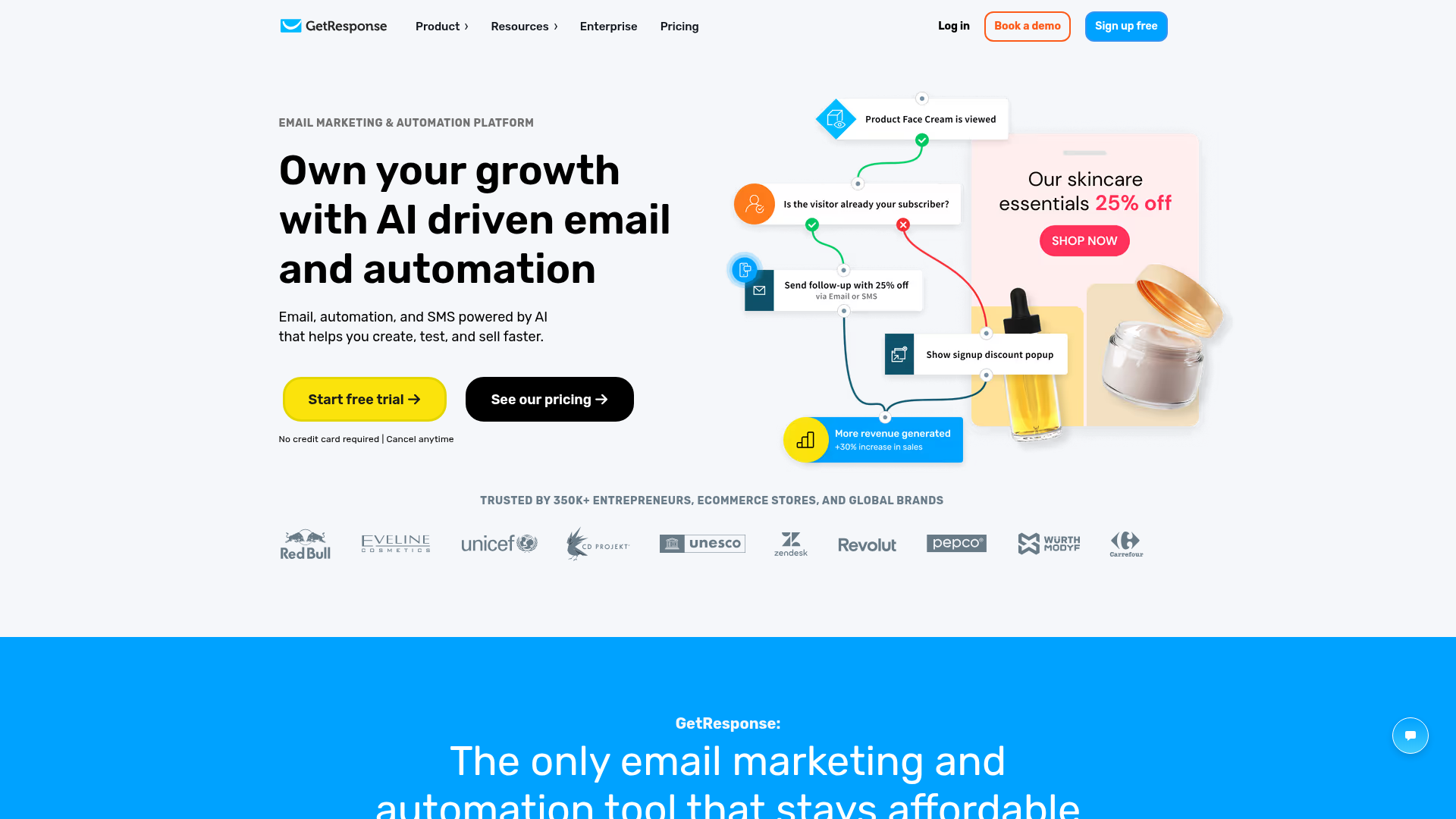
AI-powered email marketing platform with automation, landing pages, and webinars starting at $19/month
Why I like it
GetResponse is primarily an email marketing tool, but the Creator Plan ($69/month+) turns it into a newsletter-plus-courses platform. You get a course builder, membership dashboard, and paid newsletter capabilities alongside the full email marketing suite (automation, A/B testing, landing pages). If you want one platform for newsletters, online courses, and membership content, GetResponse is the most complete option. The downside: it's more expensive and more complex than dedicated newsletter tools.User ratings
✓ Pros
- Most feature-complete platform on this list
- Course builder and webinars included
- Strong automation and A/B testing
- Good deliverability reputation
✗ Cons
- Creator Plan starts at $69/month
- More complex than newsletter-first tools
- Not designed specifically for newsletters
- UI can feel dated compared to beehiiv or Substack
Scorecard
Limited agent-fit without official backing. GetResponse has a community MCP server and documented public API, but lacks OpenAPI specs, SDKs, and native integrations with Claude or ChatGPT. The missing structured outputs and webhook support make it harder to build reliable agent workflows compared to platforms with first-party MCP implementations.

Moosend
Email marketing platform with powerful automation, landing pages, and forms at budget-friendly pricing
Why I like it
Moosend is the budget pick that punches above its weight. Starting at $7/month for 500 subscribers, it includes automation workflows, A/B testing, landing pages, and ecommerce integrations. For newsletter creators who also want basic marketing automation without paying beehiiv or GetResponse prices, Moosend covers the essentials. The free plan was discontinued, but the entry price is still the lowest on this list for a full-featured tool.User ratings
✓ Pros
- Lowest entry price for a full-featured tool
- Strong automation for the price
- A/B testing included on all plans
- Good ecommerce integration options
✗ Cons
- No free plan anymore
- Smaller template library than competitors
- Less newsletter-specific features
- Brand recognition is lower
Scorecard
Skip for agent workflows. Moosend has public API docs but no MCP server, OpenAPI spec, or SDKs, leaving little for Claude or Cursor to grip. You'd be building integrations from scratch against undocumented auth and no structured outputs.

EmailOctopus
Budget-friendly email marketing platform with a generous free plan and simple automation for small businesses.
Why I like it
EmailOctopus is the platform for people who want to send newsletters without overthinking it. The free plan covers 2,500 subscribers and 10,000 emails per month, which covers most starter needs. Paid plans start at $9/month. The interface is stripped back compared to Kit or beehiiv, but that's the point: you get a simple editor, basic automation, landing pages, and reliable delivery. For side project newsletters, hobby writers, or anyone who just wants to send emails without a feature overload, EmailOctopus keeps things simple.User ratings
✓ Pros
- Generous free plan for getting started
- Clean, simple interface
- Low paid plan pricing
- Amazon SES integration for high-volume senders
✗ Cons
- Very basic automation
- Limited template selection
- No A/B testing on free plan
- Fewer features than most competitors
Scorecard
Not ready for agent workflows. EmailOctopus has documented API endpoints but lacks OpenAPI specs, SDKs, and any MCP server, making integration with Claude or Cursor require custom parsing and manual API calls. The absence of webhooks and structured outputs further limits real-time automation and reliable data handling in agentic contexts.

Flodesk
Visual email marketing platform with stunning templates and creator-focused features for designers and online businesses
Why I like it
Flodesk is the platform you pick when your emails need to look stunning. The templates are best-in-class, and the flat-rate pricing ($25/month for unlimited subscribers) removes the anxiety of list growth. The Checkout feature lets you sell digital products directly through email. The trade-off is feature depth: no A/B testing, basic automation, and limited analytics. For photographers, designers, coaches, and creators who prioritize visual impact over optimization, Flodesk delivers.✓ Pros
- Most beautiful email templates available
- Flat-rate pricing regardless of list size
- Intuitive drag-and-drop editor
- Built-in checkout for selling products
✗ Cons
- No A/B testing at all
- Basic automation only
- Limited analytics and reporting
- Small integration library
Scorecard
Good fit for agent reporting, weaker for agent doing. Flodesk runs an official MCP server at mcp.flodesk.com/mcp with OAuth and Dynamic Client Registration, listed as a connector in both Claude and ChatGPT and free for members, alongside a documented REST API at developers.flodesk.com. The catch is that the MCP is read-only by design, so an assistant can answer questions about email analytics, subscribers, form performance, checkout sales and workflow conversions but cannot send, edit or segment anything. No CLI, no OpenAPI spec and no SDKs, so anything beyond reading means writing against the REST API yourself.

Price landscape
How prices compare
Starting prices across all 10 tools in this category.


At scale
How prices change as you grow
Pricing at 1K, 5K, and 10K contacts for tools reviewed in this guide.
| Tool | 1K | 5K | 10K |
|---|---|---|---|
| Ghost | $18/mo | $18/mo | $18/mo |
| Buttondown | – | $29/mo | $79/mo |
| MailerLite | $15/mo | $39/mo | $73/mo |
| Moosend | $16/mo | $48/mo | $88/mo |
| GetResponse | $16/mo | $48/mo | $69/mo |
| Flodesk | $25/mo | $52/mo | $72/mo |
| Kit | $39/mo | $89/mo | $139/mo |
Newsletter vs Email Marketing: When to Use What
Use a newsletter platform if: you're a writer, journalist, or creator whose primary output is content. You want built-in monetization (paid subs, ads). You want platform-specific growth tools (referrals, discovery). You don't need complex automation or CRM features.
Use an email marketing tool if: you're a business running promotional campaigns. You need automation workflows, segmentation, and A/B testing. You sell products and need ecommerce integrations. You need CRM capabilities alongside email.
Use a hybrid tool if: you publish newsletters but also sell products. Kit, MailerLite, and GetResponse all handle both. Sequenzy goes further for SaaS specifically, with native Stripe/Paddle/Lemon Squeezy triggers and MRR-based segmentation baked in. You want basic automation alongside your newsletter. You need more features than Substack but less complexity than ActiveCampaign.
Methodology
How I chose these
I evaluated each platform on five criteria: monetization options (paid subscriptions, ads, sponsorships), growth tools (referral programs, recommendations, SEO), design flexibility (templates, custom branding, code access), pricing model (flat rate vs subscriber-based, revenue cuts), and deliverability reputation. I cross-referenced user feedback from G2, Capterra, Reddit, and creator communities.
Platforms are ranked by how well they serve the core newsletter use case, not by how many features they pack in.
Newsletter Platform Fee Comparison
The biggest financial decision when choosing a newsletter platform is the fee structure. Here's how the revenue cuts compare:
beehiiv: 0% platform fee. You keep everything except Stripe processing.
Ghost : 0% platform fee. Same as beehiiv, Stripe only.
Buttondown : 0% platform fee on all paid plans.
Kit: 3.5% + $0.30 per transaction on paid subscriptions.
Substack : 10% of all paid subscription revenue plus Stripe fees.
At 1,000 paid subscribers paying $10/month, the annual difference is significant. On Substack you'd pay $12,000/year in platform fees alone. On beehiiv or Ghost, you'd pay $0 in platform fees (only ~$3,500 in Stripe processing). That's an $8,500 difference.
FAQ
Frequently Asked Questions
Newsletter platforms (beehiiv, Substack, Ghost) are built for creators who want to publish content and build an audience. They focus on writing, subscriber growth, and monetization through paid subscriptions or ads. Email marketing tools (ActiveCampaign, Brevo, HubSpot) are built for businesses running campaigns, automations, CRM workflows, and ecommerce integrations. Some tools like Kit and MailerLite straddle both categories.
Kit offers the most generous free plan at 10,000 subscribers with unlimited emails. beehiiv's free plan covers 2,500 subscribers with no feature gating. EmailOctopus offers 2,500 subscribers and 10,000 emails per month. Substack is completely free but takes a 10% cut if you enable paid subscriptions. MailerLite's free plan covers 1,000 subscribers.
beehiiv, Ghost, and Buttondown all charge 0% platform fees on paid subscription revenue. You still pay Stripe's processing fees (approximately 2.9% + $0.30 per transaction), but the platforms themselves take nothing. By contrast, Substack takes 10% and Kit charges 3.5% + $0.30 per transaction.
Yes. All major newsletter platforms allow you to export your subscriber list (including email addresses). You can import this list into a new platform. The main things you lose when switching are your URL/domain setup (unless you use a custom domain), any platform-specific features like referral programs or discovery network presence, and your sending reputation which needs to be rebuilt.
beehiiv offers the most monetization options: paid subscriptions (0% fee), a built-in ad network, Boosts (paid cross-promotions), and referral programs. Substack is simplest for paid subscriptions but takes a 10% cut. Ghost charges 0% and gives you full ownership but has no built-in ad network. Kit combines newsletter monetization with digital product sales.
Not necessarily. If you already use a tool like ActiveCampaign or Brevo and your newsletter is just one part of your email strategy, you can send newsletters from your existing tool. Dedicated newsletter platforms make more sense if publishing is your primary activity, if you want built-in monetization (paid subscriptions, ads), or if you want platform-specific growth features like referral programs and discovery networks.
Continue reading





10+ years in digital marketing. I review SEO and AI visibility software for small business owners and solo operators: what each plan really costs, which one actually covers the job, and where a tool stops being worth it. Checked against vendor documentation and real user feedback, and against my own use where I have it.