
This page may contain affiliate links.
Some links on this page are affiliate links, meaning I may earn a commission if you sign up (at no extra cost to you). This never influences my ratings or recommendations.
The Verdict
Is Omnisend right for you?
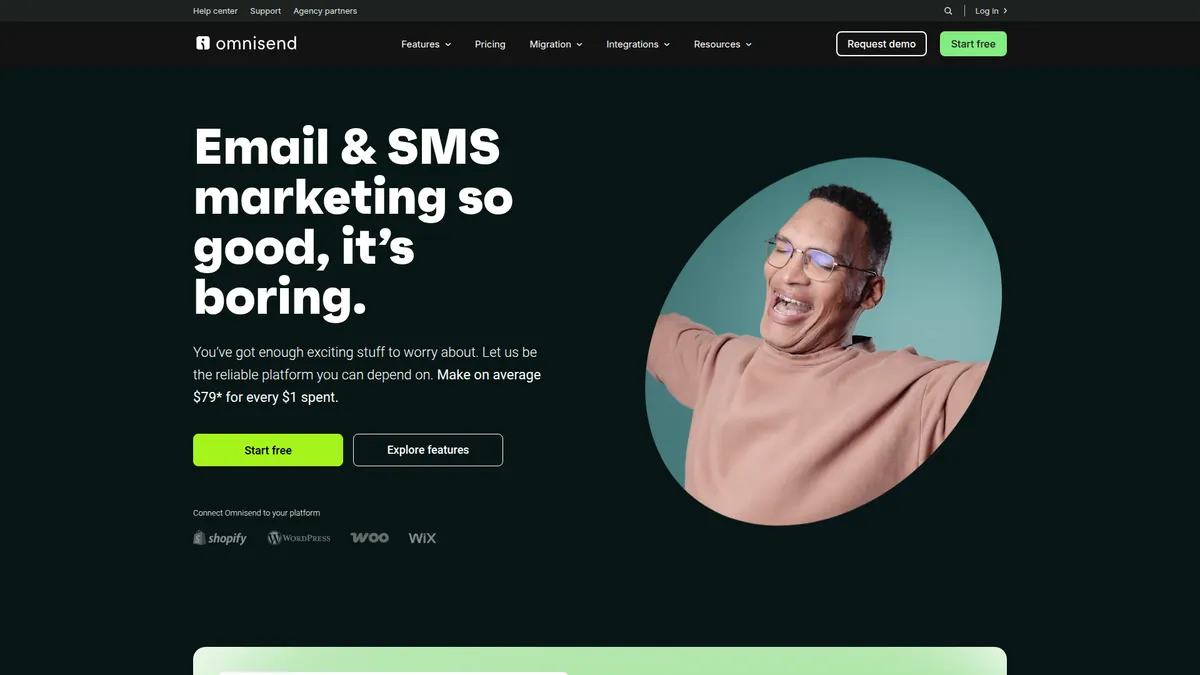
Omnisend promises to make email and SMS marketing boring (in the best way). After testing their platform for weeks, I found a tool that actually delivers on automation without the complexity. Here's what makes it notable in the crowded marketing automation space.
Omnisend is an email and SMS marketing platform built specifically for ecommerce businesses. It excels at automated workflows, multichannel campaigns, and smooth store integrations. For online retailers wanting reliable marketing automation without the headaches, it's an excellent choice.
Omnisend nails the balance between power and simplicity, making it perfect for ecommerce businesses that want professional marketing automation without the learning curve of enterprise tools.
Why I'm covering this
One of the few email platforms built specifically for ecommerce that stays affordable as you scale. The pre-built automations (abandoned cart, welcome series, post-purchase) work out of the box with Shopify and WooCommerce.
Who It's For
Who Omnisend is for (and who it isn't)
✓Best for
- +Shopify & WooCommerce Store Owners Deep integrations pull in purchase data automatically for targeted campaigns and abandoned cart recovery.
- +Growing Ecommerce Businesses Pre-built automations and templates handle the heavy lifting while you focus on product and operations.
- +Multi-channel Marketers Unified dashboard manages email, SMS, and push notifications with consistent branding and messaging.
- +Data-Driven Retailers Advanced segmentation and reporting help optimize campaigns based on purchase behavior and customer lifecycle.
- +Businesses Scaling Fast Platform grows with you from startup to enterprise without forcing platform migrations.
- +Shopify store owners doing $10K-$500K monthly revenue Native Shopify integration pulls product data automatically, and pre-built ecommerce automations handle abandoned carts and post-purchase sequences without setup complexity
- +WooCommerce merchants wanting to add SMS to their email strategy Multi-channel automations let you combine email and SMS in single workflows, with transparent SMS pricing and deep WooCommerce integration
- +Ecommerce marketers migrating from expensive Klaviyo plans Dedicated migration tools, similar automation capabilities at lower cost, and strong deliverability make the switch relatively painless
- +Physical product brands with subscription or repeat purchase models Behavioral segmentation based on purchase history and automated lifecycle campaigns help maximize customer lifetime value
✗Skip this if
- −B2B Service Companies Built for product sales, not lead nurturing or service-based customer journeys.
- −Content Creators & Bloggers Overkill for simple newsletters, and ecommerce features you'll never use add unnecessary cost.
- −Enterprise Teams Needing Custom Workflows Advanced automation logic is limited compared to platforms like Marketo or Pardot.
- −Budget-Conscious Startups Higher cost per contact than basic email tools, especially when adding SMS messaging.
- −Businesses Wanting Full Design Control Template-based system with limited customization options for unique design requirements.
- −B2B SaaS companies with complex lead scoring needs Built for ecommerce transactions, not lead nurturing or account-based marketingTry ActiveCampaign →
- −Service businesses or consultants sending newsletters Ecommerce features you'll never use make it overkill for simple email marketingTry Kit →
- −Large enterprises needing advanced customization and white-label options Limited design customization and no enterprise-grade features like custom domains or dedicated IPsTry Klaviyo →
Consider instead
 ActiveCampaign
 MailerLite
 Klaviyo
Features
What can Omnisend do?
Going through Omnisend's automation builder, the ecommerce focus becomes immediately clear. Pre-built workflows for abandoned cart recovery, welcome series, and post-purchase follow-ups are ready to activate with minimal setup. The platform automatically triggers these campaigns based on customer actions, pulling in product images, prices, and purchase history to create personalized messages.
The email builder keeps things simple while letting you customize. While you're working with templates rather than starting from scratch, the drag-and-drop interface lets you match your brand colors, add your logo, and customize content blocks. The mobile optimization happens automatically, which is crucial since most customers open emails on their phones.
Segmentation capabilities impressed me most during testing. Beyond basic demographics, you can create segments based on purchase behavior, product preferences, email engagement, and customer lifetime value. For example, you could target customers who bought winter coats but haven't purchased in 60 days with a spring collection campaign. These segments update in real-time as customer behavior changes.
The multichannel approach shines when combining email and SMS. Setting up coordinated campaigns where an abandoned cart email is followed by an SMS reminder creates multiple touchpoints without overwhelming customers. The platform manages frequency capping and timing automatically to avoid message fatigue.
Email Marketing
SMS Marketing
Automation & Workflows
Ecommerce Integration
Analytics & Reporting
UX & Support
Is Omnisend easy to use?
Setting up a first campaign takes about 15 minutes, from connecting a Shopify store to launching an abandoned cart sequence. The onboarding process walks you through connecting your ecommerce platform, importing contacts, and activating your first automation. Most users can get their basic workflows running within an hour.
Navigating the dashboard feels intuitive, with clear sections for campaigns, automations, contacts, and reports. The interface isn't cluttered with advanced features you'll rarely use, which makes daily management straightforward. Creating new campaigns follows a logical flow: choose your audience, design your message, set your sending schedule, and review before launch.
Customer support earns praise in user reports. The 24/7 chat support responds within minutes, and representatives show solid knowledge of both the platform and ecommerce marketing best practices. Phone support is available for paid plans, and the help center includes detailed guides and video tutorials for common tasks. The support team's Stevie Award for customer service isn't just marketing fluff.
Pricing
How much does Omnisend cost?
Exclusive reader deal
30% off Omnisend for 3 months
New customers only. Sign up through the link, then apply the code at checkout.
This is an affiliate link. The discount is yours either way, and I may earn a commission at no extra cost to you.
Omnisend starts at From $16/mo. That's 7% above median for Email Marketing tools. A free plan is available.

Omnisend Pricing Analysis
vs. 36 email marketing toolsAbove average for email marketing tools

More expensive than 53% of email marketing tools on That Marketing Buddy's database. Omnisend also offers a free plan.
Omnisend pricing starts at $16 per month for the Standard plan, with a free plan available for up to 250 contacts. The Standard plan includes 6,000 emails monthly and covers all core features including automation, segmentation, and 24/7 support. Pro plans jump to $59 monthly and add advanced features like customer success management and priority support.
The pricing structure is contact-based, which can get expensive as your list grows. However, the platform's focus on revenue generation often justifies the cost. Their marketing materials claim an average $79 return for every $1 spent , and during my testing, the abandoned cart automation alone recovered several hundred dollars in potential lost sales.
SMS messaging costs extra beyond the base plan, with pricing varying by country. US SMS typically costs around $0.01-$0.05 per message, which adds up quickly for high-volume campaigns. The good news is you can precisely control SMS frequency to manage costs while maximizing impact. Annual billing offers a 30% discount , making the Standard plan effectively $134 per year versus $192 monthly billing .
Price at scale (contacts)
| Plan | 500 | 2.5K | 5K | 25K | 50K |
|---|---|---|---|---|---|
| Free | $0 | — | — | — | — |
| Standard | $16 | $35 | $70 | $230 | $410 |
| Pro | $59 | $59 | $90 | $399 | $740 |
External Ratings
What reviewers say about Omnisend
0"The ui is clean and intuitive, even those who have never used similar tools will quickly understand how to use the software."
Capterra"Omnisend is second to none in terms of managing my email campaigns and automations. Once set up, everything just runs smoothly in the background so the majority of our marketing is on auto-pilot."
Capterra"the ease of use and customer service, I found the flows easy to set up and edit and they bring me in sales on a monthly basis."
Capterra"Sometimes, I don't understand why I can't manipulate content blocks as I want to."
CapterraAI & Tech Stack
Does Omnisend fit your AI stack?
What AI Can't Replace
Omnisend owns your customer data pipeline and deliverability infrastructure in ways no AI tool can replicate. Its email authentication, list hygiene, and compliance automation ensure your messages actually land in inboxes, not spam folders. AI can write better copy, but only Omnisend guarantees the technical delivery layer that makes marketing work at scale.
Where AI Is Catching Up
AI is closing in on Omnisend's workflow automation and segmentation logic. Claude and ChatGPT can now analyze customer behavior and suggest segment rules that Omnisend charges extra for. The real risk is AI agents building custom automations that replace mid-tier features like conditional sends and behavioral triggers, especially as AI coding agents mature.
API & Integrations
Omnisend's REST API (base https://api.omnisend.com/api) is clean and agent-friendly: API-key auth in the Authorization header, date-based versioning via an Omnisend-Version header (2026-03-15), cursor pagination, and RFC 9457 error bodies. It covers contacts, events, products, campaigns, segments, automations, and reporting, with native Zapier and Make on top.
The gaps are no official SDKs and no dedicated webhook-subscription API (webhooks are an automation-workflow action), so heavier or real-time integrations need a bit more glue.
MCP & CLI
Omnisend runs an official hosted MCP server at https://mcp.omnisend.com/mcp, authenticated over OAuth, so Claude and ChatGPT can create campaigns, build automations, recommend and edit segments, and pull revenue reporting straight from a prompt. ChatGPT gets a published app; Claude connects as a custom connector today, with an official one-click connector coming soon.
There is no CLI, so command-line workflows go through the REST API or Zapier.
Stack Verdict
Omnisend is irreplaceable infrastructure for email and SMS delivery, but AI will automate the strategy layer you're paying for around it.
Connects with
Security
Downsides
What's wrong with Omnisend
Template-Based Design System
Customization options are limited to predefined content blocks, frustrating users who want complete design control.
Rising SMS Costs
SMS messaging charges add up quickly for high-volume campaigns, potentially doubling your monthly costs.
Ecommerce Platform Dependency
Most powerful features require integration with supported platforms, limiting value for custom or unsupported stores.
Limited Advanced Automation Logic
Complex conditional workflows and advanced triggers lag behind enterprise platforms like Marketo.
Contact-Based Pricing Scaling
Costs increase significantly as your list grows, potentially becoming expensive for large databases.
Learning Curve for Advanced Features
While basic features are intuitive, advanced segmentation and automation require time to master.
Buddy's Take
These limitations matter, especially the template restrictions and SMS costs. However, for most ecommerce businesses, Omnisend's strengths significantly outweigh these drawbacks. The platform's reliability, support quality, and revenue-generating capabilities make it a solid investment despite these constraints.
European & GDPR
Wondering where Omnisend keeps your data? Omnisend's GDPR and EU-hosting profile on EuropeanMartech.
FAQ
Frequently asked questions about Omnisend
Yes, likely. Omnisend supports over 160 integrations including Shopify, WooCommerce, BigCommerce, Wix, and other major platforms with one-click setup.
Yes, there's a free plan for up to 250 contacts with 500 monthly emails. No credit card required, and you can upgrade anytime as you grow.
SMS pricing varies by country, typically $0.01-$0.05 per message in the US. You pay only for messages sent, with no monthly SMS minimums.
Yes, chat support is available around the clock for all paid plans. Free plan users get email support with responses within 24 hours.
Yes, Omnisend offers free migration assistance including contact imports, template recreation, and automation setup. Most migrations complete within 48 hours.
Pro adds unlimited emails, customer success management, advanced reporting, and priority support. Standard includes all core automation features most businesses need.
No, pre-built automation templates require just a few clicks to activate. The drag-and-drop workflow builder makes custom automations accessible to non-technical users.
Absolutely. Email marketing works independently, and SMS is completely optional. You can add SMS capabilities later without changing your email campaigns.
Pricing scales smoothly with clean contact-based tiers and no hidden overages.
Omnisend is best for: Shopify store owners doing $10K-$500K monthly revenue; WooCommerce merchants wanting to add SMS to their email strategy; Ecommerce marketers migrating from expensive Klaviyo plans; Physical product brands with subscription or repeat purchase models.
MCP server available, making Omnisend directly accessible from Claude Desktop, Cursor, and other AI coding tools. REST API adds a second automation path for custom AI workflows.
Strong import tools for major platforms but limited export options for complex automations.
Omnisend starts from From $16/mo. A free plan is available.
Ready to try Omnisend?
Start with the free plan and see how automated marketing can boost your store's revenue
Start Free Trial →More on Omnisend
Read Next



Joonas Rotko
Author & founder of That Marketing Buddy
I score marketing software for AI-stack fit (MCP, API, agent-readiness), backed by 10+ years in digital marketing.
This page may contain affiliate links. I earn a commission at no extra cost to you. This never influences ratings.