
I scored 122 marketing tools for how ready they are to work with AI agents. The average landed at 5.1 out of 10. Most have the basic plumbing, but only a handful are easy for an AI agent to use.
That gap is the whole story. 92% of these tools expose an API, so the plumbing has been there for years. But only 28% ship an official MCP server, the piece that lets an AI agent connect and do real work without custom code. The industry wired the building for electricity and forgot to add the light switches.
I run That Marketing Buddy, a marketing software review site, and I have been scoring every tool I cover on AI-stack fit: can an AI agent reach it, pull data, and take action. This is the first time I have put all 122 scores in one place. Here is what the data says.
Key Findings
- 122 marketing tools scored for AI-agent readiness in June 2026.
- 92% have a public API (112 of 122). APIs are nearly universal.
- 56% have an MCP server, but only 28% have an official one. The other 28% rely on community-built servers the vendor did not make.
- The average agent-readiness score is 5.1 out of 10. Reachable by an agent, but rarely no-code.
- 35 tools score 7 or higher, and every one of them has an official MCP server. 77 land in the middle (4 to 6). Just 10 score 3 or lower.
- AI Content SEO tools are the least agent-ready category at 2.4 out of 10, with zero official MCP servers.
How I Scored 122 Tools
Agent-readiness here means one thing: how easily an AI assistant like Claude, ChatGPT, or Cursor can connect to the tool and do useful work. A high score is not about how good the marketing software is. It is about how open it is to an agent.
Each tool gets a 0 to 10 score built from signals I can verify against vendor documentation:
- MCP server: does the vendor ship an official Model Context Protocol server (the no-code way for an AI to use the tool), a community one, or none. This carries the most weight.
- API: is there a public, documented REST API, and how usable is it (auth method, SDKs, an OpenAPI spec).
- Agent ergonomics: structured outputs, webhooks, an llms.txt file, and whether the tool works with Zapier or Make for no-code glue.
- Vendor signal: does the company talk about AI agents in its docs and changelog, or is the integration accidental.
The scale tiers cleanly. A closed tool with no API sits near the bottom. A documented API earns a tool the middle of the range, because an agent can reach it with code. A community MCP server adds more. And an official MCP server, the no-code path, is what lifts a tool into the top tier. An API is not nothing, which is why most tools land mid-scale rather than at zero.
The Verification Handshake
A claim of "official MCP server" is easy to make and easy to fake, so I did not take any at face value. For every MCP claim I ran a simple handshake to separate a real, first-party server from a marketing page or a community side-project.
Two checks decide it. First, ownership: does the server live on the vendor's own domain or official GitHub organisation, not a random contributor's repo. Second, the endpoint's own behaviour: a live MCP server refuses a plain browser request and answers with a 401, 405, or 406, because it expects an authenticated POST. A 404, a redirect, or a full marketing homepage means there is no server behind the URL.
In plain terms: a live server pushed back when I tried to open it in a browser, a dead or fake one just served a normal web page, and only servers on the vendor’s own domain or GitHub organisation counted as official. That handshake is why my official-MCP count is lower than a naive scrape would give you. Three tools claimed an official server and failed the check.
✗Builderall advertised an official MCP server, but there is no working endpoint and no evidence one ever shipped. Scored as no MCP.
✗Zoho Campaigns was credited with Zoho’s MCP, but Zoho’s MCP does not cover the Campaigns product. Scored as no MCP.
✗Sitebulb’s MCP page is a coming-soon waitlist, not a live server. Scored as no MCP.
I corrected all three before running the numbers, and fixed the same data on my live MCP directory. Accurate beats impressive. If you want the long version of how these interfaces differ, I wrote a full guide on API vs MCP vs CLI for marketing tools.
The 92% / 28% Gap: APIs Are Everywhere, MCP Servers Are Not
The single clearest finding: almost every marketing tool has an API (92%), but fewer than a third have built the one thing that makes them usable by an AI agent without a developer (an official MCP server, 28%).
This matters because an API and an MCP server are not the same door. An API needs someone to write code that calls it. An MCP server lets an AI assistant connect once and then just use the tool in plain language. For a marketer who does not code, the API might as well not exist. The MCP server is the difference between "my AI can do this" and "I need to hire a developer."
So the headline 92% is a little misleading. The plumbing exists, but most vendors have not put a handle on the door that customers can open. The 28% who have are the ones pulling ahead.
Most Marketing Software Is Not Agent-Ready Yet
Spread the 122 scores out and the shape is clear. 35 tools (about 1 in 4) score 7 or higher, the band I would call agent-ready, and every one of them ships an official MCP server. 77 tools sit in the partial middle: a usable API, or a community MCP, but not the no-code official path. Just 10 score 3 or lower, with no real agent path at all.
- Agent-ready (7 to 10): 35 tools. An official MCP server, the no-code path for an AI agent.
- Partial (4 to 6): 77 tools. A documented API (reachable with code) or a community MCP server.
- Not ready (0 to 3): 10 tools. No API and no MCP, effectively a closed box.
Which Categories Are Winning, and Losing
Breaking the scores down by category is where it gets interesting. Some corners of marketing software have leaned into agents. Others have barely noticed.
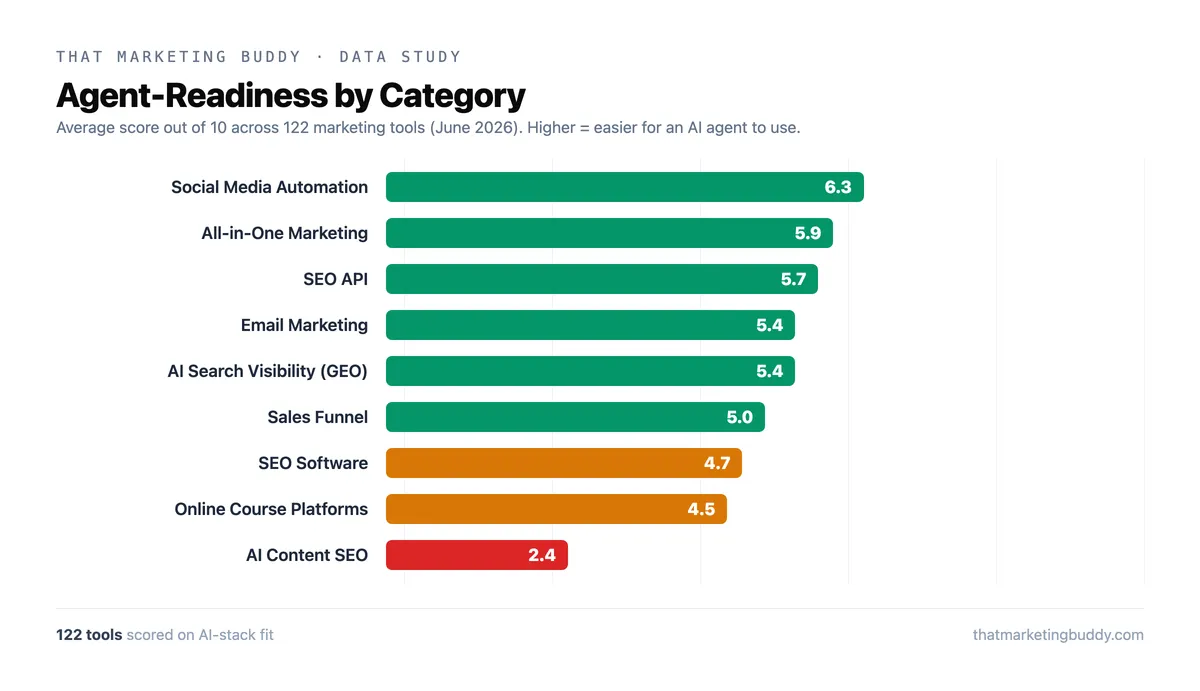
- Social Media Automation: 6.3 avg (9 tools, 5 official MCP). The most agent-ready category, led by newer API-first tools.
- All-in-One Marketing: 5.9 avg (9 tools, 4 official MCP). The big platforms (HubSpot, GoHighLevel) are investing here.
- SEO APIs: 5.7 avg (7 tools, 3 official MCP). Built for developers from day one (DataForSEO, SearchApi), so agents fit naturally.
- Email Marketing: 5.4 avg (37 tools, 10 official MCP). The largest category and the one with the most official MCP servers in absolute terms.
- AI Search Visibility (GEO): 5.4 avg (5 tools, 2 official MCP). Young category, agent-native leaders like Profound but a wide spread.
Since I ran these numbers, the line between the SEO APIs and AI Search Visibility categories has already started to blur. In July 2026 DataForSEO, one of the developer-first providers in the SEO APIs group above, shipped an LLM Mentions API that tracks how brands and competitors get cited inside ChatGPT and Google AI Overviews, priced pay-as-you-go at roughly $1 per 1,000 rows. A vendor that spent years selling raw ranking data now sells AI answer visibility data through the same endpoints.
That is the tell: the infrastructure layer is following its customers into GEO, and the tools that already expose a clean API are the ones that can bolt on an AI-visibility endpoint without rebuilding anything.
- Sales Funnel: 5.0 avg (6 tools, 1 official MCP).
- SEO Software: 4.7 avg (38 tools, 9 official MCP). The biggest category, dragged down by a long tail of legacy crawlers and rank trackers.
- Online Course Platforms: 4.5 avg (4 tools, 0 official MCP). Nobody here has shipped one yet.
- AI Content SEO: 2.4 avg (7 tools, 0 official MCP). The least agent-ready category on the board.
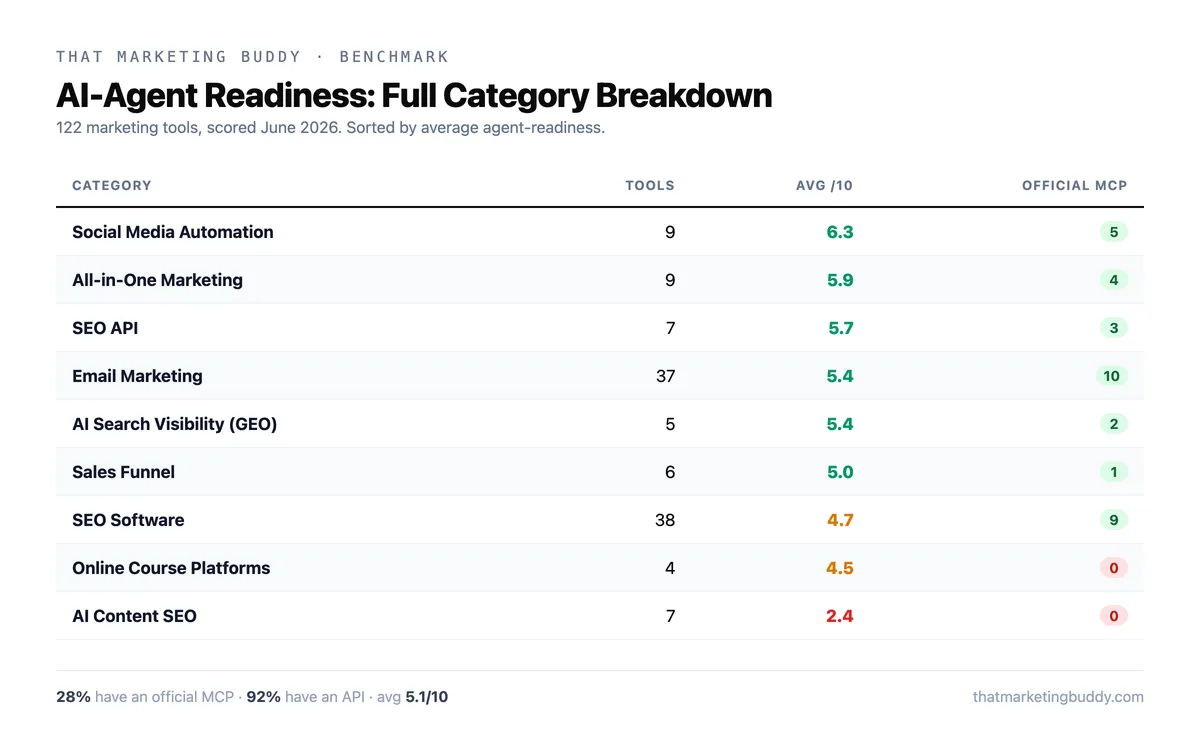
That AI Content SEO line is the one I keep rereading. The tools that sell themselves on AI, the AI content and SEO writers, are the least able to plug into an actual AI agent. They use AI inside a closed dashboard, but they have built almost nothing for the AI you already run. It is the clearest example of "AI-powered" meaning a feature, not an architecture.
Email marketing deserves the opposite credit. With 10 official MCP servers across 37 tools, it has quietly become the category where connecting your stack to Claude or ChatGPT is most realistic today, led by tools like Klaviyo, Mailjet, and Kit.
Official vs Community MCP: A 50/50 Split
Of the 68 tools with any MCP server at all, exactly half are official (34) and half are community-built (34). That even split is worth sitting with.
A community MCP server, written by a third party and posted on GitHub, can work. But it can also break the day the vendor changes its API, and nobody is on the hook to fix it. An official server is a commitment: the vendor is telling you agents are a supported way to use the product. When I score a tool, an official MCP is worth a lot more than a community one for exactly this reason.
So the real "agent-supported" number is not 56%. It is 28%. The rest is goodwill from the community, which is great, but not something I would build a workflow on.
The Most Agent-Ready Marketing Tools Right Now
The tools at the top of the index all share the same profile: an official MCP server, a documented API, and a vendor that treats agents as real users. The leaders, scoring 7 or 8:
- Leadpages (8): an official MCP server with 47 actions, rare for a landing-page builder.
- Profound (8): the AI search visibility leader, with an official MCP and real SDKs.
- Mailjet and Resend (8): developer-first email, agent access built in.
- HubSpot and Semrush (8): the big platforms shipping official, GA MCP servers.
- Klaviyo, Kit, ActiveCampaign, and Ahrefs (7): each with an official MCP and a strong API.
I keep the full, current list of which tools ship an MCP server at thatmarketingbuddy.com/mcp, and the API-first tools at thatmarketingbuddy.com/api. Both update as vendors ship.
What This Means for How You Buy Software in 2026
If you are choosing a marketing tool this year and you expect to run any of your work through an AI assistant, the score that matters is no longer just features or price. It is whether your AI can reach the tool at all.
Does this tool have an official MCP server? If yes, your AI can use it tomorrow with no code. If it only has an API, you can still wire it up, but you or a developer will write the glue. If it has neither, you are buying a closed box in a year when openness is the whole game.
My rule is simple now. A tool with an official MCP server is a tool that gets more useful as AI agents get better. A tool without one gets relatively slower every quarter, even if it never changes, because everything around it is learning to talk to agents and it is not.
Methodology and Data
Scores come from my own agent-readiness rubric, applied to the 122 marketing tools I track as of June 2026. The inputs are vendor documentation, official MCP and API pages, and the verification handshake above, run against every official-MCP claim in the set.
This is a living dataset. As vendors ship MCP servers and clean up their APIs, the scores move, and I update the MCP directory and API directory as it happens. If you run a tool and think your score is wrong, tell me what changed and I will reverify.
The short version: marketing software has the plumbing for AI agents but mostly not the doors. The 28% who have built the doors are the ones worth betting on.
Mentioned in this post


Read next

Joonas Rotko
Author & founder of That Marketing Buddy
I test and score SEO and AI-visibility software for small business owners and agencies, backed by 10+ years in digital marketing.