
This page may contain affiliate links.
Some links on this page are affiliate links, meaning I may earn a commission if you sign up (at no extra cost to you). This never influences my ratings or recommendations.
The Verdict
Is Tars right for you?
Tars builds no-code AI agents that handle customer support and lead capture without a developer team. The pitch is simple: replace repetitive tickets and static forms with a conversational agent, tested before it ever talks to a real customer.
Tars is a no-code platform for building AI agents that handle customer support tickets and qualify leads, backed by a knowledge base system and built-in testing before you go live. It fits mid-size to enterprise teams juggling high conversation volume across channels like WhatsApp and web chat.
Whether it's worth it comes down to volume: the free plan caps out at 50 conversations a month, and the next tier jumps straight to $499/month.
The evaluation tooling before deployment is the one feature that separates Tars from a lot of chatbot builders that ship first and fix later.
Why I'm covering this
Tars pairs a no-code agent builder with pre-deployment testing and RAG-based knowledge bases, backed by an 800+ brand customer base and a 4.7/5 G2 rating, at a published (if steep) starting price.
Who It's For
Who Tars is for (and who it isn't)
✓Best for
- +Mid-size support teams drowning in repetitive tickets The knowledge base and RAG system are built to deflect L0/L1 queries, and case studies show automation rates between 49% and 66% of conversations.
- +Brands running support across multiple channels One agent can deploy to website chat, WhatsApp Business API, and Slack, which matters if your customers don't all live in one place.
- +Regulated industries needing compliance on paper SOC 2, ISO 27001, GDPR, and HIPAA (on Enterprise) cover healthcare, finance, and government use cases without a custom build.
- +Marketing teams replacing static lead forms Conversational lead capture with Google Analytics, Facebook Pixel, and Zapier integrations gives more tracking than a plain landing page form.
- +Enterprise customer support teams handling high-volume repetitive queries (government, telecom, education) Case studies show 49-66% automation rates for organizations like State of Indiana and UCI Merage, with real call-volume reduction and 24/7 coverage.
- +Marketing teams running conversational lead-gen campaigns instead of static landing pages Templates for lead qualification (credit card recommendations, telecom plan selection) plus Google Analytics, Facebook Pixel, and AdWords tracking are built in.
- +Regulated industries needing compliant AI support (healthcare, finance, insurance) Enterprise plan includes HIPAA, SOC 2, and ISO compliance plus configurable data retention, which smaller chatbot tools typically don't offer.
- +IT and internal help desk teams automating employee support tickets Pre-built IT Support Agent templates handle troubleshooting and escalate unresolved issues into tickets automatically.
- +Companies already invested in WhatsApp Business for customer engagement Deep WhatsApp Business API integration is called out as a specific differentiator, alongside website and Slack deployment.
✗Skip this if
- −Solo creators or bootstrapped small businesses The free plan's 50-conversation cap runs out fast, and Premium's $499/month starting price is a hard jump for low-volume use.
- −Teams that just need a basic FAQ widget If all you want is 'answer three common questions on our homepage,' the knowledge base testing and RAG tuning here is more setup than the job requires.
- −Anyone without someone to maintain the knowledge base RAG only performs as well as the content behind it. If nobody owns that upkeep, retrieval accuracy drifts.
- −Buyers who want flat, predictable pricing Conversation-tiered pricing plus add-ons like Live Chat ($600/year/seat) and Professional Support ($5,000/year/agent) can make total cost harder to pin down upfront.
- −Solo founders or small businesses testing a chatbot on a tight budget Freemium's 50 conversations/month runs out fast, and the next tier jumps straight to $499/month with no gradual middle step.Try Tidio →
- −Social media managers who need Instagram/Messenger automation, not a general-purpose AI agent builder Tars is built around website, WhatsApp, and Slack deployment for support and lead gen, not social DM automation as a primary use case.Try ManyChat →
- −Teams that need combined email marketing and chat automation in one platform Tars has no email marketing features (campaigns, newsletters, list segmentation), so you'd still need a separate email tool alongside it.Try HubSpot →
Features
What can Tars do?
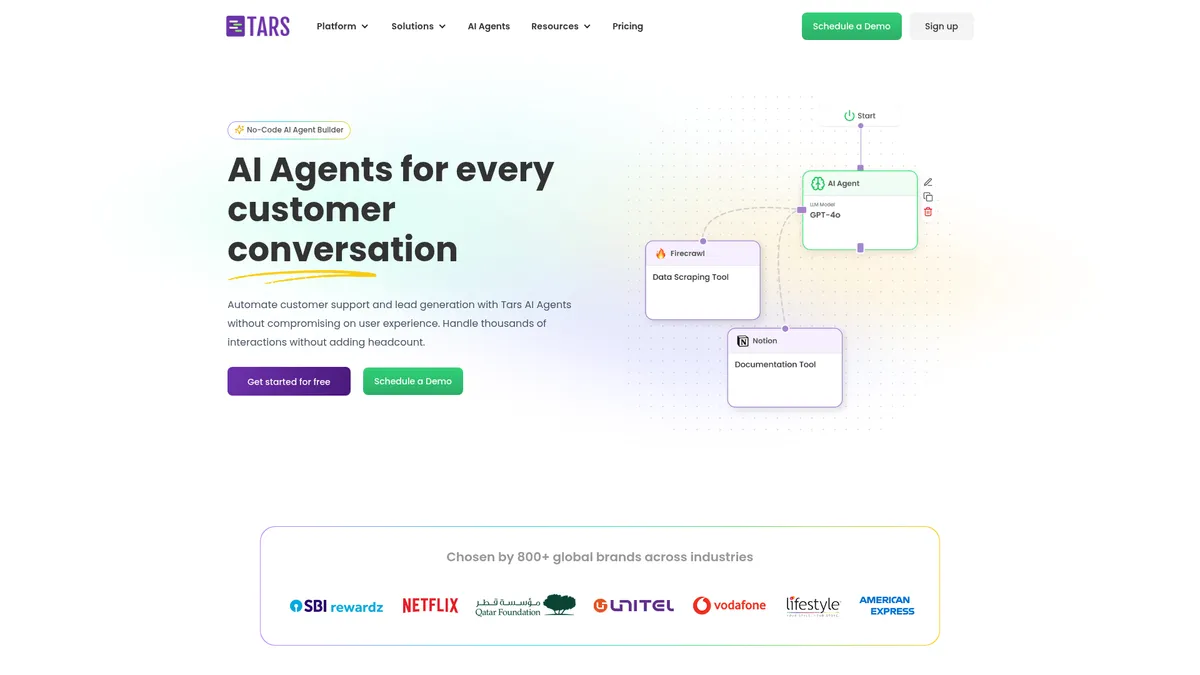
The Gambit-based builder is the entry point, and it's designed for non-developers. You pick an Agent Gambit, wire it to tools like Firecrawl or your CRM, choose an LLM, and write a base prompt with guardrails to keep it from looping. With 2,000+ templates covering use cases from IT support to hospital navigation, most teams aren't starting from a blank canvas.
The knowledge base is where the actual answer quality gets decided. Tars uses retrieval-augmented generation (RAG) with semantic search and chunk re-ranking, meaning it pulls the most relevant pieces of your documentation rather than dumping everything at the LLM. Cloud connectors to Zendesk and Salesforce are locked to Premium and Enterprise, so free users are stuck with manual uploads.
What's less common at this price point is the built-in AI evaluation system. Before an agent goes live, Tars can generate synthetic question sets and test retrieval accuracy, response quality, and behavioral consistency against them. That's a meaningful step up from platforms that let you publish first and discover gaps from angry customers. It ties into the kind of agent-readiness thinking covered in our AI-agent readiness breakdown.
On the deployment side, agents can go live on a website widget, WhatsApp Business API, or Slack, and the same agent works across channels without rebuilding it. Analytics track CX scores, resolution rates, and sentiment, which matters more here than in a typical chatbot because you're paying per conversation and want to know what's actually getting resolved versus escalated.
Agent Building
Knowledge Base & RAG
Testing & Evaluation
Deployment Channels
Analytics
UX & Support
Is Tars easy to use?
Tars carries a 4.7 out of 5 rating on G2 and 4.6 out of 5 on Gartner, along with G2 High Performer badges for Winter 2025, Enterprise, Asia Pacific, and Europe. Customer testimonials collected by Tars describe the builder as approachable once you understand the backend logic, though a few note there's a learning curve before the Gambit structure clicks.
Support quality gets mixed but generally positive mentions in the same testimonials, with users pointing to responsive teams and a willingness to accommodate specific requests. Live Chat handover and Professional Support (a dedicated customer success manager) are both add-ons rather than included features, which is worth factoring into any support-quality comparison against platforms that bundle this in.
Onboarding leans on the template library rather than a guided setup wizard, so teams starting from a template report faster time-to-launch than those building from scratch.
Pricing
How much does Tars cost?
Tars starts at $499/month. A free plan is available.
Tars starts with a Freemium plan at $0/month, then jumps to Premium at $499/month (monthly billing) or $414.92/month billed annually ($4,979/year, about 17% off), with Enterprise pricing handled through direct contact. The Freemium tier includes 50 conversations per month, basic LLM models, a 5-Knowledge Base training limit, and just 1 month of data retention. Premium scales conversation volume from 500 up to 10,000 per month, adds advanced LLM models, 20 Knowledge Bases, live chat support, ISO and SOC 2 compliance, and 12 months of data retention.
Conversation limits reset monthly.
The gap between free and Premium is the thing to plan around. There's no $50 or $150 middle tier, so a team outgrowing 50 conversations a month has to justify $499/month or stay on the free plan and hit the wall. Add-ons stack on top: Live Chat is $600/year/seat, and Professional Support Services (a dedicated customer success manager) runs $5,000/year/agent, both on top of your base plan.
Whether that pencils out depends entirely on what it replaces. If $499/month genuinely offsets a support hire or call center volume the way the Indiana case study suggests, the math works. If you're a small team testing automated support for the first time, it's a steep entry price compared to tools like HubSpot's chatbot builder or ManyChat.
| Plan | Monthly |
|---|---|
| Freemium | Free |
| Premium | $499/mo |
| Enterprise | Custom |
External Ratings
What reviewers say about Tars
0"We're saving an average of 4,000+ calls a month. Implementing an Agent revolutionized our customer service channels and our service to Indiana business owners."
Tars case study (State of Indiana)"Since our launch of Tars Agents, we've had more than 5k interactions with them from individuals on the website... This provides another avenue of access to our team while cutting down on staff needing to email back."
Tars case study (UCI Merage School)"Takes those boring forms and allows you to make the collecting of customer information enjoyable for the user. It has a lot of value and I see the company constantly working on improving it."
Tars testimonial (Director of Marketing)"TARS is an essential tool within our lead gen strategy... Compared with static landing pages, we have seen an increase in conversions and more engagement."
Tars testimonial (Founder)Downsides
What's wrong with Tars
No mid-tier plan
Freemium caps at 50 conversations/month and the next step is $499/month. Teams outgrowing free with modest volume have nowhere to land in between.
Add-ons stack cost quickly
Live Chat handover ($600/year/seat) and Professional Support ($5,000/year/agent) sit outside the base plan, which affects teams that need human handover from day one.
Basic LLM models on the free tier
Advanced LLM models are Premium-only, so free-tier answer quality may lag what the case studies demonstrate.
Short data retention on Freemium
One month of data retention on the free plan limits how much conversation history you can analyze before upgrading.
Knowledge base quality is on you
RAG only performs as well as the source content. Teams without someone maintaining documentation will see retrieval accuracy slip over time.
HIPAA and SSO locked to Enterprise
Healthcare and larger regulated teams needing HIPAA or single sign-on have to go through custom Enterprise pricing rather than a published tier.
Buddy's Take
None of these rule Tars out for the mid-size and enterprise teams it's built for. But if you're evaluating this as a small business or solo operator, the pricing gap and add-on costs are the first thing to run the numbers on before signing up.
FAQ
Frequently asked questions about Tars
Tars has a free plan (50 conversations/month), a Premium plan at $499/month (monthly billing) or $414.92/month billed annually ($4,979/year), and custom Enterprise pricing. Add-ons like Live Chat ($600/year/seat) and Professional Support ($5,000/year/agent) cost extra.
No. Tars uses a visual drag-and-drop builder based on 'Gambits,' and it includes 2,000+ pre-built templates so most teams start from a template rather than a blank canvas.
Freemium gives you 50 conversations per month, basic LLM models, 5 Knowledge Bases, community support, and 1 month of data retention. It's enough to test the platform, not to run production support at scale.
Yes, but cloud connectors to Zendesk and Salesforce are limited to Premium and Enterprise plans, not Freemium. Tars lists 600+ integrations overall, including Slack, Notion, Google Drive, and Zapier.
Tars generates synthetic test datasets from your knowledge base and evaluates retrieval accuracy, response quality, and behavioral consistency before deployment. This is one of the more distinct features compared to chatbot builders that skip pre-launch testing.
HIPAA compliance is available on the Enterprise plan, alongside SOC 2, ISO 27001, and GDPR compliance which apply more broadly across plans.
Website chat widgets, WhatsApp Business API, Slack, and SMS are all supported deployment channels, with the same agent able to work across multiple channels.
It depends on volume. Under 50 conversations a month, the free plan may cover it. Above that, the jump to $499/month Premium is steep for low-volume use cases and cheaper tools may fit better.
The jump from free to paid is brutal: 50 conversations on Freemium, then a $499/month minimum on Premium with no smaller step in between.
Tars is best for: Enterprise customer support teams handling high-volume repetitive queries (government, telecom, education); Marketing teams running conversational lead-gen campaigns instead of static landing pages; Regulated industries needing compliant AI support (healthcare, finance, insurance); IT and internal help desk teams automating employee support tickets; Companies already invested in WhatsApp Business for customer engagement.
AI is the product here, not a bolt-on: multiple LLM options, RAG-based knowledge bases, and a synthetic testing framework show active investment, though there's no mention of an MCP server.
Nothing documented points to dedicated export tools or competitor-import wizards, and the Gambit-based flow structure is proprietary.
Ready to try Tars?
Start on the free plan with 50 conversations a month before deciding if the $499/month Premium tier earns its keep.
 Start Free →
More on Tars

Joonas Rotko
Author & founder of That Marketing Buddy
I score marketing software for AI-stack fit (MCP, API, agent-readiness), backed by 10+ years in digital marketing.
This page may contain affiliate links. I earn a commission at no extra cost to you. This never influences ratings.