
This page may contain affiliate links.
Some links on this page are affiliate links, meaning I may earn a commission if you sign up (at no extra cost to you). This never influences my ratings or recommendations.
The Verdict
Is Tidio right for you?
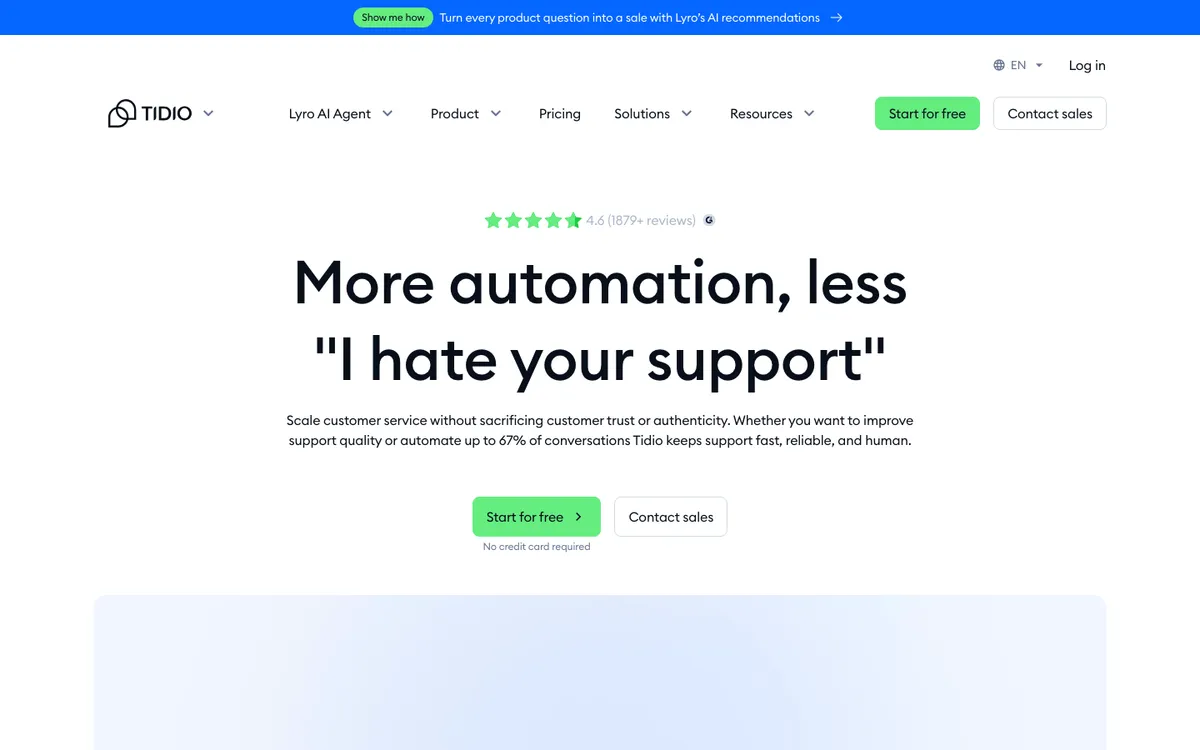
Tidio is one of the better-known names in customer service software, a suite that pairs live chat and ticketing with Lyro, its AI support agent.
For a site about AI-stack fit, the reason it earns a place is Lyro: it can plug into your systems through a REST API, webhooks, JS actions and the Model Context Protocol, so the agent can call your own tools to answer questions and take actions, not just read a static knowledge base.
That makes Tidio more agent-ready than most turnkey support bots, even if it is a support suite first and a builder second.
A polished, recognizable support suite with an AI agent that is more open than its rivals. Lyro resolves a real share of tickets on its own and can call your tools over REST or MCP, which is rare for a tool in this bracket. The trade-offs are about tiering and cost. Billing runs on two meters, billable conversations and Lyro AI conversations, so the real price tracks volume.
The cheap plans include only a one-time 50-conversation Lyro pool, webhooks are locked to the $749 Plus tier, and Tidio exposes no MCP server for an outside agent to drive Tidio itself.
Tidio is self-serve and public: a Free plan , then Starter $24.17/mo , Growth from $49.17/mo , Plus from $749/mo and a custom Premium plan. The Lyro AI agent is metered separately (add-on from $32.50/month). Annual billing gives two months free, and there is a 7-day trial with no card.
Who It's For
Who Tidio is for (and who it isn't)
✓Best for
- +SMBs and ecommerce stores If you want live chat plus an AI agent that resolves common questions out of the box, Lyro does that without you designing a bot from zero.
- +Support teams wanting automation Lyro can call your own tools through REST, webhooks and MCP, so it can act on orders or accounts, not just answer FAQs.
- +Teams that value a known brand Tidio is widely used and reviewed, which lowers the risk for a buyer who wants a safe, supported choice.
- +AI-curious support leads The MCP and API support gives a technical teammate a path to wire Lyro into your stack when you are ready.
✗Skip this if
- −Builders wanting bespoke agent logic Tidio is a support suite, not a design canvas like Voiceflow or a framework like Botpress. Complex custom agents are not its strength.
- −Teams that need webhooks cheaply Webhooks are gated to the $749 Plus tier. If real-time push to your own systems matters, that is a steep floor.
- −Anyone who wants to drive Tidio from an agent Lyro can call your tools, but Tidio exposes no MCP server for an external agent like Claude to manage Tidio itself.
- −High-volume AI users on a budget Lyro is metered separately and the cheap plans include only 50 lifetime conversations, so heavy AI use climbs fast.
 ManyChat
 Chatfuel
Features
What can Tidio do?
Tidio is a customer service platform first: a live chat widget, a shared inbox, ticketing and email management, with the kind of automations (macros, auto-assignment, ticketing rules) that a growing support team needs. It leans toward SMBs and ecommerce, and it is one of the more recognizable names in the space, which counts for something when you want a safe, well-supported pick.
Lyro is the AI agent layered on top. It trains on your help content and resolves a meaningful share of incoming questions on its own (Tidio cites up to 67% for common problems). What makes it interesting for an AI-native stack is how it connects: Lyro can plug into your systems through a REST API, webhooks, JS actions and the Model Context Protocol, so it can call your own tools to look up an order or update an account, not just recite a knowledge-base answer.
The developer story is more open than most support bots in this bracket. REST API access is on every plan, including the free one, and the documentation is approachable. The limits are about tiering: webhooks are reserved for the $749 Plus plan, and the Lyro agent is metered separately from billable conversations, so the cheaper plans give you only a one-time pool of 50 Lyro conversations before you reach for the add-on.
Support & Live Chat
Lyro AI Agent
Developer & Agent Access
UX & Support
Is Tidio easy to use?
Tidio is approachable, which is much of its appeal. Setting up the live-chat widget and pointing Lyro at your help content does not require a developer, and the interface is clean for a support agent working a shared inbox. For a non-technical SMB owner that is a gentle on-ramp to an AI agent.
Support scales with plan, from standard support lower down to a dedicated success manager on Plus and a managed AI service on Premium. Documentation covers the REST API and the developer resources, including how Lyro integrates with your systems. There is no published money-back guarantee, so the 7-day trial is the way to test before paying.
Pricing
How much does Tidio cost?
Tidio starts at $24.17/mo. That's at category median for AI Lead-Generation Chatbots tools. A free plan is available.
Tidio keeps pricing public and starts with a real free plan. After that it is Starter at $24.17/month, Growth from $49.17/month, Plus from $749/month and a custom Premium plan. Annual billing gives two months free, and there is a 7-day trial with no card. The thing to understand is that two separate meters drive cost: billable conversations and Lyro AI conversations.
The free plan is generous for trying it: 50 billable conversations, up to 10 seats, the JavaScript widget, REST API access and a one-time pool of 50 Lyro conversations. Starter and Growth scale the conversation volume and add automations. Lyro itself is metered separately, with an add-on from $32.50/month, and the Premium plan starts at 3,000+ Lyro conversations with a managed service and a guaranteed 50% resolution rate.
Two things shape the real cost. First, the Lyro meter: the cheap plans include only a one-time 50-conversation pool, so any serious AI use means the add-on or a higher plan. Second, webhooks: they unlock only on the $749 Plus tier, so if pushing real-time events to your own systems matters, that is the floor. Price the plan on your conversation volume and how much you will lean on Lyro, not the headline number.
| Plan | Monthly |
|---|---|
| Free | Free |
| Starter | $24/mo |
| GrowthPopular | $49/mo |
| Plus | $749/mo |
| Premium | Custom |
FAQ
Frequently asked questions about Tidio
Yes. The Free plan includes 50 billable conversations, up to 10 seats, the JavaScript widget, REST API access and a one-time pool of 50 Lyro AI conversations. Paid plans start at Starter $24.17/month , with two months free on annual billing.
Public tiers in USD: Free , Starter $24.17/mo , Growth from $49.17/mo , Plus from $749/mo and a custom Premium plan. Cost runs on two meters, billable conversations and Lyro AI conversations, so it tracks your volume. The Lyro add-on starts at $32.50/month.
Yes, in one direction. Lyro can integrate via the Model Context Protocol (alongside REST API, webhooks and JS actions) to call your own tools and take actions. Tidio does not, however, expose an MCP server that an external agent could use to drive Tidio itself.
Yes. A REST API is available on every plan, including Free , with OpenAPI documentation, covering conversations, contacts, tickets and Lyro data sources. Webhooks, by contrast, are gated to the Plus tier ($749/month).
Partly. Tidio is a live-chat and support suite with the Lyro AI agent built in, so you configure an AI agent rather than design one from scratch. If you want a full design canvas or a developer framework, tools like Voiceflow or Botpress fit that job better.
Pricing is public and starts free, but it scales on billable conversations and on Lyro AI conversations, two separate meters, so the real cost depends on volume more than the headline. The Lyro agent is the part that gets expensive: the cheap plans include only a one-time 50-conversation pool, and the add-on starts at $32.50/month.
More agent-ready than most turnkey support bots. Lyro can consume MCP tools and REST APIs, so it acts on your stack rather than just reading a knowledge base. What holds the score back: Tidio exposes no MCP server an external agent can use to drive Tidio itself, and the richest integration features sit on higher tiers.
Your conversation and contact data is reachable through the REST API on every plan, including free, which keeps lock-in moderate. Webhooks for pushing data out, though, are gated to the $749 Plus tier, so real-time export to your own systems is a higher-tier feature.
Tidio starts from $24.17/mo. A free plan is available. There is a 7-day free trial.
Want live chat plus an AI agent that plugs into your stack?
Tidio pairs live chat and ticketing with the Lyro AI agent, which can call your own tools over REST API, webhooks and MCP.
 Visit Tidio
More on Tidio

Joonas Rotko
Author & founder of That Marketing Buddy
I score marketing software for AI-stack fit (MCP, API, agent-readiness), backed by 10+ years in digital marketing.
This page may contain affiliate links. I earn a commission at no extra cost to you. This never influences ratings.