
This page may contain affiliate links.
Some links on this page are affiliate links, meaning I may earn a commission if you sign up (at no extra cost to you). This never influences my ratings or recommendations.
The Verdict
Is Mailgun right for you?
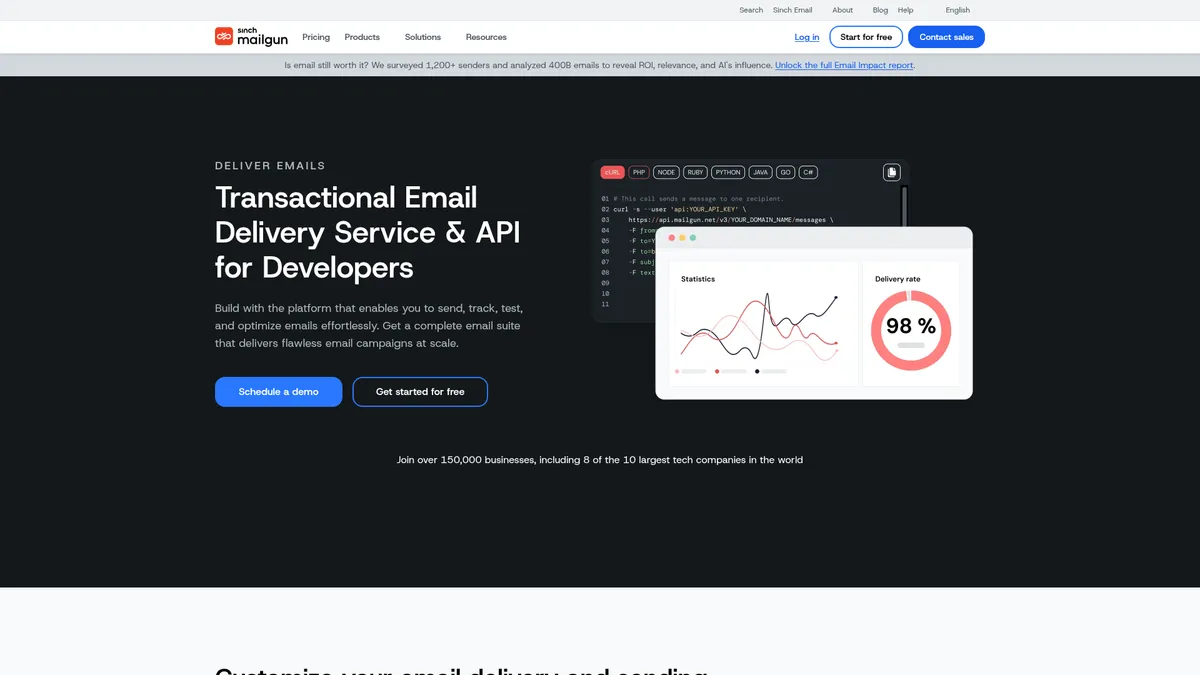
Mailgun positions itself as the email platform built by developers, for developers. It's focused on transactional email delivery through APIs rather than marketing campaigns with visual builders.
Mailgun is a transactional email service designed for developers who need reliable API-based email delivery. It excels at sending password resets, receipts, and notifications at scale but lacks the visual campaign builders that marketing teams expect. Strong deliverability and developer tools make it ideal for SaaS companies and apps.
This is for developers building email into applications, not marketers running campaigns. The API-first approach is either perfect for your tech stack or completely wrong for your team.
Why I'm covering this
Gold standard for transactional email among developers, with impressive client roster and strong deliverability rates. It represents a completely different approach from marketing-focused platforms, making it essential to understand when API-first email makes sense.
Who It's For
Who Mailgun is for (and who it isn't)
✓Best for
- +SaaS Applications Need reliable transactional emails like password resets, receipts, and user notifications with API integration.
- +E-commerce Platforms Sending order confirmations, shipping updates, and account notifications at high volume with consistent delivery.
- +Development Teams Want programmatic email control with webhooks, parsing, and detailed analytics through REST APIs.
- +High-Volume Senders Sending millions of emails monthly and need dedicated IPs, deliverability optimization, and enterprise reliability.
- +Multi-Domain Operations Managing email for multiple brands or clients with up to 1,000 custom sending domains on higher plans.
- +SaaS developers building user onboarding sequences and transactional emails RESTful API, webhook support, and reliable delivery infrastructure designed specifically for triggered emails
- +E-commerce platforms sending order confirmations, shipping updates, and receipts High-volume transactional email delivery with tracking and analytics for order-related communications
- +Enterprise dev teams managing multiple applications that need email functionality SAML SSO, dedicated IP pools, and scalable infrastructure for complex multi-app environments
- +AI developers building email-enabled applications or chatbots API architecture suitable for programmatic email generation and delivery from AI systems
✗Skip this if
- −Marketing Campaign Creators No drag-and-drop email builder or visual campaign tools. This is purely transactional, not marketing automation.
- −Small Business Owners The developer-focused interface and API requirements make it unnecessarily complex for simple newsletter sending.
- −Budget-Conscious Startups The free plan only covers 100 emails/day. Most marketing platforms offer 1,000+ contacts free.
- −Non-Technical Teams Requires API integration and technical setup. No user-friendly dashboard for non-developers to manage campaigns.
- −List Management Focused Limited subscriber management and segmentation tools compared to dedicated email marketing platforms.
- −Small business owners sending weekly newsletters to customers No marketing automation, visual email builder, or subscriber management featuresTry MailerLite →
- −Content creators building email lists with lead magnets and drip campaigns Lacks automation sequences, landing pages, and marketing-focused featuresTry Kit →
- −E-commerce marketers running abandoned cart campaigns and promotional emails No behavioral triggers, segmentation tools, or marketing campaign managementTry Klaviyo →
Consider instead
 ActiveCampaign
 MailerLite
 Klaviyo
Features
What can Mailgun do?
The email delivery API is Mailgun's core strength, providing both REST endpoints and SMTP relay options for sending emails programmatically. Developers can send individual emails or process bulk campaigns through well-documented APIs with support for HTML templates, attachments, and custom headers. The platform handles message queuing and delivery optimization automatically.
Tracking and analytics go beyond basic open rates to provide detailed webhook data for every email event. Developers can capture bounces, clicks, complaints, and delivery confirmations in real-time, making it easy to build custom analytics dashboards or trigger automated responses based on recipient behavior.
Email validation services use cached send data from Mailgun's network to provide faster, more accurate results than traditional validation methods. The real-time API can validate individual addresses during signup flows, while bulk validation handles entire lists with risk scoring to identify problematic addresses before sending.
Deliverability optimization includes dedicated IP pools for Scale plan customers, domain reputation monitoring, and access to deliverability experts. The platform also acquired Email on Acid's tools for email preview and quality assurance, allowing teams to test emails across different clients and devices before sending.
Email Delivery APIs
Tracking & Analytics
Email Validation
Deliverability Tools
Email Processing
UX & Support
Is Mailgun easy to use?
Based on G2 reviews, users consistently praise Mailgun's developer documentation and API design. The platform provides comprehensive guides, code examples in multiple programming languages, and clear error handling that makes integration straightforward for technical teams. The webhook system receives particular praise for its reliability and detailed event data.
Support varies significantly by plan level. Free and Basic plan users rely on ticket-based support, while Scale plan customers get live phone and chat access. According to customer feedback, the support team demonstrates strong technical knowledge and can help with both basic integration questions and complex deliverability issues. Response times are generally good for paid plans but can be slower for free tier users.
The dashboard interface is functional but clearly designed for developers rather than marketers. Users report that while the analytics and logs provide detailed technical information, the interface lacks the visual polish and campaign management tools found in marketing-focused platforms. This is intentional design rather than a limitation, as Mailgun expects most interaction to happen through APIs rather than the web interface.
Pricing
How much does Mailgun cost?
Mailgun starts at $15/month. That's at category median for Email Marketing tools. A free plan is available.

Mailgun Pricing Analysis
vs. 36 email marketing toolsFree tool (no paid plans)

Mailgun starts with a free plan offering 100 emails/day (3,000/month), which is extremely limited compared to marketing platforms but sufficient for testing and very low-volume transactional needs. The Basic plan costs $15/month for 10,000 emails with additional emails at $1.80 per 1,000, making it reasonable for moderate transactional volume.
Foundation plans start at $35/month for 50,000 emails and include features like 1,000 custom domains and template builders. The Scale plan begins at $90/month for 100,000 emails and adds dedicated IPs, included email validation, and premium support. Enterprise pricing is custom and designed for high-volume senders.
The pricing structure makes sense for transactional email where volume is predictable, but it's expensive compared to marketing platforms if you're just sending newsletters. Email validation is an additional cost on lower plans at $1.20 per 100 validations, though it's included in Scale plans. The value proposition improves significantly at higher volumes where deliverability and reliability become critical.
| Plan | Monthly |
|---|---|
| Free | Free |
| Basic | $15/mo |
| Foundation | $35/mo |
| Scale | $90/mo |
| Enterprise | Custom |
External Ratings
What reviewers say about Mailgun
0"For us, at the volume we're sending – every fraction of a percentage means a potential customer, and as a community of designers, it's our job to create meaningful touchpoints. High deliverability ensures that our messages and our reach are seen; any improvement in our email program has a huge effect on our business."
Customer testimonial"The API documentation is excellent and integration was straightforward. We've seen significant improvements in deliverability since switching."
G2 reviews"Mailgun is reliable for transactional emails but the pricing adds up quickly if you're sending marketing campaigns."
User feedbackDownsides
What's wrong with Mailgun
No Visual Campaign Builder
Lacks drag-and-drop email builders and marketing automation workflows that non-technical users expect
Limited Free Plan
Only 100 emails/day free compared to 1,000+ subscribers on marketing platforms
Developer-Only Interface
The dashboard and tools require technical knowledge, making it inaccessible for marketing teams
Expensive for Marketing Use
Pricing structure favors transactional volume over marketing campaigns, making newsletters costly
No Built-in List Management
Minimal subscriber segmentation and list management compared to dedicated email marketing tools
API Integration Required
Most functionality requires programming knowledge and API integration rather than plug-and-play setup
Buddy's Take
These limitations are intentional design choices rather than oversights. Mailgun is built for developers who need programmatic email control, not marketers who want visual campaign tools. The platform excels in its intended use case but simply isn't designed for traditional email marketing needs.
FAQ
Frequently asked questions about Mailgun
No, Mailgun is designed for transactional emails, not marketing campaigns. It lacks visual builders, automation workflows, and subscriber management tools that marketing teams need.
The free plan offers 100 emails/day. Basic plan is $15/month for 10,000 emails. For small business newsletters, marketing platforms like MailerLite offer better value.
Yes, Mailgun is primarily API-based and requires technical integration. Non-developers should consider marketing-focused platforms with visual interfaces instead.
Both are developer-focused transactional services. Mailgun offers additional services like email validation and preview testing, while SendGrid has broader marketing features.
100 emails/day, 1 custom domain, basic tracking, and API access. It's suitable for testing and very low-volume transactional needs only.
Yes, Mailgun is built for scale. Enterprise customers send millions of emails monthly with dedicated IPs and deliverability optimization on higher plans.
Foundation and higher plans include a template builder, but it's basic compared to marketing platforms. Most users build templates programmatically through the API.
Live phone and chat support is only available on Scale plans ($90+/month). Free and Basic plans rely on ticket-based support.
Pricing starts reasonable but scales aggressively once you hit enterprise volumes.
Mailgun is best for: SaaS developers building user onboarding sequences and transactional emails; E-commerce platforms sending order confirmations, shipping updates, and receipts; Enterprise dev teams managing multiple applications that need email functionality; AI developers building email-enabled applications or chatbots.
Excellent API foundation makes it ideal for AI-powered email workflows.
Easy to integrate but limited export options since it's primarily an API service.
Mailgun starts from $15/month. A free plan is available. There is a 30-day free trial.
Ready to try Mailgun?
Start with 100 emails/day free and scale up as your application grows
Start Free →More on Mailgun

Joonas Rotko
Author & founder of That Marketing Buddy
I score marketing software for AI-stack fit (MCP, API, agent-readiness), backed by 10+ years in digital marketing.
This page may contain affiliate links. I earn a commission at no extra cost to you. This never influences ratings.