In short
GEO (generative engine optimization), also called AEO or AI search optimization, is the work of getting your business named and cited when people ask AI assistants. It builds on SEO but isn't the same thing: in my test, 85% of the software tools AI recommended didn't have their own site in Google's top 10 for the same question, and when AI named a tool it cited that tool's own website only 18% of the time. The sources were mostly listicles, directories, review sites and Reddit. So the work is: let AI crawlers in, answer questions directly with facts in plain text, get mentioned on the third-party pages AI reads, and track the same questions every month.
Contents (11)
- 1What Is GEO (Generative Engine Optimization)?
- 2How Big Is AI Search in 2026?
- 3Does Ranking on Google Get You Into AI Answers?
- 4Why AI Visibility Is a Share of Answers, Not a Ranking
- 5Where Do ChatGPT, Gemini, Perplexity and Google's AI Get Their Answers?
- 6How to Rank in AI Search: 8 Steps That Help
- 7What Doesn't Work in GEO?
- 8Does llms.txt Help You Show Up in AI Answers?
- 9How Do You Measure AI Visibility?
- 10A 30-Day GEO Plan
- 11Frequently Asked Questions
This guide is built on my own test of 360 AI answers about marketing software, compared with what Google shows for the same questions, and on the AI companies' own documentation. Everything in it is work you can do yourself, mostly with free tools, and the 30-day plan near the end puts it in order.
11+ years in digital marketing, including years as a digital marketing agency co-owner.
My own test: 360 answers from ChatGPT, Gemini and Google AI Mode to buyer questions about marketing software, compared with Google's top 10 and AI Overviews for the same questions.
This site's own Search Console, Bing and AI crawler data.
Each AI company's own documentation for its crawlers.
Tracker prices checked on each vendor's pricing page, October 13 to 15, 2026.
What Is GEO (Generative Engine Optimization)?
Generative engine optimization (GEO) is the work of getting your business named, recommended and cited when someone asks an AI assistant such as ChatGPT, Gemini, Perplexity, Claude or Copilot, or reads Google's AI Overviews and AI Mode. Three other terms get mixed up with it all the time, so here's how they fit together:
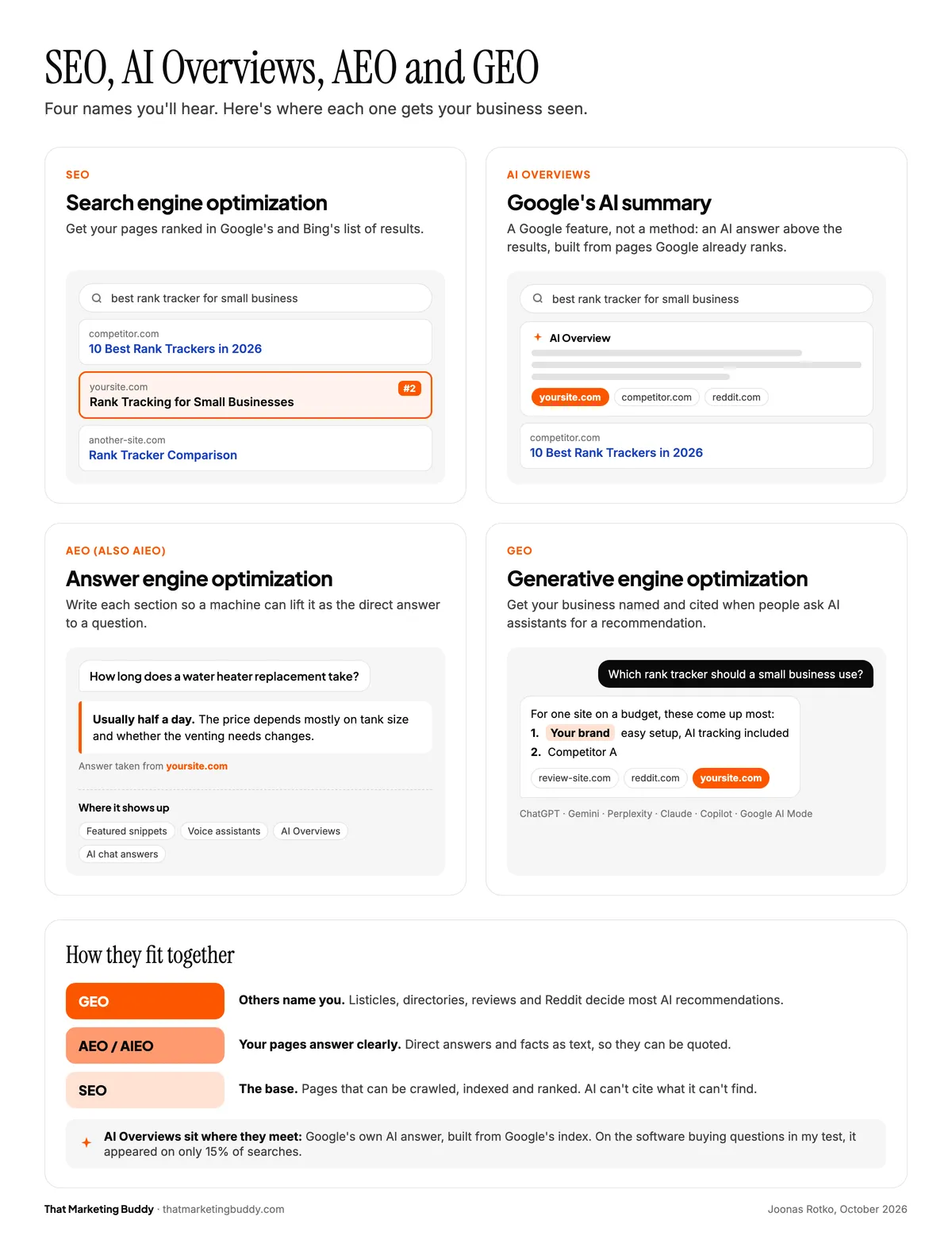
- SEO (search engine optimization): getting your pages ranked in Google's and Bing's list of results. Everything else builds on it, because an AI can't cite a page it can't find.
- AI Overviews: a Google feature, not a method. It's the AI-written summary above Google's results, with links to its sources, built from Google's own index, so the pages that rank are its raw material.
- AEO (answer engine optimization), sometimes called AIEO: writing each section so a machine can lift it as the direct answer, whether in a featured snippet (the answer box Google sometimes shows above the results), a voice assistant or an AI answer.
- GEO: getting named when an assistant recommends options. That depends less on your own pages and more on what comparisons, directories, reviews and discussions say about you.
In practice the work overlaps so much that many people use GEO, AEO and AI search optimization for the same thing. I use GEO in this guide for all of it.
Two terms are worth keeping apart, because tools measure them separately:
- Mention: the AI names your business or product in its answer.
- Citation: the AI links to one of your pages as a source.
You can be mentioned without being cited (the AI read about you somewhere else) and cited without being recommended (the AI used your page as a source for facts about a competitor). For a business, the mention is what wins customers. The citation is what sends visits.
How Big Is AI Search in 2026?
1.2 billion
weekly ChatGPT users
OpenAI, September 2026
2.5 billion
monthly users of Google AI Overviews, and 1 billion for AI Mode
Google I/O, May 2026
95%
of ChatGPT users also use Google
Similarweb, May 2026
Sources: Google's I/O keynote, SE Ranking and Similarweb via Search Engine Journal.
My own site shows the same gap between reading and sending. Over 90 days in mid-2026, AI crawlers fetched pages on That Marketing Buddy more than 1,000 times for every human visit that AI assistants sent. In July 2026, Claude sent about twice as many visits as ChatGPT or Gemini, even though Anthropic's crawler fetched my pages far less often than OpenAI's.
Two lessons from that. Crawler hits aren't traffic, so don't report them as a win. And AI reads far more than it sends, so the payoff of GEO is mostly in being named in the answer, not in the click. Judge it by mentions, citations and the leads that follow, not by visits alone.
Does Ranking on Google Get You Into AI Answers?
Partly, and less than most people expect. I tested it on the questions buyers ask about marketing software.
My test: software buying questions, AI vs Google
For the Software Index on this site, I ask ChatGPT, Gemini and Google AI Mode 120 buyer questions across five categories (SEO suites, technical SEO, AI visibility tools, SEO content autopilots and email marketing) through the SearchApi API. The October 22, 2026 run returned 359 usable answers. For the 60 short questions, such as "best SEO software for small businesses", I also fetched Google's own top 10 results and AI Overview for the same question on October 24, in US English.
The method is written up here.
85%
of the tools AI recommended didn't have their own site in Google's top 10 for the same question
22%
of the sites the assistants cited also ranked in Google's top 10
18%
of tool mentions came with a link to the tool's own website
15%
of these questions showed a Google AI Overview at all
My Software Index: 60 short buyer questions about marketing software, AI answers from October 22, 2026, Google results from October 24, 2026, US English.
The reason is what Google shows for these questions: only about one in six of its top 10 results was a software vendor's own site. The rest were comparison articles, "best tools" lists and guides. The assistants read pages like those and then name the tools directly.
- Google AI Mode34%
- Gemini32%
- ChatGPT8%
- All three22%
60 short buyer questions about marketing software. Google's top 10 = the organic results for the same question, US English.
ChatGPT goes furthest beyond Google: only 8% of the sites it cited were in Google's top 10 for the question. Gemini and Google AI Mode, both Google products, stayed closer to Google's results, at about a third. Google's own AI Overview appeared on only 9 of the 60 questions, and when it did, 88% of the tools it named were also named by the assistants.
What the answers show about where AI gets its picks:
- The assistants named a tracked tool 993 times, and cited that tool's own website only 18% of the time.
- The most-cited sites were not vendors: zapier.com appeared in 48 answers (its "best tools" articles), reddit.com in 41, and semrush.com in 37, more than any other SEO vendor.
- My own site, which reviews exactly these tools, was cited in 2 of the 359 answers. Knowing how GEO works doesn't make you visible overnight.
- ChatGPT36%
- Google AI Mode16%
- Gemini5%
- All three18%
993 tool mentions in 359 answers to 120 buyer questions about marketing software, run through the SearchApi API on October 22, 2026.
One answer shows why the third-party pages matter. Asked for the best SEO software for small businesses, Google AI Mode listed SE Ranking "from $129/mo" and added that it "offers lower-tier starter plans." SE Ranking's own pricing page lists Core at $129/month as its entry plan. The answer cited Zapier, Reddit and agency blogs, not SE Ranking. When the pages AI reads about you are wrong, the AI repeats them.
It covers marketing software only, in US English.
Each question was asked once per assistant in each run, and Google's results were fetched two days after the AI answers.
The assistants were asked through their APIs with web search on. Answers in the apps can differ for a logged-in user.
Treat the percentages as a direction, not a precise rate.
What the test means for you
SEO is still the base, because the pages AI reads have to be findable. But ranking your own site won't by itself put you in the answer. For buying questions, AI leans on the comparison articles, lists and discussions that do rank, and on what they say about you.
Why AI Visibility Is a Share of Answers, Not a Ranking
On Google you can check a search and see that you're in position 4. AI answers don't work that way. Ask the same assistant the same question twice and you can get different businesses and different sources.
- Answers change over time. Of the tools an assistant named for a question on October 4, only 68% were named again for the same question on October 22. Google AI Mode changed most: 60% were repeated.
- Wording changes the answer. In my software test, Botify appeared in 31% of answers to short technical SEO questions and in only 6% when the same need was asked as a detailed small-business scenario.
- Assistants disagree with each other. Of all the tools named for a question, only about a third (34%) were named by all three assistants.
So the useful number is a share: out of many questions, asked many times, how often are you named? One screenshot of ChatGPT recommending you, or leaving you out, tells you almost nothing. A trend over a fixed list of questions, month after month, tells you a lot.
Where Do ChatGPT, Gemini, Perplexity and Google's AI Get Their Answers?
Google AI Overviews
- Where it finds pages
- Google's index (Googlebot)
- What I saw in my tests
- Shown on only 9 of 60 software questions; 88% of the tools it named were also named by the assistants
Google AI Mode
- Where it finds pages
- Google's index (Googlebot)
- What I saw in my tests
- 34% of the sites it cited ranked in Google's top 10; cited a tool's own site for 16% of mentions
ChatGPT
- Where it finds pages
- Its own search (OAI-SearchBot) and live fetches (ChatGPT-User)
- What I saw in my tests
- Most sources per answer (4.7 sites), only 8% of them in Google's top 10; most likely to cite a tool's own site (36%)
Gemini
- Where it finds pages
- Google Search
- What I saw in my tests
- Fewest sources (2.3 sites per answer), 32% of them in Google's top 10; rarely the vendor's own site (5%)
Perplexity
- Where it finds pages
- PerplexityBot and live fetches (Perplexity-User)
- What I saw in my tests
- Not part of my test yet
Microsoft Copilot
- Where it finds pages
- Bing's index (Bingbot)
- What I saw in my tests
- Bing visibility is Copilot visibility; Bing Webmaster Tools reports Copilot citations
Claude
- Where it finds pages
- Its own search (Claude-SearchBot) and live fetches (Claude-User)
- What I saw in my tests
- Smaller audience, but sent my site the most visits of any assistant in July 2026
| Assistant | Where it finds pages | What I saw in my tests |
|---|---|---|
| Google AI Overviews | Google's index (Googlebot) | Shown on only 9 of 60 software questions; 88% of the tools it named were also named by the assistants |
| Google AI Mode | Google's index (Googlebot) | 34% of the sites it cited ranked in Google's top 10; cited a tool's own site for 16% of mentions |
| ChatGPT | Its own search (OAI-SearchBot) and live fetches (ChatGPT-User) | Most sources per answer (4.7 sites), only 8% of them in Google's top 10; most likely to cite a tool's own site (36%) |
| Gemini | Google Search | Fewest sources (2.3 sites per answer), 32% of them in Google's top 10; rarely the vendor's own site (5%) |
| Perplexity | PerplexityBot and live fetches (Perplexity-User) | Not part of my test yet |
| Microsoft Copilot | Bing's index (Bingbot) | Bing visibility is Copilot visibility; Bing Webmaster Tools reports Copilot citations |
| Claude | Its own search (Claude-SearchBot) and live fetches (Claude-User) | Smaller audience, but sent my site the most visits of any assistant in July 2026 |
Crawler names from each company's own documentation. Test numbers from my software test above.
How to Rank in AI Search: 8 Steps That Help
1. Let the AI crawlers in
An assistant can't cite a page its crawler can't fetch. Check your robots.txt and your CDN (the network that serves your site, such as Cloudflare) or firewall settings. Cloudflare started blocking AI crawlers by default on new sites in 2025, so a site can block them without anyone deciding to.
Know which bots do what, because search bots and training bots are separate:
- OpenAI: OAI-SearchBot (ChatGPT search) and ChatGPT-User (live fetches) affect visibility. GPTBot collects training data. OpenAI documents all three.
- Anthropic: Claude-SearchBot and Claude-User affect visibility. ClaudeBot collects training data.
- Perplexity: PerplexityBot and Perplexity-User.
- Google: Googlebot feeds Search, AI Overviews and AI Mode. Google-Extended controls use in Gemini apps and model training, not Search.
- Microsoft: Bingbot feeds Bing and Copilot.
You can block the training bots and keep the search bots if you don't want your content used for training. I allow all of them on this site.
Tools for this step: open yourdomain.com/robots.txt in a browser to read the rules, and Search Console's robots.txt report shows the version Google last fetched and any errors in it. Both are free. Bot blocking at the CDN or firewall level is set in that provider's dashboard, not in robots.txt.
2. Rank in Google and Bing first
Google's AI features are built on Google's index, Copilot on Bing's, and the other assistants search the web too. A page nobody can find in search rarely shows up in an AI answer. My SEO guide for small businesses covers the base. Don't skip Bing: set up Bing Webmaster Tools and use IndexNow, a free protocol, to tell Bing about new and changed pages right away.
3. Answer the question in the first sentence
AI systems pull passages, not whole pages. Put the direct answer in the first one or two sentences under each heading, then the detail. Write headings as the questions people ask ("How much does X cost?", not "Pricing"), and make each paragraph make sense on its own, without "as mentioned above."
Here's the difference in practice, for a page about replacing a water heater:
- Weak opening: "When it comes to water heaters, there are many things to consider, and in this article we'll explore them." There's nothing in it an assistant could quote.
- Strong opening: "Replacing a tank water heater usually takes half a day, and the price depends mostly on tank size and whether the venting needs changes." That's a complete answer on its own, and it's also what a person skimming the page wants.
This works in plain Google too. In my Search Console data from August and September 2026, Google linked straight to individual passages of my Semrush API pricing post at around position 5. The only two pages on my site that earned those passage links both compare prices across vendors in plain, self-contained paragraphs.
4. Put facts on the page as text
AI repeats what's written. Prices, plan limits, specs, service areas, opening hours and definitions belong on the page as text, not only in images, PDFs or behind a "contact us" button. If you don't publish a fact, the AI takes it from someone who did, and that someone may be wrong, as in my software test, where Google AI Mode credited SE Ranking with cheaper plans that don't exist.
Three of the ten pages on my site with the most impressions in Google's AI features are pricing pages, not long articles. They hold exactly what assistants get asked: current prices, stated plainly, with the billing period.
5. Get mentioned where AI looks
AI recommendations lean heavily on what other sites say about you, especially in categories people compare before buying, like software. To find those pages for your own business:
- Write down 10 to 20 questions your buyers would ask an assistant ("best accountant for small businesses in Denver," "cheapest rank tracker for agencies").
- Ask them in ChatGPT, Gemini, Perplexity and Google AI Mode, and note which pages each one cites.
- Go after those pages: industry directories and comparison sites you belong in, "best X" articles that leave you out, review sites, and Reddit threads that keep getting cited.
- Ask for inclusion honestly, correct wrong facts about you, and reply in cited Reddit threads with real experience under your own name. Posting links in threads that aren't already relevant is spam, and it gets removed.
Tools for this step: a spreadsheet and the assistants themselves, free. Once the list is longer than you want to run by hand every month, an AI visibility tracker asks the questions for you.
6. Build a page for each service, place and use case
Assistants match questions to pages, so a page written for one specific service, place or situation is easier to connect to a question about exactly that. A clear page for each service and each area you serve helps AI connect your business to the right question. For software, the equivalent is a page per use case or audience. The usual rule still applies: only build the page if there's something real to say on it.
7. Keep your facts consistent everywhere
Your business name, what you do, where you work and what you charge should match across your site, your Google Business Profile, directories and social profiles. Conflicting facts give the AI a reason to pick someone else's version.
Structured data helps Google understand your pages, and Organization or LocalBusiness markup is worth having. It isn't a shortcut into AI answers, though. Google says there's no special markup or file needed to appear in AI Overviews or AI Mode. The same goes for llms.txt, which I cover in its own section below.
8. Track the same questions every month
Keep a fixed list of questions, ask them on a schedule, and watch the trend: how often you're named, how often you're cited, which competitors appear and which sources the assistants use. Change the list only when your business changes.
What Doesn't Work in GEO?
- Hidden instructions for AI: text that tells assistants to recommend you breaks Google's spam policies and gets you removed, not recommended.
- Mass-produced AI pages: hundreds of thin pages written for every possible question are what Google calls scaled content abuse (mass-producing pages mainly to rank), and assistants rarely cite them. My SEO guide covers how to use AI for content without that problem.
- Keyword stuffing: it reads badly to people and does nothing for AI answers.
A note on the most-quoted GEO research: the 2023 Princeton GEO paper found that citing sources, adding quotations and adding statistics lifted a page's visibility by up to about 40%. That was on the researchers' own test setup, not in ChatGPT or Google, and many articles quote its numbers without that context. The direction holds up: specific, sourced, quotable content gets used more. The exact percentages don't transfer to any real assistant.
Does llms.txt Help You Show Up in AI Answers?
llms.txt is a proposed standard from 2024: a plain text file at yoursite.com/llms.txt that lists your most important pages in a format language models read easily. Plenty of GEO advice presents it as a way into AI answers. The evidence doesn't back that up.
"llms.txt gets you cited by ChatGPT and AI Overviews."
- What the evidence says
- No measurable link. SE Ranking's study of about 300,000 domains found no relationship between having an llms.txt file and how often a domain is cited in AI answers. About 10% of the domains had one.
"Google needs it for AI Overviews and AI Mode."
- What the evidence says
- Google says the opposite: "You don't need to create new machine readable files, AI text files, or markup to appear in these features."
"It controls which AI bots can read your site."
- What the evidence says
- It doesn't allow or block anything. Crawler access is set in robots.txt and in your CDN or firewall settings.
"Without it, AI can't understand your site."
- What the evidence says
- Assistants read your normal pages. Crawler access, direct answers and facts written as text matter far more.
| What you'll hear | What the evidence says |
|---|---|
| "llms.txt gets you cited by ChatGPT and AI Overviews." | No measurable link. SE Ranking's study of about 300,000 domains found no relationship between having an llms.txt file and how often a domain is cited in AI answers. About 10% of the domains had one. |
| "Google needs it for AI Overviews and AI Mode." | Google says the opposite: "You don't need to create new machine readable files, AI text files, or markup to appear in these features." |
| "It controls which AI bots can read your site." | It doesn't allow or block anything. Crawler access is set in robots.txt and in your CDN or firewall settings. |
| "Without it, AI can't understand your site." | Assistants read your normal pages. Crawler access, direct answers and facts written as text matter far more. |
Sources: SE Ranking's llms.txt study and Google's AI features documentation, both linked below.
Where it can make sense: software documentation that developers feed to coding assistants, where a clean list of pages saves them time. I keep an llms.txt on this site because it takes minutes and costs nothing, but I don't count on it for visibility, and neither should you. If someone sells you llms.txt as a GEO service, skip it. Read SE Ranking's study and Google's AI features documentation for the details.
How Do You Measure AI Visibility?
Free ways to start
- Google Search Console: since June 2026, Generative AI reports show the impressions your pages earn in AI Overviews and AI Mode, with data from May 2026. They show impressions only, with no clicks or queries yet.
- Bing Webmaster Tools: the AI Performance report shows how often your site is cited in Copilot and Bing's AI answers, and for which searches.
- Your analytics: referral visits from chatgpt.com, gemini.google.com, perplexity.ai, claude.ai and copilot.microsoft.com, and the leads they bring.
- A monthly spreadsheet: your fixed question list, asked by hand in each assistant. Slow, but it costs nothing.
If you're comfortable with code, APIs such as SearchApi and DataForSEO can ask the questions for you and store the answers. I built both of my tests that way.
Paid AI visibility trackers
Trackers ask your questions on a schedule and report mentions, citations, competitors and sources. Entry prices on monthly billing, checked against the vendors' pricing pages in October 2026:
Otterly.AI Lite
- Price
- $29/month
- Prompts
- 15
- Assistants covered
- ChatGPT, AI Overviews, Perplexity, Copilot (AI Mode and Gemini cost extra)
LLM Pulse Starter
- Price
- $58/month
- Prompts
- 50
- Assistants covered
- 5, checked weekly
Peec AI Starter
- Price
- $95/month ($80 billed annually)
- Prompts
- 50
- Assistants covered
- 3 of your choice
Promptwatch Essential
- Price
- $95/month
- Prompts
- 50
- Assistants covered
- 4, checked daily
SE Ranking Core (SEO suite)
- Price
- $129/month
- Prompts
- 100
- Assistants covered
- 5
Semrush Starter (SEO suite)
- Price
- $199/month
- Prompts
- 50
- Assistants covered
- ChatGPT, Perplexity, Gemini and more
| Tool and plan | Price | Prompts | Assistants covered |
|---|---|---|---|
| Otterly.AI Lite | $29/month | 15 | ChatGPT, AI Overviews, Perplexity, Copilot (AI Mode and Gemini cost extra) |
| LLM Pulse Starter | $58/month | 50 | 5, checked weekly |
| Peec AI Starter | $95/month ($80 billed annually) | 50 | 3 of your choice |
| Promptwatch Essential | $95/month | 50 | 4, checked daily |
| SE Ranking Core (SEO suite) | $129/month | 100 | 5 |
| Semrush Starter (SEO suite) | $199/month | 50 | ChatGPT, Perplexity, Gemini and more |
Prices from each vendor's pricing page, checked October 13 to 15, 2026. A prompt is one question the tracker asks the assistants on a schedule.
Full reviews: Otterly.AI, LLM Pulse, Peec AI, Promptwatch, SE Ranking and Semrush.
Check accuracy, not just mentions
Being named isn't the whole job. An answer can name you and still get your prices, plans or services wrong, and a wrong price in an AI answer can cost you a customer you never hear from.
When you run your question list, log three things for each answer: whether you're named, which pages are cited, and whether what it says about you is correct (prices, plan names, what you do, where you work). When something is wrong, fix it at the source: your own page first, then the third-party page the answer cited.
Which setup fits you?
- Solo owner or one small site: the free reports and a hand-run list of 10 to 20 questions once a month. When running it by hand gets slow, Otterly.AI Lite's 15 prompts fit a short list; for 20 or more questions, look at the 50-prompt plans such as LLM Pulse Starter. My AI search visibility tools roundup compares them in detail.
- Small marketing team: a 50-prompt plan with frequent checks, such as Promptwatch Essential, or the AI tracking inside an SEO suite you already pay for. SE Ranking Core includes 100 prompts.
- Agency: look at pricing per client brand. Peec AI's agency plans start at $245/month for 3 brands, and Promptwatch's start at $199/month with unlimited brands. My GEO tools for agencies roundup compares them.
A 30-Day GEO Plan
If you do one thing a week, this is the order I'd do it in:
Week 1: Access
- What to do
- Check that robots.txt and your firewall let the AI search bots in. Set up Search Console and Bing Webmaster Tools, and confirm your important pages are indexed.
- Tools (free unless noted)
- robots.txt report in Search Console, Bing Webmaster Tools
Week 2: Baseline
- What to do
- Write 10 to 20 questions your buyers would ask. Run them in ChatGPT, Gemini, Perplexity and Google AI Mode. Log who's named, which pages are cited and whether your facts are right.
- Tools (free unless noted)
- A spreadsheet and the assistants themselves
Week 3: Rewrite
- What to do
- Take your five most important pages. Put the direct answer under each heading, prices and facts as text, and one page per service or use case.
- Tools (free unless noted)
- Search Console Performance report
Week 4: Sources
- What to do
- Pick three to five pages the assistants cited in your baseline and work out an honest way onto each: a listing, a review, a correction, a useful reply.
- Tools (free unless noted)
- Your baseline spreadsheet
Every month
- What to do
- Rerun the same questions and compare the share of answers you're named in. Check Search Console's and Bing's AI reports.
- Tools (free unless noted)
- A tracker, once the manual run gets slow (from $29/month)
| Week | What to do | Tools (free unless noted) |
|---|---|---|
| Week 1: Access | Check that robots.txt and your firewall let the AI search bots in. Set up Search Console and Bing Webmaster Tools, and confirm your important pages are indexed. | robots.txt report in Search Console, Bing Webmaster Tools |
| Week 2: Baseline | Write 10 to 20 questions your buyers would ask. Run them in ChatGPT, Gemini, Perplexity and Google AI Mode. Log who's named, which pages are cited and whether your facts are right. | A spreadsheet and the assistants themselves |
| Week 3: Rewrite | Take your five most important pages. Put the direct answer under each heading, prices and facts as text, and one page per service or use case. | Search Console Performance report |
| Week 4: Sources | Pick three to five pages the assistants cited in your baseline and work out an honest way onto each: a listing, a review, a correction, a useful reply. | Your baseline spreadsheet |
| Every month | Rerun the same questions and compare the share of answers you're named in. Check Search Console's and Bing's AI reports. | A tracker, once the manual run gets slow (from $29/month) |
Frequently Asked Questions
Is SEO dead because of AI search?
No. Google Search revenue grew 17% year over year in Q2 2026, 95% of ChatGPT users also use Google, and AI assistants pull many of their sources from search indexes. SEO is the base GEO builds on.
How do I know if ChatGPT mentions my business?
Ask it the questions your buyers would ask, with web search on, several times, and note whether you're named and which pages it cites. To do this at scale, use an AI visibility tracker such as Otterly.AI, Peec AI or Promptwatch, or the AI tracking in an SEO suite like SE Ranking.
Does blocking AI crawlers hurt my visibility?
Blocking search bots such as OAI-SearchBot, Claude-SearchBot or PerplexityBot stops those assistants from fetching and citing your pages. Blocking training bots such as GPTBot or ClaudeBot doesn't affect search visibility. Blocking Google-Extended doesn't remove you from AI Overviews.
Do schema markup or llms.txt help with AI search?
Structured data helps Google understand your pages, but Google says no special markup or file is needed for its AI features, and it doesn't use llms.txt. Neither replaces clear content and third-party mentions.
How long does GEO take to work?
Fixing crawler access and page structure can show up within weeks, since assistants fetch pages live. Getting mentioned on the third-party pages AI relies on takes months, like link building. Track the same questions monthly to see the trend.
Sources
- How the Software Index measures AI visibility (That Marketing Buddy)
- AI features and your website (Google Search Central)
- Overview of OpenAI crawlers (OpenAI)
- Google I/O 2026 keynote (Google)
- ChatGPT referral traffic, May 2026 (SE Ranking)
- Google and ChatGPT audience overlap (Search Engine Journal, Similarweb data)
- Bing AI Performance report and Copilot citations (Search Influence)
- GEO: Generative Engine Optimization (Aggarwal et al., arXiv)
- Google spam policies (Google Search Central)
Tools in this guide


Read next

Joonas Rotko
SEO & GEO specialist, founder of That Marketing Buddy
I'm a Finnish SEO and GEO professional with 11+ years in digital marketing, including years as a co-owner of a digital marketing agency. On That Marketing Buddy I test and compare SEO and AI-visibility software for entrepreneurs, marketing professionals and agencies.