
Want a free personalized recommendation for your software stack?Get yours
That Marketing Buddy
Home/Best/

26 Best AI Visibility Tools in 2026 (Track and Improve Your Brand in AI Search)

PromptWatch
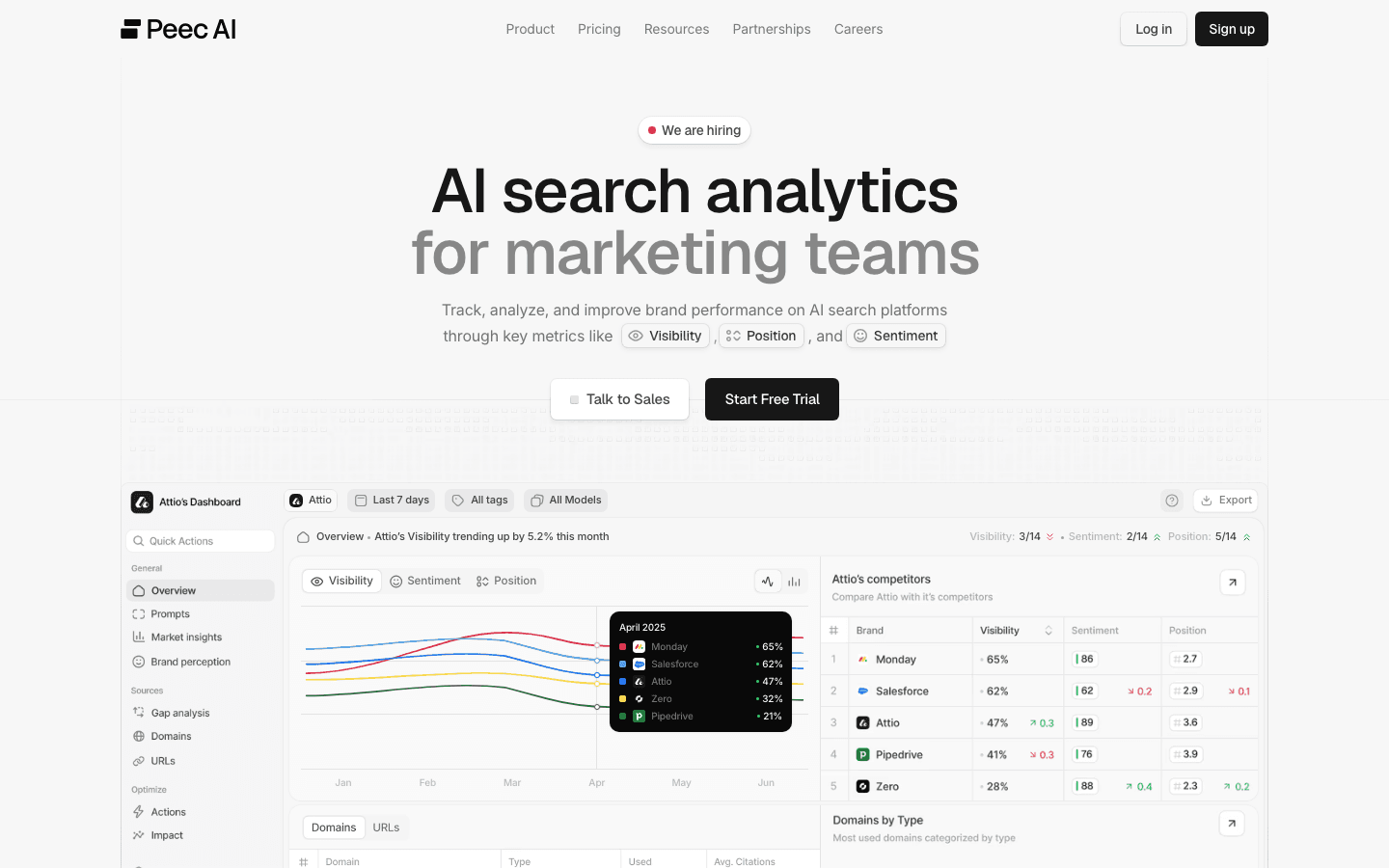
Peec AI
LLM Pulse
Otterly AI
Profound
Temso AI
SE Visible
LLMrefs
GenRank
Finseo
26 tools ranked9 tracked in database1 with free plansUpdated Jul 14, 2026
Updated regularly
Data from Buddy's database

AI visibility tools, also called GEO tools (for generative engine optimization), track how often your brand shows up in ChatGPT, Perplexity, Google AI Overviews, Gemini and Claude answers. Most of them do one thing: tracking. You hand them the prompts you want to win, and they report which answers mention you and which sources got cited. That is genuinely useful. It is also only half the job.

AI search has gone from niche to billions of queries a month, and the bigger crowd is only just arriving, still working out how to even measure it. Measurement is where everyone starts. In my opinion it should not be where you stop.

The real question is not "am I cited?" but "how do I get cited more often, and how do I turn those citations into actual visits?" That means improving the content these engines pull from, and writing hooks strong enough to get a person out of the chat window and onto your site. Tracking shows you where you stand. It does not move you forward.

You do need to measure before you know what to fix, so every tool here earns its place. I ranked this list with that bias: I lean toward tools that help you act on the data, not only watch it, and I weigh how well each one fits an AI-native workflow (API and MCP support) so you can take what a tool surfaces and act on it straight away in Claude or ChatGPT, instead of stopping at another dashboard.

This page may contain affiliate links.

Some links on this page are affiliate links, meaning I may earn a commission if you sign up (at no extra cost to you). This never influences my ratings or recommendations.

Audience

Who is this guide for?

  • Digital marketers who want to track brand mentions in AI-generated answers
  • SEO professionals adapting their strategy for AI search engines
  • Marketing agencies managing AI visibility for multiple clients
  • Brand managers monitoring how AI platforms describe their products
  • Content strategists optimizing for both traditional and AI search

The AI visibility stack: measure, optimize, then execute

It helps to see these tools as a stack, not a single category. AI visibility work runs along a ladder, from simply watching to actively changing what the AI answers say. Most tools on this page live on the first rung. Knowing where a tool sits saves you from buying a tracker when you needed an optimizer, or the other way around.

1. Track and measure. The starting point: monitor how often your brand is mentioned or cited across ChatGPT, Google AI Overviews, Perplexity and Gemini, and watch your competitors. Every tool here does at least this.

2. Optimize your content. Once you know the gaps, you rewrite and structure content so the engines pull from you. That is a content-optimization job, and I cover those tools in my best AI content and SEO tools roundup.

3. Add content on autopilot. The next rung up: tools that plan, write and publish content on their own to build topical coverage at scale. I break those down in my best AI SEO content autopilots guide.

4. Add backlinks on autopilot. The newest and least mature rung: tools that build or exchange links automatically to strengthen the pages AI engines cite. Promising, but automated link building carries real Google-penalty risk, so tread carefully.

A handful of tools now span several rungs at once. I have grouped those under full-stack and agentic GEO platforms below, because a tool that both measures and acts is a genuinely different purchase from a pure tracker.

Understanding AI Search Visibility

AI search visibility measures how often and how prominently your brand appears in AI-generated answers. Unlike traditional SEO, where you optimize for Google's organic results, AI search visibility is about being referenced, cited, or recommended when someone asks an AI assistant a question.

The main AI platforms to track include ChatGPT (by OpenAI), Perplexity, Google AI Overviews and AI Mode, Gemini, Claude (by Anthropic), Microsoft Copilot, and newer players like DeepSeek and Grok. Each platform has different ways of selecting and citing sources, which is why coverage across multiple platforms matters.

There are three related disciplines to understand. SEO (Search Engine Optimization) focuses on traditional search rankings. AIEO (AI Engine Optimization) is about optimizing your content specifically to be selected and cited by AI models. GEO (Generative Engine Optimization) takes a broader approach, combining SEO and AIEO principles to improve visibility across both traditional and AI-powered search.

These tools work by running prompts across AI platforms, then measuring whether your brand appears in the responses, how it's described, what sources are cited, and how you compare to competitors. Some focus purely on tracking, while others also provide optimization recommendations.

Quick verdict

PromptWatch is my top pick: it pairs solid AI-visibility tracking with the strongest developer surface in this category, an official MCP server and REST API included on every plan down to the free tier, so you can prove GEO value before spending a cent. Peec AI covers the most platforms if you need the broadest monitoring.

SE Visible is the one to beat if you already run SE Ranking and want AI visibility sitting next to your organic data. For budget-conscious marketers, Otterly AI delivers the essentials without breaking the bank.

How to check your AI visibility (before you buy anything)

If you just want to check where you stand right now, the manual version is simple. Write down the 20 to 50 questions a buyer would actually ask an AI assistant in your category. Run them through ChatGPT, Google AI Overviews, Perplexity and Gemini. Note three things: how often you are mentioned, whether you are cited as a source with a link, and which competitors show up instead of you.

That gives you a rough baseline in an afternoon. The tools below automate exactly this: they run large prompt sets on a schedule, track your mention rate and share of voice over time, and flag which sources the engines pull from so you know what to improve. If you manage more than a handful of prompts, or you want to watch the trend rather than a single snapshot, that automation is what you are paying for.

For a one-off gap analysis, look for a tool with a free tier or pay-as-you-go pricing so you can audit once without committing to a monthly plan.

Overview

Quick comparison

#ToolPrice
1
PromptWatchTop Pick
$95/mo
2$95/mo
3€49/mo
4$29/mo
5$99/mo (ChatGPT only)
Show all 26 tools
6$29/mo
7$99/mo
8Free plan available
9From $69/mo
10Custom pricing
11From $59/mo
12$295/mo
13$29/mo
14From $50/mo
15From $20/mo
16$29/mo
17From $139/mo
18€89/mo
19$49/mo
20From $3,000/mo
21$250/mo
22Custom pricing
23$100/mo (Growth) to $500/mo (Scale); 14-day free trial
24Free tier; pay-as-you-go at $0.10 per conversation; Enterprise custom
25From $399/mo
26$79/mo

Rankings

My Top Picks

Showing 26 of 26 tools
#1
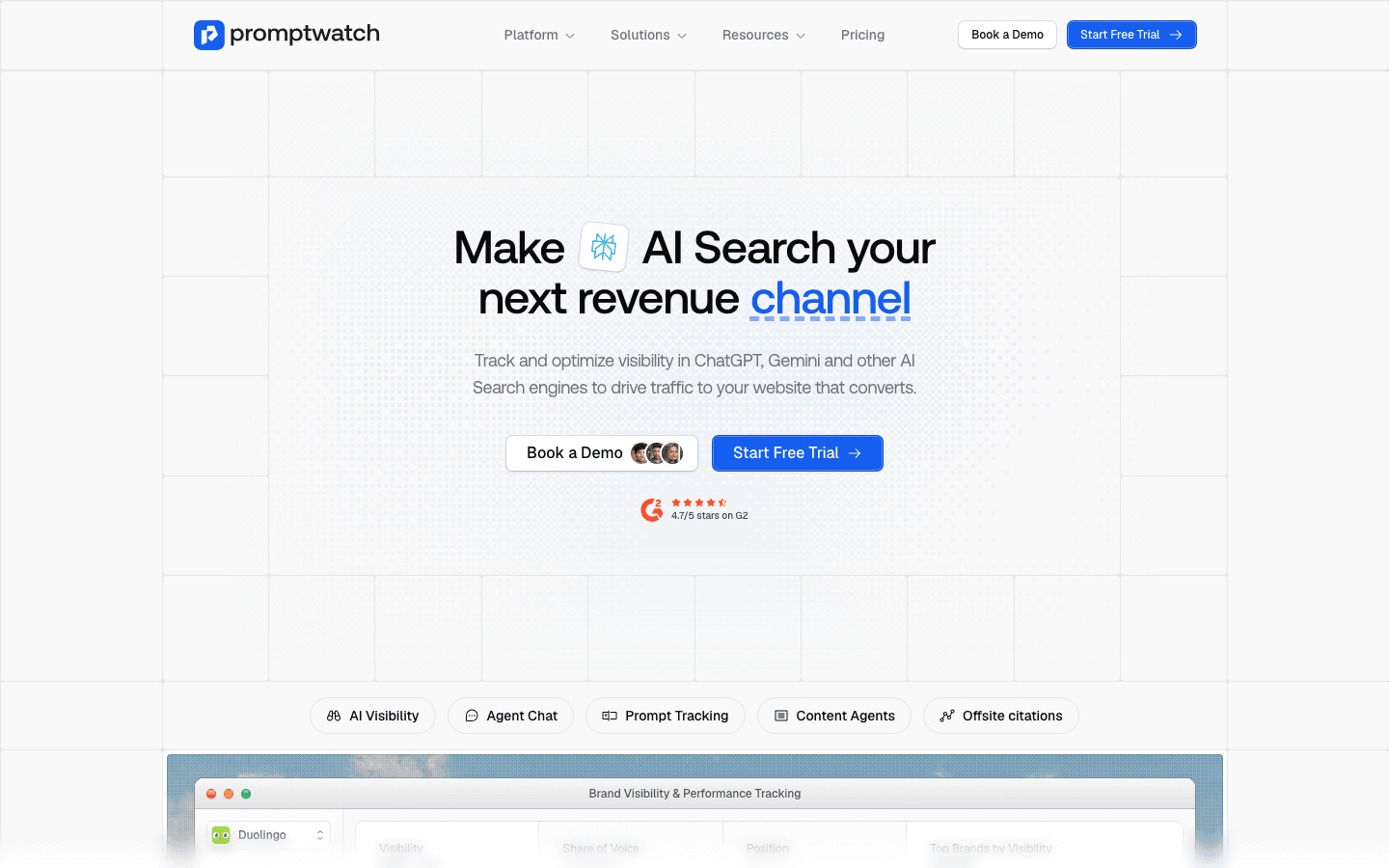
PromptWatch

PromptWatch

⭐ Top Pick
Best for: Developer and agent-driven teams that want AI visibility through a full MCP server and REST API on every plan, including a free tier

AI visibility and GEO platform with a free tier and a 59-tool MCP server plus REST API on every plan.

Why I like it:PromptWatch pairs real AI-visibility tracking with the best developer surface I have seen in this category: an official MCP server with 59 tools including writes, and a documented REST API, both included on every plan down to the free tier. If you want to prove GEO value before spending anything, or you are building an agent-driven marketing stack, start here.

Key Features

Free tier plus $95-$579/mo paid plans8+ AI models tracked from real interfacesAI crawler-log and visitor analyticsContent-gap analysis and AEO content agents59-tool MCP server with OAuth + writesREST API with OpenAPI spec, on every plan
AI-stack fit9/10
MCP
API
Zapier
Make

Best agent stack in the GEO category: official remote MCP server (server.promptwatch.com/mcp, streamable HTTP) with OAuth browser-consent auth or API key, 59 tools including write operations (create/update/delete prompts, monitors, brands, personas, generate content). REST API v2 with ~70 endpoints, OpenAPI spec, Postman collection, published three-window rate limits. MCP and API access on every plan including the free Explore tier. llms.txt + markdown docs + MCP recipes and skills guides.

Pros

  • Only free tier in the category, MCP and API included on it
  • Crawler-log evidence most rivals cannot show
  • Best agent stack (write-capable MCP tools)
  • OpenAPI spec and Postman collection

Cons

  • Young company (founded April 2025)
  • No CMS auto-publishing for content
  • Steep $95-to-$245 tier jump
PromptWatch homepage
#2
Peec AI

Peec AI

7.8/10
Best for: Marketing teams wanting thorough AI visibility tracking across the most platforms

AI search visibility analytics tracking your brand across ChatGPT, Perplexity and Gemini, with MCP on every paid plan.

Why I like it:Peec AI is a thorough AI visibility tracker that monitors your brand mentions across ChatGPT, Claude, Perplexity, and other major AI platforms. The standout strength is the breadth of coverage - it tracks more AI platforms than most competitors in this space. Marketing teams at mid-size to large companies get the most value because they need visibility across the full AI landscape, not just one or two platforms. The platform provides detailed analytics on how often your brand appears in AI responses and the context of those mentions. The main limitation is that thorough coverage comes with a higher price point than single-platform trackers.

Key Features

Daily refreshWidest LLM coverageCompetitor benchmarkingCitation analysisSentiment trackingAuto-suggested prompts
AI-stack fit7/10
MCP
API
Zapier
Make

Strong agent fit for a young product. Peec ships an official MCP server at api.peec.ai/mcp on every paid plan from $95, not just Enterprise, so agents can connect from Claude, Cursor, or n8n without an enterprise contract. It is read-only at launch, so agents pull and reason over your AI-visibility data but cannot write back. The REST API for full programmatic access is reserved for Enterprise, which is the main gap.

Pros

  • Covers more AI platforms than any competitor (incl. DeepSeek, Grok, Llama)
  • Daily data refresh on all plans
  • Smart prompt suggestions from your site content
  • Strong competitor benchmarking

Cons

  • Pricing in EUR may complicate budgeting for US teams
  • Starter plan limited to 25 prompts
  • Relatively new player in the market
Peec AI homepage screenshot
#3
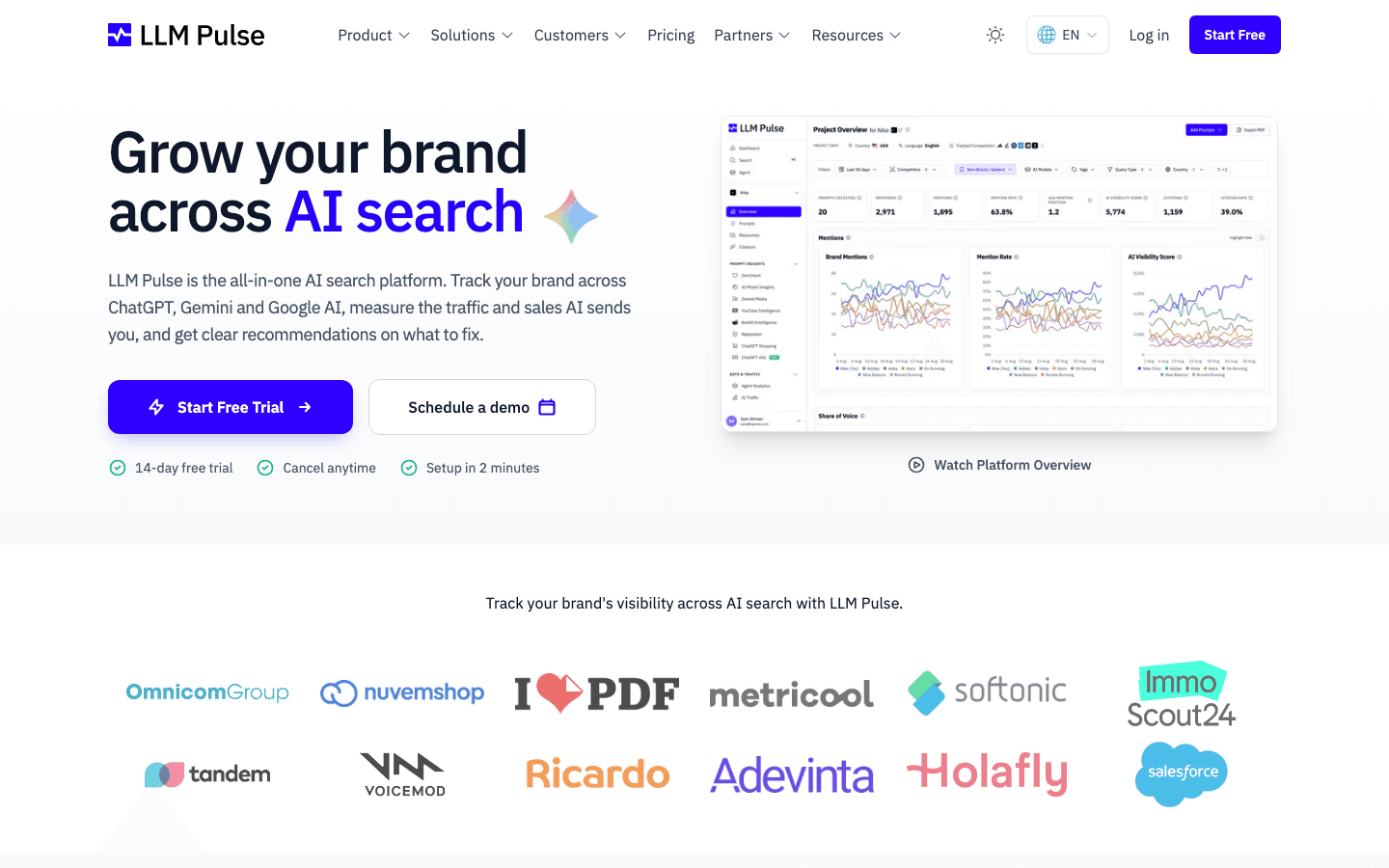
LLM Pulse

LLM Pulse

Best for Agent Access
Best for: AI-native teams that want visibility data inside Claude, Cursor or their own stack

AI search visibility tracker with a hosted MCP server and REST API, monitoring your brand across 10+ AI models.

Why I like it:Most AI-visibility tools treat the API as an afterthought. LLM Pulse ships a hosted MCP server with 45+ tools on every plan, even the €49 Starter, authenticated over OAuth with no API key, so an agent in Claude or Cursor can read your visibility data and act on it directly. It tracks more models than most rivals here (10+, including ChatGPT, Gemini, Perplexity and Google AI Overviews) and adds a REST API from the Scale tier. No free plan and euro-first pricing are the trade-offs, but for agent access this is the strongest pick in the category.

Key Features

Hosted MCP server (45+ tools, OAuth) on every planTracks 10+ AI models incl. ChatGPT, Gemini, Perplexity and Google AI OverviewsREST API (Bearer, 300 req/min) from the Scale tierGEO Writer, sentiment, share of voice, citation analysisWhite label and unlimited team seats for agencies
AI-stack fit
MCP
API
Zapier
Make

Pros

  • Native MCP server on every plan, even the €49 Starter
  • Broad model coverage (10+ engines tracked)
  • Public, self-serve pricing with a 14-day trial

Cons

  • No free-forever plan (14-day trial only)
  • Euro-first pricing with tax added on top
  • REST API gated to the €299 Scale tier
LLM Pulse homepage screenshot
#4
Otterly AI

Otterly AI

Best Value
7.7/10
Best for: Small businesses and solo marketers who want solid AI tracking without a big budget

AI search visibility tracker across ChatGPT, Perplexity and Copilot, with a live MCP server and API.

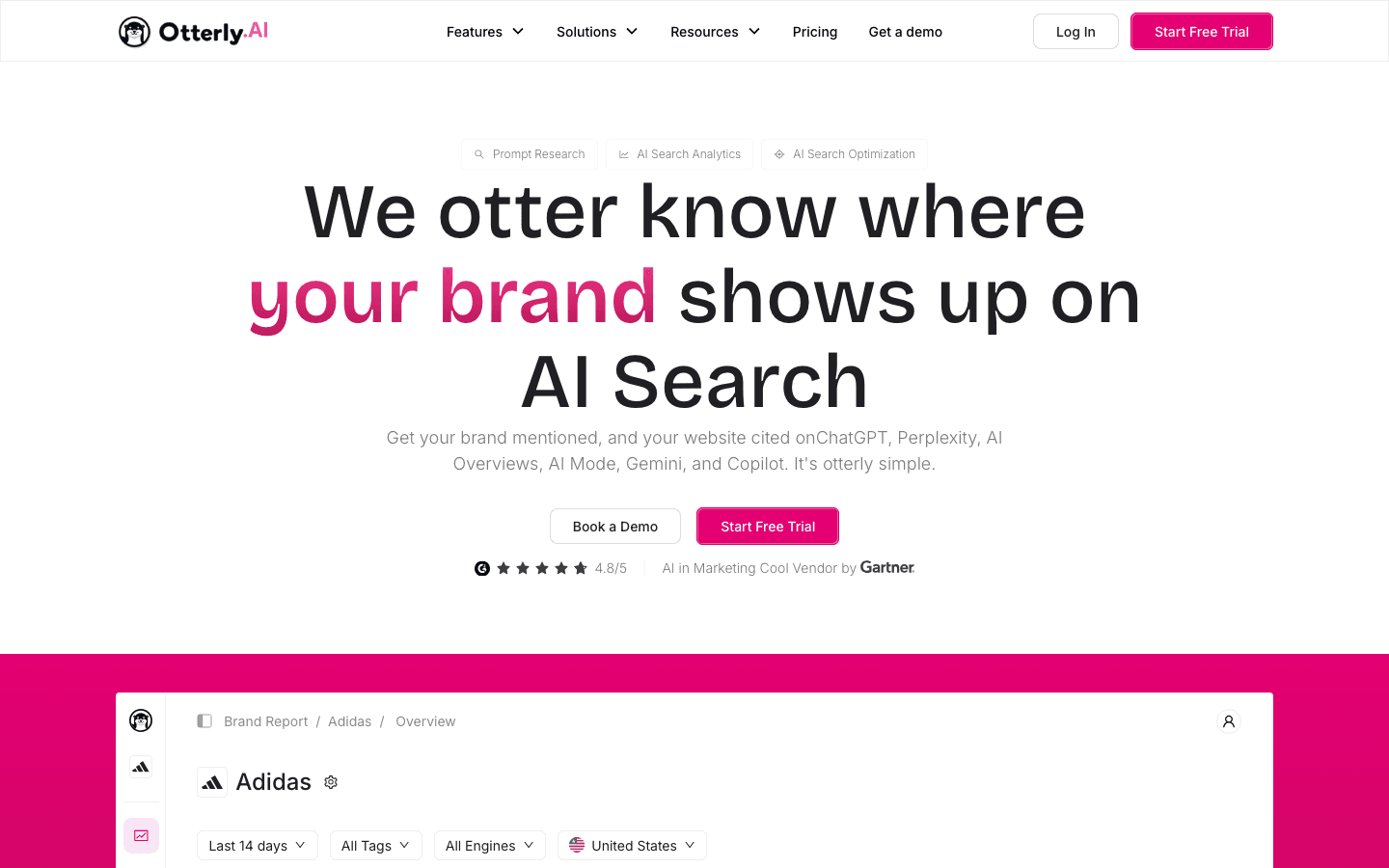
Why I like it:Otterly AI is a budget-friendly AI visibility tracker designed for smaller teams who want solid monitoring without enterprise pricing. The standout strength is the balance between essential features and affordability - you get the core tracking capabilities without paying for enterprise bells and whistles. Small businesses and solo marketers benefit most because they can start tracking AI mentions without a major budget commitment. The platform tracks brand mentions across key AI platforms and provides basic analytics on mention frequency and sentiment. The limitation is fewer advanced features compared to enterprise-focused tools, but that's exactly what keeps the price accessible.

Key Features

GEO URL auditsBrand mention trackingCitation analysisUnlimited team membersCompetitor monitoring14-day free trial
AI-stack fit7/10
MCP
API
Zapier
Make

Strong agent fit at a budget price. Otterly runs a live official MCP server at data.otterly.ai/mcp, authenticated with OAuth 2.0 (no API keys), exposing roughly 20 tools across workspaces, brand reports, GEO audits, and write actions, so agents can both read and act on your AI-visibility data. It pairs that with a public REST API (2,000 requests a month on Standard, 5,000 on Premium), an official Claude Skill, and a 101-workflow marketplace. The main gaps: the $29 Lite tier has no API or MCP, and there are no language SDKs, so it sits level with Peec and below Profound's broader enterprise stack.

Pros

  • Affordable entry point at $29/mo
  • GEO optimization audits included
  • Unlimited team members on all plans
  • 14-day free trial available

Cons

  • Lite plan limited to 15 prompts
  • Fewer AI platforms than Peec AI
  • No DeepSeek or Grok coverage
Otterly AI homepage screenshot
#5
Profound

Profound

G2 Leader
8.4/10
Best for: Mid-size to enterprise teams that need the deepest AI visibility data available

AI search visibility platform tracking how your brand shows up across ChatGPT, Perplexity and other AI engines.

Why I like it:Profound is an AI visibility platform that claims to offer the deepest data analysis available in this space. The standout strength is the granular level of insight - it goes beyond basic mention tracking to analyze context, sentiment, and competitive positioning in AI responses. Mid-size to enterprise teams get the most value because they need advanced analytics to inform strategic decisions about AI optimization. The platform can track nuanced metrics like how your brand is positioned relative to competitors in AI-generated responses. The limitation is that this depth of analysis comes with complexity that might overwhelm smaller teams who just want basic tracking.

Key Features

400M+ prompt dataset10+ AI enginesSOC 2 Type II certifiedG2 AEO LeaderCompetitive intelligenceCustom reporting
AI-stack fit8/10
MCP
API
Zapier
Make

Strong agent-fit. Profound has an official MCP server and documented public APIs with Node and Python SDKs, enabling seamless integration with Claude and ChatGPT workflows. The main limitation is lack of OpenAPI specs and structured outputs, which can require additional parsing work in agentic chains.

Pros

  • Deepest prompt dataset in the market
  • Covers 10+ AI engines
  • SOC 2 Type II certified for enterprise compliance
  • G2 Leader with 92/100 AEO score

Cons

  • Starting at $499/mo puts it out of reach for small teams
  • Enterprise-focused interface can feel complex
  • No free trial publicly listed
Profound homepage screenshot
#6
Temso AI

Temso AI

Best for Closed-Loop Execution
7/10
Best for: Teams that want AI-search visibility turned into executed work, not just dashboards

Closed-loop AEO platform that tracks AI search visibility and runs an AI agent to act on it, with a REST API.

Why I like it:Most tools in this category stop at telling you that ChatGPT ignores your brand. Temso AI closes the loop: an AI agent drafts the content, outreach and on-page fixes and executes them within guardrails you set. It now backs that with a real agent stack too, a live OAuth MCP server (read and write) that connects straight into Claude, Cursor and ChatGPT, plus a documented REST API. The honest catch is access: the agent and REST API both unlock at $199 Growth, the MCP is on every plan and now read and write. But if you want AI-search visibility that acts on itself, Temso AI is the clearest pick here.

Key Features

AI agent that executes content, outreach and on-page fixesLive OAuth MCP server (Claude, Cursor, ChatGPT)REST API (OpenAPI, Bearer keys, from the Growth tier)Tracks 8 engines incl. Claude, Grok, MistralLooker Studio integration
AI-stack fit
MCP
API
Zapier
Make

Pros

  • Closed loop: tracks AND acts via an execution agent
  • Live read+write MCP server plus a documented REST API
  • Widest engine coverage incl. Claude, Grok and Mistral

Cons

  • Useful tiers start at $199 Growth (agent + REST API)
  • Actions capped on lower tiers (20 to 50)
  • Prompts cap tight on lower tiers
Temso AI homepage screenshot
#7
SE Visible

SE Visible

Best for SE Ranking Users
8.1/10
Best for: Agencies and mid-market marketing teams tracking AI visibility alongside traditional search performance

AI search visibility tracker from the SE Ranking team, monitoring your brand across ChatGPT, Gemini and Perplexity.

Why I like it:SE Visible's clearest advantage is that it gives you a way to view LLM visibility in context. Teams using it alongside SE Ranking can see how their AI visibility moves relative to organic rankings and traffic (via GA4 integration). This gives a broader picture of how performance in one channel impacts the other. The standalone product, in turn, still makes sense for teams whose primary focus is LLM visibility monitoring rather than full SEO workflow. The honest limitation: cross-channel data correlation isn't automated yet. You get the data layers, but drawing connections across them currently requires manual analysis.

Key Features

AI Visibility ScoreBrand mention and citation trackingReal AI responses (not simulations)Competitor benchmarkingPrompt and topic insightsSE Ranking integration
AI-stack fit3/10
MCP
API
Zapier
Make

Weak agent fit as a standalone product. SE Visible is a dashboard: you read AI-visibility data in the UI and export it to CSV, but there is no API or MCP server on the SE Visible plan, so an agent cannot pull your data programmatically. The agent-ready path lives one product over: the SE Ranking platform ships an official hosted MCP server (160+ tools, including AI search visibility) that I rate 9/10, on a separate subscription. Buy SE Visible for the dashboard; buy the SE Ranking platform if you need agent access.

Pros

  • Flexible deployment: standalone or integrated with SE Ranking's SEO suite
  • Covers five LLMs (AI Overviews, AI Mode, ChatGPT, Gemini, Perplexity)
  • Tracks multiple locations (US, UK, Canada, France, Germany, Netherlands, Spain)
  • Sentiment analysis across AI engines, scored from, 100 to +100

Cons

  • Cross-channel data correlation not yet automated; connecting insights across channels requires manual analysis
  • SE Visible is the newer product in the suite, with the feature set still expanding
SE Visible homepage screenshot
#8
LLMrefs

LLMrefs

Best Free Tier
7.5/10
Best for: Freelancers and small businesses who want to start tracking AI visibility for free

Generates realistic conversational prompts around your keywords, collects AI responses in real time, and aggregates results into Share of Voice, Citation Count, and Average Position metrics.

Why I like it:LLMrefs is a free AI visibility tracker that lets freelancers and small businesses start monitoring their AI presence without upfront costs. The standout strength is the zero-barrier entry - you can begin tracking immediately without credit card requirements or trial limitations. Freelancers and small businesses benefit most because they can test AI visibility tracking before committing budget to paid tools. The platform provides basic tracking of brand mentions across popular AI platforms with simple reporting dashboards. The limitation is that free tiers typically come with restricted features or limited query volumes, so you'll likely need to upgrade as your needs grow.

Key Features

Free tierAuto-generated promptsShare of Voice trackingDaily updates on ProCitation countingCSV exports

Pros

  • Usable free tier (10 prompts)
  • Auto-generates natural conversational prompts
  • Covers 6 AI platforms including Claude and Grok
  • Affordable Pro plan at $79/mo

Cons

  • Free tier refreshes every 48 hours
  • Smaller company with less track record
  • Limited reporting compared to premium tools
LLMrefs homepage screenshot
#9
GenRank

GenRank

7/10
Best for: Teams who primarily care about ChatGPT visibility and want a focused, simple tool

Dedicated ChatGPT rank tracker that monitors brand mentions and citations specifically in ChatGPT responses, including Web Search mode. Tracks trends over time with prompt-level analysis.

Why I like it:GenRank is a focused AI visibility tracker built specifically for monitoring ChatGPT mentions and rankings. The standout strength is the depth of ChatGPT-specific insights - instead of spreading thin across multiple platforms, it goes deep on the most widely used AI assistant. Teams who primarily care about ChatGPT visibility get the most value because they get specialized features rather than generic multi-platform tracking. The platform can track how your brand ranks in ChatGPT responses for specific queries and monitor changes over time. The limitation is the narrow focus - if you need visibility across Claude, Perplexity, and other AI platforms, you'll need additional tools.

Key Features

ChatGPT specialistWeb Search mode trackingFree tierTrend analysisPrompt-level insightsMultiple projects on Pro

Pros

  • Deep ChatGPT-specific insights
  • Free plan for testing
  • Simple and focused interface
  • Tracks ChatGPT Web Search mode

Cons

  • Only tracks ChatGPT (no Perplexity, Gemini, etc.)
  • Limited to one platform
  • Smaller feature set than multi-platform tools
GenRank homepage screenshot
#10
Finseo

Finseo

Best for: Enterprise and agent-driven teams that want daily tracking across 8 AI models with an official remote MCP server and API access

Enterprise AI visibility tracker for ChatGPT, Claude, Gemini and Perplexity, with a REST API and MCP server.

Why I like it:Finseo is the enterprise pick in this list, and the one with the best developer story. You get daily visibility tracking across 8 AI models with competitor and source analysis, plus traffic analytics that split AI bot crawlers from human visitors. For agent-driven stacks it is rare air: an official remote MCP server and a documented REST API with published rate limits. The catch is the buying process: no public prices, demo-only, so it suits brands with procurement rather than founders with a card.

Key Features

8 AI models tracked dailyCompetitor and source rankingsBot vs human traffic analyticsWhite-label report builderOfficial MCP server + REST APIUnlimited team seats
AI-stack fit8/10
MCP
API
Zapier
Make

Official remote MCP server (api.finseo.ai/v1/mcp, Bearer key, 7 read tools for projects/metrics/prompts/competitors/sources/tags/fanouts) plus a documented REST API with OpenAPI 3.1 spec, scoped API keys (read/write/export), published per-plan rate limits and llms.txt on both site and docs. Held back from higher: API keys require a paid, demo-gated plan (no self-serve signup) and the MCP surface is read-only.

Pros

  • Daily tracking across 8 models with real capacity (100 prompts, 9,000 answers/mo on Business)
  • Official MCP server plus OpenAPI-documented REST API
  • Unlimited seats on every plan
  • EU procurement native: invoice billing, DPA, German AVV

Cons

  • No public pricing: every plan is demo-gated
  • No free plan or visible trial
  • Overkill for solo founders and small sites
Finseo AI visibility tracking platform homepage
#11
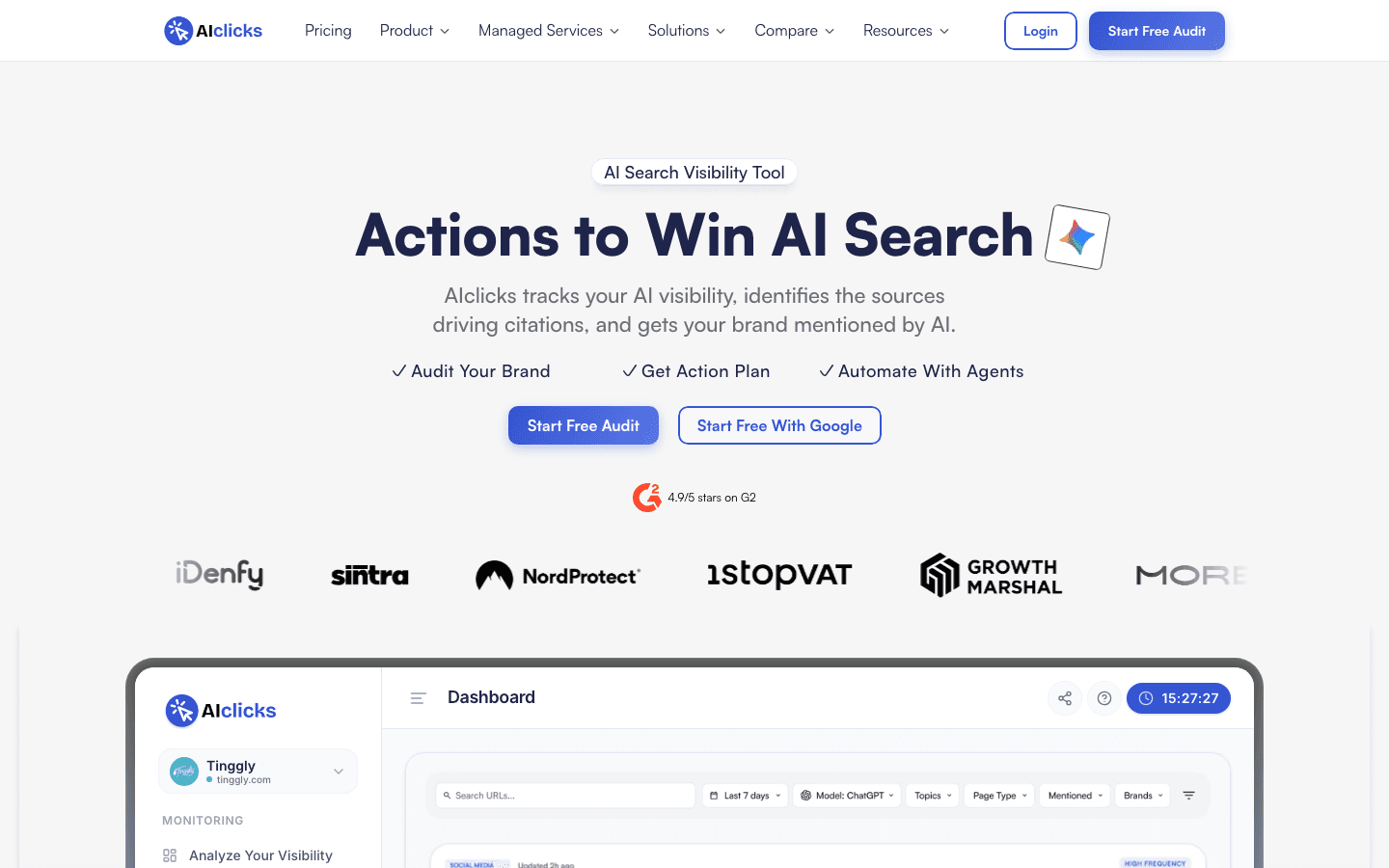
AIclicks

AIclicks

7/10
Best for: Marketers who want tracking combined with optimization guidance

AI search analytics, GEO optimization, and monitoring platform that tracks prompts and brand mentions within AI tools. Combines tracking with actionable optimization recommendations.

Why I like it:AIclicks combines AI visibility tracking with optimization guidance to help improve your AI mention performance. The standout strength is the actionable recommendations - it doesn't just tell you where you're mentioned, but suggests how to improve those mentions. Marketers who want to actively optimize their AI presence get the most value because tracking without optimization guidance only tells half the story. The platform can identify content gaps and suggest improvements to increase positive AI mentions and citations. The limitation is that optimization features add complexity and cost compared to pure tracking tools, which might be overkill for teams who just want basic monitoring.

Key Features

Prompt trackingGEO optimizationOptimization recommendationsBrand monitoringCompetitor analysisEducational resources

Pros

  • Combines tracking with actionable optimization tips
  • Good educational resources
  • Solid monitoring across key platforms

Cons

  • Covers fewer platforms (ChatGPT, Perplexity, Gemini)
  • Less established than major players
  • Limited pricing transparency online
AIclicks homepage screenshot
#12
AthenaHQ

AthenaHQ

Best for: Growth teams who want AI-native insights built by people who understand how AI models actually work

AI search visibility tracker with a built-in content optimization agent, from $295/month.

Why I like it:AthenaHQ is an AI visibility platform built by people who understand how AI models actually work, focusing on AI-native insights rather than adapting traditional SEO metrics. The standout strength is the technical depth - the insights are designed specifically for how AI models retrieve and cite information. Growth teams at tech companies get the most value because they need advanced analysis that matches their technical sophistication and growth focus. The platform provides insights into how AI models are trained on and reference your content, not just surface-level mention tracking. The limitation is that AI-native insights require more interpretation than simple mention counts, which might overwhelm non-technical marketers.

Key Features

Ex-Google/DeepMind teamShare of voice reportingSentiment analysisCredit-based pricingContent optimization insightsCompetitive benchmarking
AI-stack fit
MCP
API
Zapier
Make

Pros

  • Built by people who understand AI model internals
  • Deep technical insights beyond basic tracking
  • Flexible credit-based consumption model
  • Covers major AI platforms

Cons

  • Starting at $295/mo is pricey for small teams
  • Credit-based model can be hard to predict costs
  • Less focus on budget-friendly options
AthenaHQ homepage screenshot
#13
PromptMonitor

PromptMonitor

7/10
Best for: Budget-conscious teams who want dual crawler + visibility tracking at an affordable price

Tracks and improves company visibility across 8+ major AI platforms. Uniquely combines AI crawler analytics (what AI reads from your site) with visibility tracking (what AI says about your brand).

Why I like it:PromptMonitor offers dual functionality with both web crawler capabilities and AI visibility tracking at an affordable price point. The standout strength is getting two tools in one - you can crawl content and track AI mentions without paying for separate platforms. Budget-conscious teams get the most value because they can consolidate multiple monitoring needs under one subscription. The platform can track both traditional web mentions and AI platform citations, giving you a complete picture of your online visibility. The limitation is that dual-purpose tools sometimes sacrifice depth in one area, so you might get less advanced AI tracking than dedicated AI visibility platforms.

Key Features

Crawler analyticsVisibility tracking8+ platformsBudget-friendlyDual analytics viewAI readability insights

Pros

  • Unique dual crawler + visibility tracking
  • Only $29/mo for 8+ platforms
  • Shows what AI bots read from your site
  • Good value for the price

Cons

  • Smaller company with limited track record
  • Less advanced reporting than premium tools
  • Limited prompt volume on base plan
PromptMonitor homepage screenshot
#14
Peekaboo AI

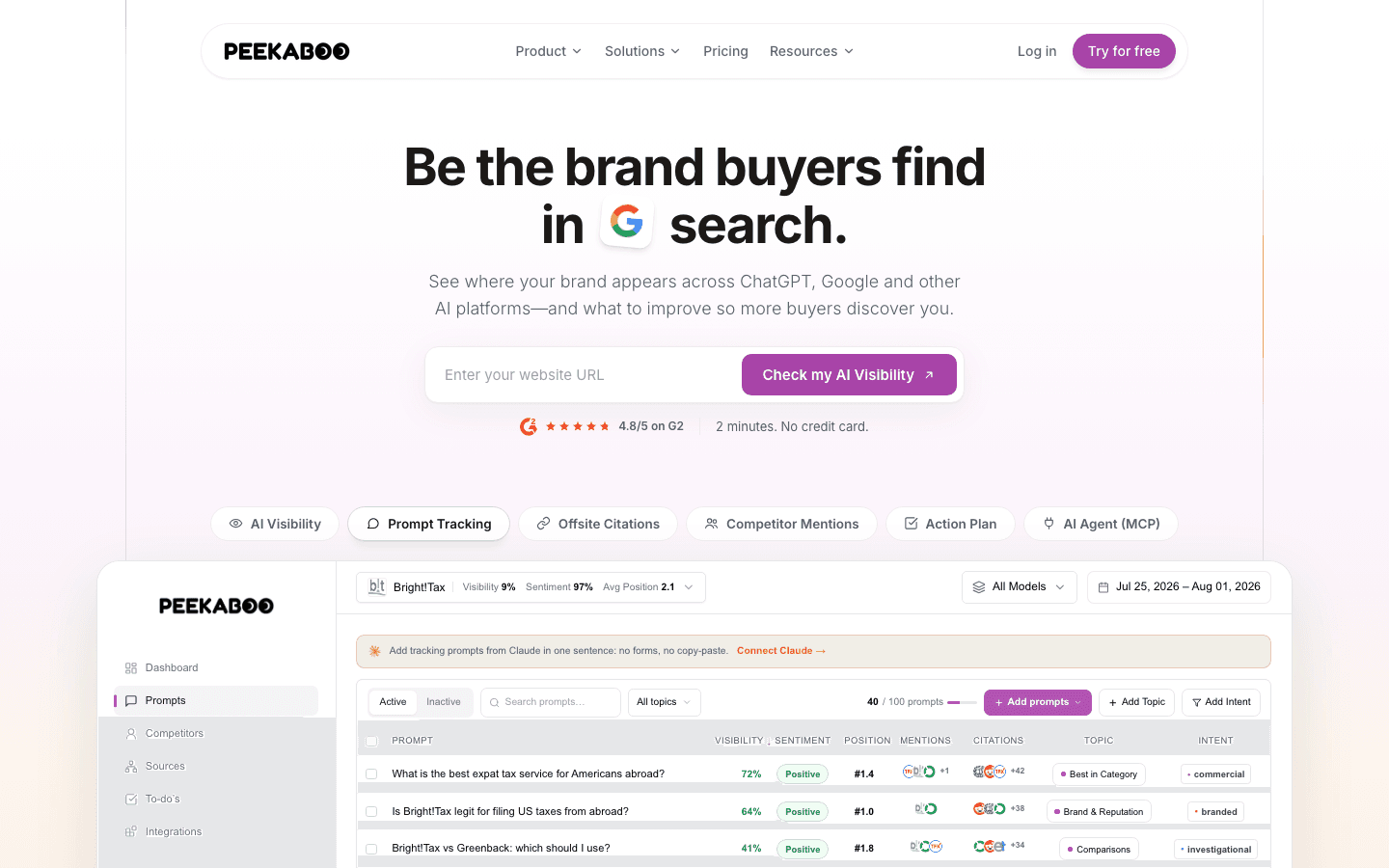
Peekaboo AI

7/10
Best for: Agencies and teams with multiple members who need unlimited seats at a fixed price

AI visibility and analytics tool designed for SMBs and agencies. Tracks brand visibility across major AI search platforms with a customizable pricing calculator and unlimited team seats on every plan.

Why I like it:Peekaboo AI is an AI visibility tracker that offers unlimited team seats at a fixed price, making it ideal for agencies and larger teams. The standout strength is the pricing model - you can add unlimited users without per-seat charges that quickly escalate with team growth. Agencies and teams with multiple members get the most value because they can give access to everyone without worrying about escalating costs. The platform provides standard AI visibility tracking across major platforms with team collaboration features built in. The limitation is that unlimited seats only matter if you actually need multiple users - solo marketers or small teams might pay for seats they don't use.

Key Features

Unlimited team seatsCustom pricing calculatorAgency-friendlyMulti-platform trackingBrand analyticsCompetitive insights

Pros

  • Unlimited team seats on every plan
  • Customizable pricing calculator
  • Designed for agencies and multi-user teams
  • Affordable starting point

Cons

  • Newer tool with less market validation
  • Fewer AI platforms than top competitors
  • Limited public documentation
Peekaboo AI homepage screenshot
#15
RankScale AI

RankScale AI

Most Affordable
7/10
Best for: Freelancers and very small businesses who want to start AI visibility tracking at the lowest cost

Tracks and analyzes brand visibility in AI search engines with daily monitoring, competitor benchmarking, citation analysis, sentiment tracking, and an AI Readiness Score that audits your website.

Why I like it:RankScale AI positions itself as the most affordable entry point for AI visibility tracking, targeting very small businesses and freelancers. The standout strength is the ultra-low price point that makes AI tracking accessible even for single-person operations. Freelancers and very small businesses get the most value because they can start tracking AI mentions without the budget commitment required by enterprise tools. The platform provides basic tracking of brand mentions across key AI platforms with simple reporting. The limitation is that rock-bottom pricing usually means limited features, fewer platforms monitored, or restricted query volumes compared to higher-tier tools.

Key Features

Lowest price pointAI Readiness ScoreDaily monitoringCitation analysisCompetitor benchmarkingCredit-based system

Pros

  • Cheapest option at $20/mo
  • AI Readiness Score website audit
  • Credit-based system scales affordably
  • Covers key platforms (ChatGPT, Claude, Perplexity)

Cons

  • Essential plan has limited credits (120/mo)
  • Covers fewer platforms than premium competitors
  • Basic reporting compared to higher-tier tools
RankScale AI homepage screenshot
#16
Ahrefs

Ahrefs

Best for Ahrefs Users
8.3/10
Best for: Teams already using Ahrefs who want AI visibility without adding another tool

Comprehensive SEO platform with powerful backlink analysis and keyword research tools

Why I like it:Ahrefs has added AI visibility tracking to their existing SEO platform, letting current users monitor AI mentions without switching tools. The standout strength is the integration - your AI visibility data sits alongside your existing SEO metrics in one familiar interface. Teams already using Ahrefs get the most value because they can extend their current workflow without learning new tools or managing additional subscriptions. The platform leverages Ahrefs' existing data infrastructure to track brand mentions across AI platforms. The limitation is that AI tracking might be less advanced than dedicated AI visibility tools, since it's an add-on feature rather than the core product.

Key Features

200M+ prompt indexBrand Radar featureYouTube/TikTok/Reddit trackingAI Overviews trackingCompetitor comparisonIntegrated with Ahrefs SEO suite
AI-stack fit7/10
MCP
API
Zapier
Make

Solid agent integration with official MCP support and well-documented API across Claude, ChatGPT, and Gemini. The official MCP server and public API docs make it straightforward to embed Ahrefs queries into agent workflows. Main limitation is the lack of webhooks and structured outputs, which restricts real-time automation and reduces output consistency for downstream processing.

Pros

  • Massive 200M+ prompt dataset
  • Extends tracking to YouTube, TikTok, Reddit
  • Integrates with full Ahrefs SEO suite
  • Trusted platform with years of track record

Cons

  • $199/mo per index is expensive (on top of Ahrefs subscription)
  • AI features are add-on, not included in base plan
  • Less AI-specific depth than dedicated tools
Ahrefs homepage screenshot
#17
Semrush

Semrush

Best for Semrush Users
9.2/10
Best for: Teams already using Semrush who want an all-in-one SEO + AI visibility solution

Complete SEO platform with AI search tracking, keyword research, competitor analysis, and content optimization tools.

Why I like it:Semrush has integrated AI visibility tracking into their thorough SEO platform, offering an all-in-one solution for teams already in their ecosystem. The standout strength is the unified dashboard - you get traditional SEO metrics, paid search data, and AI visibility in one place. Teams already using Semrush get the most value because they can add AI tracking without introducing another tool to their workflow. The platform can correlate AI mention data with traditional search performance, giving you a complete picture of your online visibility. The limitation is that integrated features sometimes lack the depth of specialized tools, so dedicated AI visibility platforms might offer more granular insights.

Key Features

AI Visibility ToolkitPrompt monitoringLLM crawlability optimizationSemrush One bundleCompetitive researchFull SEO integration
AI-stack fit8/10
MCP
API
Zapier
Make

MCP verified 2026-07-07: mcp.semrush.com/v1/mcp, OAuth 2.0/API key, read-only data, gated to Starter $199+. 6->7 Joonas approved.

Pros

  • Tight integration with Semrush SEO suite
  • AI Visibility included on Pro+ ($248.17/mo annual) for 1 domain + 100 daily AI prompts; standalone AI Visibility from $99/mo per domain
  • Strong competitive research capabilities
  • Established platform with strong support

Cons

  • AI Toolkit is a separate $99/mo add-on
  • Covers only ChatGPT, Gemini, Perplexity
  • Less AI platform coverage than dedicated tools
Semrush homepage screenshot
#18
Superlines

Superlines

Best for: Agencies and multi-market European teams wanting real-interface tracking across 10+ engines with unlimited brands and an MCP server

Finnish AI search intelligence platform: tracks 10+ AI engines from real interfaces, with MCP and API on every plan.

Why I like it:Superlines is the veteran European option here: real-interface tracking across 10+ engines, market-level competitive benchmarking, and an official MCP server (open source, three deployment options) with API access on every plan. The €89 entry and unlimited-brands policy make it a strong pick for agencies and multi-market companies.

Key Features

10+ engines, pick 3 to all 10 by tierReal-interface data collectionMarket and language-level benchmarkingWebpage AI-readiness audits + Schema.org optimizerOfficial MCP server (27 tools, scoped writes)Unlimited users and brands on every plan
AI-stack fit8/10
MCP
API
Zapier
Make

Official MCP server (GitHub Superlines/mcp-server, npm @superlines/mcp-server, remote HTTP at mcpsse.superlines.io) with 27 tools: 21 reads covering metrics, citations, competitive gaps, webpage audits and strategy, plus 6 writes gated behind scoped permissions (write:brands, write:prompts). REST API with Bearer keys and published per-plan rate limits (60/120/300 rpm) on every plan including Starter. Held back from higher: query-param API design with no OpenAPI spec, and the remote MCP passes the API key as a URL token parameter.

Pros

  • Widest engine coverage (10+, incl. Copilot, DeepSeek)
  • Unlimited users and brands, every plan
  • Official open-source MCP server (GitHub + npm + remote)
  • Established company since 2020

Cons

  • No free plan (7-day trials only)
  • Only 2 months of data history below Enterprise
  • €89-to-€379 jump for brands
Superlines homepage
#19
Frase

Frase

Best Content + Tracking Combo
8.2/10
Best for: Content marketers who want to create AI-optimized content and track visibility in one platform

AI-powered SEO content platform with research, optimization, and AI search visibility tracking

Why I like it:Frase combines content creation and optimization tools with AI visibility tracking, letting content marketers create and monitor AI-optimized content in one platform. The standout strength is the end-to-end workflow - you can research, write, optimize, and track content performance all within Frase. Content marketers get the most value because they can optimize content for AI visibility while creating it, rather than tracking performance after the fact. The platform can analyze how your content performs in AI responses and suggest optimizations to improve citation rates. The limitation is that combination platforms might offer less advanced tracking than dedicated AI visibility tools focused solely on monitoring.

Key Features

8 AI platformsContent optimizationGEO optimizationAI agent with 80+ skillsSite auditsIncluded on all plans
AI-stack fit6/10
MCP
API
Zapier
Make

Moderate agent-fit with community MCP support. Frase offers a documented public API and native Claude integration, but lacks official MCP hosting, OpenAPI specs, and structured outputs that would unlock fuller agentic capabilities. The community MCP server bridges some gaps, though relying on third-party maintenance introduces continuity risk.

Pros

  • AI visibility tracking included on all plans
  • Content creation + tracking in one platform
  • Covers 8 AI platforms
  • Affordable starting point at $39/mo

Cons

  • Jack-of-all-trades risk (content + tracking + SEO)
  • AI visibility features may be less deep than specialists
  • Can feel complex with so many features
Frase homepage screenshot
#20
Evertune

Evertune

Highest Volume
Best for: Large enterprises and e-commerce brands that need statistically significant AI visibility data at scale

Enterprise AI visibility tracking, content activation, and AI ad buying, from $3,000/mo.

Why I like it:Evertune targets large enterprises and e-commerce brands that need statistically significant AI visibility data at scale with enterprise-grade accuracy. The standout strength is the data reliability - it's built for organizations that need confidence intervals and statistical significance rather than rough tracking estimates. Large enterprises and e-commerce brands get the most value because their decision-making requires data quality that can withstand executive scrutiny. The platform can provide statistically valid insights about AI mention trends across thousands of products or brand variations. The limitation is that enterprise-grade data quality comes with enterprise pricing that puts it out of reach for smaller businesses.

Key Features

1M+ prompts/brand/monthShopping IntelligenceStatistical significance6 AI platforms$19M fundingBrand perception tracking

Pros

  • Highest prompt volume in the market (1M+/month)
  • Shopping Intelligence for e-commerce
  • Statistically significant data
  • Covers ChatGPT, Claude, Gemini, Perplexity, Meta AI, DeepSeek

Cons

  • Starting at $3,000/mo is enterprise-only pricing
  • Sales-led process required
  • Overkill for small and mid-size businesses
Evertune homepage screenshot
#21
Scrunch AI

Scrunch AI

Best for: Brands that want to actively push content to AI agents, not just track mentions

AI search visibility platform tracking brand mentions across ChatGPT, Perplexity and more, from $250/month.

Why I like it:Scrunch AI goes beyond passive tracking to actively push your content to AI agents, focusing on improving AI citations rather than just monitoring them. The standout strength is the proactive approach - instead of just watching what AI platforms say about you, it works to influence those mentions. Brands that want to actively optimize their AI presence get the most value because passive monitoring only tells you what's happening, not how to improve it. The platform can submit content to AI training datasets and monitor how that content influences future AI responses about your brand. The limitation is that active AI optimization is more complex and expensive than simple mention tracking, and results might take longer to materialize.

Key Features

Active content delivery to AIWebsite AI optimizationBrand monitoringMultiple plan tiersAgency plan availableAI crawl optimization
AI-stack fit4/10
MCP
API
Zapier
Make

Not ready for agent workflows. Scrunch AI has documented public API access, but lacks MCP support, OpenAPI specs, SDKs, and structured output capabilities that modern agent stacks require. Without these integrations, you'd need custom middleware to connect it to Claude or Cursor workflows.

Pros

  • Goes beyond tracking into active AI content delivery
  • Website optimization for AI crawlers
  • Multiple plan options including agency tier
  • Proactive rather than reactive approach

Cons

  • Starting at $250/mo is premium pricing
  • Specific platform coverage not fully detailed
  • Newer concept that may need market validation
Scrunch AI homepage screenshot
#22
Conductor

Conductor

Best for: Large content-heavy enterprises needing end-to-end SEO governance with AI intelligence layered on top

Enterprise AEO + SEO platform combining AI visibility tracking, content generation, and site monitoring.

Why I like it:Conductor adds AI intelligence on top of their existing enterprise SEO governance platform, targeting large content-heavy organizations that need systematic SEO management. The standout strength is the enterprise governance approach - it's built for organizations that need to manage SEO and AI optimization across hundreds or thousands of pages. Large content-heavy enterprises get the most value because they need systematic processes for optimizing content at scale, not just ad-hoc monitoring. The platform can integrate AI visibility insights into existing content workflows and governance processes. The limitation is that enterprise SEO platforms are complex and expensive, making them overkill for smaller organizations that just need basic AI tracking.

Key Features

Mention vs. citation distinctionAI Search Performance reportsEnterprise SEO platformContent governanceChatGPT/Perplexity/Gemini/AI OverviewsFull SEO suite
AI-stack fit4/10
MCP
API
Zapier
Make

Weak agent-fit for most workflows. Conductor has documented APIs and Node SDK support, but lacks MCP, OpenAPI specs, and Claude integration, making it difficult to use in modern agentic stacks. The absence of an MCP server is the primary blocker for seamless Cursor or Claude integration.

Pros

  • Distinguishes brand mentions from website citations
  • Full enterprise SEO platform included
  • Strong content governance features
  • Established enterprise vendor

Cons

  • Starting at $3,000+/mo
  • Enterprise sales process required
  • AI features are part of larger platform, not standalone
Conductor homepage screenshot
#23
Trakkr

Trakkr

Best Coverage
Best for: Teams that need thorough AI search monitoring across the widest range of platforms

AI search analytics that monitors brand visibility and citations across 8 AI platforms (ChatGPT, Claude, Perplexity, Gemini, Google AI Overviews, Grok, Meta AI, DeepSeek).

Why I like it:Trakkr monitors your brand visibility across 8 major AI platforms, including newer ones like Grok and DeepSeek that most competitors ignore. The platform tracks not just mentions but actual citations, which tells you if AI models are recommending your brand with source attribution. I like that it covers Google AI Overviews alongside the chat-based models since that's where most people encounter AI search results. You get 50 queries per month on the Growth plan, which is enough for most brands to track their core topics. The pricing jumps quickly though, hitting $399/month for the Scale tier.

Key Features

Monitors 8 AI platforms including ChatGPT, Claude, Perplexity, and GeminiTracks brand citations and source attributionCovers Google AI Overviews and newer platforms like Grok14-day free trial to test platform coverageQuery-based pricing model with clear monthly limits

Pros

  • Widest platform coverage including emerging AI models
  • Focuses on citations, not just mentions
  • Includes Google AI Overviews in monitoring scope

Cons

  • Expensive scaling with $399/month top tier
  • Limited queries on entry plan may not suit larger brands
Trakkr homepage screenshot
Visit TrakkrReview coming soon
#24
Gumshoe

Gumshoe

Pay-as-you-go Pick
Best for: Agencies and consultants who need flexible AI monitoring without monthly commitments

Monitors how your brand appears in AI-generated recommendations across 11 LLMs (ChatGPT, Claude, Gemini, Perplexity, DeepSeek, Google AI Overview and more).

Why I like it:Gumshoe offers the most flexible pricing in this space with a genuine free tier and pay-as-you-go at $0.10 per conversation. It monitors 11 LLMs including the major players plus newer models like DeepSeek, focusing specifically on recommendation scenarios where your brand might get mentioned. The conversation-based pricing makes sense since you're paying for actual AI interactions rather than arbitrary query limits. I like that you can test the platform completely free before deciding to scale up. The challenge is predicting costs since conversation volume can vary, but for agencies managing multiple clients, this flexibility beats fixed monthly fees.

Key Features

Monitors 11 LLMs including ChatGPT, Claude, and DeepSeekPay-per-conversation pricing at $0.10 eachFree tier available for testingFocuses on AI recommendation scenariosEnterprise options for larger implementations

Pros

  • True pay-as-you-go model with no monthly minimums
  • Covers 11 different LLMs including newer models
  • Free tier lets you test before committing

Cons

  • Unpredictable monthly costs based on usage
  • Conversation pricing model may not suit consistent monitoring needs
Gumshoe homepage screenshot
Visit GumshoeReview coming soon
#25
Goodie AI

Goodie AI

Enterprise Focus
Best for: Large brands with complex AI search optimization needs and custom requirements

AI search optimization platform focused on improving how brands surface in AI answers and AI Overviews.

Why I like it:Goodie AI focuses specifically on AI search optimization rather than just monitoring, positioning itself as a strategic platform for improving how brands surface in AI-generated answers. The emphasis on Google AI Overviews makes sense since that's where most consumers encounter AI search results. Custom pricing suggests they're targeting enterprise clients with advanced needs and dedicated budgets for AI visibility. The platform appears to offer optimization recommendations beyond basic tracking, which could be valuable for brands serious about AI search strategy. Without transparent pricing or trial options, it's clearly designed for enterprise sales cycles rather than self-service adoption.

Key Features

AI search optimization platform for brand visibilityFocus on improving performance in AI answers and OverviewsEnterprise-focused with custom implementationsStrategic approach beyond basic monitoringContact sales for pricing and feature details

Pros

  • Focuses on optimization, not just monitoring
  • Enterprise-grade platform for complex requirements
  • Emphasis on Google AI Overviews where users actually search

Cons

  • No transparent pricing or trial options
  • Enterprise sales process required for access
Goodie AI homepage screenshot
Visit Goodie AIReview coming soon
#26
Aiso

Aiso

Best for Real-Conversation Data
6.8/10
Best for: Teams that want to see what people actually ask AI about their category, not synthetic prompts

AI visibility tracker built on a consent panel of real ChatGPT conversations, with an official Apify data actor.

Why I like it:Aiso is the rare AI-visibility tool that starts from real demand instead of prompts it wrote itself. Its consent-based panel of real ChatGPT conversations shows what people actually ask AI about your category, with intent and sentiment attached, which is a different signal for content and positioning. It is early (three features live, more on the roadmap) and its agent story is light: programmatic access is an Apify actor, not a native API or MCP. But for the data alone it earns a place here. If the real-conversation angle matters more to you than deep tooling, it is worth a look.

Key Features

Consent-based panel of real ChatGPT conversationsConversation Explorer with intent classificationAI Mention Tracker (frequency, sentiment, rank)Fan-outs & GPT Trends (hidden sub-queries)Tracks ChatGPT, Gemini, Perplexity, Claude

Pros

  • Unique data: real ChatGPT conversations, not synthetic prompts
  • Surfaces the real buyer prompts in your category
  • 14-day free trial, no card required

Cons

  • Early-stage: only three features live today
  • No native API or MCP, only an Apify actor for data access
  • Pricier entry than budget trackers, from $79/mo
Aiso homepage screenshot

Price landscape

How prices compare

Starting prices across all 9 tools in this category.

Reviewed In database

AI visibility is mostly SEO (here is what is actually new)

It is worth being honest about what AI visibility actually takes, because most of it is not new. Getting cited by ChatGPT or Google AI Overviews is won by the same levers that have always driven SEO: topical authority, original data worth quoting, clearly structured content, and a reputation that lives off your own site in the form of links and brand mentions. The engines are new. The work that earns a citation mostly is not.

So what is genuinely new? Two things. First, the surfaces themselves, your brand showing up inside an AI answer instead of a blue link. Second, measuring it, which is what the tools above are for. Everything in between, the optimization that actually moves the needle, is SEO extended to a new surface.

That means the tools that improve your AI visibility overlap heavily with the ones you may already use. To build the topical authority and content depth these engines reward, my best SEO software roundup is the place to start. To structure individual pages so they get pulled into answers, see my best AI content and SEO tools. And for the step by step of earning citations, I wrote a full guide to ranking in AI search.

The practical takeaway: do not treat AI visibility as a separate discipline that needs a separate stack. Treat it as SEO with a new measurement layer on top. Use the trackers here to see where you stand and which prompts you are losing, then fix the underlying content and authority with the SEO tools you already know. Measure first, optimize second.

Methodology

How I chose these

I evaluated these 27 AI search visibility tools based on platform coverage (how many AI engines they monitor), accuracy of citation tracking, pricing transparency, and readiness for the current AI landscape. The top tools track at least ChatGPT, Perplexity, and Claude, provide clear source attribution data, and offer straightforward pricing without hidden enterprise requirements.

I prioritized tools that understand how AI models actually cite sources, not just keyword-based monitoring adapted for AI platforms.

FAQ

Frequently Asked Questions

AI search visibility tracking monitors how often your brand, products, or content appear in responses from AI search engines like ChatGPT, Perplexity, Claude, and Gemini. Unlike traditional search where you rank for specific keywords, AI engines synthesize information and cite sources dynamically. You need this because millions of people now ask AI assistants questions instead of googling, and you have no idea if your brand is being mentioned, ignored, or misrepresented in those conversations.

Start with ChatGPT, Perplexity, and Claude as they handle the most search-like queries in 2026. ChatGPT has the largest user base, Perplexity specializes in research queries, and Claude is growing rapidly among professionals. Google's AI Overviews matter for traditional search integration, while specialized engines like You.com or Bing Chat serve smaller but valuable audiences. I recommend tracking at least 3-4 major platforms rather than trying to monitor everything.

Pricing ranges from free tiers to $500+ monthly depending on query volume and platform coverage. Budget options like RankScale AI start around $29/month for basic tracking, while thorough tools like Peec AI or Profound cost $200-400 monthly for serious monitoring. Enterprise solutions can exceed $1,000 monthly. Most tools charge based on queries tracked per month, with 1,000-5,000 queries being typical for small to mid-size businesses.

Traditional SEO tracks your ranking position for specific keywords in search results. AI visibility tracking monitors whether you're mentioned or cited when AI engines answer questions, regardless of the exact query. AI responses are contextual and conversational, so you might be cited for topics you never directly targeted. The metrics are also different: instead of ranking positions, you track mention frequency, citation accuracy, sentiment, and source attribution across AI platforms.

Yes, most AI visibility tools let you monitor competitor mentions alongside your own brand. You can see which competitors get cited most frequently, what topics they dominate in AI responses, and identify content gaps where you could compete. This competitive intelligence is particularly valuable because AI engines don't show traditional search results, making it harder to manually research competitor visibility without dedicated tracking tools.

Accuracy varies significantly between tools and depends on how they query AI platforms. The best tools use diverse query sets and multiple prompting approaches to get representative data, but all AI visibility tracking involves some sampling since you can't monitor every possible question. Look for tools that show their methodology, refresh data regularly, and acknowledge the inherent limitations. No tool can guarantee 100% accuracy, but the leading options provide reliable directional insights.

Currently, yes. While some traditional SEO platforms like Ahrefs and Semrush added AI visibility features, dedicated GEO tools typically provide more thorough tracking and better insights. The AI search landscape changes too rapidly for traditional SEO tools to keep pace with specialized platforms. However, this may consolidate over time as AI visibility becomes standard in SEO workflows. For now, most serious marketers use both types of tools.

Start by creating thorough, well-structured content that directly answers common questions in your industry. AI engines favor authoritative sources with clear information architecture, proper citations, and factual accuracy. Build topic authority through consistent content publishing, earn quality backlinks, and ensure your website has clear E-A-T signals. Some tools like Scrunch AI also offer active content promotion to AI platforms, though organic visibility through quality content remains the most sustainable approach.

Tracking tools measure how often your brand appears in AI answers. Optimization tools help you rewrite content so the engines cite you more often. Autopilot tools go further and generate content or build links on their own. Most tools on this page are trackers. For optimization see my best AI content and SEO tools roundup, and for autopilots my best AI SEO content autopilots guide. Think of it as a ladder from watching to acting.

They mostly describe the same shift. AI visibility is the outcome, how often your brand shows up in AI answers. GEO (generative engine optimization), AEO (answer engine optimization) and LLMO (large language model optimization) are competing names for the practice of improving that visibility. GEO is the most common term among practitioners, but most people search for the outcome, AI visibility, which is why I lead with it.

Continue reading

Joonas Rotko
Joonas RotkoAuthor & Founder of That Marketing Buddy

10+ years in digital marketing. I review marketing software for AI-stack fit: real pricing, MCP and API support, and how cleanly each tool drops into an AI agent workflow, cross-checked against verified data and real user feedback.

PromptWatch

PromptWatch

Try PromptWatch
WEEKLY NEWSLETTER

The marketing tools worth your money, scored for AI agent readiness

Every week I score the tools for MCP, API, and agent-readiness, then email you the ones that actually deliver, what plugs into Claude and Cursor, the pricing changes, and what to skip. No fluff, no daily spam.

Join for free. One email a week, unsubscribe anytime.