

This page may contain affiliate links.
Some links on this page are affiliate links, meaning I may earn a commission if you sign up (at no extra cost to you). This never influences my ratings or recommendations.
The catch: the pricing page doesn't show actual numbers (it's all 'friendly pricing as you scale'), and the listed native integrations stop at three tools (Crisp, Slack, Zendesk). If you want clearer pricing, broader integrations, or a chatbot that does more than answer FAQs, it's worth putting a few competitors side by side before your 7-day trial runs out.
Why Switch
Why people look for SiteGPT alternatives
Pricing isn't published anywhere on the site, so you can't compare costs without booking a demo or starting the trial
Only three native integrations are listed (Crisp, Slack, Zendesk), while several alternatives support 12 to 100+ tools
No mention of anti-hallucination safeguards, which matters if your bot is answering pricing, refund, or policy questions
Agency and reseller plans require emailing support directly rather than picking a self-serve tier
Some competitors offer usage-based or free-forever plans that fit a small site better than a percentage-based scaling model
Alternatives
Best SiteGPT alternatives
5 alternatives ranked.

Chatbase
Teams that want an AI agent with actual reasoning, not just FAQ lookup
Platform for building and deploying AI customer support agents that automate support workflows and solve complex customer issues.
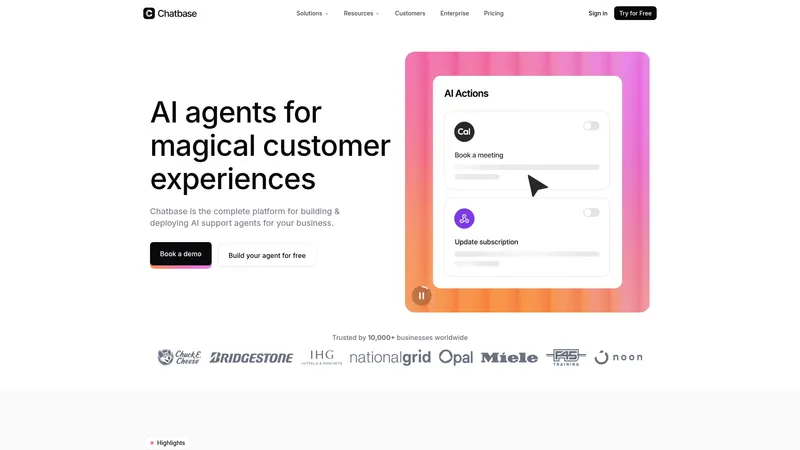
Why consider Chatbase
Chatbase is built specifically for LLM reasoning rather than simple keyword matching, and it connects to 15+ tools including Zendesk, Stripe, and Salesforce. The smart escalation to human agents with omnichannel support is a step beyond SiteGPT's single escalate-to-human button.
Pros
- +Built for LLM reasoning, not just retrieval
- +15+ integrations including Zendesk, Stripe, and Salesforce
- +Omnichannel escalation to human agents
Cons
- −Pricing is contact-sales only, so there's no public number to compare against SiteGPT
- −No independent review data available to verify real-world support quality

Paperchat
Top PickAnyone who wants to test an AI support chatbot without paying anything
AI chatbot platform for customer support and lead collection, custom-trained on business data with no coding required.
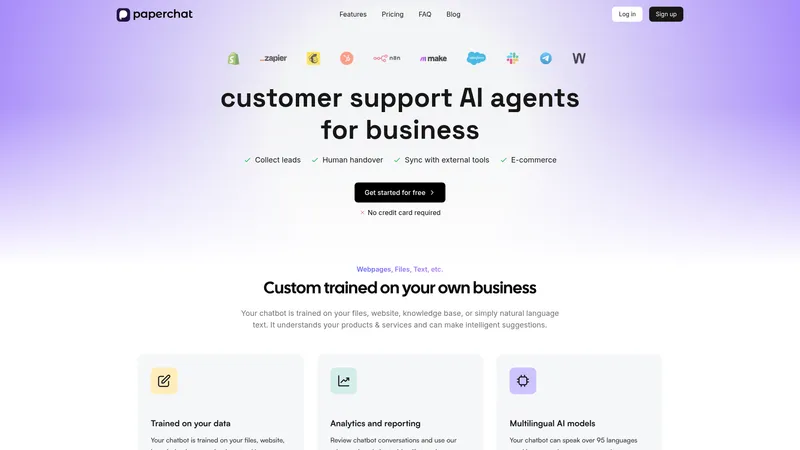
Why consider Paperchat
Paperchat is trained on your own business data like SiteGPT, matches its 95+ language support, and adds no-code integrations with Shopify, Zapier, and HubSpot. Being free removes the biggest question mark SiteGPT leaves on the table: what does this actually cost me?
Pros
- +Free to use
- +12+ no-code integrations including Shopify, Zapier, and HubSpot
- +95+ languages plus built-in analytics
Cons
- −No independent reviews yet to confirm reliability at higher volume
- −Details on training data limits for the free tier aren't published

CustomGPT
Companies that need documented accuracy and compliance for enterprise buyers
No-code platform for creating custom AI agents trained on your business content with accurate answers and citations.
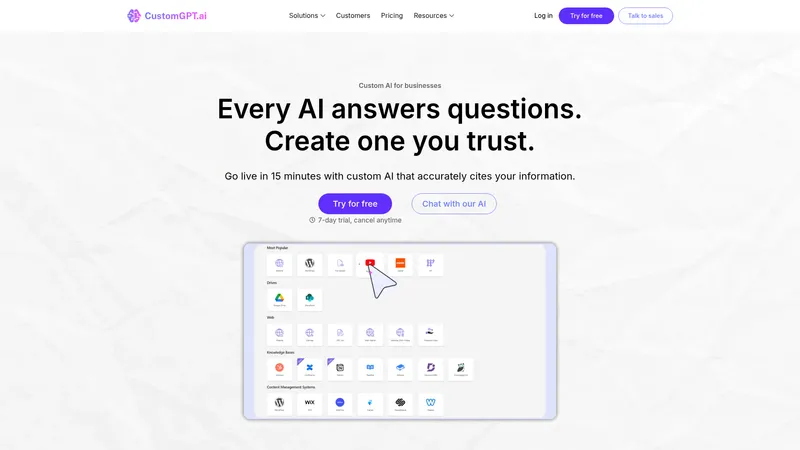
Why consider CustomGPT
CustomGPT leads with anti-hallucination technology that's been verified #1 by a third party, backed by SOC-2 Type II and GDPR compliance. Support for 1,400+ file types and 100+ integrations, plus a client list that includes MIT, the UN, and Adobe, makes a case for teams where accuracy is non-negotiable.
Pros
- +Anti-hallucination technology verified #1 by a third party
- +SOC-2 Type II and GDPR compliance for enterprise buyers
- +1,400+ supported file types and 100+ integrations
Cons
- −Starts at $99/mo, a steeper entry point than most chatbot tools on this list
- −Enterprise positioning may be more than a small site needs

DocsBot
Teams that already have a knowledge base and want fast deployment
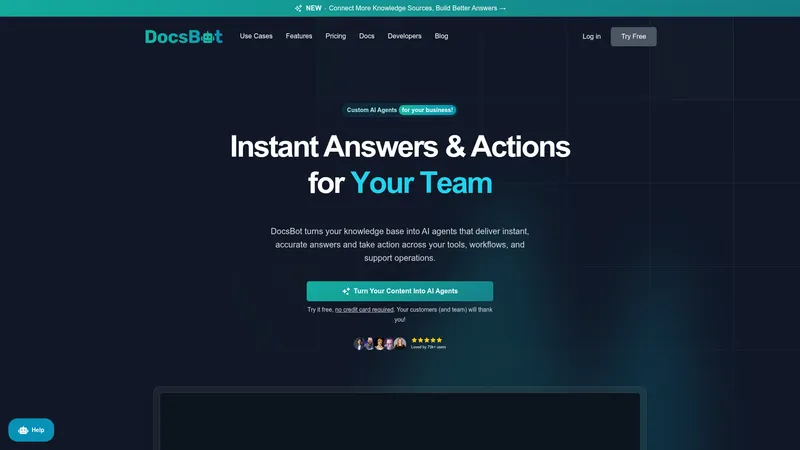
AI chatbot platform that transforms knowledge bases into intelligent agents for customer support, sales, and internal knowledge retrieval.
Why consider DocsBot
DocsBot turns an existing knowledge base into a chatbot with 37+ content source integrations, and it can automate processes across your business tools instead of just replying to questions. That action-taking piece pushes it past a basic Q&A bot.
Pros
- +Free to use
- +37+ content source integrations for training
- +Can trigger actions across connected business tools, not just answer questions
Cons
- −No published pricing tiers beyond the free plan, so scaling costs are unclear
- −Thin third-party review coverage to verify claims against

Botpress
Support teams that want to add agents without adding per-seat costs
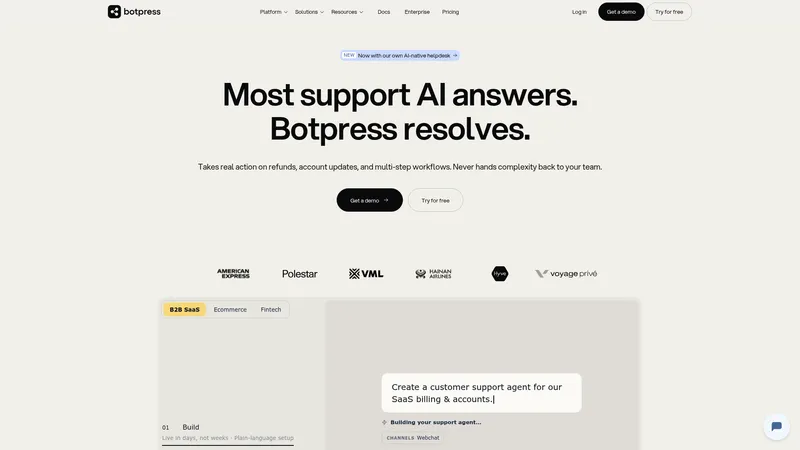
AI-native customer support platform that resolves tickets, handles workflows, and integrates with Zendesk or Intercom.
Why consider Botpress
Botpress skips per-seat pricing entirely, so adding more agents to your account doesn't inflate your bill. It handles complex tickets with built-in escalation logic and plugs into Zendesk or Intercom, or runs standalone if you'd rather not touch your existing helpdesk.
Pros
- +No per-seat costs, unlimited seats
- +Built-in escalation logic for complex tickets
- +Works with existing helpdesks like Zendesk and Intercom, or standalone
Cons
- −Pricing is contact-sales only, so total cost isn't clear upfront
- −No independent review data available to confirm real-world support quality
Checklist
What to look for in an alternative
Start with training data flexibility. SiteGPT lets you train on URLs, sitemaps, YouTube content, and uploaded files like PDFs and DOCX, plus connectors for Notion, Google Drive, Dropbox, OneDrive, Box, and GitHub. Not every alternative matches that breadth, so check what formats and sources a tool actually supports before assuming it can ingest your knowledge base.
Integration depth is the second thing to check. If your support workflow lives in Zendesk, Salesforce, or Stripe, you want a chatbot that connects natively rather than one that needs a middleman like Zapier for every action.
This is also where agent readiness matters: a bot that can only answer questions is different from one that can trigger actions in your other systems through APIs or MCP servers.
Last, look at compliance and pricing transparency together. SiteGPT is SOC 2 Type II examined, GDPR certified, and HIPAA assessed, which is a real bar for a support chatbot. But compliance badges don't tell you what you'll pay at 10,000 monthly conversations. If a vendor won't publish a price ladder, budget extra time for a sales call before you can even compare.
FAQ
Frequently Asked Questions
It covers the basics well: a chatbot trained on your website content, 95+ language support, and a hand-off button when a conversation needs a human. It's also SOC 2 Type II examined, GDPR certified, and HIPAA assessed, which matters if you handle sensitive customer data.
The public site doesn't list exact numbers, it just says pricing is 'friendly as you scale' and offers a 7-day free trial you can cancel anytime. Check the SiteGPT pricing page for the latest available details, or start the trial to see plan options directly.
Based on its own site, SiteGPT natively integrates with Crisp, Slack, and Zendesk. That's narrower than competitors like Chatbase (15+ integrations) or CustomGPT (100+ integrations).
No. SiteGPT offers a 7-day free trial rather than an ongoing free tier. If a free-forever plan matters to you, Paperchat and DocsBot both offer one based on my research.
Paperchat and DocsBot are both listed as free to use. Paperchat adds 95+ language support and no-code integrations with Shopify, Zapier, and HubSpot, while DocsBot focuses on turning an existing knowledge base into a chatbot with 37+ content source integrations.
CustomGPT documents SOC-2 Type II and GDPR compliance alongside anti-hallucination technology verified by a third party, and lists clients like MIT, the UN, and Adobe. SiteGPT itself also covers SOC 2 Type II, GDPR, and HIPAA, so it's worth comparing both directly if compliance is your top filter.
Some can. SiteGPT has a 'Functions' feature that turns chat commands into in-app actions, DocsBot can automate processes across connected tools, and Botpress handles complex tickets with escalation logic. If you need a bot that takes action rather than just replying, check for this capability specifically since not every tool on this list supports it.
Still considering SiteGPT?
Try it free for 7 days before deciding.
More on SiteGPT


Joonas Rotko
Author & founder of That Marketing Buddy
I score marketing software for AI-stack fit (MCP, API, agent-readiness), backed by 10+ years in digital marketing. I track 60+ tools so you can find the right fit.
This page may contain affiliate links. I earn a commission at no extra cost to you. This never influences the recommendations.