
This page may contain affiliate links.
Some links on this page are affiliate links, meaning I may earn a commission if you sign up (at no extra cost to you). This never influences my ratings or recommendations.
That's a bigger promise than most chat automation tools make, so it's worth checking how it stacks up against tools built specifically for support tickets, WhatsApp-first commerce, or custom-trained LLM bots. Here's how eight alternatives handle channels, pricing, and AI depth differently.
Why Switch
Why people look for Chatfuel alternatives
Chatfuel's own homepage leans heavily on Instagram, WhatsApp, and Facebook; if your business runs mainly through a website widget or Slack, tools like Tidio or Chatbase cover those channels directly.
The scraped Chatfuel site doesn't publish tiered pricing, so you won't know your monthly cost until you're inside the signup flow, something ManyChat and Intercom solve with published price ladders.
If your priority is resolving support tickets rather than running sales and marketing messages, Botpress and Intercom's Fin AI are built specifically around ticket handling and escalation.
Agencies juggling several client accounts might want usage-based pricing instead of flat tiers. Botpress's no-per-seat model is worth a look here.
If WhatsApp is genuinely the only channel that matters to your business, a WhatsApp-focused platform like Wati may offer deeper functionality than a generalist tool trying to cover everything.
Alternatives
Best Chatfuel alternatives
7 alternatives ranked. 2 are cheaper. 2 offer free plans.

ManyChat
Businesses that want a published price ladder and social-first automation similar to Chatfuel's core use case
Social-first chat marketing platform for Instagram, Messenger, WhatsApp, and SMS lead capture with AI-powered intent recognition.

Why consider ManyChat
ManyChat covers the same core channels as Chatfuel (Instagram, Messenger, WhatsApp, plus SMS) and uses AI-powered intent recognition to qualify leads. It's the closest like-for-like comparison in terms of what it's actually built to do.
Pros
- +Free plan available to test before paying anything
- +Covers Instagram, Messenger, WhatsApp, and SMS in one tool
- +AI-powered intent recognition built into lead capture
Cons
- −Business and Elite tiers climb to $69/mo and $139/mo fast if you need more volume
- −Built primarily for marketing and lead capture, not the booking/strategy scope Chatfuel advertises

Tidio
Teams that want live chat plus an autonomous AI agent for support-style conversations
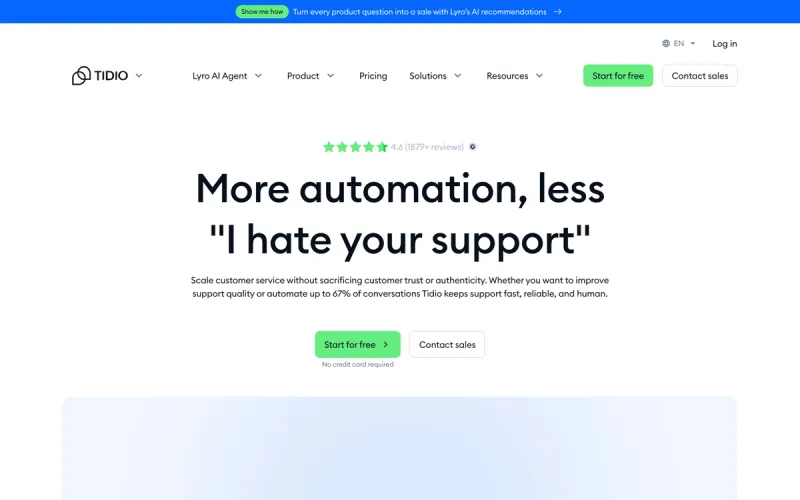
Live chat and support platform with Lyro AI agent for autonomous conversations across web, Instagram, Messenger, and WhatsApp.
Why consider Tidio
Tidio's Lyro AI agent handles conversations independently across web chat, Instagram, Messenger, and WhatsApp. It leans more toward support and live chat than social commerce automation, so it's a fit if that's actually your priority.
Pros
- +Free plan to start
- +Lyro AI agent runs conversations autonomously, not just scripted replies
- +7-day trial on paid plans to test before committing
Cons
- −Pricing jumps steeply from Growth ($49.17/mo) to Plus ($749/mo)
- −Geared more toward website/support chat than Instagram or WhatsApp commerce flows

Wati
Businesses where WhatsApp is the primary or only channel that matters
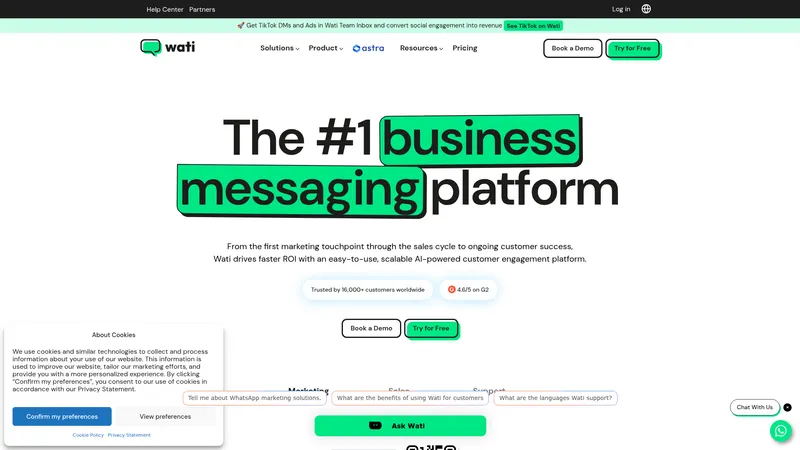
Conversational AI platform for marketing, sales, and support teams to engage customers across WhatsApp, Instagram, and other channels.
Why consider Wati
Wati is built around WhatsApp first, with Instagram and TikTok as secondary channels, plus a unified team inbox for managing conversations. If your customers live in WhatsApp, this is a narrower but deeper option than a generalist tool.
Pros
- +AI-powered chatbots with conversational intelligence
- +Multi-channel support spanning WhatsApp, Instagram, and TikTok
- +Team inbox keeps conversations from multiple channels in one place
Cons
- −Contact-sales pricing only, no public numbers to compare against
- −No free plan mentioned, so you can't test-drive it without a sales conversation
UChat
Teams that want the flexibility to mix rule-based flows with ChatGPT-powered bots
Omnichannel chatbot builder deploying flow-based + ChatGPT bots across 13+ platforms including WhatsApp, Instagram, Facebook, and web.
Why consider UChat
UChat deploys across 13+ platforms including WhatsApp, Instagram, Facebook, and web, combining traditional flow-based bots with ChatGPT integration. That flexibility is useful if you're not ready to commit fully to either approach.
Pros
- +Supports both flow-based bots and ChatGPT-powered bots in one platform
- +Covers 13+ platforms, broader channel reach than most competitors here
- +Useful middle ground for teams transitioning from rules to AI
Cons
- −I couldn't confirm a published entry price
- −Less of a track record compared to more established names on this list

Botpress
Businesses that want an AI handling full support workflows, not just chat replies
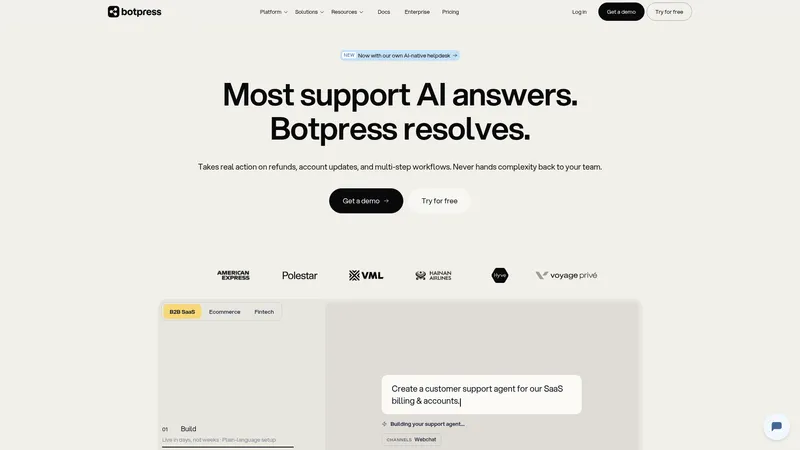
AI-native customer support helpdesk that resolves complex tickets, handles workflows, and learns from every resolution.
Why consider Botpress
Botpress is built to resolve complex, multi-step support tickets and escalations without routing back to a human team, and it learns from every resolution over time. Its usage-based pricing with no per-seat costs is a genuinely different model from the flat tiers most chat tools use.
Pros
- +No per-seat costs, pricing is based on usage with AI included
- +Handles multi-step workflows and escalations end-to-end
- +Enterprise security certifications: SOC II, GDPR compliant, KPMG tested
Cons
- −Contact-sales pricing means no quick self-serve signup
- −Built more for support ticket resolution than sales/marketing DM automation

Chatbase
Teams that want an AI trained specifically on their own documents and knowledge base
Multi-LLM chatbot platform for training custom AI on documents with deployment across WhatsApp, Instagram, Facebook, website, and Slack.
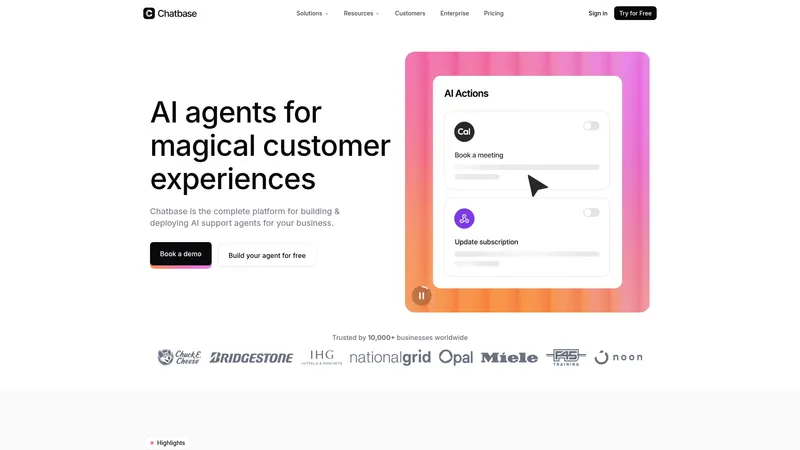
Why consider Chatbase
Chatbase lets you train a custom AI on your own content across multiple LLMs, then deploy it to WhatsApp, Instagram, Facebook, your website, or Slack. That document-training approach is different from Chatfuel's task-based 'AI coworker' framing.
Pros
- +Free plan available
- +Trains custom AI on your own documents across multiple LLMs
- +Deploys to five channels including Slack, which most competitors here don't cover
Cons
- −Standard ($120/mo) and Pro ($400/mo) tiers get expensive quickly
- −Annual billing is baked into the published rates ($384/year for Hobby), so check the fine print before assuming month-to-month flexibility

Intercom
Businesses that want published pricing and an AI built for autonomous ticket resolution across chat, email, and messenger
Customer communications platform with Fin AI for autonomous resolution of support tickets and sales inquiries across chat, email, and messenger.

Why consider Intercom
Intercom's Fin AI resolves support tickets and sales inquiries on its own, and unlike most tools on this list, Intercom's pricing is fully public with clear monthly and annual rates. The catch is it's built around chat/email/messenger support, not Instagram or WhatsApp commerce flows specifically.
Pros
- +Fin AI resolves tickets and inquiries autonomously, not just scripted replies
- +Transparent pricing: Essential at $39/mo monthly ($29/mo billed annually)
- +14-day trial to test before committing
Cons
- −Entry price is higher than most social-first chat tools on this list
- −Built primarily for chat/email/messenger support rather than Instagram/WhatsApp commerce automation
Price Chart
How Chatfuel compares on price
Of the 2 alternatives tracked, 2 start at a lower price than Chatfuel's $69/mo. 2 offer a free plan.


Checklist
What to look for in an alternative
Start with channel coverage. Which platforms does your audience actually message you on: Instagram DMs, WhatsApp, your website, or some mix? UChat spreads across 13+ platforms, while Intercom focuses on capturing website visitors for sales pipelines. Match the tool to where your conversations actually happen, not where you wish they happened.
Next, look at how the AI actually works. Some tools still run on rule-based flows you build yourself; others, like Chatbase, train a custom AI on your own documents, or use a dedicated conversational agent like Tidio's Lyro. If you're building toward an agentic marketing stack, check whether the platform exposes an API for automation.
Most social chat tools in this space haven't published MCP servers yet, so plan your integrations manually rather than assuming plug-and-play access. Finally, check pricing structure before you commit. Free plans (ManyChat, Tidio, Chatbase) let you test the workflow risk-free, but several jumps between tiers are steep.
Botpress and UChat publish full ladders, and Wati publishes tiers too, so you can compare real numbers without a sales call. Watch the billing toggle on each: Botpress and Chatfuel both headline the annual rate, so the first price you see is not the monthly one.
FAQ
Frequently Asked Questions
Chatfuel bills itself as an AI coworker that handles messaging, bookings, ad follow-ups, and strategy recommendations across Instagram, WhatsApp, and Facebook, rather than just answering incoming messages.
Chatfuel publishes its tiers: a free Chatfuel Light plan and AI PRO at $69/month, or $49/month billed yearly. No credit card is required to start on the free plan. Note the pricing page opens on the yearly tab, so the first number you see is the annual rate rather than the monthly one. See the Chatfuel Pricing breakdown for the full comparison.
ManyChat covers similar ground, Instagram, Messenger, WhatsApp, and SMS, with a published price ladder running from free up to $139/mo for the Elite plan.
Wati specializes in WhatsApp alongside Instagram and TikTok, though its pricing is contact-sales only, so you'll need to talk to their team for exact costs.
Yes. ManyChat, Tidio, and Chatbase all offer free plans. Just watch the paid tiers closely, Chatbase in particular jumps from free to $120/mo (Standard) once you outgrow the basics.
Botpress runs on usage-based pricing with no per-seat costs and is built to handle full support workflows autonomously, which lines up closely with how Chatfuel frames its own 'AI coworker' pitch.
Chatfuel notes no credit card is required to sign up. Among the alternatives, ManyChat, Tidio, and Chatbase also offer free tiers without upfront payment, though it's worth confirming current terms on each vendor's pricing page before you commit.
Still considering Chatfuel?
Check it out before committing to an alternative.
More on Chatfuel


Joonas Rotko
Author & founder of That Marketing Buddy
I score marketing software for AI-stack fit (MCP, API, agent-readiness), backed by 10+ years in digital marketing. I track 3 tools so you can find the right fit.
This page may contain affiliate links. I earn a commission at no extra cost to you. This never influences the recommendations.