

SEO & GEO professional · Hands-on review · Updated 2026-11-16
How this review was prepared
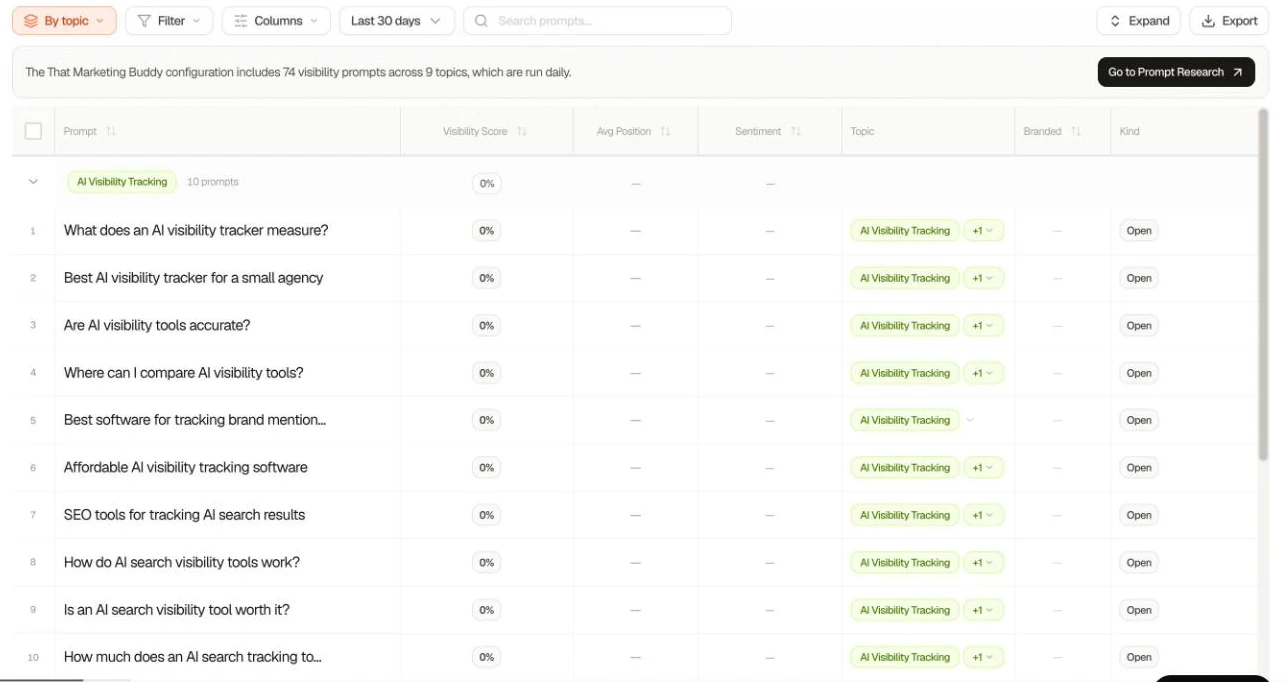
Account: a Searchable Pro trial on my own account, started November 9, 2026. Test project: thatmarketingbuddy.com, United States, English, tracked daily on ChatGPT, Google AI Overviews and Perplexity, the three engines the trial includes. Prompts: Searchable's own 50 suggested prompts plus the 24 prompts I use in every AI visibility review, 74 of the plan's 100. What I tested: setup and onboarding, the first days of data, every view in the app, the site health audit, opportunities, brand facts, reports, the built-in agent, LLM Analytics with a Vercel log drain, the add-on engine prices on the pricing page and in the app, and the MCP server from Claude Code with read and write access. On November 11 and 14, 2026 I fetched the same 24 prompts directly from ChatGPT and Google AI Overviews and compared whether my site was mentioned and cited with the flags Searchable stored for the same prompts, read through its summary view on November 12 and through its stored answers on November 14. My direct Perplexity fetches have failed since November 9, so Perplexity is not checked. Not tested: the add-on engines, which stay locked during the trial, the script-based visitor analytics, and the Scale and agency features such as white-label reports and Looker Studio.
Affiliate links on this page may earn me a commission, at no extra cost to you. They don't change what I recommend.
The Verdict
Is Searchable right for you?
Searchable is best for companies and agencies that take AI visibility seriously and want daily numbers on ChatGPT, Google AI Overviews and Perplexity. Pro costs $125 a month for 100 prompts; every other engine is a paid add-on, from $25 to $200 a month each.
Key findings from my test
- The app is polished and every number opens to the full stored answer and its sources. The MCP server has 60 tools and worked well from Claude Code.
- The default headline score counts prompts that name my own brand: 13.3% on day one, and 1.5% with unbranded prompts only.
- On November 14 its stored answers matched my own direct checks on mentions for all 24 prompts on ChatGPT and AI Overviews, and on citations for 23 of 24 (ChatGPT) and 24 of 24 (AI Overviews). Only 2 of the 24 prompts name my site, so the test is easy. Its summary view showed fewer citations than the stored answers behind it.
- Pro includes three engines. Google AI Mode and Gemini together take it from $125 to $200 a month, and add-ons stay locked during the trial.
- The audit and opportunities found a few real problems, but they are written for a software vendor, not a review site, and I counted about 22 false alarms among the 141 audit issues.
- Two things did not work as shown: every position cell in the Topics view reads #0.0, and LLM Analytics says "No cookies by default" while its script sets a visitor cookie unless you change one setting.
Quick answer: which tool fits you
- If you want daily tracking on ChatGPT, AI Overviews and Perplexity
 SearchableThis reviewPro $125 a month, 100 prompts
- If you need Gemini and Google AI Mode included
 SE Visible$89 a month, 75 prompts checked daily
- If you want five engines and weekly checks are enough
 LLM Pulse$58 a month, 50 prompts checked weekly
- If you want the cheapest way to start
 OtterlyLite $29 a month, 15 prompts checked daily
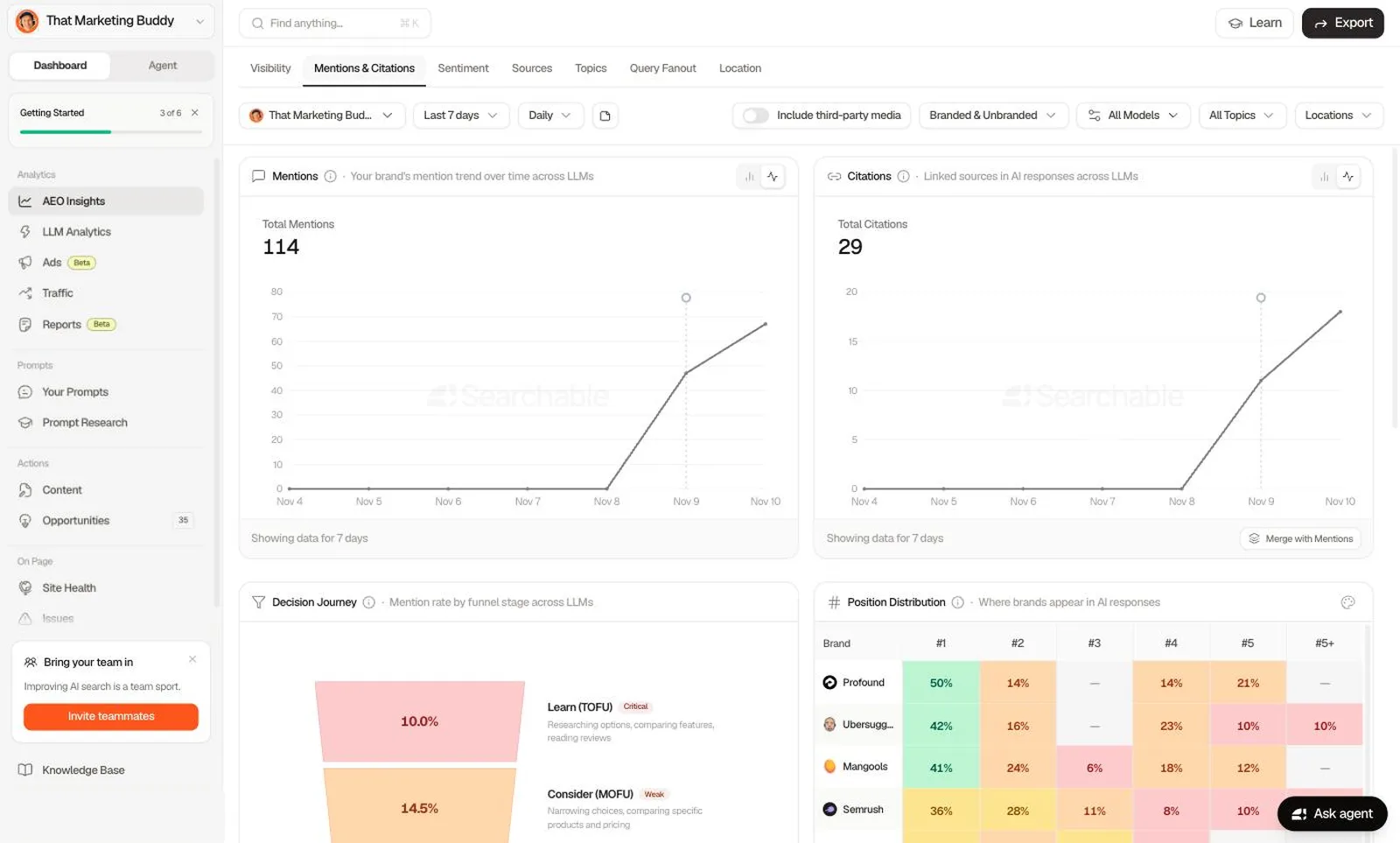
I tracked 74 prompts for thatmarketingbuddy.com on three AI engines and went through every view the trial opens. The answers arrived the same afternoon, every answer is stored in full with its sources, and the MCP server let me read and change the project from Claude Code. The numbers need care: the default headline score counts prompts that name my own brand, and its citation summary showed fewer citations than the stored answers behind it.
I would recommend it to companies that take this seriously and to agencies, and not to one-person side projects. The interface feels high quality and clear, like real effort went into it, and I would probably pay for it myself, especially for the agency features when working for several clients. If you need Google AI Mode and Gemini as well, Pro becomes $200 a month. SE Visible includes both for $89 a month, and LLM Pulse covers five engines for $58 a month with weekly checks.
My rating
4.0 / 5
- Data accuracy (my tests)4.0
Its stored answers matched my own same-day checks on mentions for all 24 prompts and on citations for 23 of 24 (ChatGPT) and 24 of 24 (AI Overviews); the per-prompt summary showed fewer citations than the answers behind it, and I could not check Perplexity.
- Features and depth4.0
Tracking, sources, topics, query fan-out, a site audit, opportunities, a content studio, reports and an agent sit in one app, but the audit raised about 22 false alarms among 141 issues and the opportunities are written for software vendors.
- Value for a small business3.5
$125 a month covers 100 prompts checked daily on three engines with unlimited seats, but Google AI Mode and Gemini together take it to $200, and every other engine is a paid add-on.
- Ease of use4.0
The app is polished and clear and every number opens to the stored answer, but the first minutes bring five interruptions and the default score counts prompts that name your own brand.
- AI search features4.5
The MCP server works on every paid plan, including the trial, and showed 60 tools in Claude Code; full list outputs were too large to read in one go.
- Trial and billing3.5
The 14-day trial needs a card and bills automatically when it ends, and add-on engines stay locked until you pay.
I rate only tools I have used myself, on criteria from 1 to 5, and leave out any I couldn't measure. The overall score is my own judgement, not an average. Rated 2026-11-17.
Compare it: Best AI visibility tools
Who It's For
Who Searchable is for (and who it isn't)
✓ Best for
- +Companies that take AI visibility seriously. Pro checks 100 prompts every day on ChatGPT, Google AI Overviews and Perplexity for $125 a month, with unlimited users and countries.
- +Agencies that work for several clients. The agency Launch plan costs $250 a month for 5 projects, 200 prompts, 200 separate pitch prompts, white-label reports and Looker Studio.
- +Teams that want every answer, not just a score. Each answer is stored in full with its sources and the brands it names, so you can check any number yourself.
- +Anyone who works through Claude or ChatGPT. The MCP server reads and changes projects, prompts, competitors and brand facts on every paid plan, including the trial.
× Consider something else if
- −You need Gemini and Google AI Mode included. SE Visible's Basic plan tracks ChatGPT, Gemini, Google AI Mode and AI Overviews daily for $89 a month. On Searchable those two engines add $75 a month to Pro.Try SE Visible →
- −Weekly checks are enough. LLM Pulse's Starter covers 50 prompts on five engines, Gemini and AI Mode included, for $58 a month, checked weekly.Try LLM Pulse →
- −You want the cheapest way to start. Otterly's Lite plan costs $29 a month for 15 prompts checked daily. Searchable's cheapest plan is $125 a month.Try Otterly →
What You Can Do
What can Searchable do?
Every Searchable feature, and who it is for
This table covers every feature in the Searchable app in November 2026, with my verdict on each after the first days. The sections below go through them in a similar order.
Visibility dashboard
- What it does
- Daily visibility score, share of voice and a rankings table of the brands AI names
- My verdict
- Clear, but the default score includes brand prompts
- Best for
- Everyone
Prompts and stored answers
- What it does
- Every answer per engine and run, with its sources and brands
- My verdict
- The best part. It makes the numbers checkable
- Best for
- Everyone
Mentions and citations
- What it does
- Counts of mentions and citations per engine, with trend
- My verdict
- Useful. The summary view undercounted citations; the stored answers matched my checks
- Best for
- Content and PR work
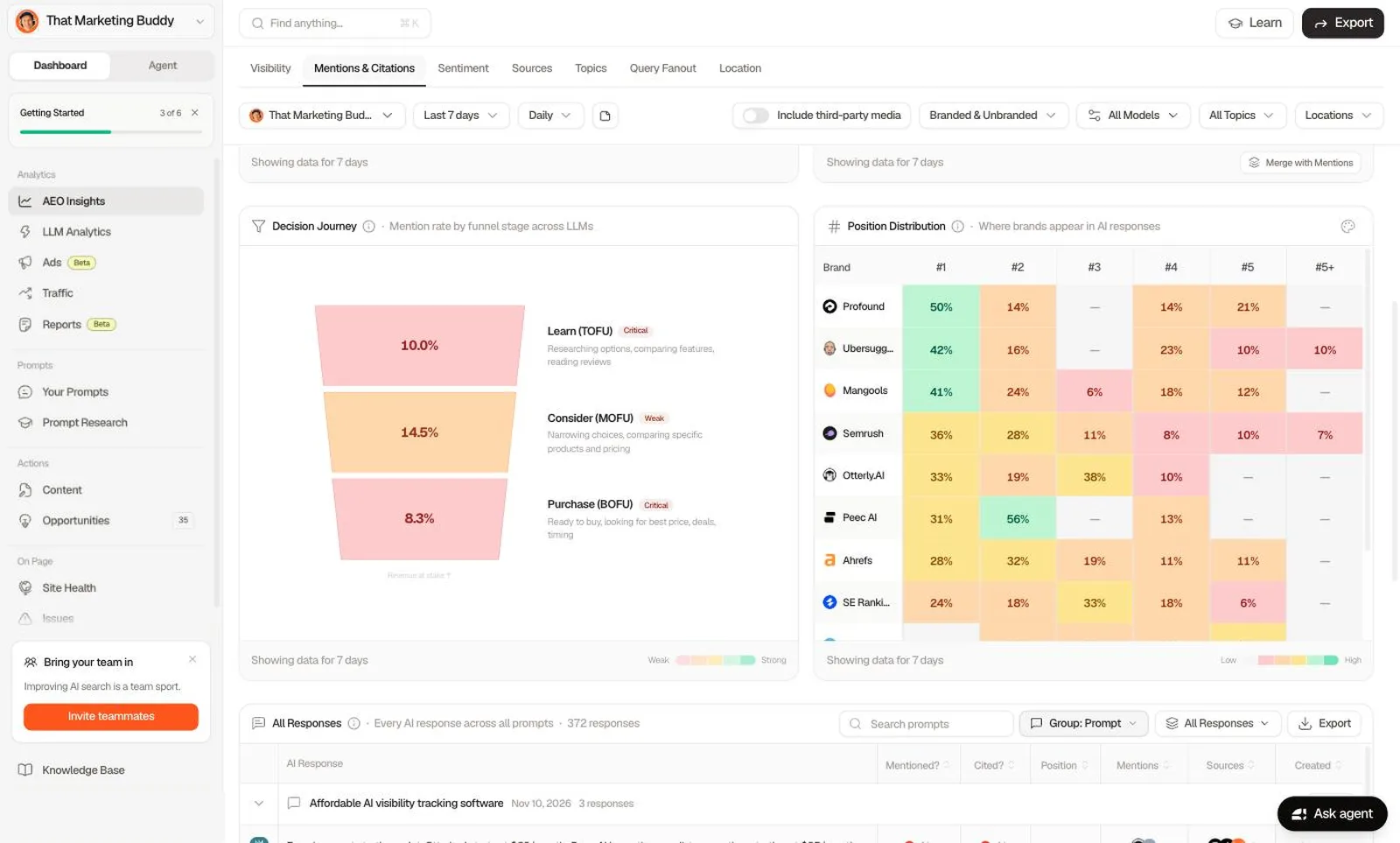
Decision Journey
- What it does
- Visibility split by funnel stage
- My verdict
- Clear view of where in the funnel the mentions are
- Best for
- Teams with a funnel
Sources
- What it does
- Top cited domains, content types and URLs
- My verdict
- Good data, easy to scan
- Best for
- Content and PR work
Topics and position
- What it does
- Visibility per topic and average position
- My verdict
- Did not work: every position reads #0.0
- Best for
- Not usable yet
Query fan-out
- What it does
- The related queries engines run for a prompt, with a Track button
- My verdict
- Useful for outlining pages
- Best for
- Content writers
LLM Analytics
- What it does
- AI crawler visits from your server logs, plus an optional script
- My verdict
- Promising. The cookie claim does not match the script default
- Best for
- Sites with log access
Site health audit
- What it does
- Technical and AEO audit of up to 200 pages
- My verdict
- Fast. 2 page-specific catches, about 22 false alarms
- Best for
- Teams that check the findings
Opportunities
- What it does
- A prioritised to-do list from the audit and the answers
- My verdict
- Written for software vendors, so several items did not fit
- Best for
- Software companies
Brand facts
- What it does
- The statements AI makes about you, which you mark right or wrong
- My verdict
- The most useful action view. Marking facts changed my brand profile overnight
- Best for
- Everyone
Content Studio
- What it does
- AI article drafts for the topics you want to win
- My verdict
- Empty in my account, so no verdict
- Best for
- Not rated
Reports
- What it does
- Three templates, sharing, white label on a higher tier
- My verdict
- Looks professional. One headline claim was misleading
- Best for
- Agencies
Built-in agent
- What it does
- Ask questions about your data in plain language
- My verdict
- Fast, but its numbers differ from the dashboard
- Best for
- Quick lookups
MCP server and API
- What it does
- Read and change the project from Claude or ChatGPT
- My verdict
- Clear and smooth. Large list outputs
- Best for
- AI-assisted workflows
Add-on engines
- What it does
- Seven more engines, priced per plan
- My verdict
- Not tested. Locked on the trial
- Best for
- Brands that need Google AI Mode or Gemini
| Feature | What it does | My verdict | Best for |
|---|---|---|---|
| Visibility dashboard | Daily visibility score, share of voice and a rankings table of the brands AI names | Clear, but the default score includes brand prompts | Everyone |
| Prompts and stored answers | Every answer per engine and run, with its sources and brands | The best part. It makes the numbers checkable | Everyone |
| Mentions and citations | Counts of mentions and citations per engine, with trend | Useful. The summary view undercounted citations; the stored answers matched my checks | Content and PR work |
| Decision Journey | Visibility split by funnel stage | Clear view of where in the funnel the mentions are | Teams with a funnel |
| Sources | Top cited domains, content types and URLs | Good data, easy to scan | Content and PR work |
| Topics and position | Visibility per topic and average position | Did not work: every position reads #0.0 | Not usable yet |
| Query fan-out | The related queries engines run for a prompt, with a Track button | Useful for outlining pages | Content writers |
| LLM Analytics | AI crawler visits from your server logs, plus an optional script | Promising. The cookie claim does not match the script default | Sites with log access |
| Site health audit | Technical and AEO audit of up to 200 pages | Fast. 2 page-specific catches, about 22 false alarms | Teams that check the findings |
| Opportunities | A prioritised to-do list from the audit and the answers | Written for software vendors, so several items did not fit | Software companies |
| Brand facts | The statements AI makes about you, which you mark right or wrong | The most useful action view. Marking facts changed my brand profile overnight | Everyone |
| Content Studio | AI article drafts for the topics you want to win | Empty in my account, so no verdict | Not rated |
| Reports | Three templates, sharing, white label on a higher tier | Looks professional. One headline claim was misleading | Agencies |
| Built-in agent | Ask questions about your data in plain language | Fast, but its numbers differ from the dashboard | Quick lookups |
| MCP server and API | Read and change the project from Claude or ChatGPT | Clear and smooth. Large list outputs | AI-assisted workflows |
| Add-on engines | Seven more engines, priced per plan | Not tested. Locked on the trial | Brands that need Google AI Mode or Gemini |
Searchable Pro trial, November 9 to 16, 2026. thatmarketingbuddy.com, US, English.
What it's like to use
The interface feels really high quality and clear, like real effort went into it. It is the same feeling I got from Promptwatch when I tested it on six AI engines, and it gives a trustworthy overall impression. If you are still choosing, I compare it with the others in the AI visibility tools I have tested.
It is built for companies that take AI visibility seriously, and for agencies. I would not recommend it to a one-person side project.
What I liked most is how clear the MCP connection and the AI use are: they seem really smooth. What I liked second is that Searchable built its own analytics tool that you install on your site. In my view it can give better data than something like Google Analytics, few tools have this, and it is a big plus. I connected only the server-log part of it, described below.
The slowest views take 20 to 30 seconds to open, and the first minutes are noisy with videos, pop-ups and a chat widget. After that it is calm.
Setup and how fast the first data arrives
Setup took about 2.5 minutes and six screens before the plan choice: brand or agency, website, brand name, market, competitors, and a first-report screen. Searchable guessed my brand name correctly and let me add a second spelling. It set no default country or language, so I picked United States and English myself.
Its five suggested competitors were all software directories (SaaSworthy, AlternativeTo, TrustRadius, Crozdesk, Tekpon). They are not the sites I compete with, so I entered my own five.
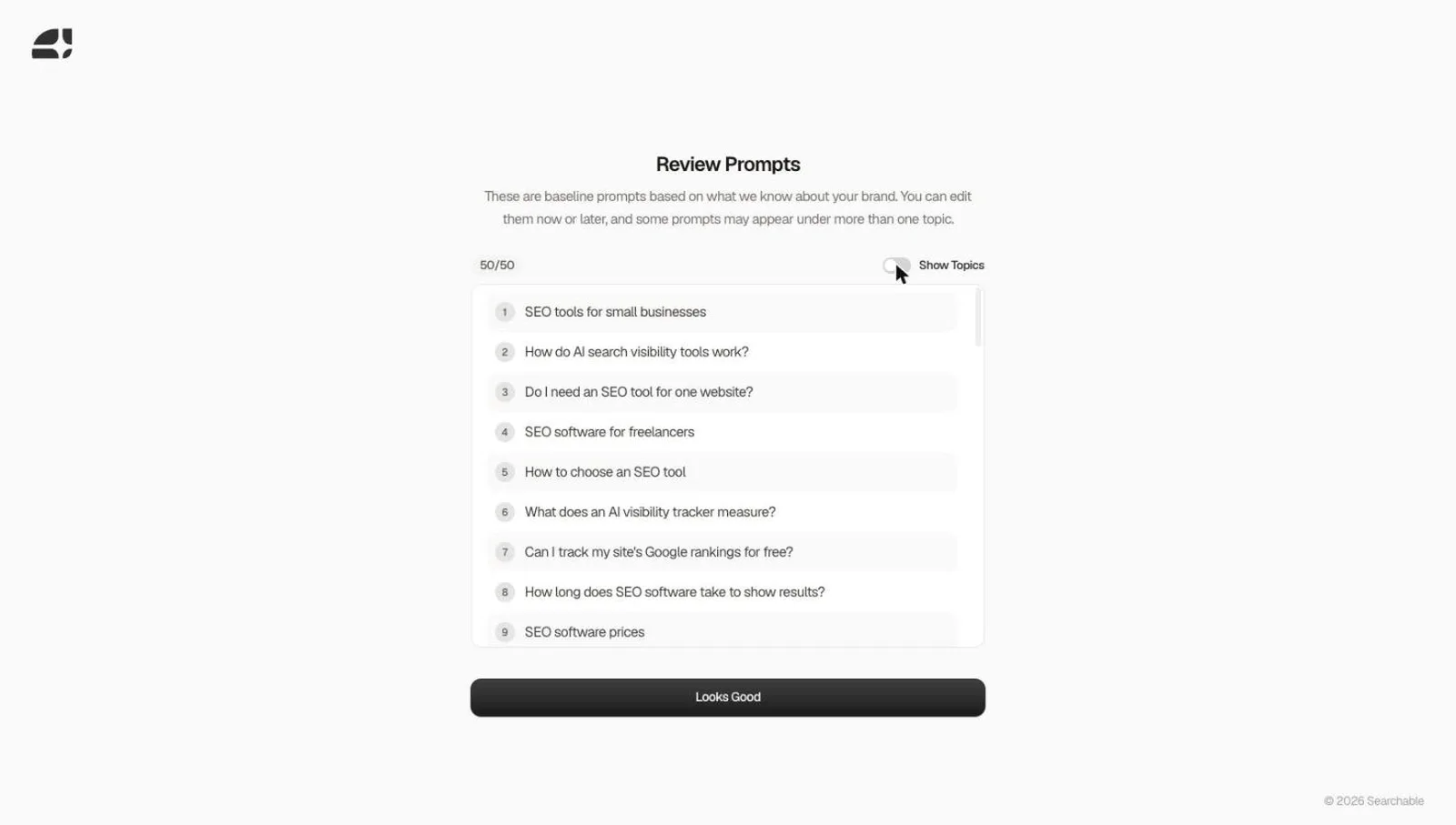
The prompt list comes after the plan choice: 50 prompts in 8 topics, all preselected, 6 of them naming my brand. A Prompt Research view proposed 133 more, which don't count toward the plan. I added my own 24 prompts with a CSV upload in under a minute; the counter only showed 74 of 100 after a page reload. The first answers were in the dashboard the same afternoon.
The first minutes are noisy: an auto-playing welcome video, a dialog that claims viewers "improve their AI search visibility by 2.6x" when you skip it, a webinar pop-up, a training banner, a chat widget and a product tour, five interruptions in about two minutes.
Screens before the plan choice
- Result
- 6, about 2.5 minutes
Default country and language
- Result
- None, you pick
Suggested competitors
- Result
- 5 software directories
Suggested prompts
- Result
- 50 in 8 topics, 6 naming my brand
Extra prompts proposed
- Result
- 133, outside the plan limit
First data
- Result
- Same afternoon
Pop-ups and promos in the first minutes
- Result
- 5
| Setup, November 9, 2026 | Result |
|---|---|
| Screens before the plan choice | 6, about 2.5 minutes |
| Default country and language | None, you pick |
| Suggested competitors | 5 software directories |
| Suggested prompts | 50 in 8 topics, 6 naming my brand |
| Extra prompts proposed | 133, outside the plan limit |
| First data | Same afternoon |
| Pop-ups and promos in the first minutes | 5 |
thatmarketingbuddy.com, Pro trial, United States, English.
Is the headline visibility score what it looks like?
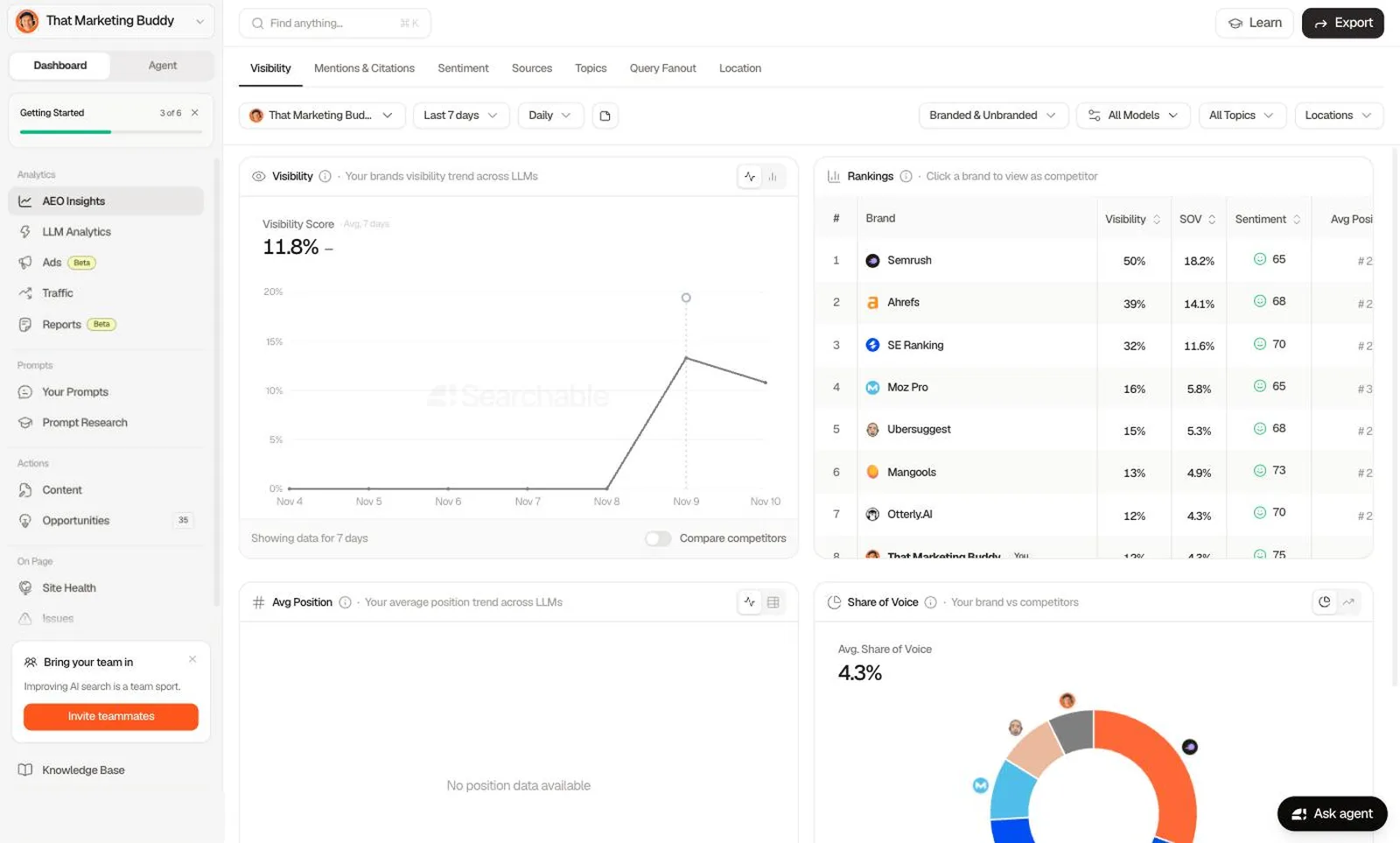
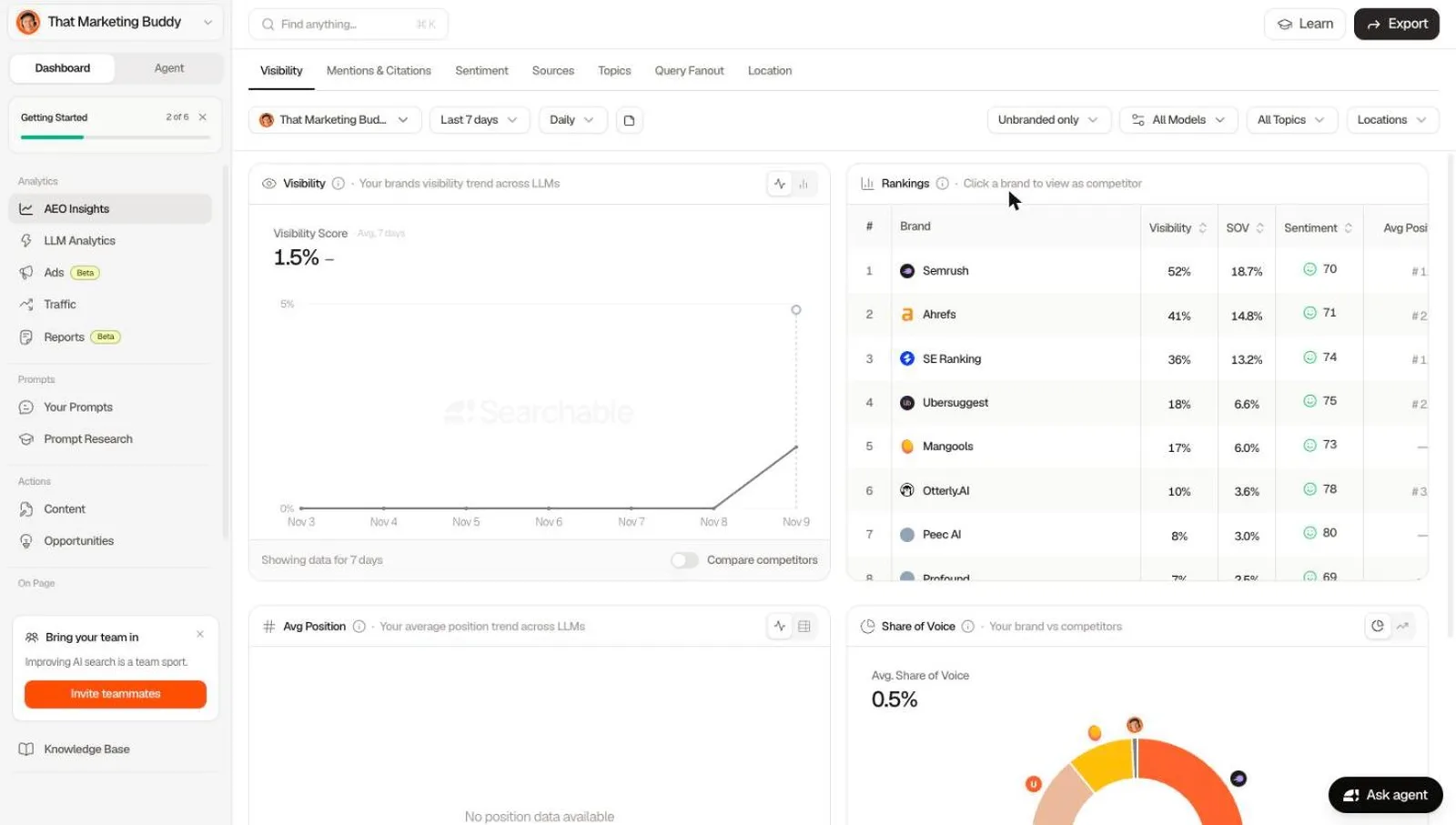
No. On the first day the dashboard opened on "Branded & Unbranded" prompts and showed my visibility at 13.3%, with my site sixth among 61 brands. Switched to unbranded prompts only, it read 1.5%. The difference is the prompts that name my brand: 6 of Searchable's own 50, plus 2 of mine. On ChatGPT my site was mentioned in 6 of the 50 answers, and all 6 came from prompts that named it; none of the 44 unbranded prompts mentioned it.
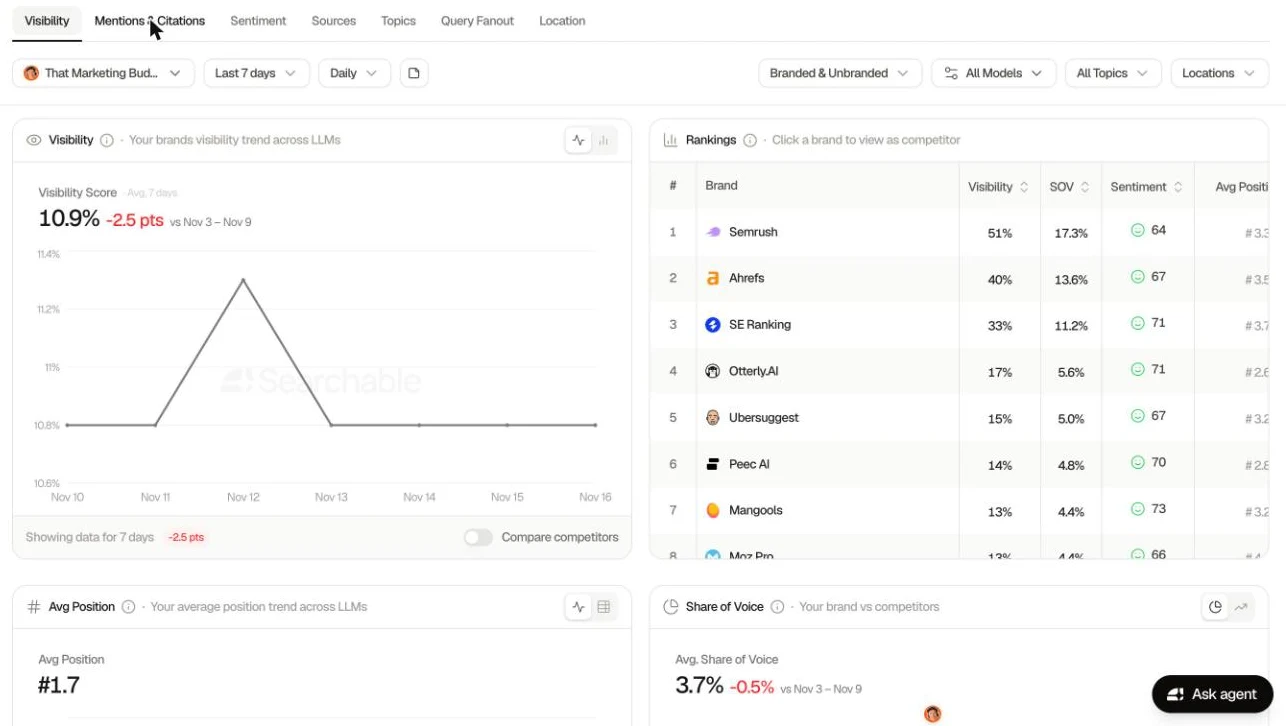
The score moved over the first days, but not because of my site. It read 13.3% on November 9 with 50 prompts, 10.8% on November 10 after my 24 prompts joined (Searchable flagged the changed prompt set), and 11.3% on November 12. On November 10 all three engines showed exactly 10.8%. That is not a rollup bug: the 8 prompts that name my brand are mentioned 100% of the time on every engine, and on November 12 only 1 of the 66 unbranded prompts mentioned my site, on Perplexity, which is the 1.5%.
The brand ranking also ignores the five competitors I entered: it lists the brands it found in the answers, so mine were Semrush, Ahrefs, SE Ranking, Ubersuggest and Mangools, the tools my site reviews. Read the unbranded number before you quote any score, and expect it to be low for a small site.
November 9, branded and unbranded (default view)
- Result
- 13.3%
November 9, unbranded prompts only
- Result
- 1.5%
November 10, 74 prompts, default view
- Result
- 10.8%, the same on all 3 engines
November 12, default view
- Result
- 11.3%
November 12, unbranded prompts mentioning my site
- Result
- 1 of 66, Perplexity only
November 10 to 16, default view, 7-day average
- Result
- 10.9%, shown as 2.5 points down against a week with one day of data
Share of voice, November 9 default view
- Result
- 5.2% across 61 brands
Average position
- Result
- "No position data available"
| Visibility, thatmarketingbuddy.com | Result |
|---|---|
| November 9, branded and unbranded (default view) | 13.3% |
| November 9, unbranded prompts only | 1.5% |
| November 10, 74 prompts, default view | 10.8%, the same on all 3 engines |
| November 12, default view | 11.3% |
| November 12, unbranded prompts mentioning my site | 1 of 66, Perplexity only |
| November 10 to 16, default view, 7-day average | 10.9%, shown as 2.5 points down against a week with one day of data |
| Share of voice, November 9 default view | 5.2% across 61 brands |
| Average position | "No position data available" |
74 prompts on ChatGPT, Google AI Overviews and Perplexity, US. The prompt set grew from 50 to 74 on November 10.
Do its numbers match the real AI answers?
Mostly yes, if you read the stored answers. The summary views were the weak spot.
On November 11 and 14, 2026 I fetched the same 24 prompts directly from ChatGPT and Google AI Overviews and compared them with what Searchable stored. On November 14 the mention flags matched my checks on all 24 prompts on both engines. That sounds perfect, but it proves little: only the 2 prompts that name my site are positive anywhere, and 22 of the 24 are negative on both sides. It tells me Searchable does not invent mentions.
Citations are the harder test. In the stored answers, Searchable listed my site among the sources on the same prompts as my direct check on 23 of 24 prompts on ChatGPT and 24 of 24 on AI Overviews. The one difference was the email marketing software for agencies prompt on ChatGPT, where my direct fetch cited my site and Searchable's stored answer did not. Real answers move on their own: between my two direct fetches on November 11 the cited flag changed on 2 of 24 prompts on ChatGPT and 1 of 24 on AI Overviews, so a one-prompt gap is within that noise.
The summary view and the answer view disagreed. On November 12 the per-prompt summary showed no brand citation on 3 of the 4 prompts where my direct check found my site as a source. On November 14 it showed 0 citations on every AI Overviews prompt, although my site is among the sources of three of those answers, and it also showed 0 for a few ChatGPT and Perplexity prompts whose answers cite it. If you quote a citation count, open the answer behind it.
I could not check Perplexity: my direct fetches for it have failed since November 9, so it has no second source. Searchable's stored Perplexity answers on November 14 mention my site on the same 2 prompts as the other engines and cite it on 3.
I also compared its crawler view with my own server logs, using shares only. Among the three AI assistant crawlers Searchable shows OpenAI 68%, Perplexity 17% and Anthropic 15%, while my own logs show OpenAI 25%, Perplexity 68% and Anthropic 6%. The totals are within 3% of each other, but the mix is not the same. I would use it as a second opinion, not as the count.
ChatGPT: site mentioned
- Searchable vs my checks
- 24 of 24
- My checks vs each other
- 24 of 24
AI Overviews: site mentioned
- Searchable vs my checks
- 24 of 24
- My checks vs each other
- 24 of 24
ChatGPT: site cited, stored answers
- Searchable vs my checks
- 23 of 24
- My checks vs each other
- Cited flag changed on 2 of 24 between my Nov 11 runs
AI Overviews: site cited, stored answers
- Searchable vs my checks
- 24 of 24
- My checks vs each other
- Cited flag changed on 1 of 24 between my Nov 11 runs
Citations in the per-prompt summary view
- Searchable vs my checks
- No brand citation on 3 of the 4 prompts my check found (Nov 12)
- My checks vs each other
- Not applicable
Perplexity
- Searchable vs my checks
- Not checked, no second source
- My checks vs each other
- No working direct check
| Agreement on 24 prompts | Searchable vs my checks | My checks vs each other |
|---|---|---|
| ChatGPT: site mentioned | 24 of 24 | 24 of 24 |
| AI Overviews: site mentioned | 24 of 24 | 24 of 24 |
| ChatGPT: site cited, stored answers | 23 of 24 | Cited flag changed on 2 of 24 between my Nov 11 runs |
| AI Overviews: site cited, stored answers | 24 of 24 | Cited flag changed on 1 of 24 between my Nov 11 runs |
| Citations in the per-prompt summary view | No brand citation on 3 of the 4 prompts my check found (Nov 12) | Not applicable |
| Perplexity | Not checked, no second source | No working direct check |
Searchable's stored answers vs my direct fetches on November 14, 2026; my own fetches vs each other on November 11. thatmarketingbuddy.com, US, English.
How many answers does Searchable collect per prompt?
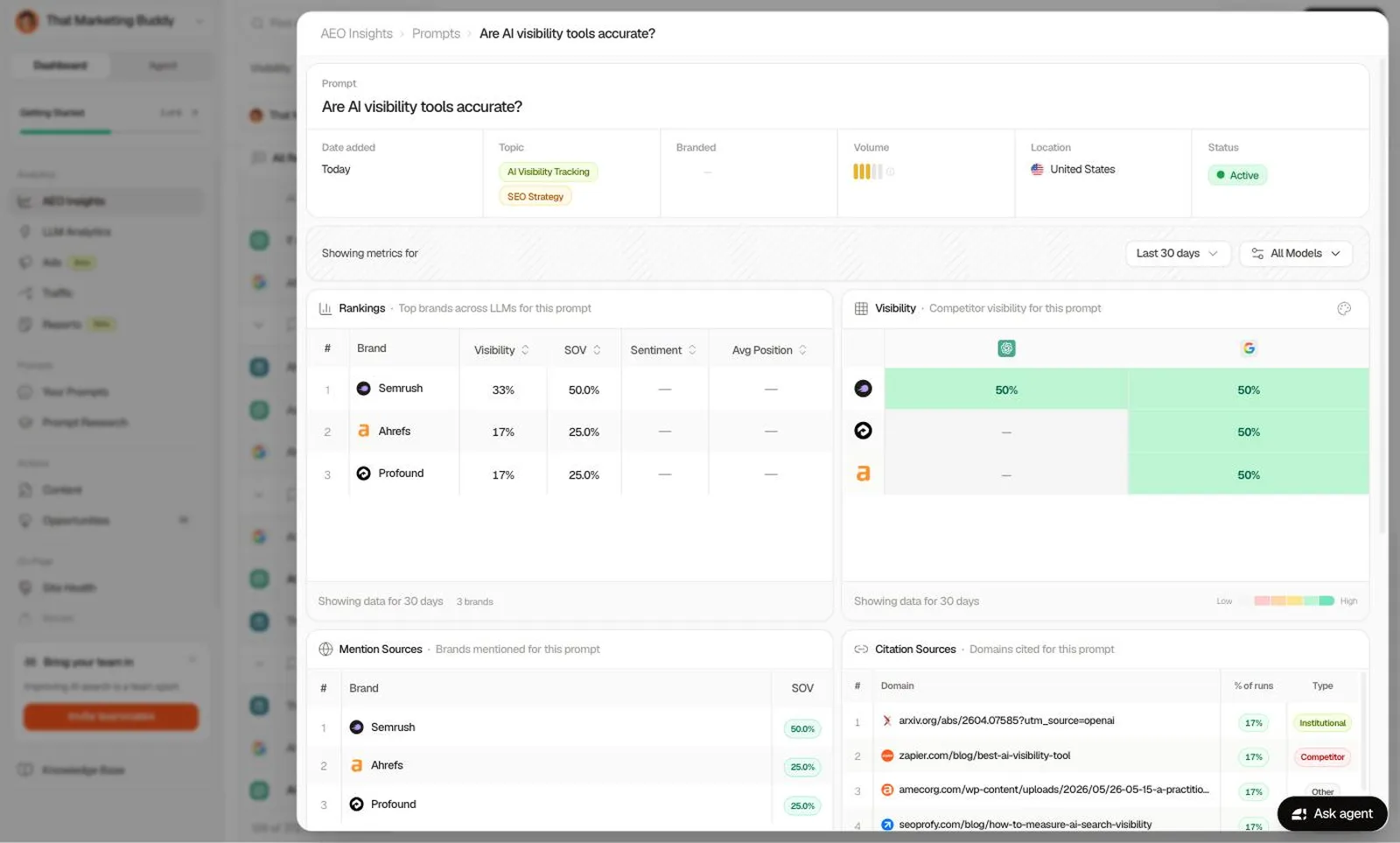
One per engine per day. Pro includes 9,000 answers a month, which is 100 prompts on three engines once a day for 30 days. The first run showed three answers per prompt, one from each engine, all within the same minute, and on November 10 all 222 expected answers (74 prompts on 3 engines) were there.
The prompt limit is counted per prompt, not per prompt and engine, so 74 prompts used 74 of the 100. Archiving a prompt frees its slot and keeps its history. Prompts added after a run wait for the next one: the first run used only Searchable's 50 prompts, so my 24 got no answers on day one.
One answer a day means a single day's number can move because the AI answer changed, not because anything changed on your site. In my own direct checks the cited flag changed on 0 to 2 of 24 prompts between runs, so part of a one-day move can be noise.
Which AI engines does Searchable track, and what do the others cost?
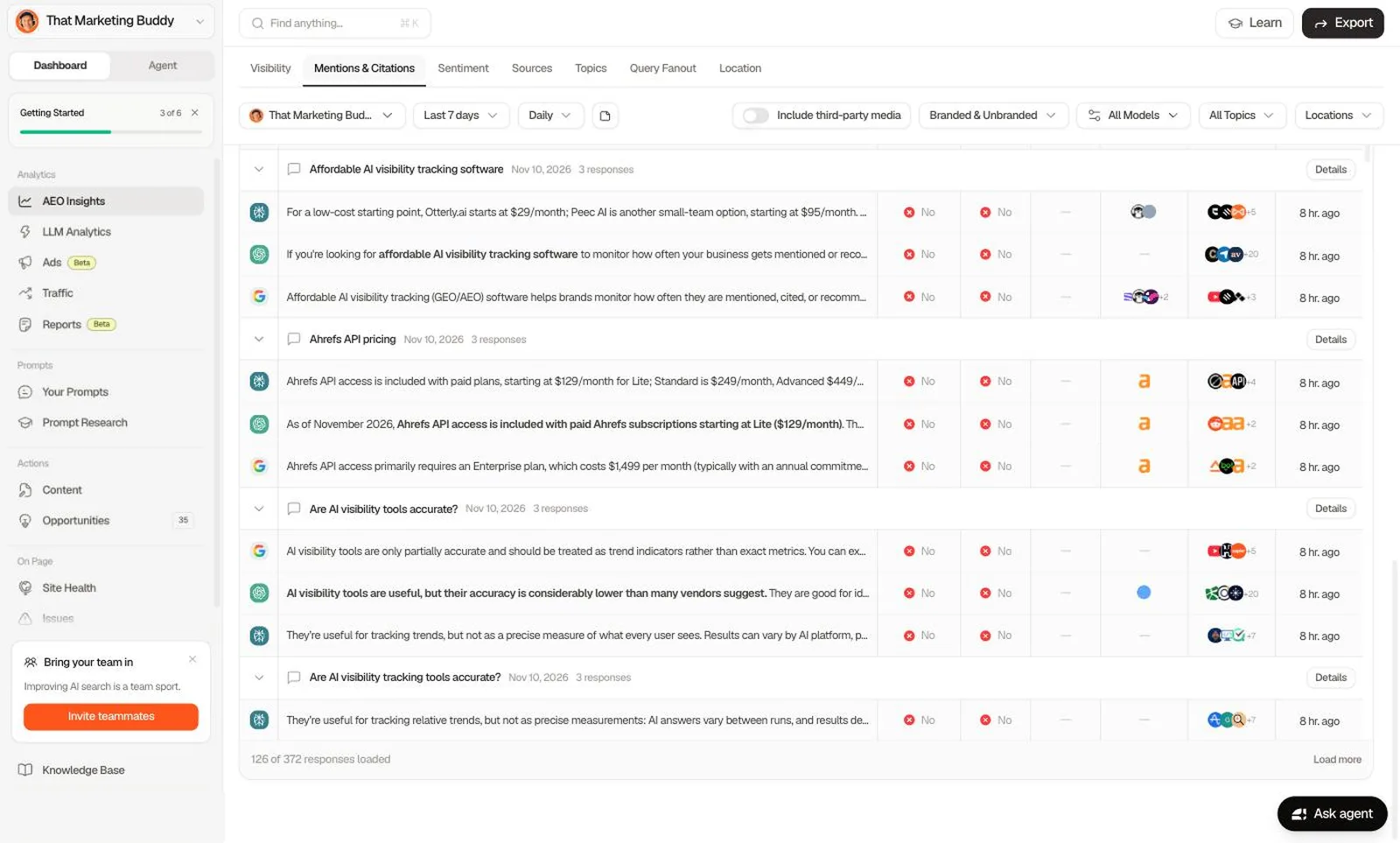
Every plan includes three engines: ChatGPT, Google AI Overviews and Perplexity. Seven more are paid add-ons on every plan: Google AI Mode, Microsoft Copilot, DeepSeek, Gemini, Claude, Grok and Meta Muse. Claude and Grok also come as cheaper "Lite" versions that answer from training data with web search turned off, so their answers have no live citations. Add-on prices rise with the plan: Gemini costs $50 a month on Pro and $250 a month on Scale. Paying yearly takes 20% off the plan but not the add-ons. During the trial the add-ons are locked; the app marks them "After trial" and says buying one ends the trial, so you can't test Gemini or AI Mode before you pay.
ChatGPT, AI Overviews, Perplexity
- Pro
- Included
- Scale
- Included
- Agency Launch
- Included
- Enterprise
- Included
Google AI Mode, Copilot, DeepSeek (each)
- Pro
- +$25
- Scale
- +$125
- Agency Launch
- +$50
- Enterprise
- +$315
Gemini
- Pro
- +$50
- Scale
- +$250
- Agency Launch
- +$100
- Enterprise
- +$625
Claude Lite, Grok Lite (each)
- Pro
- +$50
- Scale
- +$250
- Agency Launch
- +$100
- Enterprise
- +$625
Claude, Grok, Meta Muse (each)
- Pro
- +$200
- Scale
- +$1,000
- Agency Launch
- +$400
- Enterprise
- +$2,500
| Add-on engine, per month | Pro | Scale | Agency Launch | Enterprise |
|---|---|---|---|---|
| ChatGPT, AI Overviews, Perplexity | Included | Included | Included | Included |
| Google AI Mode, Copilot, DeepSeek (each) | +$25 | +$125 | +$50 | +$315 |
| Gemini | +$50 | +$250 | +$100 | +$625 |
| Claude Lite, Grok Lite (each) | +$50 | +$250 | +$100 | +$625 |
| Claude, Grok, Meta Muse (each) | +$200 | +$1,000 | +$400 | +$2,500 |
Searchable pricing page, November 9, 2026, USD per month. Same add-on prices on yearly billing. Agency Growth uses the Scale prices.
What a small business really pays for the engines it needs
For most small businesses the engines that matter after ChatGPT are Google's: AI Mode and Gemini. On Searchable that makes Pro $200 a month, or $175 a month billed yearly, for 100 prompts checked daily on five engines. That is less than Otterly's Standard plan with the same two add-ons ($189 a month plus $59 a month each, $307 a month for 100 prompts, see my Otterly review), but more than SE Visible's Basic plan, which includes Gemini and AI Mode for $89 a month on 75 prompts without Perplexity. LLM Pulse's Starter includes all five for $58 a month on 50 prompts, checked weekly. Claude is the expensive one: $200 a month on Pro, which takes the plan to $325 a month. Every engine you add also multiplies the answers you have to read.
ChatGPT, AI Overviews, Perplexity
- Searchable Pro, monthly
- $125/month
- Searchable Pro, billed yearly
- $100/month
+ Google AI Mode
- Searchable Pro, monthly
- $150/month
- Searchable Pro, billed yearly
- $125/month
+ Google AI Mode and Gemini
- Searchable Pro, monthly
- $200/month
- Searchable Pro, billed yearly
- $175/month
+ Claude
- Searchable Pro, monthly
- $325/month
- Searchable Pro, billed yearly
- $300/month
+ all seven full add-ons
- Searchable Pro, monthly
- $850/month
- Searchable Pro, billed yearly
- $825/month
| Engines checked daily, 100 prompts | Searchable Pro, monthly | Searchable Pro, billed yearly |
|---|---|---|
| ChatGPT, AI Overviews, Perplexity | $125/month | $100/month |
| + Google AI Mode | $150/month | $125/month |
| + Google AI Mode and Gemini | $200/month | $175/month |
| + Claude | $325/month | $300/month |
| + all seven full add-ons | $850/month | $825/month |
Per month, USD, before tax. Yearly prices are the per-month equivalent: plan discounted 20%, add-ons not.
Sources and citations: which pages the AI answers use
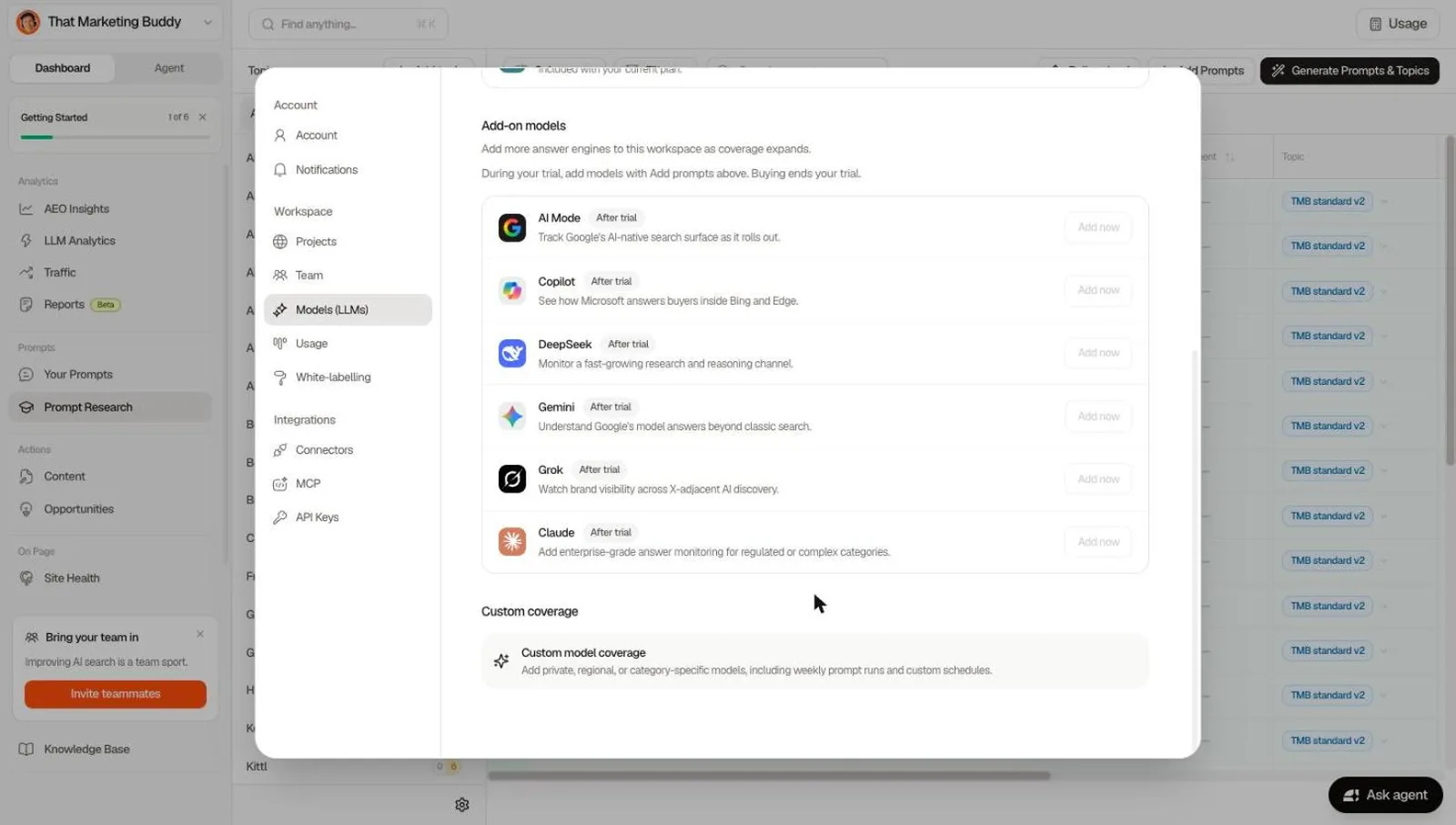
Sources shows who wins the answers. It lists the top cited domains, the content types and every cited URL. On unbranded ChatGPT prompts, semrush.com was cited in 48.6% of answers. My own site shows up as "Owned" at 6.2%.
Each source in a prompt's detail view carries a type, and Perplexity gets one extra distinction: Searchable separates the citations the answer shows inline from the sources the engine consulted, so a 0 for citations can sit next to hundreds of sources. For content and PR work this is the view I would open first: it shows which sites to get mentioned on.
Topics and the position view: numbers that did not work
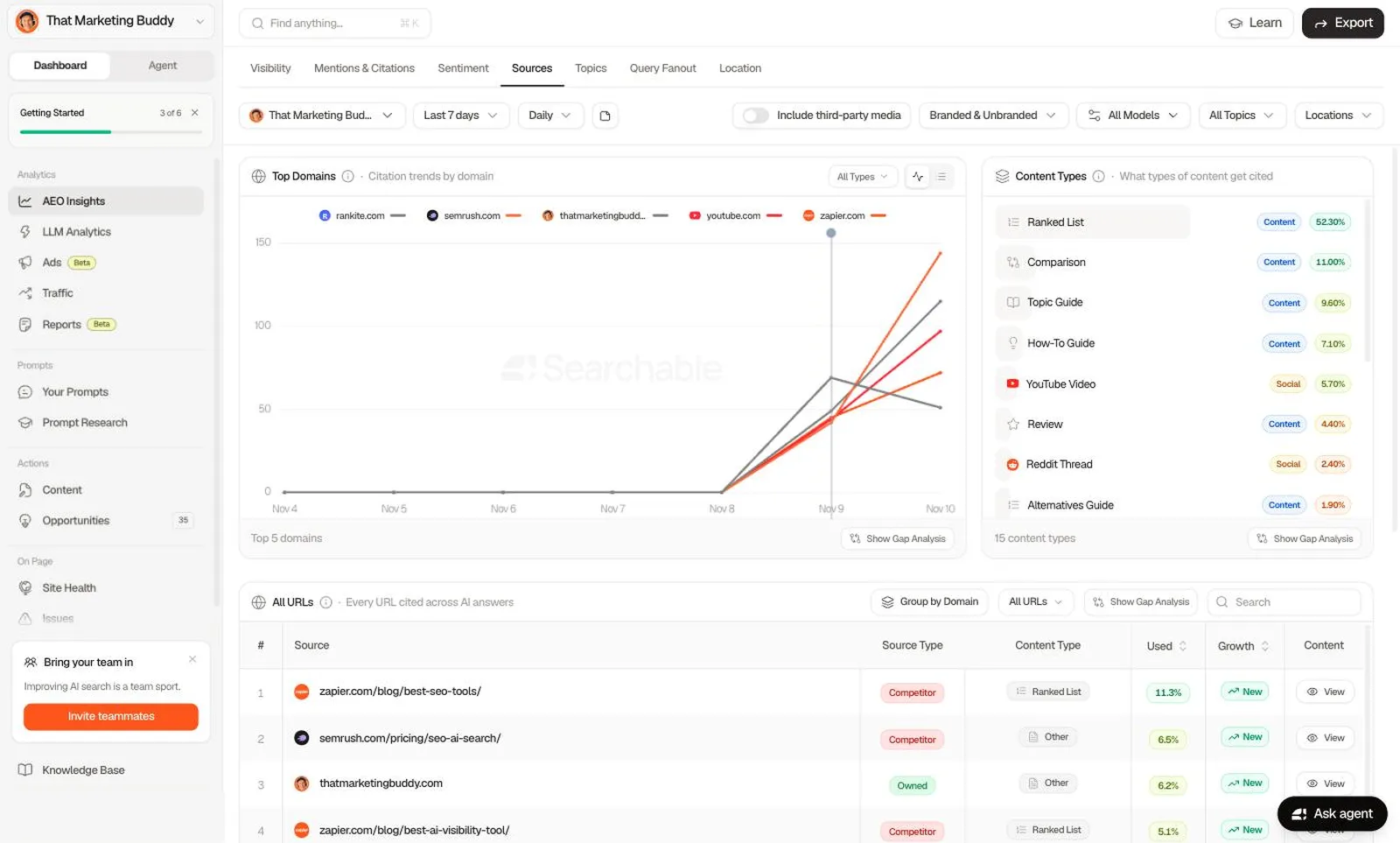
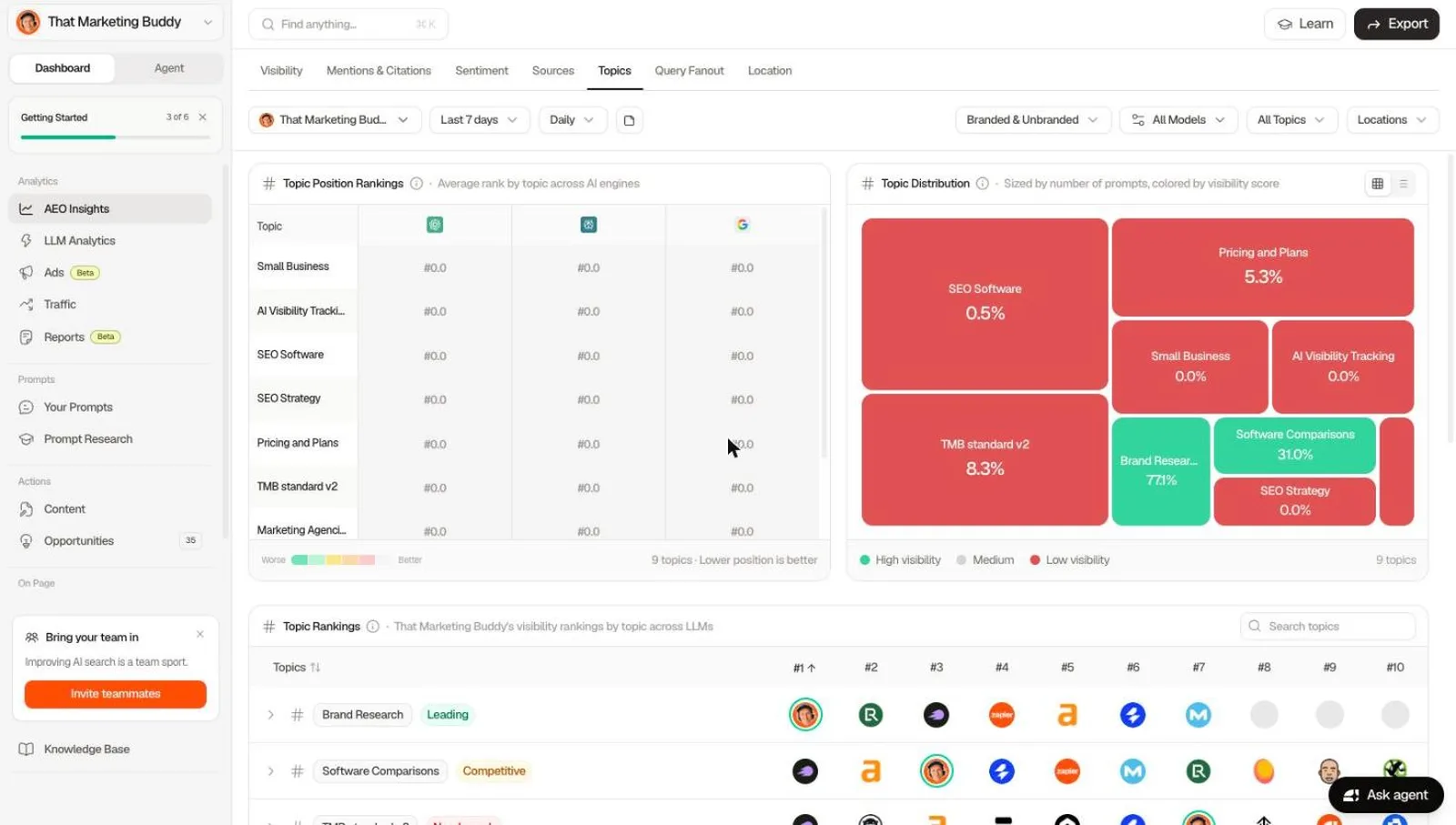
The Topics view groups prompts into topics and should show how visible you are in each. On November 10, every position cell read #0.0, and the Avg Position figure elsewhere in the app was empty. A number of zero position is not a rank, so I could not use the view.
The trend chart has a related quirk: it plots November 4 to 8 as 0%, days before I created the project. A new user reads that as a rise from nothing. Other views, such as Mentions and Citations and Sources, worked.
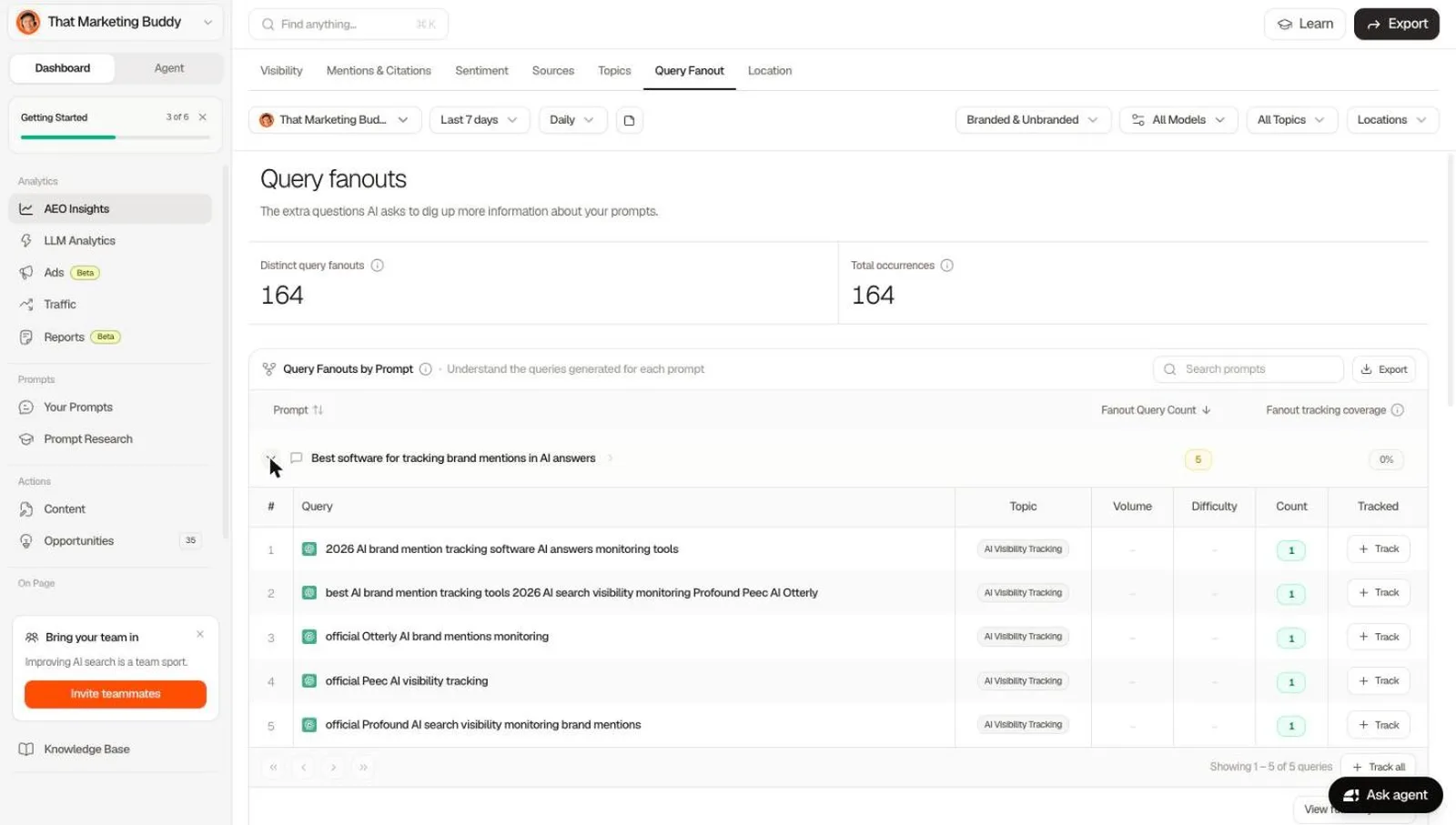
Query fan-out: the questions the engines ask behind a prompt
Query fan-out lists the related queries the AI engines run behind your prompts. My 74 prompts produced 164 distinct fan-out queries, and every row has a Track button that turns it into a tracked prompt.
It is useful for outlining a page: the list shows the questions an answer is built from.
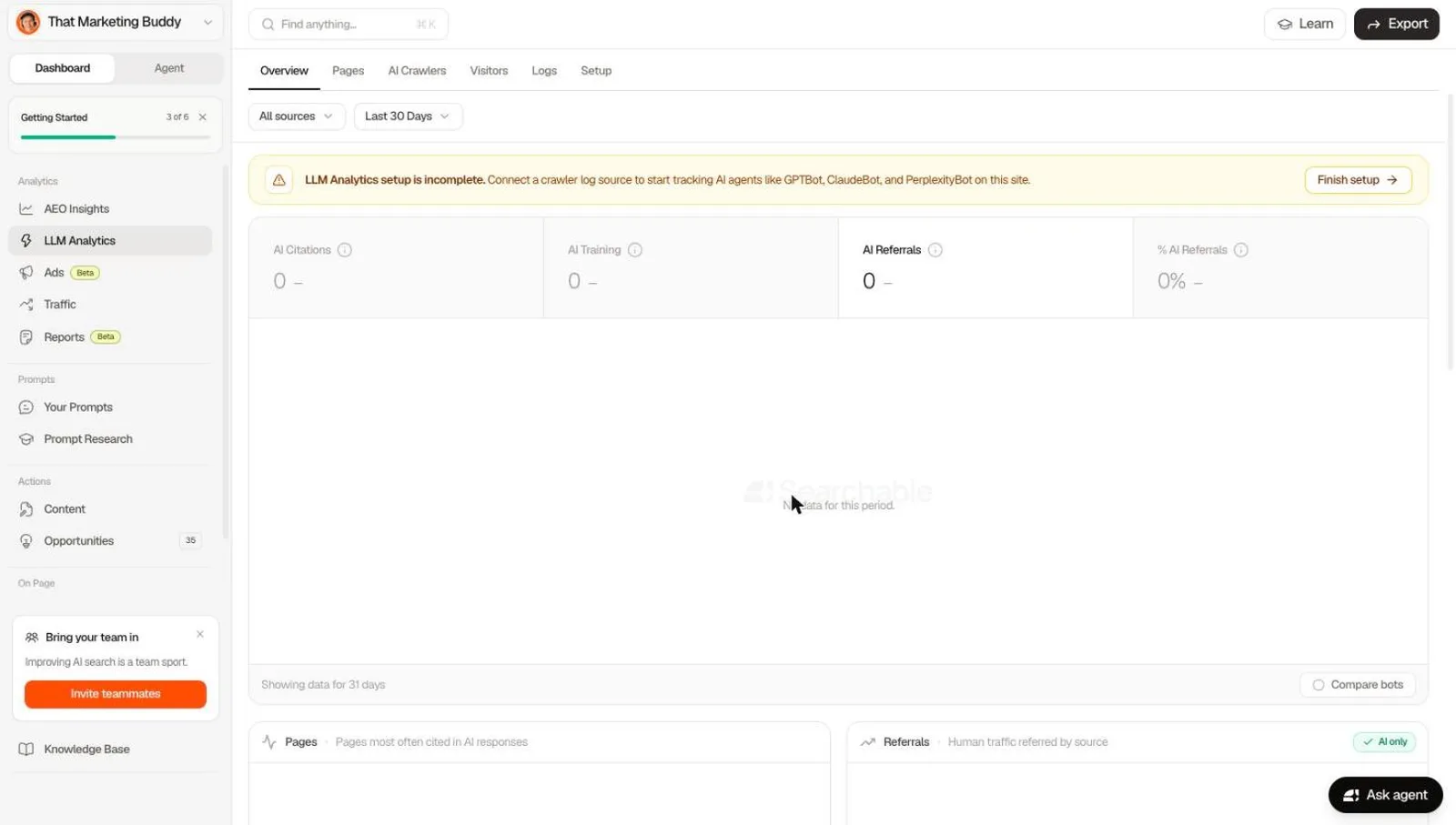
LLM Analytics: AI crawler traffic from your server logs
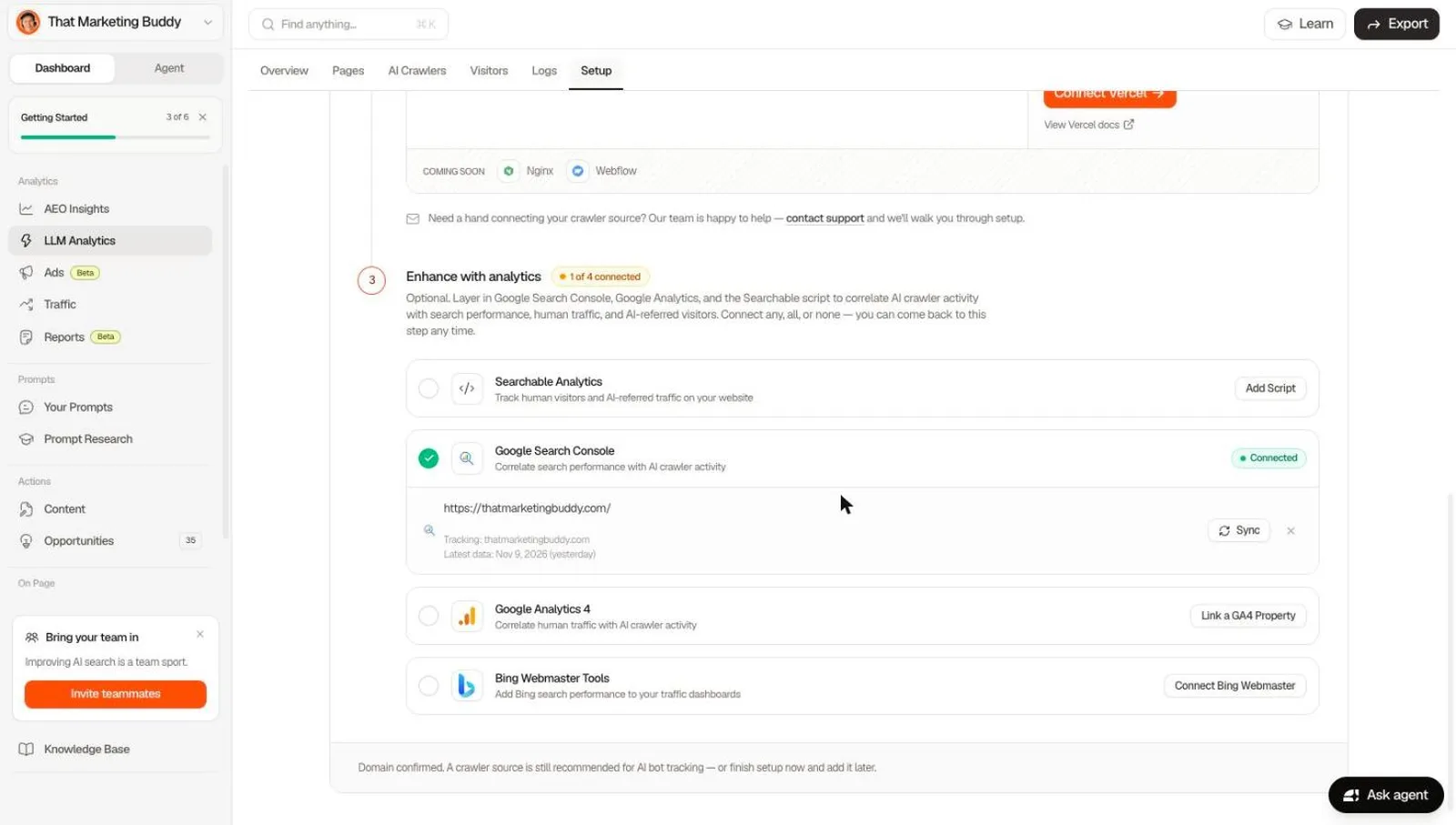
LLM Analytics shows AI crawler visits and, with a script, visitor data. There are two sources: a crawler source that reads your server logs, and a script of about 5 KB that you add to your pages. The setup detects Vercel automatically and lists 11 providers, with Nginx and Webflow marked as coming soon. In step 3 Google Search Console was connected for me, and GA4 and Bing were not.
I connected the Vercel log drain on November 10. Docs and app disagree on the plan it needs: the app says Log Drains need Vercel Enterprise, while the documentation says Pro or Enterprise.
One finding to check before you install the script. The page says "No cookies by default", but the script's default consent is "granted", which sets a visitor cookie that lasts 730 days and stores a value in localStorage. It only runs cookieless if you set data-consent="denied", and that attribute is not in the snippet you copy. If you serve EU visitors, set it yourself. I did not install the script on my live site, so I cannot judge the visitor data.
The crawler data is the part I could compare, and the mix differs from my own logs, as described under accuracy above. Searchable reports no human visits from AI in the window.
Site health audit: what it found on my site
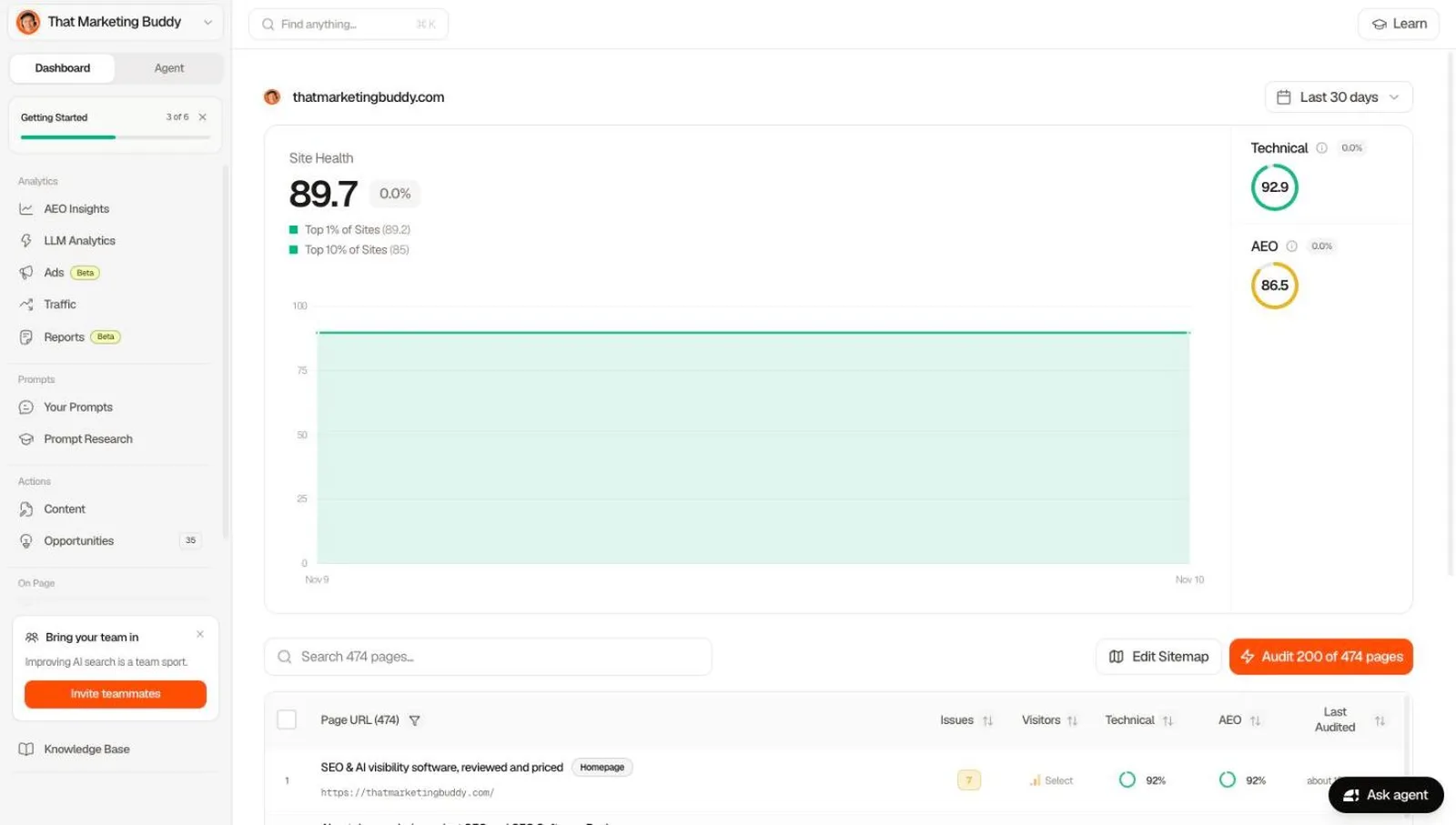
Site Health audits your pages for technical and AEO problems. It found 474 pages on my site and audits 200 of them on Pro. My 20-page audit finished in under 2 minutes and used 20 of the 200 audits. The scores were 89.7 overall, 92.9 technical and 86.5 AEO. For how to fix findings like these, see my guide to ranking in AI search.
It raised 141 issues: 3 critical, 17 high, 61 medium and 60 low, 73 technical and 68 on content. Two were real, page-specific catches: a meta description promising 4 alternatives on a page that lists 3, and a "prices verified" date that did not match the page. About 22 were false alarms: it flagged Person and Organization schema as a problem when they were correctly nested, called a freshly updated page outdated, and asked for Product schema on pricing pages.
So read it as a checklist, not as a score to chase. It is fast and finds some things a person would miss, and every item needs a human check.
Time
- Result
- Under 2 minutes, 20 of 200 audits used
Issues raised
- Result
- 141 (3 critical, 17 high, 61 medium, 60 low)
Technical and content issues
- Result
- 73 and 68
Page-specific real catches
- Result
- 2
False alarms I identified
- Result
- About 22
Scores
- Result
- Technical 93 average, AEO 86 average
| Audit of 20 pages, November 9, 2026 | Result |
|---|---|
| Time | Under 2 minutes, 20 of 200 audits used |
| Issues raised | 141 (3 critical, 17 high, 61 medium, 60 low) |
| Technical and content issues | 73 and 68 |
| Page-specific real catches | 2 |
| False alarms I identified | About 22 |
| Scores | Technical 93 average, AEO 86 average |
thatmarketingbuddy.com, Pro trial.
Opportunities: a to-do list written for a software vendor
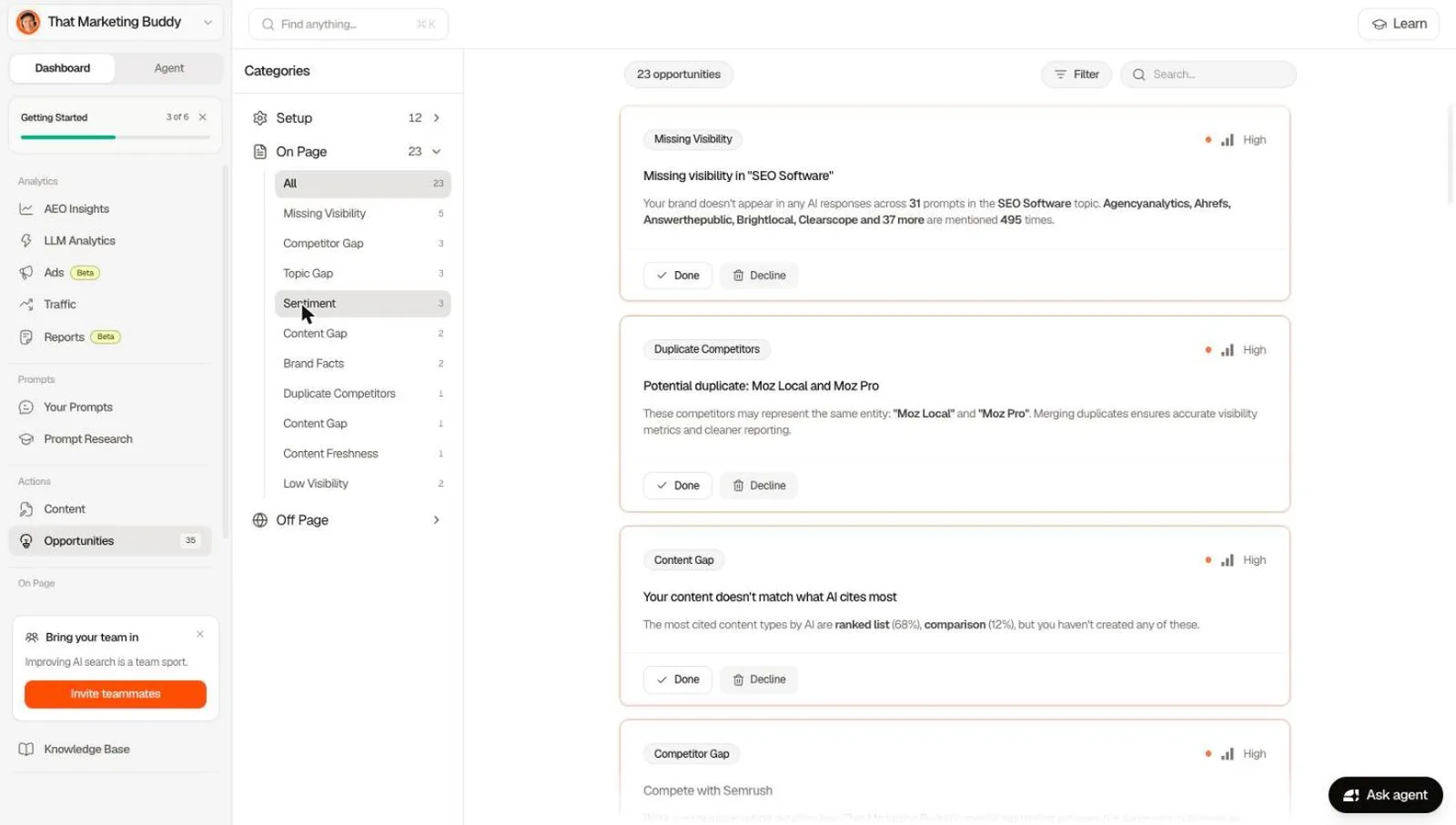
Opportunities turn the audit and the answers into a to-do list. Overnight I had 36: 2 critical, 23 high and 11 medium, in categories such as Setup (12) and On Page (23). A critical item told me to connect Google Search Console and stayed critical after I had connected it.
Several items assumed I sell software. One said I have no ranked lists, which is wrong: I have 14 best-of pages and 95 comparison pages. One suggested inventing client case studies, which I would never publish. The topic-gap diagnosis names Otterly as my top rival, while the sites that actually take the slot in the answers are roundup publishers.
Who it is for: software companies get a ready list. A publisher can use a few items and has to discard many.
Brand facts: what AI says about you, checked one by one
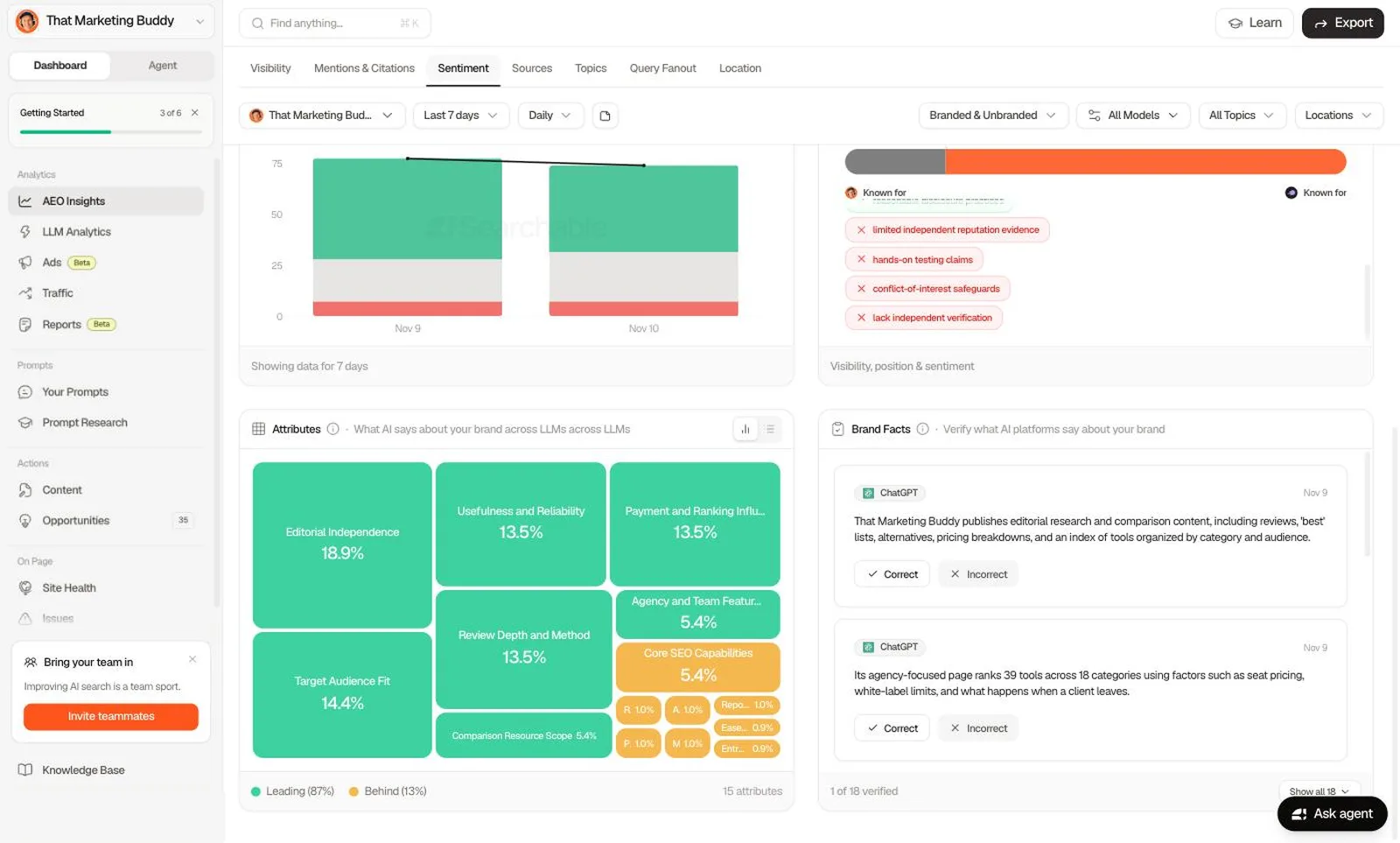
Brand facts was the most useful thing on day one. Searchable collects the statements the engines make about my site, 18 of them, and lets you mark each as right or wrong. I checked all 18: 13 were right, 4 were wrong because they are out of date, and 1 I could not judge. Three of the four stale facts come from a free recommendation service I retired in October and replaced with a tool finder.
Marking a fact is one click, or one call from Claude, and Searchable says marked facts feed its nightly brand update. When I marked one as a fail, the brand profile positioning had been rewritten by the next morning. That is useful if the new text is right, and I would read it before trusting it.
Two counts disagree: the dashboard lists 18 facts and another view counted 52, and the agent reports a perception score of 69 while the sentiment view says 75.3. I could not tell which one is the source of truth.
Content Studio
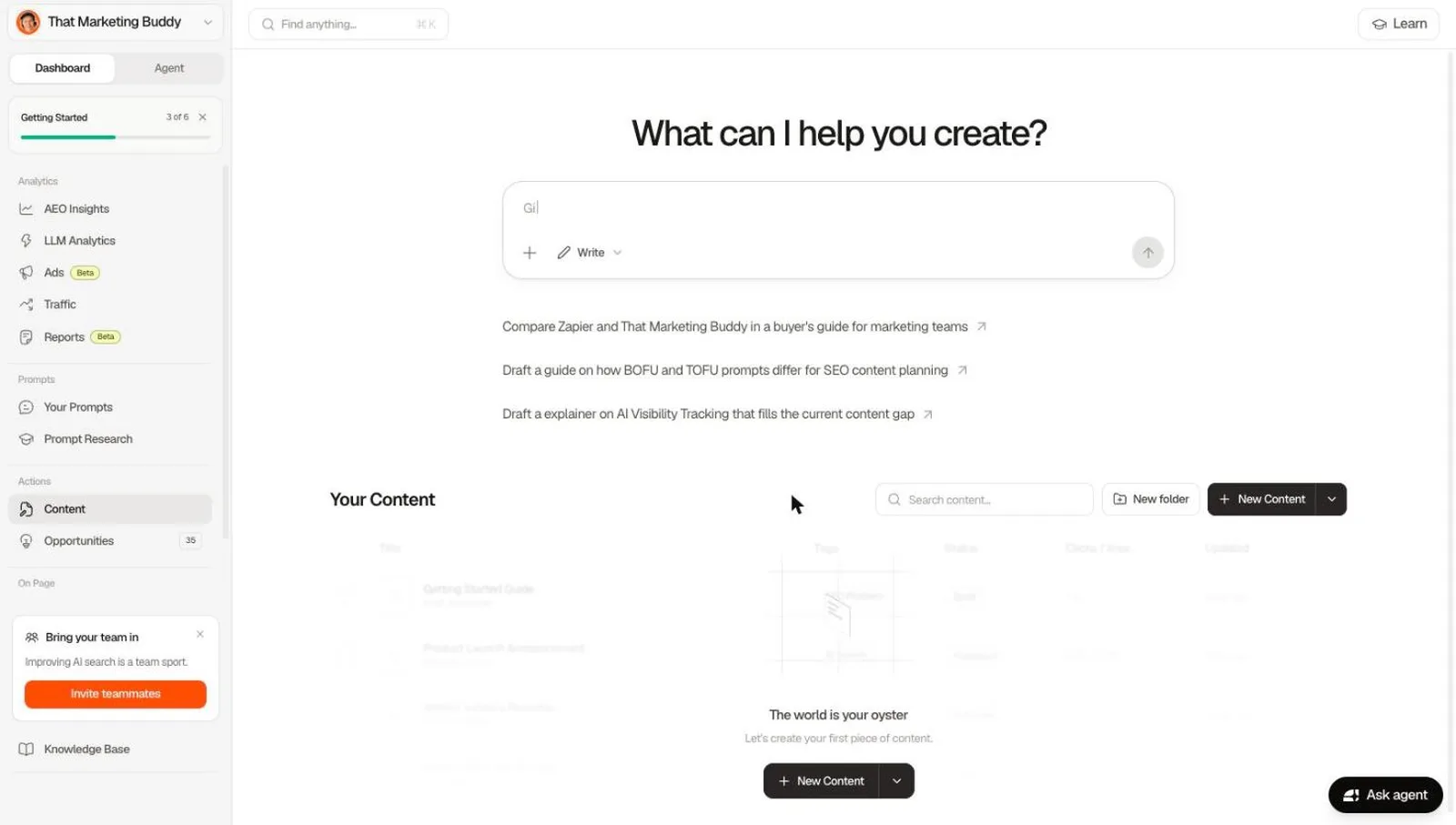
Content Studio is meant to draft articles for the topics you want to win. In my account it was empty: 0 articles. Its suggestions paired Zapier with my site, which does not describe my content. The MCP server cannot create articles either, so I have no draft to judge.
I would treat it as unproven until you have seen one article from your own site.
Reports: templates, sharing and the +10.8 points claim
Reports has three templates and sharing options. White label is marked "Higher tier", so it is not on Pro. This is the view an agency needs: the layouts are clean and ready to share.
One claim to check before you send a report. The Executive AI Visibility report said my visibility rose by 10.8 percentage points. The baseline was the empty days before tracking began, so the number measured the start of tracking, not an improvement.
For agencies that report to several clients, this is where the agency plans pay off, and I compare the options in my list of the best GEO tools for agencies.
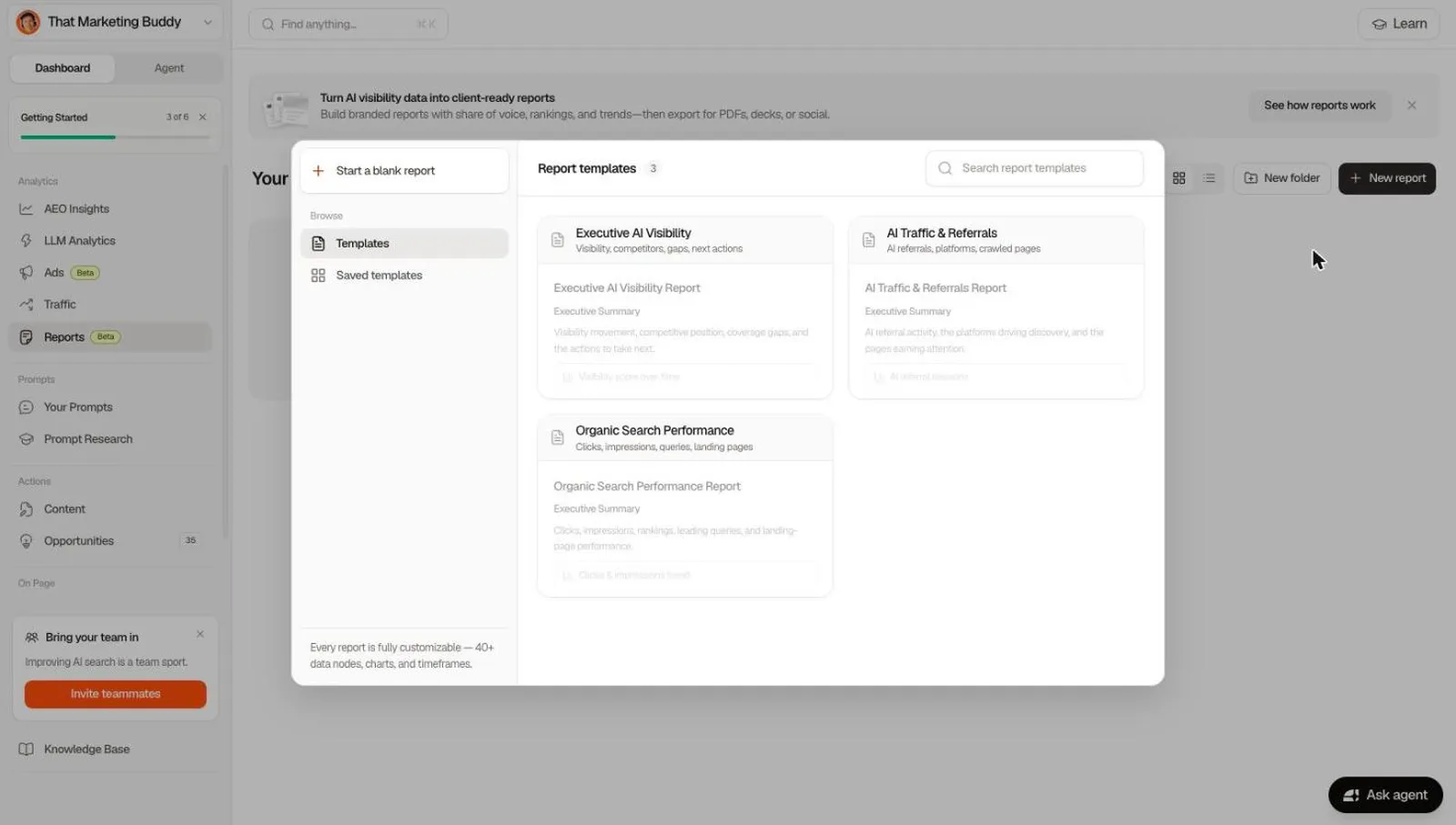
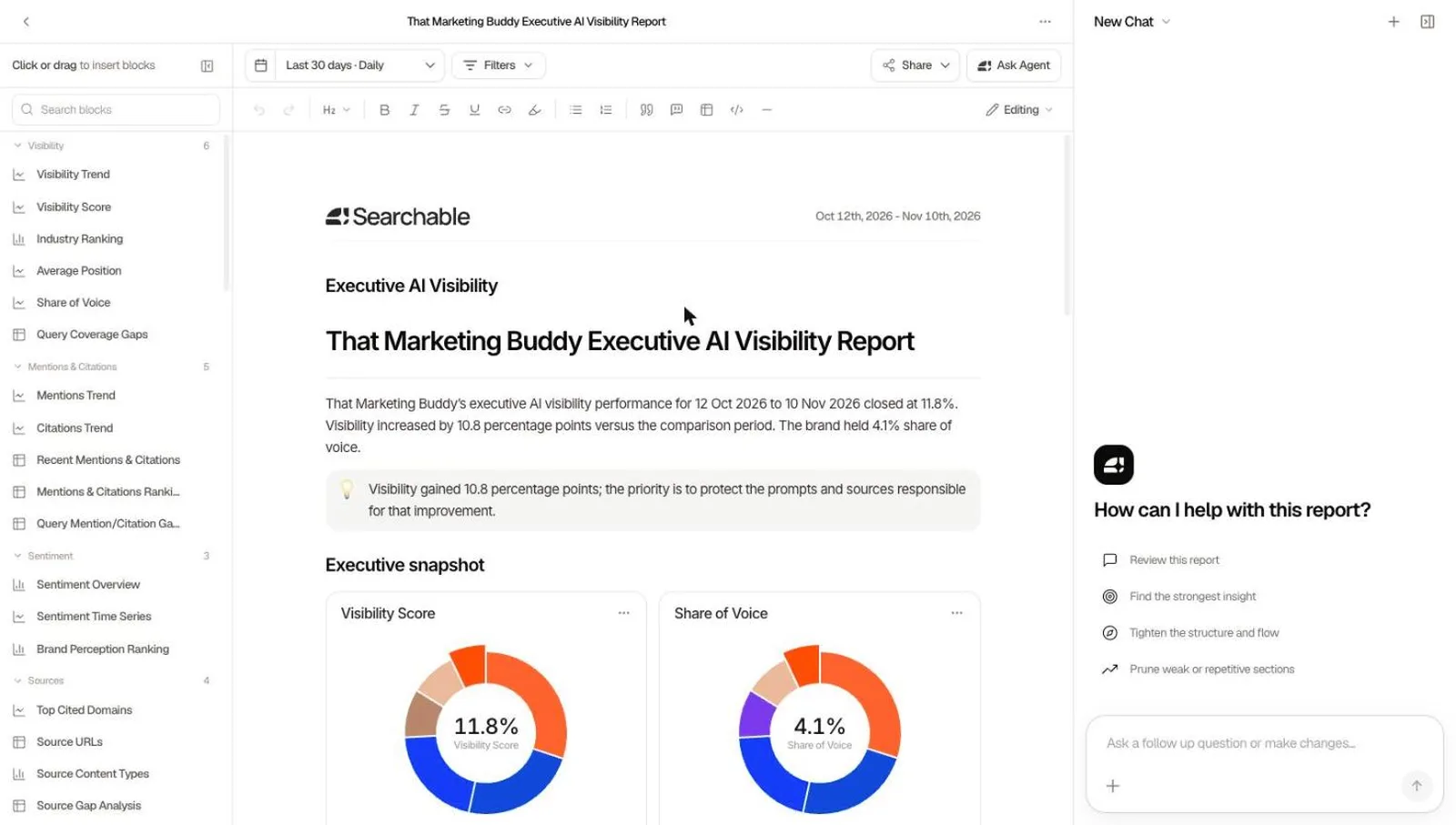
The built-in agent: ask questions about your data
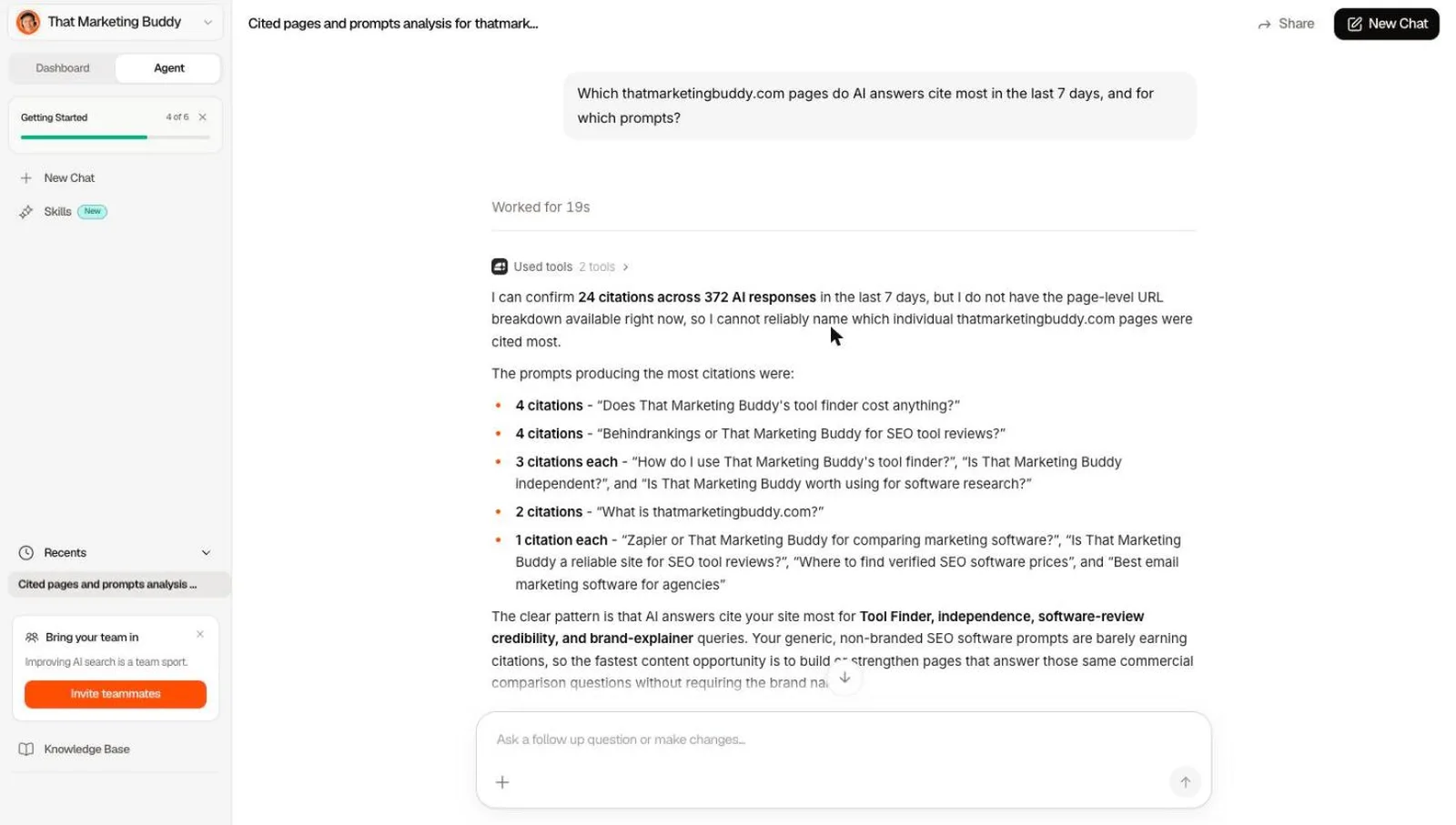
The built-in agent answers questions about your project in plain language. My question about citations came back in 19 seconds.
The numbers did not match the dashboard: it said 24 citations across 372 responses, while the Mentions and Citations view showed 29. It also gave no page-level URLs. Use it for a quick orientation and open the view for the number you will quote.
Use it through Claude with the MCP server
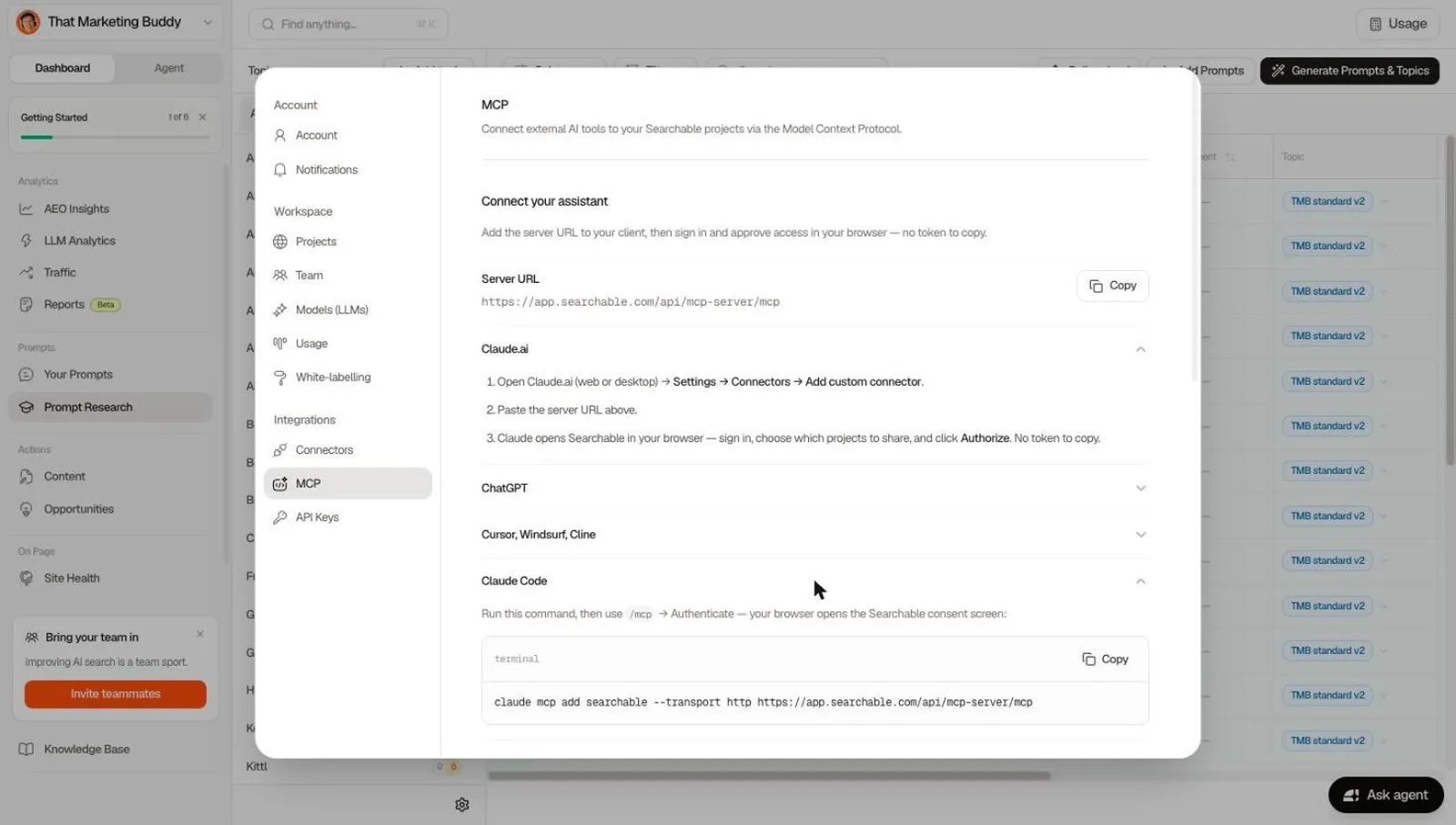
The MCP server works on every paid plan, including the trial, and connects with OAuth: you sign in, pick the projects, and choose read-only or read and write. The AI use is clear and smooth, and it is the part I would use most. In Claude Code it showed 60 tools, 4 of them older names kept for compatibility.
I asked which unbranded prompts mention a competitor but not my site on ChatGPT, and which domains are cited instead; one call returned the citation trend, top domains and share per engine, and the numbers matched the dashboard. The answer tool returns the full answer text with its sources and the brands it names, so you can check any score from Claude. I also added a prompt, archived it and marked the outdated brand fact as wrong. If MCP is new to you, I explain the setup in my guide to using MCP with marketing tools.
Every write tool I tried has a preview mode that describes the change in plain words, but the preview is optional: without it the change happens at once.
One practical problem: list tools return a logo image inside every row, so listing my 74 prompts returned about 1.5 MB, too much for Claude to read in one go. The topic analysis returned 90 KB and the site health tool 187 KB. Ask for summaries or single prompts rather than full lists.
What I did not test
Four parts of Searchable are not covered by my test, so I give no verdict on them.
The add-on engines, Google AI Mode, Gemini, Copilot, Claude and the rest, stay locked during the trial, so I could not see their data.
The Scale and agency features, white-label reports, Looker Studio and the pitch prompts for prospects, are not on Pro.
The script-based visitor analytics: I connected the server-log source only, so I cannot judge the visitor data, and I did not connect GA4 or Bing.
Content Studio was empty in my account, so I have no article to judge.
Works With
Which website platforms does Searchable work with?
Tracks AI answers with no install; AI bot analytics can use middleware or a REST API on any stack.
Searchable also has official integrations with:
 WordPress
 Next.js
How each connection works (2)›
Checked against Searchable's own docs and official app stores on 22 October 2026.
AI, API & MCP
How Searchable fits an AI-agent workflow
AI agent workflow
Run Searchable from Claude with the MCP server
Prompts that worked for me: "Which unbranded prompts mention a competitor but not me on ChatGPT, and which domains are cited instead?" "Show the full ChatGPT answer for this prompt with its sources." "List the brand facts AI states about my site and mark the outdated ones." Ask for summaries or one prompt at a time: full lists come back very large.
Approval boundary: With write access, Claude can add, change and archive prompts, competitors and brand facts, run audits and share reports. A preview is available on every write tool I tried, but it is optional, so pick read-only at sign-in if you only want reports.
MCP
officialOfficial MCP server on every paid plan
Remote server with OAuth sign-in, available on every paid plan including the trial. You choose the projects and read-only or read and write at sign-in; static access tokens are also available, read-only unless you allow writing. 60 tools in Claude Code on November 9, 2026, covering visibility, share of voice, answers, sources, sentiment, brand facts, prompts, competitors, audits and reports.
Searchable MCP →API
officialREST API on every plan
API access is listed on every plan in Searchable's plan comparison, Pro included.
Searchable pricing →Pricing
How much does Searchable cost?
Pro costs $125 a month, or $100 a month billed yearly ($1,200 a year), for one project and 100 prompts checked daily on ChatGPT, Google AI Overviews and Perplexity. Scale is $400 a month ($320 billed yearly) for 10 projects and 500 prompts, and Enterprise starts at $999 a month ($799 billed yearly). Agencies have their own plans: Launch at $250, Growth at $400 and Enterprise Agencies from $999 a month.
| Plan | Monthly |
|---|---|
| Pro · 100 prompts, 1 projectPopular | $125/mo |
| Scale · 500 prompts, 10 projects | $400/mo |
| Enterprise · 1,250 prompts, unlimited projects | $999/mo |
| Agency Launch · 200 prompts, 5 projects | $250/mo |
| Agency Growth · 500 prompts, 10 projects | $400/mo |
| Custom | Custom |
Trial: 14 days on Pro and Scale, card required at checkout; the plan bills automatically when the trial ends unless you cancel, and add-on engines unlock only after the trial. When I cancelled on day 8, the app closed the same day and asked me to pick a plan, so export your data before you cancel. Every engine beyond ChatGPT, AI Overviews and Perplexity is a monthly add-on priced per plan, from $25 to $200 a month on Pro, and add-ons get no yearly discount.
The engines you need set the real price
Pro with Google AI Mode and Gemini costs $200 a month. Add Claude and it is $325 a month. All seven full add-ons take Pro to $850 a month.
Yearly billing discounts the plan, not the add-ons
Pro billed yearly is $100 a month, but Claude still costs $200 a month on top, so the total is $300 a month.
Add-ons cost five times more on Scale
Gemini is $50 a month on Pro and $250 a month on Scale; Claude is $200 a month and $1,000 a month. Scale with AI Mode and Gemini costs $775 a month.
Agencies: Launch before Scale
Launch costs $250 a month for 5 projects, 200 prompts, 200 pitch prompts for prospects, white-label reports and Looker Studio. Pro has neither; Scale has both but costs $400 a month.
Prompts count once, answers count per engine
100 prompts means 100 questions, each asked on every engine you track once a day. The 9,000 answers a month on Pro is one answer per prompt per engine per day.
Alternatives
When I'd choose something else
Three different buying priorities, and what I'd pick instead for each one.
Pick it for Gemini and AI Mode included

SE Visible
Basic costs $89 a month for 75 prompts checked daily on ChatGPT, Gemini, Google AI Mode and AI Overviews.
Trade-off: Searchable wins when you need Perplexity, 100 prompts, or the agency plans with pitch prompts.
Explore SE Visible for this use case →Pick it for five engines on a small budget

LLM Pulse
Starter costs $58 a month for 50 prompts on ChatGPT, Perplexity, Gemini, AI Mode and AI Overviews, checked weekly.
Trade-off: Searchable wins when you need numbers every day: LLM Pulse's daily Starter costs $94 a month.
Explore LLM Pulse for this use case →Pick it for the cheapest start

Otterly
Lite costs $29 a month for 15 prompts checked daily. 100 prompts means Standard at $189 a month.
Trade-off: Searchable wins at 100 prompts: Pro is $125 a month against Otterly's $189 a month, and cheaper again once Gemini and AI Mode are added.
Explore Otterly for this use case →Pick it to choose your own three engines

Peec AI
Starter costs $95 a month for 50 prompts checked daily on three engines you pick, Gemini and AI Mode among them.
Trade-off: Searchable wins on prompts per dollar: 100 prompts for $125 a month.
Explore Peec AI for this use case →Keep going
- Compare Searchable against the field: Best AI Visibility Tools for Agencies, 14 Best AI Visibility Tools in 2026: Real Prices Compared
Downsides
Limitations to consider before subscribing
Three engines included
Google AI Mode, Gemini, Claude and four more are paid add-ons, with no yearly discount.
Headline score includes brand prompts
My default visibility read 13.3%; unbranded prompts only, 1.5%.
Position view shows #0.0
Every cell in the Topics view read #0.0 and the average position was empty.
Opportunities are written for software vendors
Several items assumed I sell software, and one claimed I have no ranked lists.
One answer per prompt per engine a day
A single day's number can move because the AI answer changed, not your site.
The trial covers only the base engines
Add-ons are locked until you pay, buying one ends the trial, and a card is required.
Large MCP list outputs
A logo image in every row made my 74-prompt list about 1.5 MB.
A noisy start
Five pop-ups, videos and tours in the first two minutes.
My Recommendation
My recommendation: decide on engines before the trial ends
Start the 14-day trial, add 20 to 30 prompts a customer would ask without your brand name, and read the unbranded score and a few full answers. If ChatGPT, AI Overviews and Perplexity are the engines you care about, Pro at $125 a month is a fair price for 100 prompts checked daily.
Choose SE Visible if you need Gemini and AI Mode included, LLM Pulse if weekly checks on five engines are enough, or Otterly if you want to start at $29 a month.
What to check during the trial
- –Switch the visibility view to unbranded prompts before you read the score.
- –Upload your own prompts by CSV and check the next day that they ran.
- –Open three answers in full and check the brands and sources yourself.
- –Check the brand facts for anything outdated that AI says about you.
- –Pick your add-on engines before the trial ends; buying one ends the trial.
FAQ
Frequently asked questions about Searchable
Pro costs $125 a month, or $100 a month billed yearly, for 100 prompts checked daily on ChatGPT, Google AI Overviews and Perplexity. Scale is $400 a month and Enterprise from $999 a month. Other engines cost extra: on Pro, Google AI Mode is $25 a month, Gemini $50 a month and Claude $200 a month.
Yes, 14 days on Pro and Scale. A card is required at checkout, and the plan bills automatically when the trial ends unless you cancel. The trial tracks only ChatGPT, AI Overviews and Perplexity; add-on engines unlock after it, and buying one ends the trial. The pricing page lists no free plan.
Every plan includes ChatGPT, Google AI Overviews and Perplexity. Google AI Mode, Microsoft Copilot, DeepSeek, Gemini, Claude, Grok and Meta Muse are paid add-ons on every plan, priced per plan, plus cheaper Lite versions of Claude and Grok without web search.
Yes. Paying yearly saves 20% on the plan: Pro is $100 a month, Scale $320 a month and Enterprise $799 a month. Add-on engines cost the same on yearly billing.
Three priced plans for brands (Pro $125 a month, Scale $400 a month, Enterprise from $999 a month), three for agencies (Launch $250 a month, Growth $400 a month, Enterprise Agencies from $999 a month), and a Custom plan through sales.
On November 14 its stored answers matched my own direct checks on mentions for all 24 prompts on ChatGPT and AI Overviews, and on citations for 23 of 24 (ChatGPT) and 24 of 24 (AI Overviews). Only 2 of the 24 prompts name my site, so that is an easy test, and I could not check Perplexity. Its summary view showed fewer citations than the stored answers, so open the answer before quoting a count. Its default headline score includes prompts that name your brand, so read the unbranded number: mine was 13.3% with brand prompts and 1.5% without.
Yes, through the agency plans. Launch costs $250 a month for 5 projects, 200 prompts, 200 pitch prompts, white-label reports and Looker Studio. The brand plan Pro has one project and no white label.
Yes, on every paid plan, including the trial. The MCP server connects with OAuth, lets you choose read-only or read and write, and showed 60 tools in Claude Code. API access is included from Pro.
Updates
What changed in this review
- 2026-11-16 Reworked after a full tour of the app: key findings, a feature table, one section per feature with who it is for, 23 screenshots and my own experience added. Accuracy checked against direct ChatGPT and AI Overview answers on November 11 and 14.
- 2026-11-09 Rewritten as a hands-on review on a Pro trial: 74 prompts tracked daily for my own site. Prices re-checked on searchable.com, including every add-on engine. Corrected: API access, annual billing and the Enterprise plan are all available, and the plan is called Pro.
- 2026-09-23 First version, researched from Searchable's website without a hands-on test.
Joonas Rotko
SEO & GEO professional, founder of That Marketing Buddy
I'm a Finnish SEO and GEO professional with 11+ years in digital marketing, including years as a co-owner of a digital marketing agency. On That Marketing Buddy I test and compare SEO and AI-visibility software for entrepreneurs, marketing professionals and agencies.
Sources & References (3)
Spot something out of date?Vendors and readers, send me the correct fact.
Software sites change almost every week, and I want every claim on this page to be factually correct. If you are a vendor or a reader, send me the correct fact and a link to the official page. I will check it and update the page. The opinions and rankings stay mine.