
This page may contain affiliate links.
Some links on this page are affiliate links, meaning I may earn a commission if you sign up (at no extra cost to you). This never influences my ratings or recommendations.
People start looking elsewhere once they hit its edges: no endpoints for comments or DMs, and a quickstart mode that puts 'Post for Me' on your users' OAuth screen instead of your own brand.
Overview
Quick comparison
| # | Tool | Price |
|---|---|---|
| 1 | Free for 2 accounts, then $6/account per month | |
| 2 | $29/mo | |
| 3 | $19/mo | |
| 4 | $149/mo (Premium) | |
| 5 | Free plan, paid from $100/mo |
Why Switch
Why people look for Post for Me alternatives
Post for Me's documented API covers posts, feeds, and analytics only. There's no comment or DM endpoint, so if your agent needs to reply to what it just published, you're adding a second vendor.
The Quickstart connection path uses Post for Me's own developer credentials, which means your users see Post for Me's logo and name on the OAuth consent screen, not yours.
Quickstart connections also inherit Post for Me's approved permission scope. If they haven't been approved for a specific platform feature, neither have you.
Switching to White Label mode fixes the branding problem, but then you're back in the platform approval queue at TikTok, Instagram, and the rest, which is exactly the friction a posting API is supposed to remove.
Pricing scales with post volume rather than seats or accounts, which works for high-volume publishing but may not match products built around many connected accounts posting infrequently.
Alternatives
Best Post for Me alternatives
9 alternatives ranked. 5 are cheaper. 10 offer free plans.

Zernio
Top PickBuilders who need ad networks and DMs, not just organic publishing
Developer-first social and ads API with an MCP server, covering 16 social platforms and 7 ad networks, billed per connected account.
Why consider Zernio
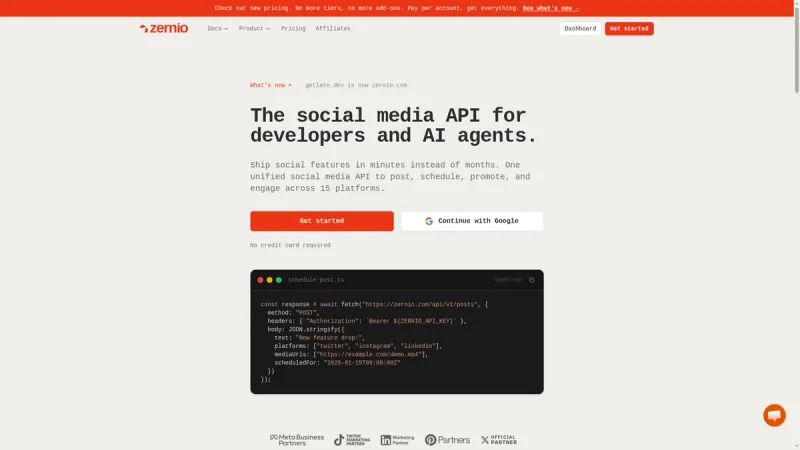
Zernio is the closest thing on this list to what Post for Me does, and then some: one API for 16 social platforms plus 7 ad networks , with an MCP server so an agent can call it directly. The billing model is the real fork in the road. Post for Me charges for volume, Zernio charges per connected account, free for the first two. Few accounts posting a lot favours Post for Me. Many accounts posting a little favours Zernio.
Pros
- +Covers 16 social platforms and 7 ad networks, where Post for Me stops at 9 social networks
- +Ships an MCP server alongside the REST API, so agents can drive it without an SDK
- +First 2 connected accounts are free, no credit card, so you can build against it before paying
Cons
- −Billed per connected account, so cost tracks account count rather than post volume
- −Past 2 accounts it is $6 each, which overtakes Post for Me flat $10 quickly
- −Younger product with a shorter track record than the established posting APIs

Postiz
Teams that want to self-host or need way more than 9 platforms
Open-source social media scheduler for 30+ platforms with built-in AI agents and public REST API, self-hostable or hosted.
Why consider Postiz
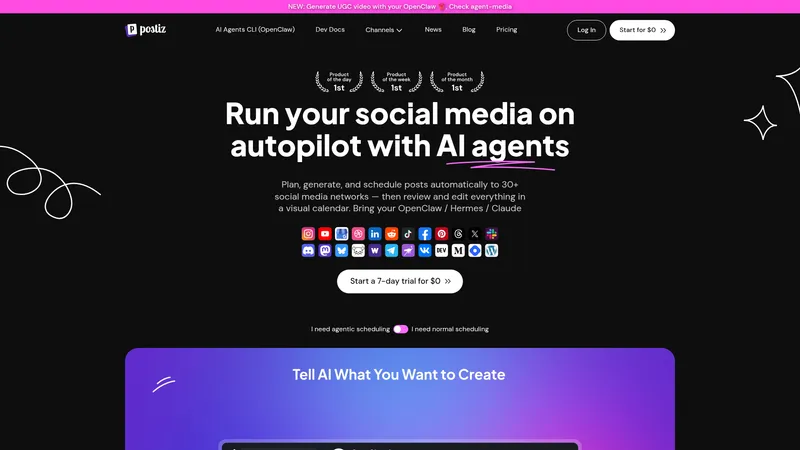
Postiz is open source like Post for Me, but goes further: it's self-hostable, covers 30+ platforms, and includes built-in AI agents on top of a public REST API. Self-hosting also sidesteps the OAuth branding question entirely since it's your infrastructure.
Pros
- +30+ platforms versus Post for Me's 9
- +Self-hostable, so no third-party name on your OAuth screen
- +Free plan plus a 7-day trial on paid tiers
Cons
- −Paid plans start at $29/month, notably above Post for Me's $10
- −Self-hosting means you own the maintenance burden Post for Me was designed to remove

WoopSocial
Builders who want a scheduler designed around agents from the start
AI social scheduler with native MCP server and REST API built to be driven by agents.
Why consider WoopSocial
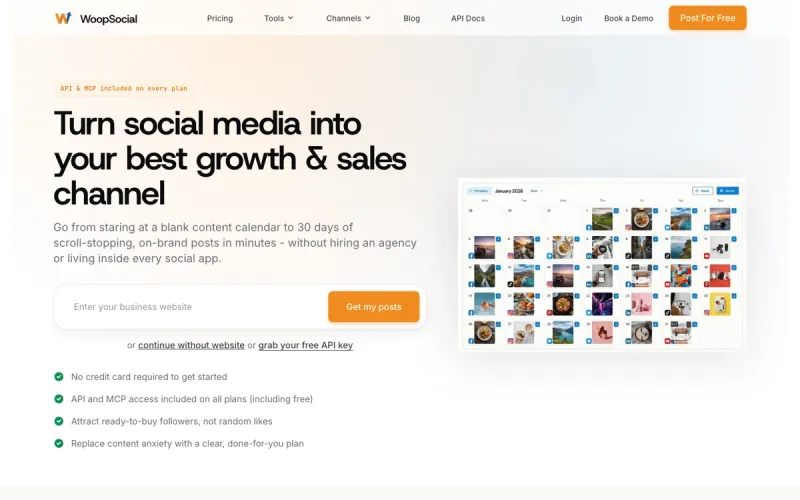
WoopSocial ships a native MCP server and REST API built specifically to be driven by AI agents rather than retrofitted for them. It has a free plan, which gives you a way to test agent-driven posting without committing to a paid tier first.
Pros
- +Native MCP server, not an API with MCP added later
- +Free plan to start
- +REST API for non-agent integrations too
Cons
- −Paid tier pricing isn't published, so budgeting ahead of signup is hard
- −Documentation on comment/DM support isn't clear from available research

Ayrshare
Products that need comments and DMs, not just publishing
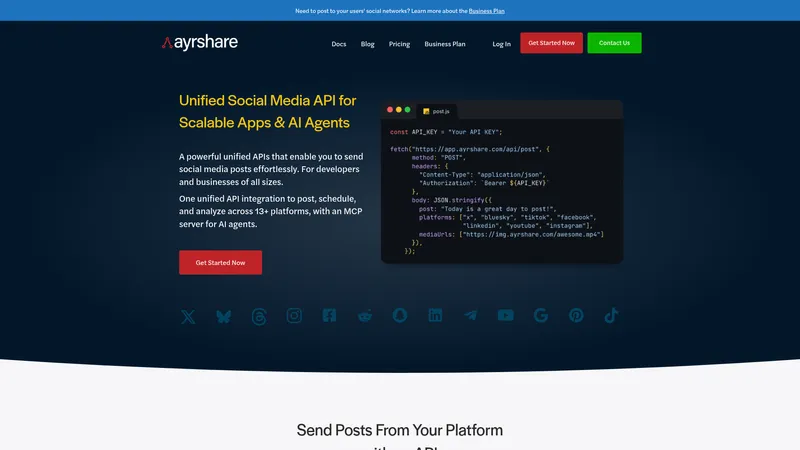
Developer-focused social media API for posting to 13+ platforms with comments, DMs, and analytics endpoints.
Why consider Ayrshare
Ayrshare is the direct answer to Post for Me's biggest gap: it has dedicated comment, DM, and ads endpoints across 13+ platforms. If your agent needs to close the loop on engagement, this is one of the few APIs in the category that documents it.
Pros
- +Comment and DM endpoints fill the exact hole in Post for Me's API
- +Covers 13+ platforms
- +14-day trial to test the endpoints before paying
Cons
- −No permanent free plan, the 28-day trial on Launch is the only way to test it
- −Priced per active social profile, so cost tracks account count rather than usage

bundle.social
Teams who want a dashboard for non-developers plus an API for the dev team
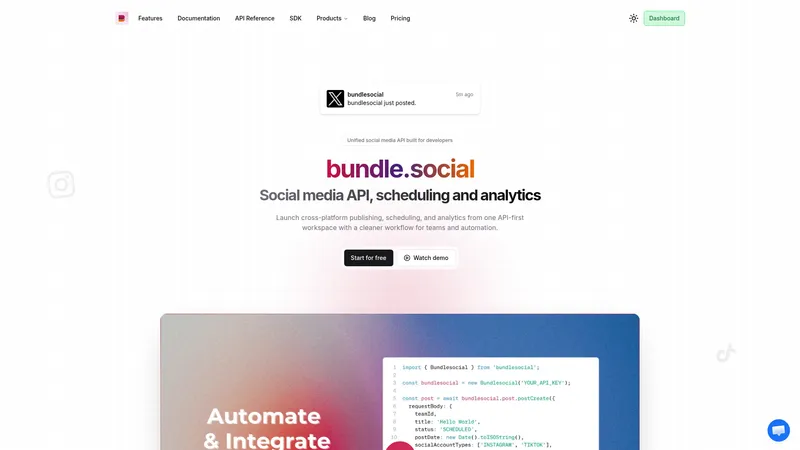
Social media management platform with full dashboard plus developer API, official MCP server and CLI, unlimited users on every plan.
Why consider bundle.social
bundle.social pairs a full management dashboard with a developer API, an official MCP server, and a CLI. Unlimited users on every plan, including the free one, is a genuine departure from Post for Me's developer-only, no-UI approach.
Pros
- +Free plan available to start
- +MCP server and CLI on top of the API
- +Unlimited users on every tier, even free
Cons
- −Pro plan jumps to $100/month if you outgrow the free tier
- −The dashboard adds overhead you don't need if you only want raw API access

Blotato
Builders whose agent needs to write the post, not just publish it
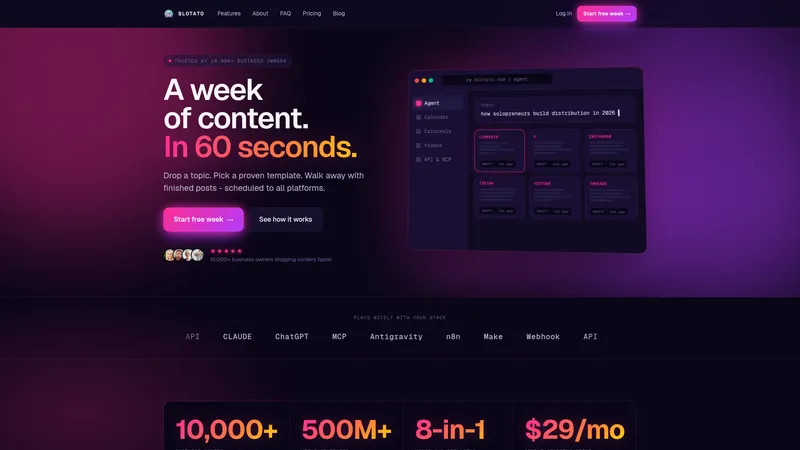
AI-powered social media automation with content generation, publishing to 9 platforms, and engagement endpoints for Instagram and Facebook.
Why consider Blotato
Blotato combines content generation with publishing to 9 platforms and adds engagement endpoints for Instagram and Facebook, an area Post for Me doesn't touch. It's built with an MCP server as a first-class piece of the product, not an afterthought.
Pros
- +Content generation and publishing behind one interface
- +Engagement endpoints for Instagram and Facebook
- +MCP server available for agent workflows
Cons
- −Starter tier is $29/month, close to 3x Post for Me's price
- −Same 9-platform ceiling as Post for Me, so no breadth advantage

Genviral
Short-form content teams that want a CLI alongside the API
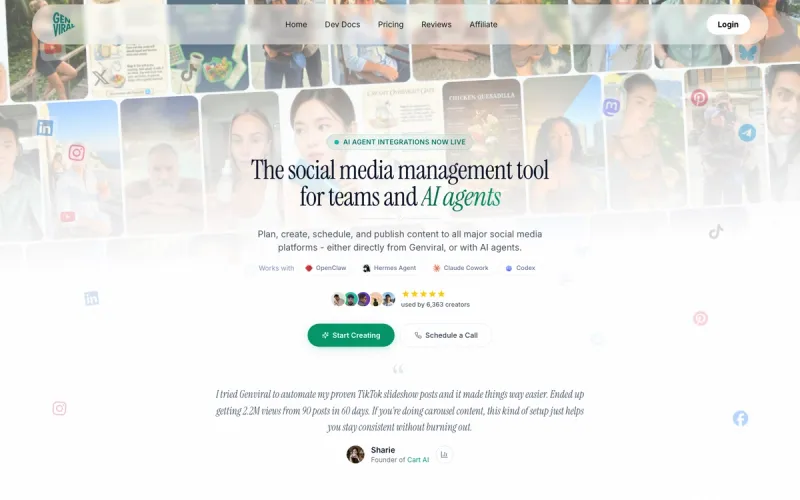
AI social scheduler and short-form content engine with full REST API and CLI built for AI agents.
Why consider Genviral
Genviral pairs a content generation engine with a full REST API and CLI, aimed squarely at agent-driven workflows rather than manual scheduling. The CLI is the differentiator here since most competitors, including Post for Me, only ship a REST API.
Pros
- +CLI included, not just a REST API
- +Built around AI agents from the ground up
- +Short-form content generation baked in
Cons
- −Pricing isn't publicly listed for any tier
- −Platform coverage isn't documented in available research, so confirm before committing

Buffer
Non-developers who want a UI instead of an API to embed
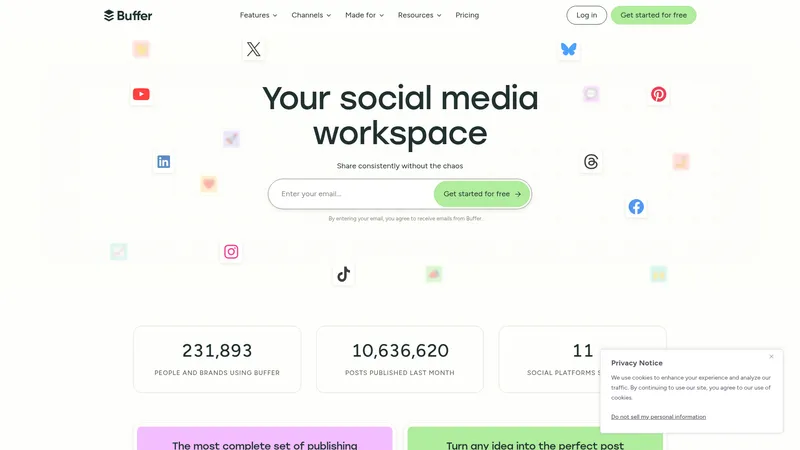
Social media scheduler with 11 platforms, AI assistant, and forever-free plan for 3 channels.
Why consider Buffer
Buffer is worth naming here mostly as a contrast. It's a scheduling tool with a dashboard and an AI assistant, not a developer API meant to sit inside your own product. If you're a marketing team rather than a builder, Buffer's forever-free plan for 3 channels is the simpler path.
Pros
- +Free plan for 3 channels, no trial expiration
- +No code required to get started
- +Straightforward per-channel pricing
Cons
- −Not built as an API for embedding into your own app or product
- −Per-channel pricing (from $6/month per channel) adds up fast at scale

Outstand
Developers who want an MCP server bundled in, not just a REST API
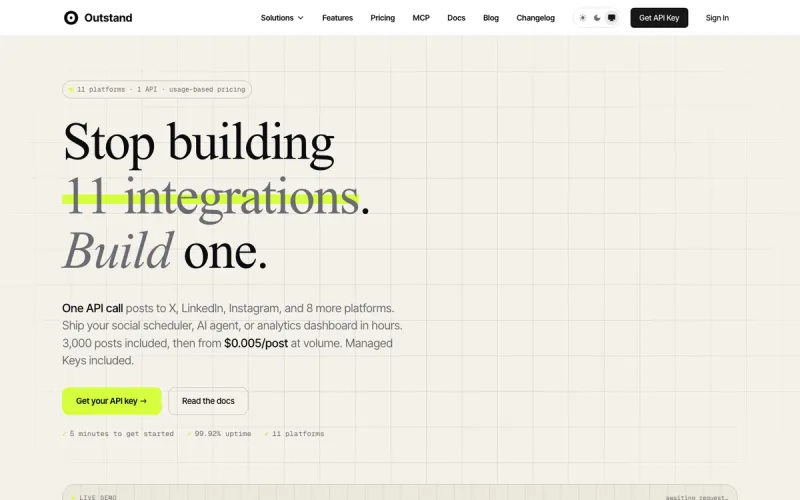
Unified social media API and MCP server for 11 platforms, priced per post instead of per seat.
Why consider Outstand
Outstand covers 11 platforms with a unified API and ships an MCP server alongside it, which puts it closest to Post for Me's architecture but built agent-first from day one. Pricing runs per post rather than per seat, similar in spirit to Post for Me's volume-based model.
Pros
- +MCP server included, not bolted on
- +Covers 11 platforms versus Post for Me's 9
- +Per-post pricing model, no per-seat penalty
Cons
- −Starts at $19/month, roughly double Post for Me's entry price
- −No published free tier for testing before you commit
Price Chart
How Post for Me compares on price
Of the 21 alternatives tracked, 5 start at a lower price than Post for Me's $10/mo. 10 offer a free plan.


Checklist
What to look for in an alternative
Start with endpoint scope, not platform count. Nine platforms means nothing if the only actions available are publish, read feed, and pull analytics. If your product or agent needs to answer a comment, send a DM, or manage ad campaigns, check the API docs for those endpoints specifically before you commit, because plenty of 'social media API' products quietly stop at publishing.
Next, look at how OAuth branding works. Some tools let you skip platform developer approval by using their credentials, which is fast but puts their name on your users' consent screen. Others require you to register your own app with each platform, which takes longer but keeps your brand in front of your users the whole time.
Neither approach is wrong, it depends on whether you're prototyping or shipping to production. Finally, check for MCP server support if you're building anything agent-driven.
A REST API works fine for a human developer wiring up endpoints by hand, but if you want an LLM agent to publish, schedule, or read analytics on its own, a native MCP server saves you from writing that glue code yourself. Not every alternative below has one, and that's worth weighing against price.
FAQ
Frequently Asked Questions
Post for Me is a unified social media posting API covering 9 platforms including TikTok, Instagram, and YouTube. It handles publishing, feeds, and post analytics through a single REST endpoint, and its server code is open source on GitHub.
The two most common reasons are missing endpoints and OAuth branding. Post for Me's API doesn't include comments or DM endpoints, and its Quickstart connection mode shows 'Post for Me' on your users' consent screen instead of your own app name.
No. Its documented API covers media upload, social accounts, social posts, post results, and webhooks, which means publishing and reading, but nothing for comments or direct messages.
Quickstart uses Post for Me's own developer credentials so you can skip each platform's approval process, but users see Post for Me's branding during OAuth. White Label uses your own credentials so users see your app name, but you have to go through each platform's developer approval process yourself.
Several do: Outstand, bundle.social, WoopSocial, and Blotato all ship an MCP server alongside their REST API, which matters if you want an LLM agent to publish or manage posts without custom glue code.
bundle.social, WoopSocial, Postiz, and Buffer all offer free plans. Buffer's is the most straightforward for non-developers (3 channels, no trial expiration), while the others are closer to Post for Me's developer-API model.
Postiz covers 30+ platforms and Ayrshare covers 13+, both well beyond Post for Me's 9. Outstand covers 11. If platform breadth is your main constraint, those three are the ones to check first.
Still considering Post for Me?
Check it out before committing to an alternative.
More on Post for Me


Joonas Rotko
Author & founder of That Marketing Buddy
I score marketing software for AI-stack fit (MCP, API, agent-readiness), backed by 10+ years in digital marketing. I track 22 tools so you can find the right fit.
This page may contain affiliate links. I earn a commission at no extra cost to you. This never influences the recommendations.