

Joonas Rotko · Founder, That Marketing Buddy
I spent 10+ years buying marketing software for my own agency and its clients, so I know which tools earn their monthly fee and which ones quietly drain it. Now I check the prices and the claims on this site myself.
This page may contain affiliate links.
Some links on this page are affiliate links, meaning I may earn a commission if you sign up (at no extra cost to you). This never influences my ratings or recommendations.
The Verdict
Is AirOps right for you?
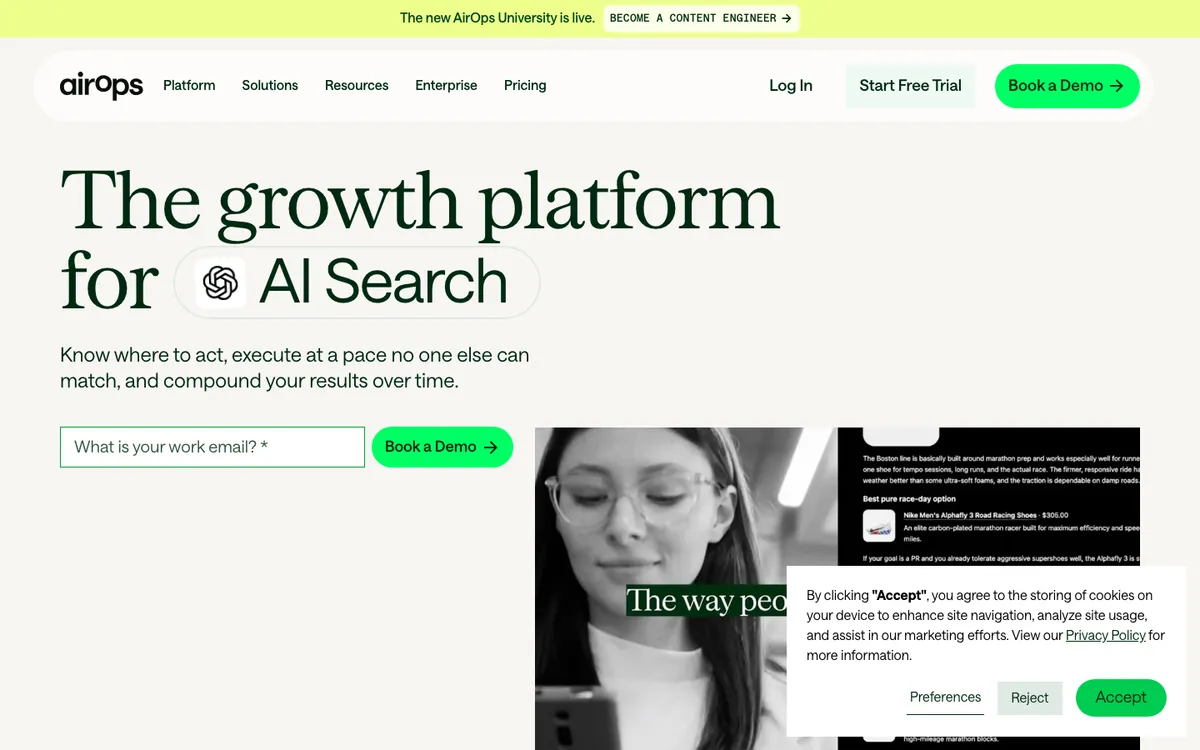
AirOps tracks where your brand shows up across Google, ChatGPT, Perplexity, Gemini, and Claude, then hands the fix-it work to an AI agent called Quill. Big-name case studies (Webflow, Carta, Asana) back the pitch, but you won't find a single dollar figure on the pricing page.
AirOps is a platform that tracks AI search visibility and then puts an agent (Quill) to work closing the gaps it finds, from content refreshes to net-new drafts published straight to your CMS. It's built for teams with existing content operations and a budget to match, not solo operators dipping a toe into AEO.
Whether it's worth it depends entirely on a sales conversation, since none of the three plans list a public price.
The Insights-to-Action loop is a smart structure, but hiding every price behind 'Talk to Sales' makes it hard to know if you're looking at a $99/month tool or a $10,000/month one.
Why I'm covering this
AirOps pairs AI search visibility tracking with an agent, Quill, that drafts and publishes the fixes it finds, backed by named case studies from Webflow, Ramp, and Carta. That combination of tracking and execution in one tool is uncommon in this category.
Who It's For
Who AirOps is for (and who it isn't)
✓Best for
- +Content teams at mid-size to enterprise SaaS companies You already publish at volume and need help prioritizing content refreshes and closing gaps identified through AI search citation tracking, similar to the Webflow and Carta case studies.
- +Growth or SEO leads managing multiple content workflows You want an agent that can draft briefs, update internal links, and refresh stale pages in the background, then pull you in only for final review, which matches how AirOps describes Quill's role.
- +Organizations that need both onsite and offsite AI visibility work AirOps tracks third-party sources that drive AI citations, not just your own pages, which matters if a large share of your AI visibility comes from sites you don't own.
✗Skip this if
- −Solo bloggers or freelancers on a tight budget The Solo plan only tracks ChatGPT and caps you at 100 tracked prompts and pages, with no visible price to weigh against that limit.
- −Anyone who needs to compare exact pricing before a demo call Solo, Pro, and Enterprise all funnel toward 'Start for Free' or 'Talk to Sales,' so you can't budget against a fixed number without contacting the team.
- −Teams that just want a visibility dashboard, nothing else If you only need to see mention rates and citations without an execution layer, a narrower tracker will likely cost less and take less setup.
Consider instead
 Surfer
 Clearscope
 Rankability
Features
What can AirOps do?
The Insights layer is the entry point, and it's built to do more than count mentions. AirOps tracks citations by domain, breaks down sentiment by theme, and separately tracks what Reddit and community threads are saying about your brand in AI answers, which is a level of granularity a lot of visibility trackers skip.
Quill is the part AirOps leans on hardest in its marketing, and on paper it's a real step past a dashboard. Instead of just flagging that a page is stale, Quill is meant to draft the refresh, update internal links, and add key takeaways, then loop a human in for final review, according to a quote from one customer's Growth Lead. Whether that holds up at your own content volume is something only a trial run will tell you.
Workflows and Playbooks are where AirOps starts to look more like a build environment than a point solution. You get code steps, SQL queries, conditional branching, and integrations with Moz and DataForSEO for SEO research baked into the same canvas as the AI steps, which is a heavier lift to learn than a simple content generator but gives more control once you're past onboarding.
Brand Kits and Knowledge Bases exist specifically to stop AI-generated content from sounding generic once you're producing it at scale across multiple writers, agents, and workflows. That's a real problem for any team running content production through an agent, and AirOps building it in as a core concept (not an afterthought) is one of the more sensible design choices here.
AI Search Insights
Quill & Playbooks
Workflows & Integrations
Brand Governance & Collaboration
UX & Support
Is AirOps easy to use?
AirOps' documentation, hosted at docs.airops.com, is extensive: separate pages walk through Playbooks, Workflows, individual step types, triggers, and troubleshooting, which suggests a product with enough moving parts that a thin FAQ wouldn't cut it. That depth is a double-edged signal: it points to real capability, but also to a learning curve, since you're not just picking a template, you're assembling Inputs, Sections, Tools, and Triggers yourself.
Support tiers scale with plan level based on the pricing page: Solo gets community and live chat support, while Pro adds live cohort trainings and priority support, and Enterprise adds a dedicated account manager and 1:1 expert onboarding. That structure suggests AirOps expects lower-tier customers to mostly self-serve through docs, while paying customers on Pro and up get more hands-on help getting Playbooks running correctly.
The customer stories AirOps publishes are enterprise teams with dedicated support, which is not the same experience a Solo customer gets.
Pricing
How much does AirOps cost?
AirOps starts at Custom pricing. No free plan, but there’s a 14-day free trial.

AirOps Pricing Analysis
vs. 38 AI search visibility toolsEnterprise pricing, contact sales for quotes

AirOps uses custom enterprise pricing. The self-serve AI search visibility tools on That Marketing Buddy's database range from $19 to $800/mo.
AirOps does not publish a single dollar figure for any of its three plans, Solo, Pro, or Enterprise, according to both the pricing page and the source-of-truth pricing data behind this review. Every tier routes you to either 'Start for Free' or 'Talk to Sales,' and the actual cost appears to depend on variables like tracked prompts and pages, content production tasks, brand kits, and seats. A 14-day free trial is available, which at least lets you test the workflow before any pricing conversation starts.
What's clear from the feature comparison is the shape of the ladder: Solo caps you at 100 tracked prompts and ChatGPT-only insights with 20,000 production tasks, Pro moves to 250 tracked prompts across four AI engines (ChatGPT, Google, Perplexity, Google AI Studio) with 75,000 tasks and unlimited seats, and Enterprise removes the caps entirely with custom agent builds and multi-region tracking. That's a meaningful capability jump between tiers, but without prices attached, it's impossible to say where the value actually lands compared to a tool with a posted price tag.
For budgeting purposes, this makes AirOps hard to compare directly against tools like Frase, which lists a $49/month starting price on its own pricing page. If transparent, self-serve pricing matters to you, that's a real point against AirOps until you've actually gotten a quote.
| Plan | Monthly |
|---|---|
| Solo | Custom |
| Pro | Custom |
| Enterprise | Custom |
External Ratings
What reviewers say about AirOps
"The quality of our content since using Air Ops has honestly increased pretty significantly."
George Bonaci, VP of Growth, Ramp (AirOps case study)"AirOps isn't just about velocity. It's allowing us to scale without losing our brand's human touch."
Nicole Baer, CMO, Carta (AirOps case study)"We're not replacing human oversight, we're making it sharper and 800% faster."
Enrique Santamaría, Head of Global Organic Growth (AirOps case study)"AirOps takes care of the necessary but repetitive work: updating internal links, refreshing outdated content, adding key takeaways. It pulls me in for the final review where my expertise actually matters."
Ecesu Bayir, Growth Lead, SEO & GEO (AirOps case study)AI & Tech Stack
Does AirOps fit your AI stack?
What AI Can't Replace
AirOps closes the loop between seeing and doing. Insights track citations, mentions, sentiment and share of voice across ChatGPT, Google, Gemini, Perplexity and Claude, then Playbooks and Quill turn those gaps into drafted, refreshed and published content with a human at the approval gate. Most tools in this category stop at the dashboard.
Where AI Is Catching Up
Low to moderate. You could stitch a visibility tracker to your own agent and a CMS integration, and plenty of teams will. What is hard to rebuild is the connective tissue: Brand Kits and Knowledge Bases as governed context, Grids for bulk runs, and measurement tying each action back to citations gained. The moat is the harness around the model, not the model.
API & Integrations
A real REST API, documented at docs.airops.com/api-reference, authenticated with a Bearer key generated in Workspace Settings. It covers Executions (trigger and monitor workflow runs), Agent Apps, Files, Grids, Memory Stores and Brand Kits, so your own code can drive the platform rather than just read from it.
One thing to pin down before signing: the plan comparison table lists data export as CSV on Solo and Pro and "CSV, API" on Enterprise, so ask sales exactly what your tier exposes.
MCP & CLI
An official MCP server at app.airops.com/mcp over streamable HTTP with OAuth 2.0, plus a Claude Connector in Claude's directory that renders Interactive Apps (real charts in the conversation, not a text description of a chart). Setup is documented for Claude Code, Cursor, VS Code and Windsurf.
The tool surface goes beyond reading: alongside AEO analytics and Knowledge Base semantic search, an agent can update Brand Kits and read, write and create Grids. There is no separate CLI, and none is needed when the MCP server is this complete.
Stack Verdict
One of the most agent-ready platforms in AI search: official OAuth MCP with write access, a Claude Connector with interactive output, and a REST API that triggers real executions. The friction is commercial rather than technical. AirOps publishes no prices, so working out whether this fits your stack starts with a sales call rather than a signup form.
Connects with
Security
Downsides
What's wrong with AirOps
No published pricing anywhere
Solo, Pro, and Enterprise all route to a free trial signup or a sales call, so you can't budget-compare AirOps against a competitor with a posted price without contacting the team first.
Solo plan tracks ChatGPT only
If you want to compare visibility across Google AI Mode, Perplexity, and Gemini, you need at least the Pro tier, which affects anyone starting small.
Task-based limits could get tight at scale
20,000 tasks on Solo and 75,000 on Pro sound generous until you're running Playbooks across a large content library, at which point Enterprise (and another sales call) becomes necessary.
Heavier setup than a plug-and-play content generator
Getting real value out of Quill and Playbooks means building Brand Kits, Knowledge Bases, and briefs first, which is a bigger upfront lift than tools that generate content the moment you sign up.
No confirmed public MCP server for external builders
AirOps lets Playbooks pull in outside tools through MCP Connectors, but there's no documented AirOps-hosted MCP server for connecting your own agents directly to AirOps data the way some competitors offer.
Enterprise-skewed customer base
The named case studies (Webflow, Carta, Ramp, Asana, Docebo, Apollo) all point to companies with existing marketing teams and budget, which may signal the product experience is tuned for that segment first.
Are these dealbreakers?
None of these are dealbreakers if you're already running a content operation at scale and have the budget to match. But if you're comparing tools by price on a spreadsheet before ever talking to a sales rep, AirOps is going to be the hardest one to slot in.
Ready to try AirOps?
Run the 14-day free trial and build one Playbook before deciding if the sales conversation is worth having.
Start Free Trial →FAQ
Frequently asked questions about AirOps
AirOps is used to track AI search visibility across engines like ChatGPT, Google, Gemini, and Perplexity, then execute content work (refreshes, new drafts, publishing) through its AI agent, Quill, based on what the tracking finds.
AirOps doesn't publish prices for its Solo, Pro, or Enterprise plans. All three require you to start a free trial or talk to sales, and pricing appears to depend on tracked prompts, tasks, seats, and brand kits.
Yes, AirOps offers a 14-day free trial, and the Solo and Pro plan pages both have 'Start for Free' buttons before any pricing conversation happens.
Quill is AirOps' AI agent, described as the platform's 'agent captain.' You give it a strategy brief and brand context, and it drives execution across Insights, Brand Kits, and Playbooks, looping your team in for review at set points.
Yes, AirOps documents an Insights API that provides programmatic access to mention rate, share of voice, citations, and page performance data, useful for custom dashboards or reporting pipelines.
AirOps has an MCP Connectors tool inside Playbooks, which lets Playbooks pull in outside systems and custom tools. There's no confirmed documentation of AirOps hosting its own MCP server for external agents to connect into.
Based on the pricing page, Solo tracks ChatGPT only, while Pro and Enterprise track Google, Perplexity, ChatGPT, and Google AI Studio, with Enterprise also supporting multiple regions, personas, and languages.
It's a stretch. The feature set and case studies (Webflow, Carta, Docebo) point to teams with existing content operations, and the lack of published pricing makes it harder to gauge fit for a smaller budget.
The weakest part of the deal, and the reason the score is this low. As of July 2026 the pricing page carries no dollar figure for any tier, so you cannot compare AirOps against a $125 or $400 competitor without booking a call. Billing is metered by tasks on top of that, so even after you get a quote the monthly number moves with usage. The free trial and 50,000 test credits soften the risk, but budgeting still starts with a sales conversation.
AirOps is best for: Content teams at mid-size to enterprise SaaS companies; Growth or SEO leads managing multiple content workflows; Organizations that need both onsite and offsite AI visibility work.
About as agent-ready as this category gets. AirOps treats MCP as a second front door to the product, not a bolt-on: the docs frame it as one brain, two ways in, and the tool list goes past read-only analytics into writing Brand Kits and Grids. Auth is OAuth rather than a pasted key, and Claude gets a one-click connector with rendered charts. The single thing keeping it off a perfect score is that plan-level access is not spelled out publicly, so confirm what your tier includes.
Your data can come out: CSV on any plan, plus API and MCP reads for anything scripted. The lock-in is not the data, it is the Playbooks, Workflows and Brand Kits you build inside the platform, which have no equivalent to import into another tool. The plan table also puts API data export against Enterprise, so if programmatic export matters at your tier, make that explicit before signing.
Sources & References (3)
More on AirOps
This page may contain affiliate links. I earn a commission at no extra cost to you. This never influences ratings.