
Meta runs its own MCP server for ads. I confirmed that by hand rather than trusting a directory: mcp.facebook.com/ads returns 405 to a GET, answers a POSTed initialize request with a structured "Authentication Required" MCP error, and replies "MCP server not found for path" to anything else. That is Meta's own MCP router, and it is gated behind Business OAuth.
What I could not confirm is anything about what it does. Meta's documentation pages for it return 404, its developer blog post renders empty, and there is no Meta-published CLI on npm. The numbers circulating widely, a count of 29 tools, three permission tiers, campaigns created paused, all trace back to third-party blogs rather than to Meta.
Pipeboard, a competitor, says it is a gated beta that reports is_ads_mcp_enabled: false for most accounts, which is a rival's claim but does match documentation you cannot reach. So this page leads with what works today. Ten tools, sorted by whether an assistant can reach your Meta account, what it is allowed to change when it gets there, and what that costs.
Meta's own server is on the list, described only as far as I could verify it, because it costs nothing to try and if your account is in the rollout it is the one you want. Every endpoint named here was checked by hand on 23 August 2026. Every price came from the vendor's own pricing page the same day.
This page may contain affiliate links.
Some links on this page are affiliate links, meaning I may earn a commission if you sign up (at no extra cost to you). This never influences my ratings or recommendations.
Audience
Who is this guide for?
- ✓Meta advertisers who want an assistant reading and writing their account today
- ✓Ecommerce teams weighing an AI connector against an opinionated ad platform
- ✓Agencies comparing per-ad-account pricing against per-task and per-credit models
- ✓Anyone who tried Meta's own MCP endpoint and found their account was not enabled
- ✓Media buyers who want creative and pixel work in the same conversation as reporting
Quick picks
Which tool is right for you?
Skip the scroll. Pick your situation:


Quick verdict
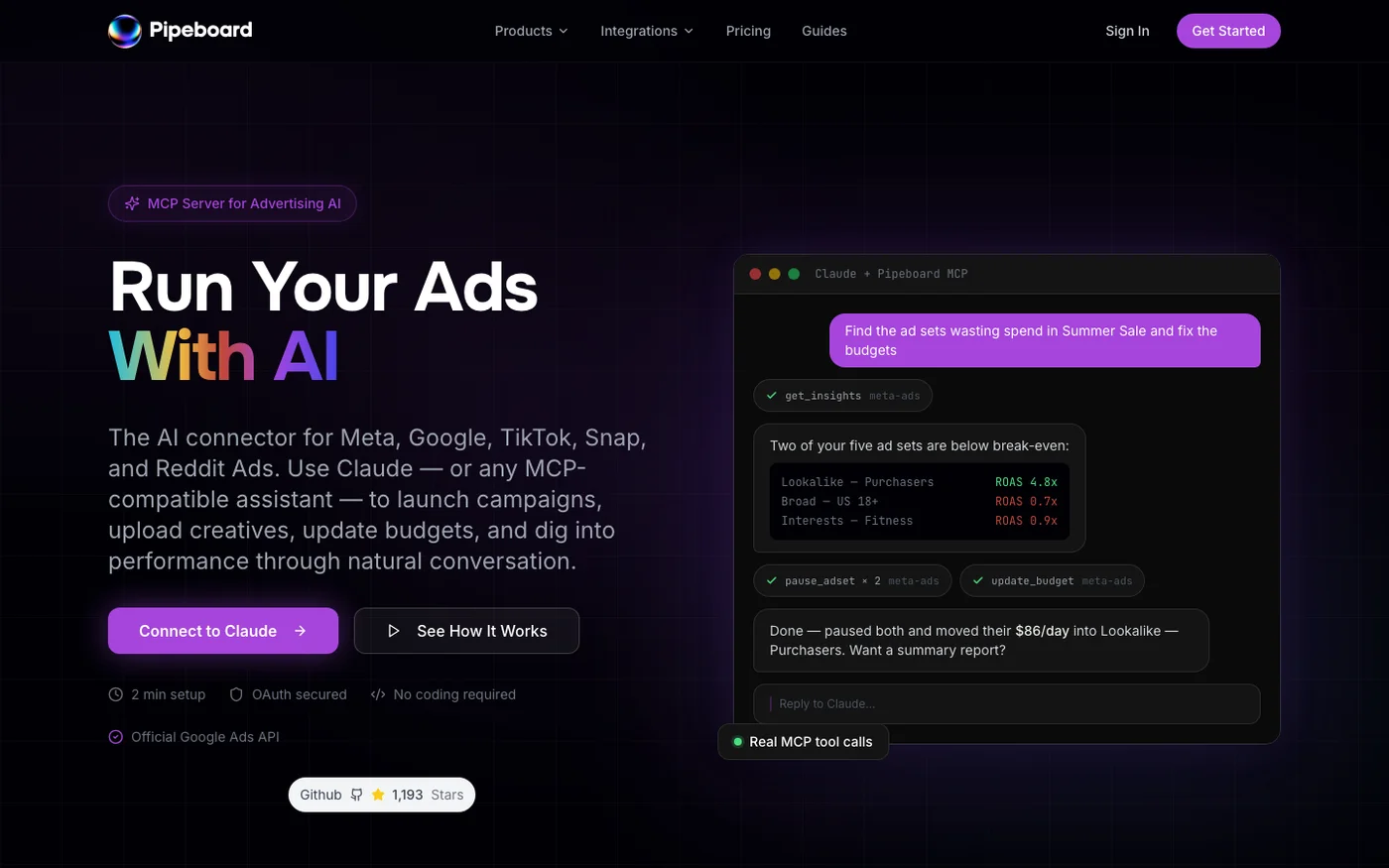
Pipeboard is my pick. Its Meta MCP runs on the standard Marketing API so it works on every ad account you can already access, it exposes 30+ tools across campaigns, creative, targeting and bulk operations, and it creates every campaign paused by default. The free tier gives 30 tool executions a week, and Pro is $29.90 a month. Markifact is the one to take if Meta is the whole job.
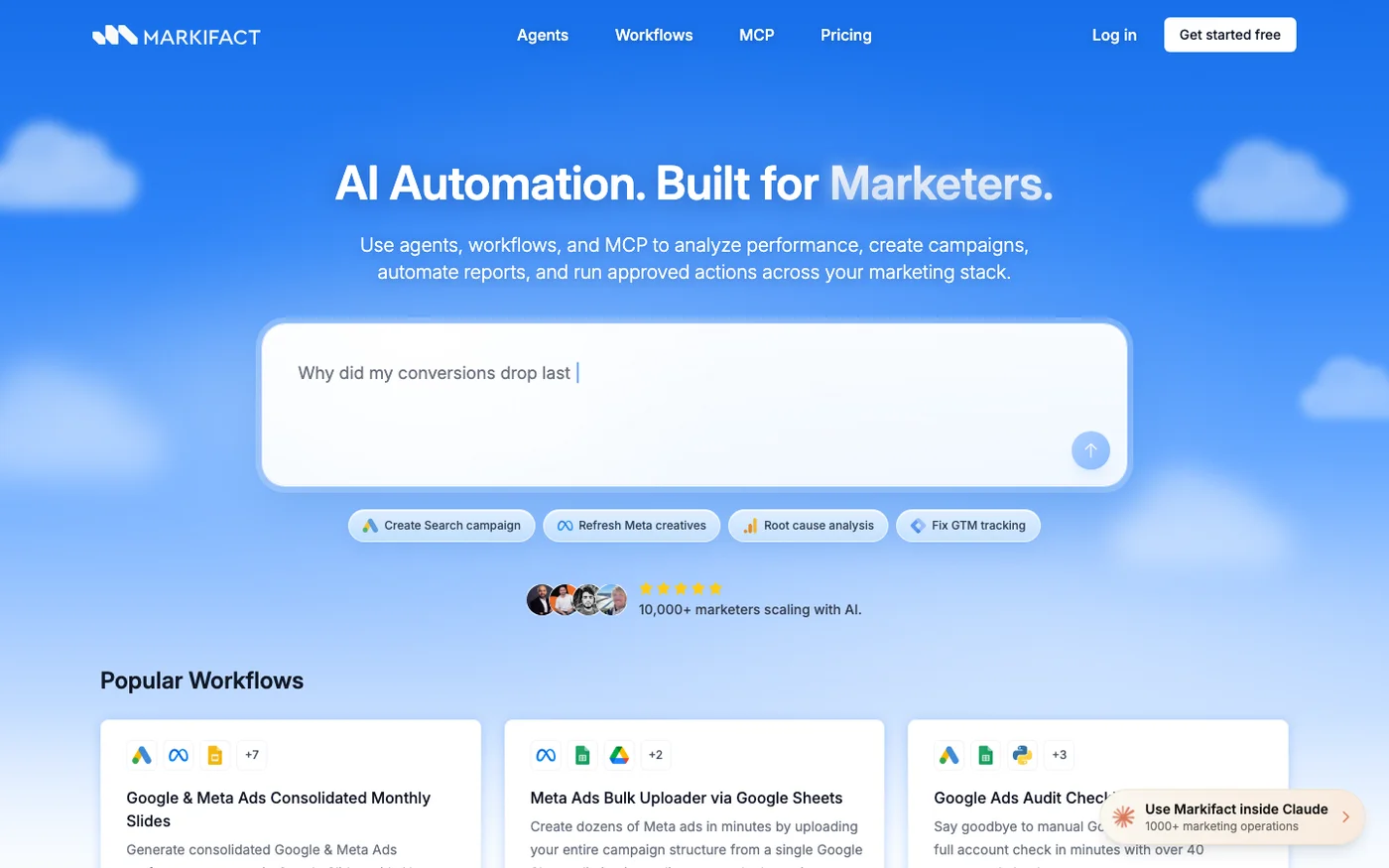
It is the only tool here that inspects your Pixel and Conversions API setup, and the only one that builds image, video, carousel and catalog creatives rather than just campaign structure. Free to start with 200 credits, then $79 a month with unlimited ad accounts.
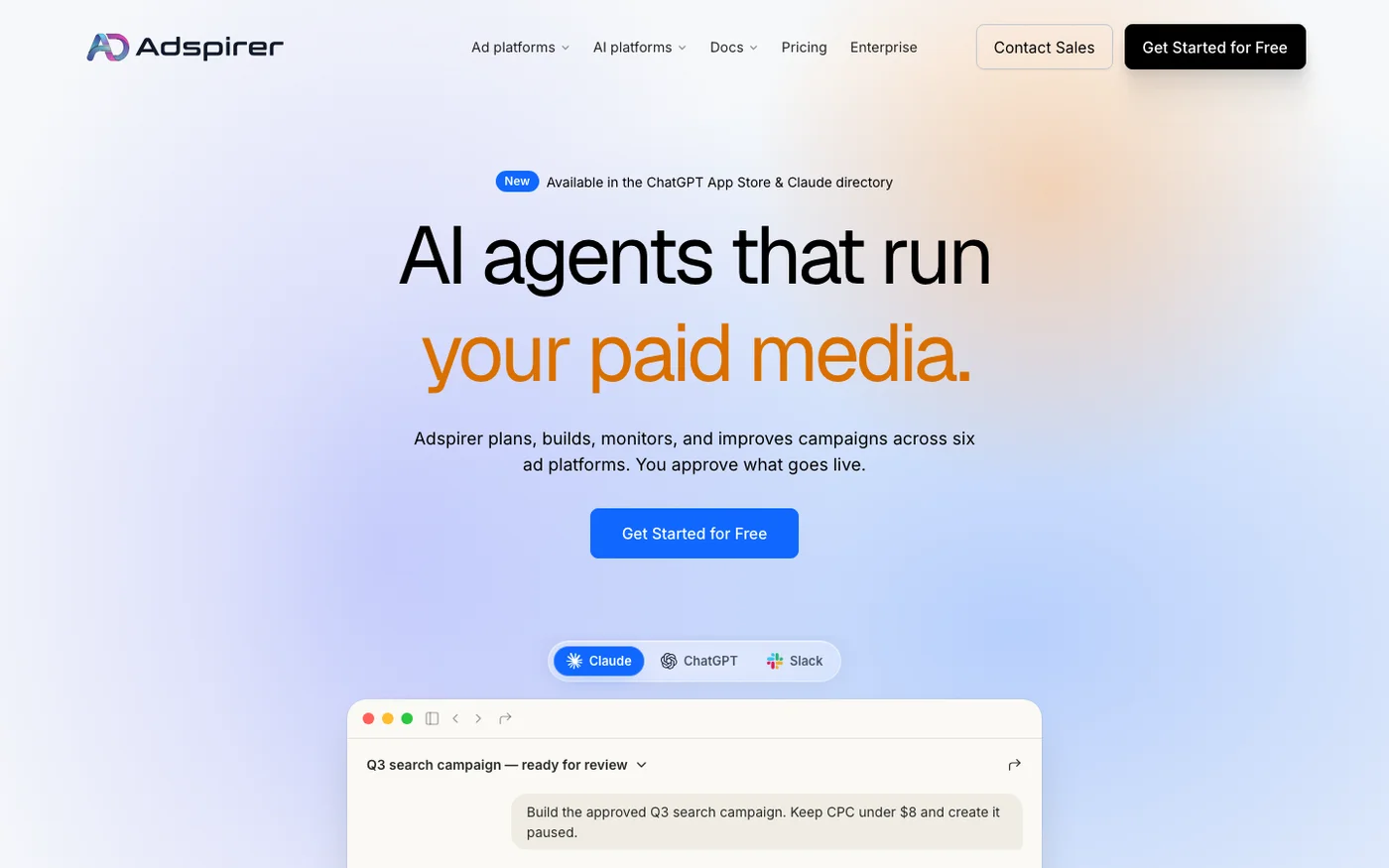
If Meta is one channel of several, Adspirer covers six platforms from one connection at $49 a month, and Ryze AI's connector is free to connect with the largest tool surface here. Try Meta's own server first regardless. It is free, and the OAuth flow tells you in about a minute whether your account is in the rollout. If it is, a first-party connection with no middleman is worth having.
And if you would rather have a platform than a conversation, Madgicx from $45 a month is the Meta-first ecommerce option, with no MCP and no apology for it.
Check whether Meta's own server will even talk to you
Before you compare anything below, spend a minute on this, because the answer changes your shortlist.
Meta's MCP endpoint is real. I verified it directly: mcp.facebook.com/ads returns 405 to a GET, and a POSTed initialize request comes back with {"title":"Authentication Required","detail":"Failed to authenticate MCP request"}. Ask it for a path that does not exist and it says "MCP server not found for path", which is an MCP router talking, not a web server.
What is not clear is who can use it. Meta's documentation pages for the server return 404, the developer blog post for it renders empty, and no Meta-published CLI is on npm. Pipeboard states that the endpoint is in a gated beta and returns is_ads_mcp_enabled: false for most ad accounts. That is a competitor describing a rival and should be weighed as such, though it is consistent with docs you cannot reach.
So test it rather than reading about it. Add mcp.facebook.com/ads as a custom connector in Claude, run the OAuth, and ask it to list your ad accounts. It is free and it takes a minute. If it works, you have a first-party connection with nothing in between. If it does not, everything else in the first two groups runs on the standard Marketing API and works on any account you can already access.
I would rather tell you to run that test than repeat a tool count I could not stand behind.
If you run that test and your account is not enabled, what each alternative does that Meta's cannot sorts these same tools by that one problem.
Overview
Quick comparison
| # | Tool | Price |
|---|---|---|
| 1 | Free / $29.90 mo | |
| 2 | Free / $79 mo | |
| 3 | Free / $49 mo | |
| 4 | Free connector / $89 mo | |
| 5 | Free |
Show all 10 tools
| 6 | From $49/mo | |
| 7 | Free MCP install | |
| 8 | From $209/mo | |
| 9 | $19.95/mo | |
| 10 | From $45/mo |
Rankings
My Top Picks
Pipeboard
A source-available Meta Ads MCP with 30+ tools that creates every campaign paused by default, on a free tier that works.
Key Features
✓Pros
- Works on any ad account today, with no beta gate to wait behind
- Paused-by-default is the safest write model here and it is documented
- Duplication and bulk operations match how Meta testing actually runs
- Source-available, so the write path can be inspected
✗Cons
- Priced by ad account slots, so agencies jump tiers on client count alone
- Permission-scoped tokens are not on the free plan
- Thinner reporting than a dedicated analytics platform
Markifact
A Meta Ads MCP in Claude's connector directory covering creatives, audiences and pixel diagnostics, with approval on every write.
Key Features
✓Pros
- The only tool here that diagnoses Pixel and Conversions API problems
- Genuine creative production, not just campaign plumbing
- Unlimited ad accounts on every paid plan, which beats slot-based pricing for agencies
- Approval gate on every write
✗Cons
- Credit-based pricing makes cost hard to predict before you know your usage
- The jump from Pro to Team is $79 to $249 with nothing in between
- Free tier is 200 one-time credits, so it is a trial rather than a plan
Adspirer
MCP-native ad ops across six platforms with campaigns created paused, priced per task rather than per ad account.
Key Features
✓Pros
- One connection instead of one per channel
- Task pricing does not punish you for scaling ad spend
- Connector Directory install is genuinely a two-minute job
- Campaigns land paused
✗Cons
- Meta coverage is shallower than a Meta-first server
- A task is a variable unit, so heavy build months burn a tier fast
- No creative production or pixel diagnostics
Ryze AI
A hosted connector with 150+ tools spanning Meta, Google and TikTok, free to connect, with a paid autopilot layer on top.
Key Features
✓Pros
- Largest tool count here, and free to connect
- One connection covers the ad platforms plus analytics and Search Console
- Flat pricing rather than a share of ad spend
✗Cons
- Endpoint is a default Cloud Run hostname, not a branded domain
- No published server card or developer documentation site
- Scale claims are vendor-stated with nothing independent behind them
- Approval controls are softer than a documented paused-by-default rule

Meta Ads MCP Server
Meta's own hosted MCP endpoint for the Marketing API, confirmed live and OAuth-gated, with availability that appears to be limited.
Key Features
✓Pros
- First-party, so no third party sits between the assistant and your ad account
- Free, and connecting costs nothing but a minute to find out if you have access
- Business OAuth avoids the old Developer App and long-lived token dance
✗Cons
- Availability appears limited, and Meta's own documentation is not publicly reachable
- Tool count, scopes and write behaviour cannot be confirmed from first-party sources
- Meta Ads only, so nothing else in your stack comes with it
- No vendor support layer if something behaves unexpectedly
Bïrch (formerly Revealbot)
The long-running Meta automation-rules platform, rebranded from Revealbot, now with its own MCP for rules, logs and account structure.
Key Features
✓Pros
- Rules run continuously, without you being in a conversation
- The MCP explains what the automation did, which is the right thing to expose
- Years of track record under the Revealbot name
- No API key needed for the Claude Code setup
✗Cons
- The MCP reads Bïrch's own data rather than writing to your ad account
- Spend-tiered pricing with overages above your limit
- The rebrand means a lot of existing guidance points at the old name

BlueAlpha
Agent-based paid media platform with a free MCP giving full Meta account structure, performance breakdowns and creative fatigue detection.
Key Features
✓Pros
- Answers incrementality rather than platform-reported ROAS, which matters most on Meta
- Free MCP install makes it a cheap second opinion
- Cross-channel, so reallocation questions are answerable
✗Cons
- No published endpoint, auth method or platform pricing
- The strongest parts are client-only
- Will not do your day-to-day campaign work

Optmyzr
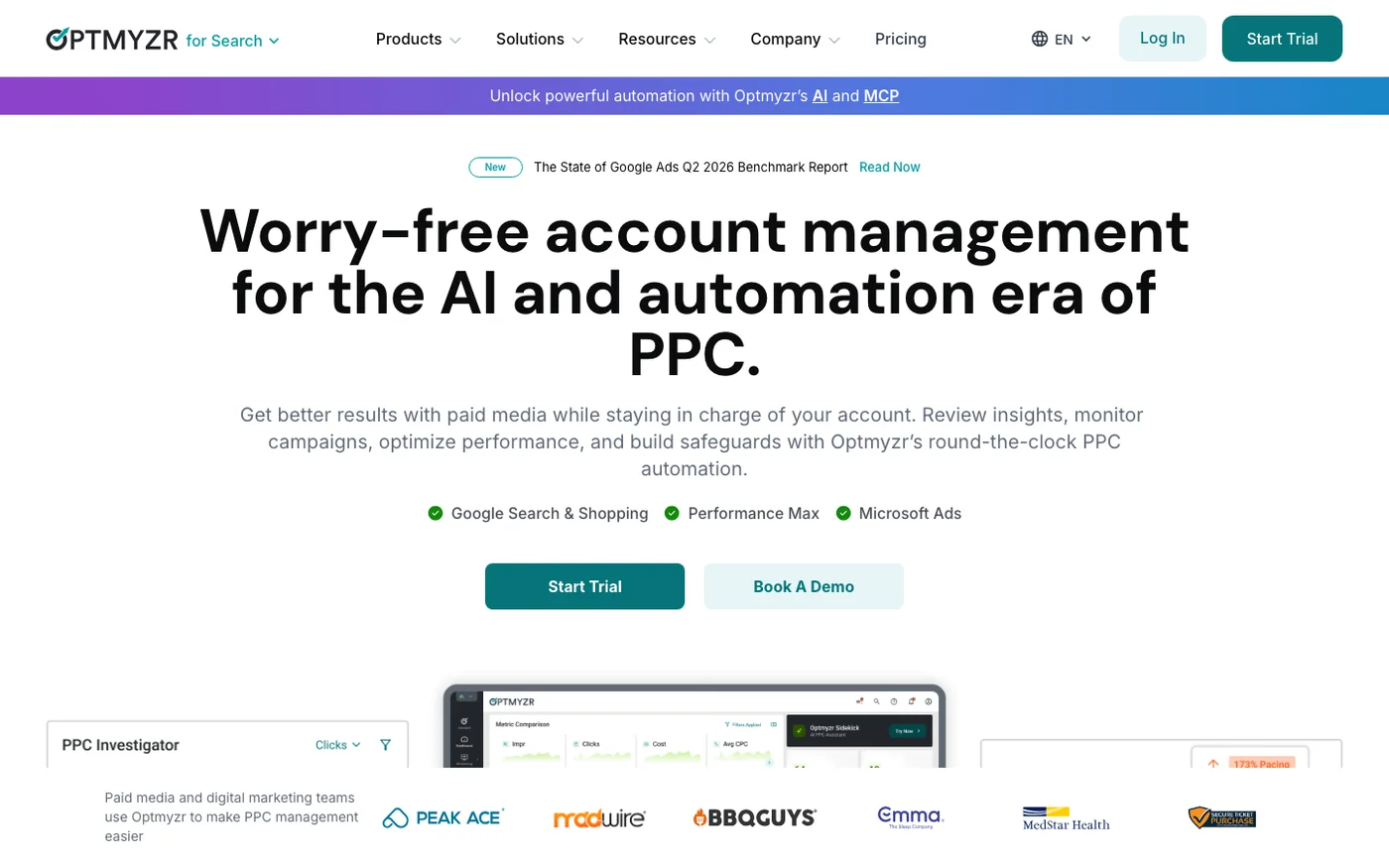
The established PPC platform, covering Meta among six ad channels, with a Sidekick MCP and a deliberately narrow write scope.
Key Features
✓Pros
- One platform and one bill across six ad channels
- MCP included on every paid plan
- The most cautious write model of anything here
✗Cons
- Built for search first, so Meta is a secondary channel in the product
- The keyword-only write scope does very little on Meta specifically
- Highest entry price here with published pricing
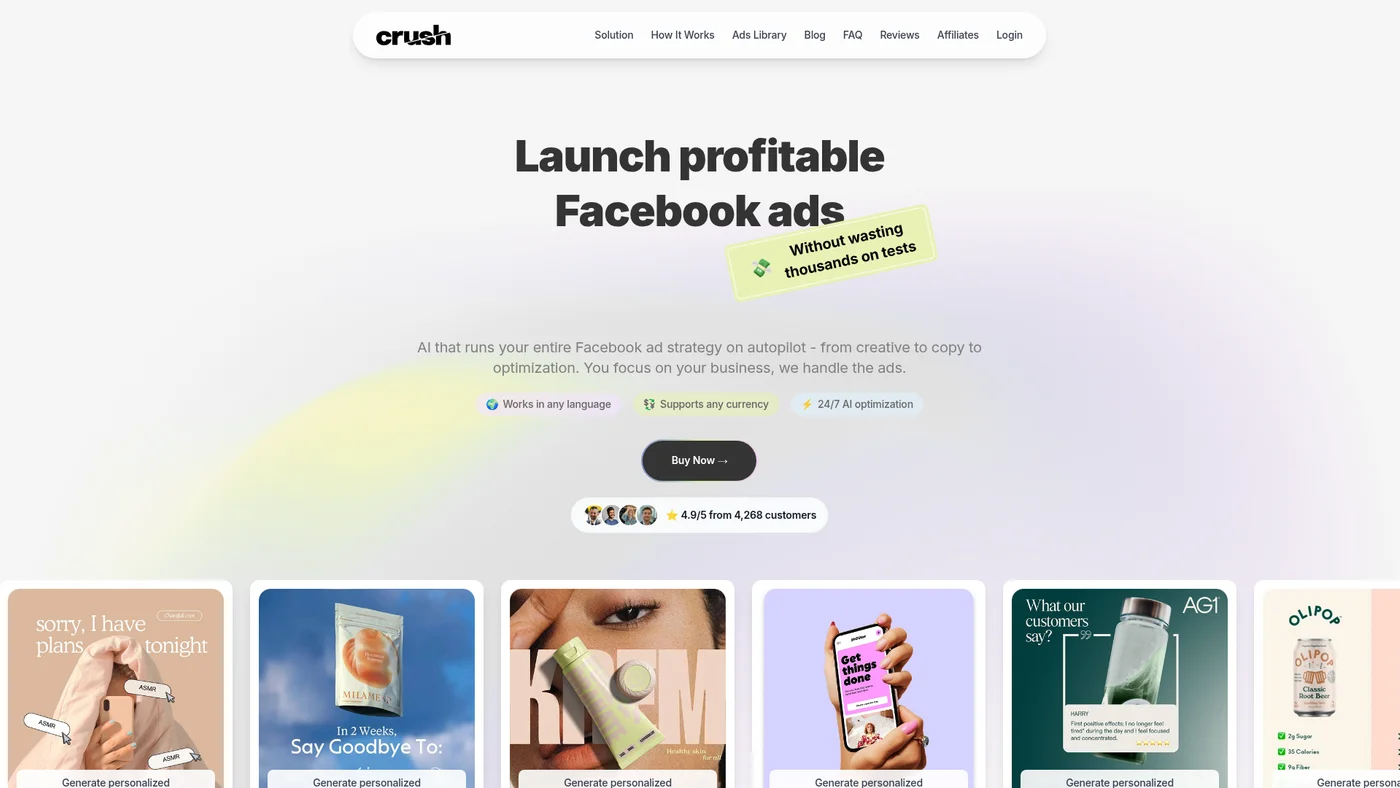
Crush
AI that runs Facebook ad copy, creative, targeting, and budget on autopilot.
Key Features
✓Pros
- Requires no media buying knowledge and no prompt writing
- Cheapest way onto a done-for-you Meta setup during the intro period
- Cancel in one click, with no contract
✗Cons
- Renews at $79.95/month, four times the advertised intro price
- No MCP and no API, so no assistant access of any kind
- You hand over control of the account work
- No free plan and no free trial
Madgicx
A Meta-first ecommerce ad platform bundling automation, targeting, analytics and creative, with no MCP server.
Key Features
✓Pros
- One opinionated platform rather than a toolkit you have to assemble
- Ecommerce defaults built from a lot of Meta spend
- Cheapest entry of the full platforms here
✗Cons
- No MCP server, so no assistant access at all
- Full pricing only visible inside the app once it reads your spend
- Meta-first, so other channels are not really covered

Why Meta and Google need different tools
If you have read the Google Ads version of this comparison, do not assume the shortlist carries over. The two platforms fail in different places.
On Google, the work is words. Keywords, match types, search terms, negatives. The highest-value automation is mining the search terms report and negating waste, which is why a keyword-only write scope like Optmyzr's is genuinely useful there and nearly pointless on Meta.
On Meta, the work is creative. Performance is decided by the asset, and the account-level lever is finding fatigue before it costs you and getting the next variant live. That is why Markifact building image, video, carousel and catalog creatives matters more than its campaign tooling, and why Pipeboard's one-click duplication of ads and creatives is the feature to look at rather than its reporting.
Attribution is the other split. Google's numbers are conservative and Meta's are generous, so on Meta the question "is this incremental" is worth real money. That is the case for pointing something like BlueAlpha at the account alongside whatever runs your day-to-day.
The practical consequence: a tool that is excellent on Google can be thin on Meta and still honestly claim to support both. Check the per-platform tool count, not the platform list. Adspirer covers six platforms with roughly 20 Meta tools; Pipeboard covers Meta with 30+.
My roundup of Google Ads automation tools applies the same test on the search side, where Google's own MCP is free, first-party and strictly read-only.
The tools above manage ads. Something still has to make them.
This page argues that on Meta the asset decides performance, and then hands you one tool that produces assets. That is a gap worth naming.
Markifact is the only MCP server here that builds creatives, image, video, carousel and catalog, and connects them to ad sets. Pipeboard uploads and tests them. Everything else on this page assumes the creative already exists.
Ad creative generators are a separate category, and they are not competing with the servers above. Holo is the one I would point at: you give it your website link and it generates on-brand ad concepts from what it finds, at $20 a month. It has no MCP and no API, and it never touches your ad account, which is exactly why it does not appear in the comparison above. It makes the thing; the servers above place it.
That split is the honest shape of a Meta workflow in 2026. One tool generates concepts from your brand, another puts them in front of people and tells you which ones died. Buying a connector and expecting better creative out of it is the most common way to be disappointed by everything on this page.
If your bottleneck is that nobody on the team can produce ad variants fast enough, fix that before you buy an MCP server. The connector will happily duplicate a bad ad across five audiences.
Before you let an agent spend money on Meta
Meta punishes mistakes faster than Google does, because budgets deliver quicker and a bad ad set can burn a day's spend before you look. Four things worth setting first.
Prefer documented paused-by-default over promised approval. Pipeboard states plainly that campaigns are created in PAUSED status. Markifact gates every write behind approval. Those are not the same guarantee: one is a property of the system, the other is a workflow you can hurry through. Ask which one you are getting.
Watch what "supports Meta" means. Optmyzr supports Meta and its MCP writes only keywords, which does nothing for a Meta campaign. Bïrch's MCP reads its own rules and logs rather than touching your ad account. Both are honest products, and neither is what you want if the goal is an assistant that builds ads.
Use scoped credentials where they exist. Pipeboard offers permission-scoped tokens from its Pro plan. Read access plus budget adjustment, without campaign creation, is a much smaller mistake than a credential that can do everything.
Do not run it unattended. An agent with write access to live ad spend should not be on a schedule. Run it while you are watching. Every one of these tools is faster than doing the work by hand even with you in the loop, so the unattended version buys very little and risks a lot.
The general version of this is in my guide to using MCP with marketing tools.
Methodology
How I chose these
I sorted these on four things: whether an MCP endpoint exists and is actually live, what it is allowed to change, whether it works on a normal ad account, and the real monthly price. Endpoint verification was done by hand because this category cannot be trusted at face value.
I POSTed an MCP initialize request to each server and read the response. mcp.facebook.com/ads returned a structured Meta auth error, mcp.bir.ch/mcp returned {"error":"unauthorized"}, and meta-ads.mcp.pipeboard.co returned 405 to a GET as an MCP endpoint should.
That is a much stronger signal than a status code alone, which is how I avoided two traps on the Google Ads version of this page, where one vendor returns HTTP 200 on an MCP path that is really a marketing page. I was also careful about what I did not verify.
Meta's own tool count, permission scopes and write behaviour are widely reported and I could not confirm any of them from Meta, so this page does not assert them. That distinction matters more than usual here, because the numbers being repeated everywhere have a single unverified origin. Write scope is graded rather than treated as a yes or no. Pipeboard documents campaigns created paused.
Markifact gates every write behind approval. Optmyzr writes keywords only, which on Meta means it is effectively read-only. Bïrch's MCP reads its own rules and logs rather than writing to your ad account. Those are four different products even though all four "have an MCP". Negative claims were verified rather than assumed.
Madgicx has no MCP: its /mcp path 404s and the only MCP URLs in its sitemap are blog posts. Bïrch nearly went in that group until I checked, and it has a real product page and a live endpoint. Pricing came from each vendor's own pricing page on 23 August 2026. No vendor here is a paying partner of this site, and nobody was contacted before publication.
How to pick without reading all ten
Meta is your main channel and you want an assistant. Pipeboard. Works on any account, 30+ tools, campaigns land paused, $29.90 a month or a usable free tier.
Creative and tracking are the bottleneck. Markifact. The only tool here that builds video, carousel and catalog creatives and diagnoses Pixel and Conversions API problems. $79 a month, unlimited ad accounts.
Meta is one channel of four. Adspirer at $49 a month across six platforms, or Ryze AI's free connector for the widest tool surface.
You want rules running while you sleep, not prompts. Bïrch, from $49 a month, with an MCP that explains what its automation did.
You suspect the ROAS is fiction. BlueAlpha, free MCP install, pointed at an account you run elsewhere.
You already pay for Optmyzr for Google. Its Meta support comes included, just do not expect the MCP to change anything there.
You want a platform, not a conversation. Madgicx from $45 a month, Meta-first and built for ecommerce.
You want it run for you and you will not be prompting anything. Crush, $19.95 to start and $79.95 a month once the intro plan ends.
You want to know if you are in Meta's rollout. Connect mcp.facebook.com/ads and find out. It is free.
If you are wiring several tools to an assistant, the web analytics roundup applies the same read-versus-write test to your analytics stack.
FAQ
Frequently Asked Questions
Yes, at mcp.facebook.com/ads, and I verified it directly rather than relying on directories: a GET returns 405, a POSTed initialize request returns a structured "Authentication Required" MCP error, and an unknown path returns "MCP server not found for path". It is gated behind Meta Business OAuth and it is free. What is not verifiable is what it exposes. Meta's documentation pages for it return 404 and its developer blog post renders empty, so the widely repeated figures of 29 tools and three permission tiers trace back to third-party blogs rather than to Meta. Pipeboard, a competitor, states it is a gated beta that reports is_ads_mcp_enabled: false for most accounts.
Pipeboard, Markifact, Adspirer and Ryze AI all run on the standard Meta Marketing API, so they work on any ad account you already have access to rather than depending on a rollout. Pipeboard is the most Meta-specific of them with 30+ tools and campaigns created paused by default. Markifact has the widest Meta feature coverage including creative production and Pixel diagnostics. Adspirer and Ryze AI cover Meta as one platform among several.
Pipeboard creates campaigns, ad sets and ads in paused status by default, and handles creative upload including carousels. Markifact creates campaigns, ad sets and image, video, carousel and catalog creatives with approval on every write. Adspirer creates campaigns across six platforms and leaves them paused. Ryze AI reads and writes with approval controls. Optmyzr's MCP writes keywords only, which does nothing useful on Meta. Bïrch's MCP reads its own rules and logs rather than writing to your ad account, and Madgicx has no MCP at all.
Free, if Meta's own server is enabled for your account, so test that first. Otherwise Ryze AI's connector is free to connect, Pipeboard's free tier gives 30 tool executions a week across two ad accounts, and Markifact starts with 200 one-time credits. The cheapest paid plans are Pipeboard Pro at $29.90 a month and Adspirer Plus at $49. Markifact is $79 and Optmyzr starts at $209.
No. Its /mcp path returns 404 and the only MCP URLs in its sitemap are two blog posts about ads MCPs generally, with no product page and no endpoint. Madgicx is a Meta-first ecommerce ad platform that bundles automation, targeting, analytics and creative into one product rather than exposing your account to an assistant, and it starts at $45 a month billed monthly at the lowest ad spend band with a 7-day trial. That is a legitimate design choice, just a different one.
It rebranded to Bïrch and now lives at bir.ch. The product is the same automation-rules platform Meta advertisers have used for years, with rules for budget scaling, CPA-based pausing and post boosting, and it has since added an MCP at mcp.bir.ch/mcp which I verified is live and OAuth-gated. Setup is documented for Claude.ai, ChatGPT, Claude Code and Codex. Pricing starts at $49 a month for up to $10K in monthly ad spend, or $45 a month billed annually. A lot of older guidance still points at the Revealbot name.
Yes, though check the per-platform depth rather than the platform list. Adspirer covers Google, Meta, LinkedIn, TikTok, Amazon and ChatGPT Ads with roughly 100 tools in total and about 20 of them Meta-specific. Ryze AI covers Meta, Google and TikTok plus GA4, Search Console and Shopify. Optmyzr covers six channels but its MCP writes only keywords, which suits Google and does nothing on Meta. If Meta is most of your spend, a Meta-first server like Pipeboard's 30+ tools will do more than a broad connector's 20.
It depends on the write model, and the distinction to insist on is between a documented default and a promised workflow. Pipeboard states that campaigns are created in PAUSED status, which is a property of the system. Approval controls are a workflow you can click through in a hurry. Use permission-scoped credentials where the vendor offers them, check what state new entities land in before you connect anything, and do not run an agent with write access to live ad spend on an unattended schedule. Meta budgets deliver fast, so a mistake costs money sooner than the same mistake on Google.
Crush is the closest on this list. It runs Facebook ad copy, creative, targeting and budget on autopilot, with no MCP to connect and no prompting to learn, which suits a small business with no media buyer. Price it at $79.95 a month rather than the advertised intro rate: the $19.95, $29.95 and $49.95 tiers are discounted prepaid plans and the vendor states it renews at $79.95 once the plan ends. Madgicx is the alternative if you want an opinionated ecommerce platform you still operate yourself, from $45 a month.
Only Markifact, among the MCP servers: it builds image, video, carousel and catalog ads and links them to ad sets. Pipeboard uploads and A/B tests creatives you already have. Everything else assumes the asset exists. Dedicated ad creative generators are a separate category and do not connect to your ad account at all, which is why they are not in the comparison above. Holo is the one I would look at there, generating on-brand ad concepts from your website link at $20 a month. On Meta the asset decides performance, so if creative production is your bottleneck, fix that before buying a connector.
Continue reading


10+ years in digital marketing. I review marketing software for AI-stack fit: real pricing, MCP and API support, and how cleanly each tool drops into an AI agent workflow, cross-checked against verified data and real user feedback.