


Joonas Rotko · Founder, That Marketing Buddy
I assess marketing software through 10+ years of agency work, current product research, buyer needs, competing tools and total cost.
How this review was prepared
This is a research-based review built from Constant Contact's live plan and contact-tier pricing, billing documentation, developer documentation and current product pages, cross-checked against independent pricing trackers.
This page may include affiliate links, meaning I may earn a commission if you sign up (at no extra cost to you).
The Verdict
Is Constant Contact right for you?
Constant Contact is easier to justify for a supported small-business email program than for a rapidly growing list.
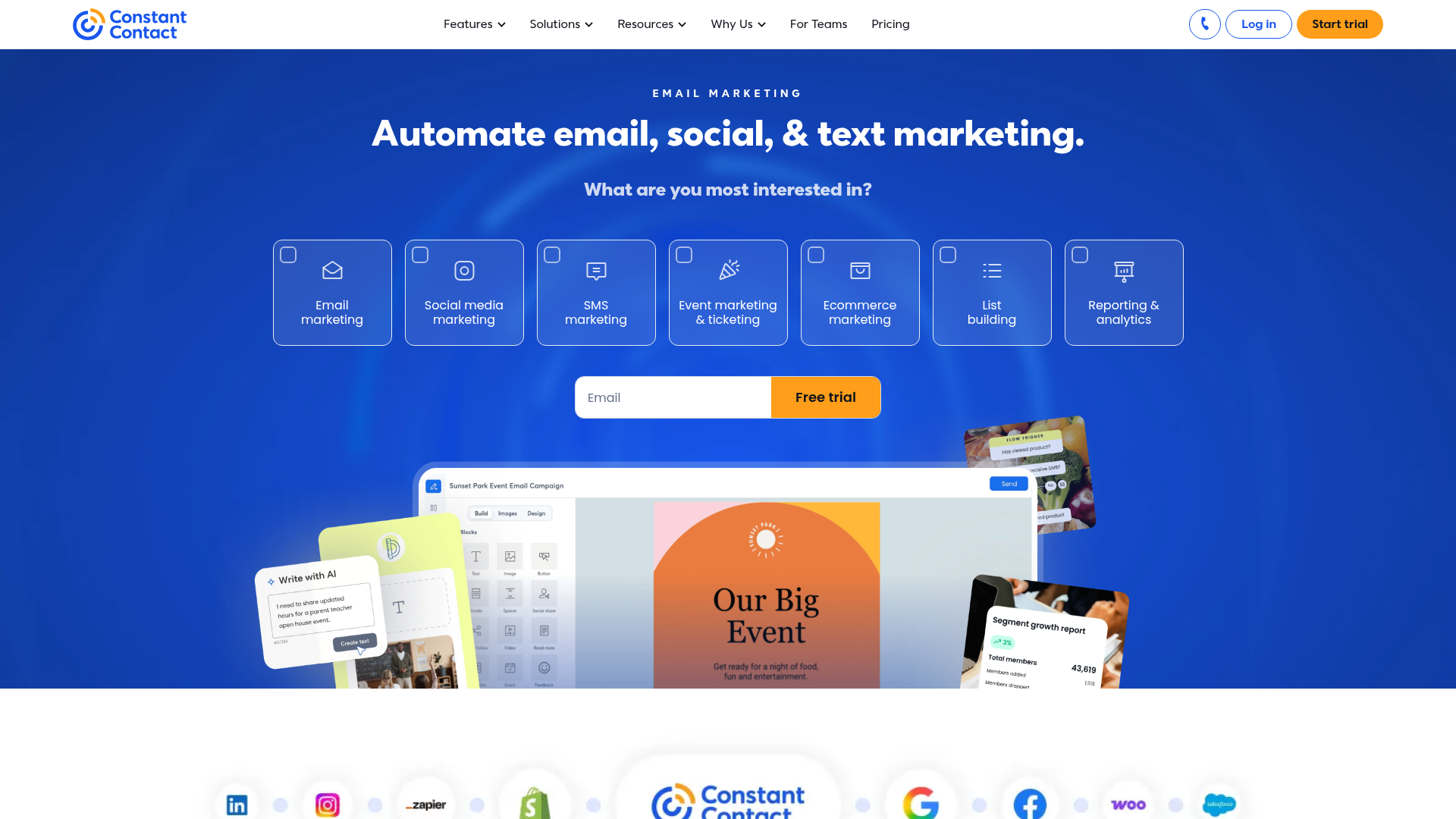
Running since 1995, it layers native event marketing and RSVP tools onto email, something MailerLite, Brevo and Sequenzy don't offer natively. But the $12-80/month headline is a 500-contact price; the published contact tiers put Standard at $110 and Premium at $200 by 5,000 contacts.
It fits a business that values phone support and events over the newest automation logic, and has priced the real contact-count scaling into its budget.
Who It's For
Who Constant Contact is for (and who it isn't)
✓ Best for
- +Local businesses and nonprofits new to email marketing. Phone support on every plan and a well-trodden template library reduce the learning curve for a first-time sender.
- +Organizations running ticketed or RSVP events. Native event pages, promo codes and both virtual and in-person RSVP tools are a genuine differentiator most ESP competitors don't build natively.
- +Teams that want a known, established brand. Three decades of operating history and a large support team matter to buyers who value stability over cutting-edge automation.
× Consider something else if
- −Your list is growing past a few thousand contacts. Contact-count pricing means the $35 Standard headline becomes $110/month in the published 2,501-5,000 contact tier.Try MailerLite →
- −You need deep behavioral automation. Multiple reviews describe Constant Contact's automation logic as basic next to tools built around branching triggers.Try ActiveCampaign →
- −You want SMS and WhatsApp bundled without an add-on fee. Constant Contact prices SMS as a separate add-on starting at $10/month; some competitors bundle messaging channels into the base plan.Try Brevo →
What You Can Do
What can Constant Contact do?
Event marketing with built-in RSVP
Build branded event pages, sell tickets and collect RSVPs, either through a full event campaign or a lightweight RSVP block inside a regular email. Supports promo codes and both virtual and in-person events, a real workflow most email-first competitors lack natively.
List segmentation and automation on Standard and above
Multi-step automations like a welcome series or re-engagement sequence live on Standard and up; Lite is broadcast-only. Reviews describe the automation logic as suited to straightforward if-then sequences, not deep behavioral branching.
AI-assisted campaign drafting
The AI Content Generator turns a short brief into a draft subject line, preheader, body and CTA. It's a starting point for a non-copywriter small business owner, not a replacement for reviewing tone and offer accuracy before sending.
SMS follow-up for time-sensitive promotions
Layer SMS on top of email for event reminders or flash sales; Premium includes 500 messages/month, Lite and Standard add it starting at $10/month for up to 500 messages, US only.
AI Capabilities
AI, API and assistant workflows
An AI Content Generator drafts campaigns from a brief
Included on all paid plans per Constant Contact's own product pages, it drafts subject lines, preheader text, body copy and CTAs from a short prompt. Treat vendor claims about it as vendor-stated, not independently audited.
An official V3 REST API is live
Constant Contact runs an OAuth2-authenticated V3 API at developer.constantcontact.com. Legacy V2 keys are no longer issued for new integrations.
The MCP server is community-built, not official
A third-party GitHub repository wraps the V3 API with over 100 tools, but Constant Contact does not publish or support it. Treat any AI-agent connection through it as unofficial.
Pricing
How much does Constant Contact cost?
The published entry plan starts at $12/mo. For this review's professional buyer, the practical starting point is $55-75/mo before users and add-ons. No free plan, but there’s a 30-day free trial.
Monthly price by contact tier
| Plan | 0–500 | 501–1K | 1,001–2.5K | 2,501–5K |
|---|---|---|---|---|
| Lite | $12 | $30 | $50 | $80 |
| Standard | $35 | $55 | $75 | $110 |
| Premium | $80 | $110 | $150 | $200 |
Constant Contact charges for both the feature plan and the highest contact tier reached during the billing period. At 500 contacts, Standard costs $35/month; at 5,000 contacts, the same plan costs $110/month. Premium rises from $80 to $200/month across those tiers. Annual prepayment and verified nonprofit discounts can reduce the bill, but the live calculator should be checked with your real list size before comparing it with a send-based alternative.
Standard, not Lite, is the realistic plan
Lite excludes segmentation, automation beyond a single welcome email and A/B testing, the tools that make email marketing worth running beyond a broadcast blast.
Send allowance scales with contacts, and overage is billed
Monthly sends are capped at 10x contacts on Lite, 12x on Standard and 24x on Premium, with overage billed at $0.002/email, a real constraint for anyone sending more than once or twice a week.
Alternatives
When I'd choose something else
Three different buying priorities, and what I'd pick instead for each one.
Real free tier plus SMS and WhatsApp

Brevo
For a buyer who wants a genuine free tier plus SMS, WhatsApp and transactional email under one account instead of paying extra for SMS as a bolt-on.
Trade-off: Brevo's event and RSVP tooling is thinner than Constant Contact's dedicated version.
Explore Brevo for this use case →Modern automation at a lower price

MailerLite
For a buyer who wants a more modern editor and automation at a lower price once contacts scale past a few hundred, the direct better-value comparison reviewers repeatedly cite.
Trade-off: MailerLite has no native event or RSVP tooling.
Explore MailerLite for this use case →AI-native campaign building

Sequenzy
For a buyer who wants AI-native campaign building rather than an AI feature bolted onto a platform built in 1995.
Trade-off: Sequenzy is newer with a smaller integration catalog and no event tooling.
Explore Sequenzy for this use case →Keep going
- Compare Constant Contact against the field: 22 Best Email Marketing Software (2026)
Downsides
Limitations to consider before subscribing
Contact-count pricing jump
The $12-80/month headline is a 500-contact price; the published 2,501-5,000 contact tier pushes Standard and Premium to $110-200/month.
Automation depth trails competitors
Multiple third-party reviews independently describe automation as behind ActiveCampaign, Klaviyo and even MailerLite on branching and behavioral logic.
Interface feels dated
Consistent across 2026 reviews: the UI and template library read as older-feeling next to MailerLite, Kit or beehiiv.
No permanent free plan
Only a 30-day trial exists, unlike MailerLite, Brevo or Sequenzy's free tiers.
My Recommendation
Budget for the contact-count ladder, not the entry price
Shortlist Constant Contact when phone support, event RSVP tools and an established brand matter more than the newest automation logic, and the real 5,000-contact price has been priced in.
Choose something else when the list is growing fast, deep behavioral automation is the priority, or SMS/WhatsApp bundled into the base plan matters.
What to check during the trial
- –Run the 30-day trial with your real contact list size, not a test list, to see the actual send allowance
- –Use the live pricing calculator with your real contact count and compare the result with a send-based alternative
- –Test the AI Content Generator on a real campaign brief before trusting it for a full send
- –Confirm whether an event/RSVP workflow is genuinely needed before paying for it as a differentiator
FAQ
Frequently asked questions about Constant Contact
The $12/$35/$80 monthly starting prices cover up to 500 contacts. In the published 2,501-5,000 contact tier, Lite costs $80, Standard $110 and Premium $200 a month, so compare tools at your actual list size rather than their entry prices.
No. A community-built server on GitHub wraps its API with over 100 tools, but Constant Contact doesn't publish or support it. There's no first-party MCP server as of this research.
Native event marketing and RSVP tools, branded event pages, promo codes and support for both virtual and in-person events, a workflow most email-first competitors don't build natively.
No permanent free plan exists. There's a 30-day free trial with no credit card required, plus a separate 30-day money-back guarantee after subscribing.
Sources & References (5)
Spot something out of date?Vendors and readers, send me the correct fact.
Software sites change almost every week, and I want every claim on this page to be factually correct. If you are a vendor or a reader, send me the correct fact and a link to the official page. I will check it and update the page. The opinions and rankings stay mine.