


Joonas Rotko · Founder, That Marketing Buddy
I assess marketing software through 10+ years of agency work, current product research, buyer needs, competing tools and total cost.
How this review was prepared
I researched MailerLite's current public product, pricing and technical documentation on 2026-09-15. I have not treated vendor claims as hands-on results, and I have not invented performance from features I have not personally tested.
This page may include affiliate links, meaning I may earn a commission if you sign up (at no extra cost to you).
The Verdict
Is MailerLite right for you?
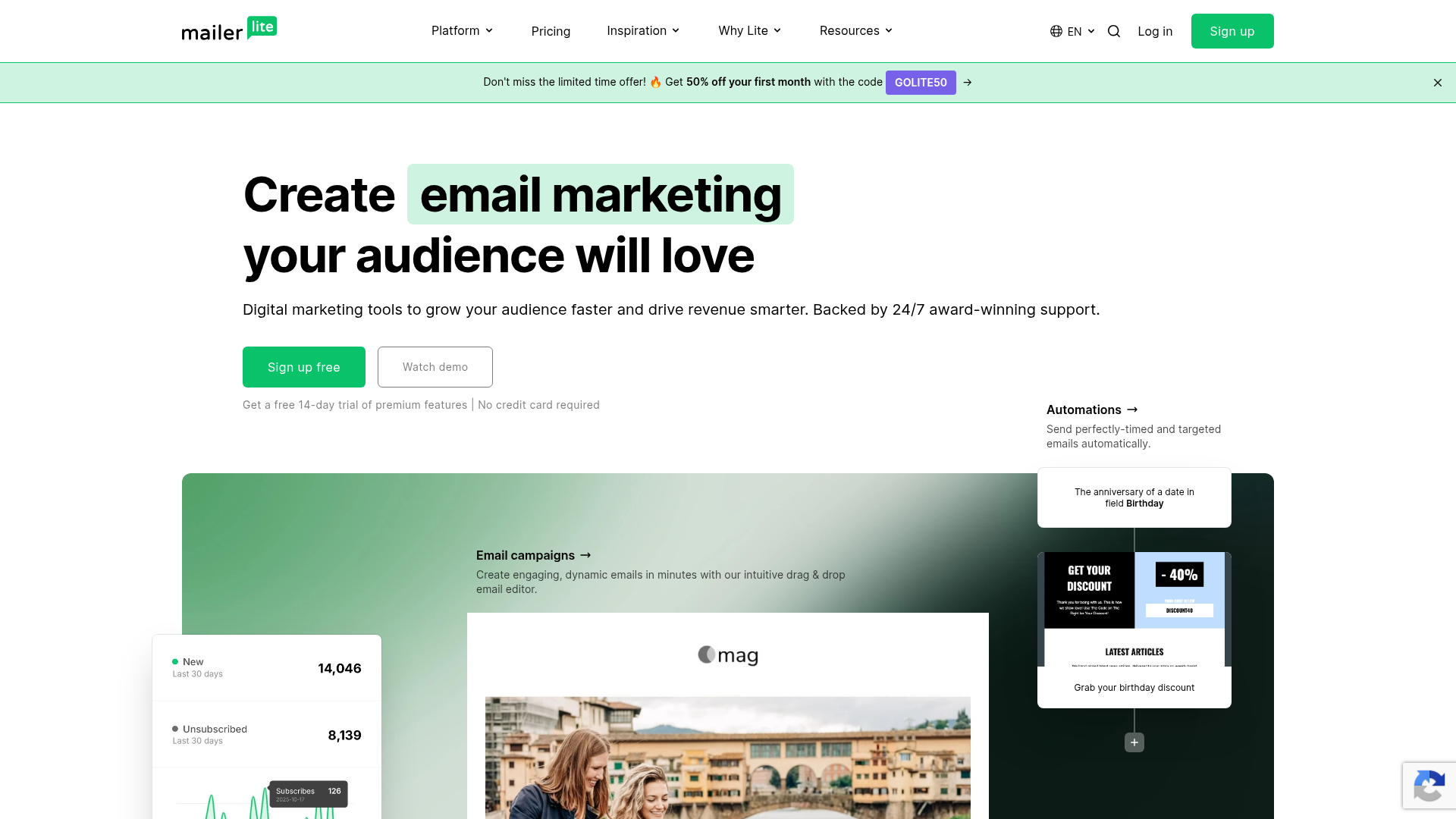
MailerLite is a strong default when a lean team needs email, forms, landing pages and sensible automation in one approachable account.
The current free plan stops at 250 subscribers and 2,500 monthly emails. Comfort starts at $12/month, while Power starts at $25/month and adds unlimited seats and monthly sends, which makes Power the cleaner agency or busy-team comparison.
Billing grows with active subscribers, so list hygiene and separate client accounts matter more than the low starting number suggests.
Who It's For
Who MailerLite is for (and who it isn't)
✓ Best for
- +Small teams running email without a specialist. The product keeps campaigns, forms and common automations accessible.
- +Agencies that want clients to own their accounts. Separate billing and account access can keep data ownership clear while the agency earns through referrals.
- +Teams using AI assistants around email data. MailerLite publishes an API and MCP endpoint for supported workflows.
× Consider something else if
- −Complex lifecycle automation drives the decision. Consider it when branching journeys, CRM events and deeper automation matter more than simplicity.Try ActiveCampaign →
- −Transactional email and CRM belong in the same account. Consider it when campaign sends, transactional messaging and sales activity need one broader platform.Try Brevo →
- −Creator growth and paid newsletters are central. Consider it when recommendations, sponsorships and creator monetisation shape the email strategy.Try Kit →
What You Can Do
What can MailerLite do?
Build lists with forms and landing pages
Create lead capture without adding a separate landing-page tool. Define consent, source tags and the promised follow-up before sending traffic.
Send campaigns and behavioural automations
Comfort supports common sequences; Power expands automation and removes seat pressure. Test the real branch logic rather than judging the visual builder alone.
Collaborate without sharing logins
Power includes unlimited seats, while Comfort includes three. Agencies should keep each client's ownership, billing and permissions explicit.
Review performance and clean the list
Campaign and automation reports show engagement. Suppress inactive or invalid contacts so the active-subscriber bill reflects an audience you can still reach.
AI, API & MCP
How MailerLite uses AI and automation
MailerLite runs an official, vendor-hosted MCP server covering subscribers, campaigns, automations, and e-commerce, letting an agent manage the full marketing workflow from a chat.
AI agent workflow
Subscriber add, segment, and automation check
An agent can add a new subscriber, tag them into a segment, and trigger or verify that an automation fires, all through MCP tool calls, then check webhook configuration for related order data if e-commerce is connected.
Approval boundary: A human should confirm before the agent sends or schedules an actual email campaign to a live list, or before an automation change that would fire messages to real contacts.
MCP
officialOAuth MCP across nine tool categories
MailerLite's official MCP server at mcp.mailerlite.com/mcp uses OAuth with browser sign-in and covers nine categories: subscribers, campaigns, groups, segments, fields, forms, automations, templates, and e-commerce/webhooks. General MCP access isn't tier-gated, though the ChatGPT connector specifically requires a Pro or Plus account.
MailerLite MCP documentation →API
officialREST API wrapping the same nine categories
MailerLite's REST API covers the same subscriber, campaign, group, segment, field, form, automation, template, and e-commerce data the MCP server wraps. The specific authentication method for direct REST access and any rate limits aren't published separately from the MCP docs.
MailerLite developer documentation →Pricing
How much does MailerLite cost?
The published entry plan starts at Free. For this review's professional buyer, the practical starting point is $25/month before users and add-ons. A free plan is available.
| Plan | Monthly |
|---|---|
| Free | Free |
| Comfort | $12/mo |
| PowerPopular | $25/mo |
Free includes 250 active subscribers and 2,500 emails each month. Comfort starts at $12/month or $10.80/month billed annually for 500 subscribers and includes three seats. Power starts at $25/month or $22.50/month billed annually and adds unlimited seats and monthly sends. Every paid total rises with active subscriber count.
The free plan is now a small test
A 250-subscriber ceiling is enough to learn the workflow, not to run an established list.
Power fits teams and agencies better
Unlimited seats and sends remove two operational constraints for a modest starting premium.
Active subscribers set the real bill
Model the expected list tier and remove inactive contacts rather than comparing only the 500-subscriber headline.
Alternatives
When I'd choose something else
Three different buying priorities, and what I'd pick instead for each one.
Best direct alternative

ActiveCampaign
Choose ActiveCampaign when branching journeys, CRM events and deeper automation matter more than simplicity.
Trade-off: It requires more setup and usually costs more as the database grows.
Explore ActiveCampaign for this use case →Best for a different workflow

Brevo
Choose Brevo when campaign sends, transactional messaging and sales activity need one broader platform.
Trade-off: Its product and pricing structure are less simple.
Explore Brevo for this use case →Best if the scope is wrong

Kit
Choose Kit when recommendations, sponsorships and creator monetisation shape the email strategy.
Trade-off: It is less natural for multi-client agency operations.
Explore Kit for this use case →Keep going
- Compare MailerLite against the field: Best Newsletter Platforms (2026)
- Compare MailerLite against the field: 22 Best Email Marketing Software (2026)
- Put it to work: Systeme.io Free Plan: Is It Really Enough?
- Put it to work: Cold Email vs Email Marketing Software: Which One Your Team Needs
Downsides
Limitations to consider before subscribing
Pricing climbs with the list
A low entry price is not the cost of a mature database.
Advanced CRM is outside the core
Lead scoring, sales pipelines and deep account-based workflows need another system or a broader alternative.
Separate client accounts need governance
Agencies should document ownership, permissions and billing instead of pooling unrelated audiences.
My Recommendation
My recommendation for MailerLite
Shortlist MailerLite when a small team wants email automation that people can learn quickly and the expected contact tier remains economical.
Choose a deeper automation or CRM platform when customer journeys span sales, service and transactional systems.
What to check during the trial
- –Import a clean representative subscriber segment
- –Build one form-to-email automation
- –Invite the actual collaborators
- –Test an API or MCP read workflow
- –Model cost at today's list and the next two tiers
FAQ
Frequently asked questions about MailerLite
Yes. The current free plan allows up to 250 subscribers and 2,500 emails per month.
Power is the cleaner operational fit because it includes unlimited seats and monthly email sends. It starts at $25/month for 500 subscribers.
MailerLite publishes an official MCP endpoint alongside its API. Use account-specific credentials and approvals before allowing write actions.