

Want a free personalized recommendation for your software stack?Get yours
That Marketing Buddy
8My scoreThat Marketing Buddy scores HasData 8 out of 10.
Software/Seo Apis/
HasData

HasData Review 2026: Strong on Agents, Sneaky on SERP Pricing

Web scraping and SERP APIs with a 57-tool MCP server, AI Mode capture and plain-English AI extraction.

From $49/month starting30-day free trialFree planHands-on tested
Updated Sep 3, 202612 tools in SEO APIs
Data from Buddy's database
Joonas Rotko

Joonas Rotko · Founder, That Marketing Buddy

I have spent 10+ years doing hands-on digital marketing and buying marketing software for my team and clients, and I now score every tool on this site for how well it works with AI agents. Ex Google Premier Partner agency co-owner.

Hands-on reviewUpdated Sep 3, 202612 tools in this category
This page may contain affiliate links.

Some links on this page are affiliate links, meaning I may earn a commission if you sign up (at no extra cost to you). This never influences my ratings or recommendations.
The Verdict

Is HasData right for you?

#4 of 12 in this category by price2% below median4 tools offer free plans

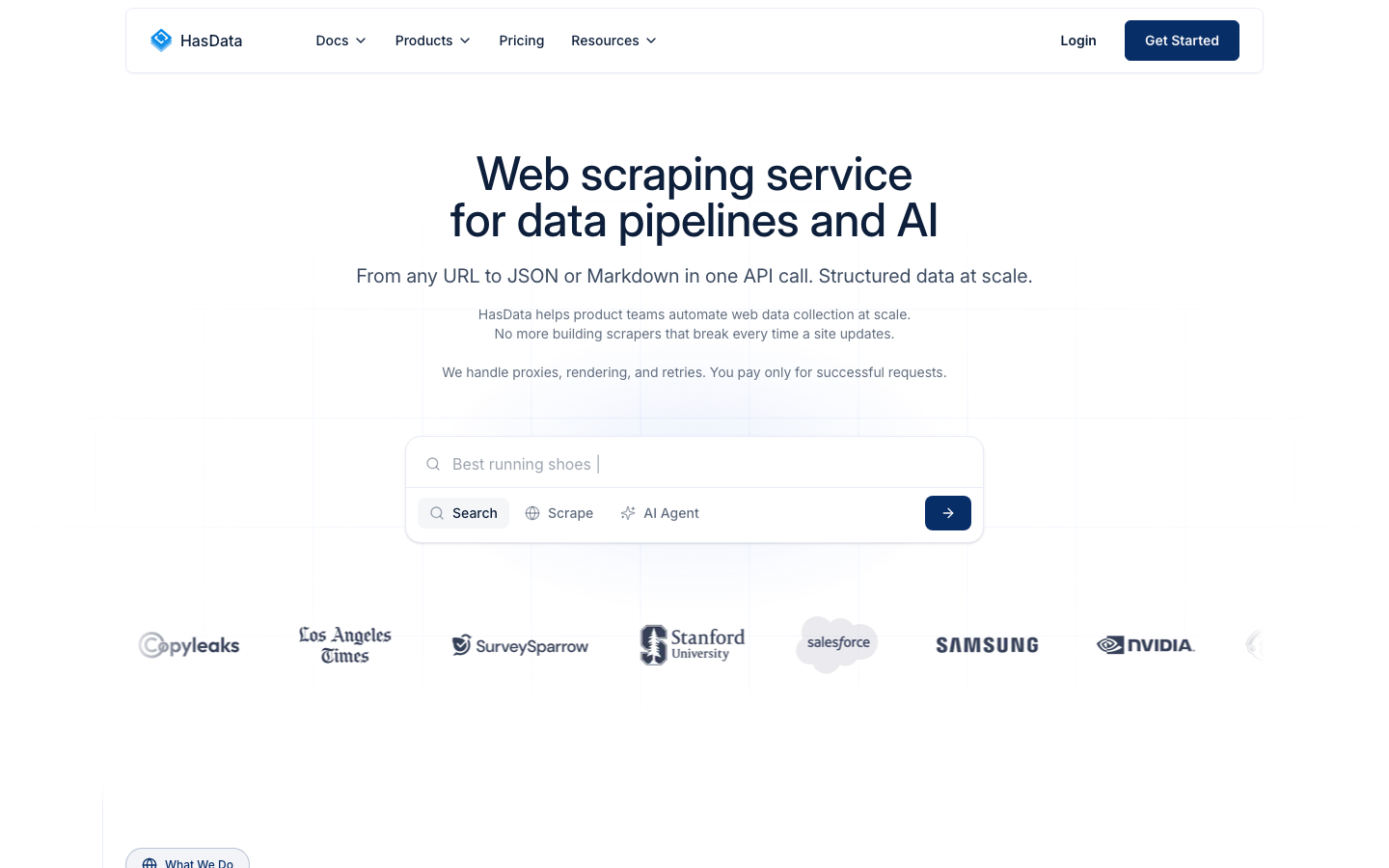
HasData sells web scraping and SERP data through APIs, and it does two things most of its competitors do not: it ships a 57-tool MCP server, and it sells Google AI Mode data with the citations attached. I spent a session with a vendor-provided account putting both through real calls.

A capable scraping platform with unusually good agent support and genuine AI search coverage. The credit system hides the real price of SERP work, which is mid-market rather than cheap, and the REST error messages need work. Strong if you want scraping and search from one vendor.

Buy HasData for breadth and agent support. Its entry-tier SERP pricing is mid-market, not cheap, but that flips at Growth-tier volume, where it undercuts every other vendor on this list. If you need Google AI Mode data with citations, or want scraping and search from one vendor, it is one of the few places to get both.

Who It's For

Who HasData is for (and who it isn't)

Best for

  • +
    Teams tracking AI search visibility The AI Mode API returns generated answers with structured citations, which is the raw material for tracking whether your brand gets mentioned in AI answers.
  • +
    Agencies pulling rank data for a roster of clients One key covers search, maps and ecommerce across every client account, and at $2.45 per 1,000 Google SERP calls on the entry plan the maths beats a per-seat rank tracker once you are past a handful of clients. Check the credit table below against your real query volume first: this is mid-market pricing, not cheap.
  • +
    Agents and MCP-first workflows 57 well-described MCP tools behind one API key, so an agent can pull search, maps, ecommerce and social data without custom integration work.
  • +
    Anyone who needs scraping plus SERP from one vendor Buying a general Web Scraping API and a SERP API separately usually costs more than the combined HasData bill.

Skip this if

  • Very low-volume SERP-only buyers At $2.45 per 1,000 requests on the entry Startup plan, a pure SERP workload is cheaper elsewhere below Business-tier volume. That flips once you are actually pushing volume: on Growth, HasData's $0.69 per 1,000 undercuts SearchApi, SerpApi, ValueSERP and Zenserp at comparable spend. A high-volume SERP buyer is not the one who should skip this.
  • Anyone needing backlink or keyword databases HasData sells live scraped data, not an index. There is no backlink graph and no keyword volume database.
  • Enterprises that require a long vendor track record This is a small company with a shorter public history than SerpApi or Bright Data, which matters for procurement.
  • Teams wanting dashboards and reports This is infrastructure. Beyond the no-code scrapers there is no reporting layer, and the data is for you to put somewhere else.

By buyer

Where HasData sits, depending on who you are

I rank every tool in SEO APIs separately against each kind of buyer. Its strongest placing is 2nd.

4th

Agency

3 to 30 people, multiple client accounts

5th

Consultant

solo, juggling 5 to 15 clients

2nd

Solo builder who lives in AI

wires tools into Claude Code or Cursor

5th

Solo builder who wants it simple

one tool, no wiring

Features

What can HasData do?

HasData is a web scraping platform that sells structured public web data through APIs. It covers two things that usually come from separate vendors: a general Web Scraping API that fetches any public URL through managed proxies, and a set of source-specific scrapers for Google search, Maps, Amazon, YouTube, TikTok, Zillow, Yelp and about 20 other sources.

The company is small and Latvian-registered, with 1,300+ customers by its own count. That matters for the buying decision, so I will come back to it.

The part I found most interesting is the AI search coverage. HasData ships a Google AI Mode API and an AI Overview endpoint that return the generated answer text along with the sources Google cited. For anyone tracking whether their brand gets mentioned in AI answers, that is the raw material, and most SERP API vendors still do not sell it.

Better than I expected. The Web Scraping API takes an `aiExtractRules` object where you describe the fields you want in plain English, and it returns structured JSON. I pointed it at a live pricing page and asked for plan name, monthly price and included credits as a list. It returned four clean plan objects on the first attempt, in 7.2 seconds, with no selectors written and no retries.

That is the feature I would actually pay for. Writing CSS selectors against a marketing page is work that breaks every time the vendor ships a redesign, and describing the fields instead removes that maintenance entirely.

Against DataForSEO, HasData is narrower and easier to start with. DataForSEO sells more SEO-specific data, including backlinks and keyword databases that HasData does not have at all, and its pay-as-you-go pricing has no monthly floor. HasData wins if you want general web scraping and AI Mode capture from the same vendor.

Against SerpApi, the trade is track record for breadth. SerpApi has been the reference SERP API for years and has the longer public history. HasData covers far more non-search sources and sells AI Mode data, which SerpApi does not.

Against ValueSERP, it depends entirely on volume. ValueSERP is a focused SERP API at $1.00 to $1.60 per 1,000. HasData is more expensive at its entry tier ($2.45 per 1,000), but cheaper than ValueSERP once you are on Business or above: $0.99 per 1,000 already beats ValueSERP's interpolated rate at that volume, and the gap widens sharply on Growth, where HasData's $0.69 per 1,000 undercuts ValueSERP's own $0.90-1.00 range at comparable scale.

Run your own monthly query count through both tables before deciding, since which side of that line you land on is what actually matters.

The category context is on the best SEO APIs roundup, which compares all of them on coverage and pricing model.

From my test account

Inside HasData

HasData gave me an account with 20,000 credits and 50 concurrency, so I ran the things a buyer would actually check rather than reading the docs back to you.

I connected to the MCP server with an API key and counted the tools it advertises: 57, which matches what HasData claims. I pulled a live Google SERP and got results back in 2.7 seconds, then did the same call over REST to see whether MCP added overhead. It did not. I asked the AI Mode endpoint a question and it took 11.3 seconds to return 20 blocks of answer text and 8 cited sources. I pointed the scraper at a live pricing page with plain-English extraction rules and it returned four clean plan objects in 7.2 seconds, first try, no selectors.

Then I fired 20 requests at once to see whether the concurrency number is real. All 20 came back, 200 organic results, 4.7 seconds wall clock, no rate limiting. Afterwards I checked the billing against the usage endpoint, which is where I found the numbers disagreeing. The whole session cost 195 of 20,000 credits.

HasData No-Code Scrapers dashboard running a Google Search Results config, sidebar showing 19.5K credits and 1 concurrency
The point-and-click No-Code Scrapers tool, a saved Google SERP config returning 109 results. The sidebar confirms the account is down to 1 concurrency from the 50 at first review, worth checking before relying on either number.

UX & Support

Is HasData easy to use?

The dashboard is clean and gets out of the way. Sidebar, API playground, no-code scrapers, an AI agent chat, usage and billing. My API key was already provisioned when I logged in, and the API Keys page links straight out to integration guides for CLI, MCP, OpenClaw, Agent Skill and n8n. That set of links tells you where this company thinks its users are, and it is a reasonable bet.

Support runs through email, with priority email from Business up and a named manager from Growth. There is also a public Discord linked in the sidebar. Enterprise adds SSO and SOC-2.

Error messages on the REST side are thin. When I called a path that did not exist, the API returned a 400 with a body of `{"requestMetadata":{"id":"...","status":"error"}}` and nothing telling me what was wrong. The MCP layer handled the same class of mistake far better, passing through a readable 422 with the failing field named. Auth errors are fine in both places: a bad key returns a clear `{"message":"Invalid api key"}`.

The usage reporting looked inconsistent on this account. The `/user/me/usage` endpoint returned `totalCredits: 1000` next to `availableCredits: 19805`. HasData says this is specific to how this review account was provisioned (Free-plan cap plus 20,000 credits added manually), not a bug in the endpoint itself, and that on a normal paid-plan account the two figures agree so percentage-remaining is computable.

The Usage dashboard also lags. It was still showing "No usage in this period" and zero credits spent while the live counter in the sidebar had already dropped. The page says it updates hourly, so the two numbers disagree by design, but seeing "0 credits" after spending some is unsettling the first time.

Pricing

How much does HasData cost?

HasData starts at From $49/month. That's 2% below median for SEO APIs. A free plan is available.

HasData starts free and runs $49, $99 and from $208 per month on monthly billing, with a custom Enterprise tier above that. Annual billing is sold as two months free, so Startup drops to about $40.83 per month ($490 a year) and Business to $82.50 per month ($990 a year).

The free tier is a real one: 1,000 credits a month, no credit card, plus a 30-day trial that opens up the paid features. The catch is 1 concurrent request and results deleted after 7 days, so it is sized for checking coverage against your own queries, not for running anything.

This is the number everyone gets wrong, including me before this week. Credits are not requests. A Web Scraping API call costs 1 credit, a Google Maps call costs 5, and a Google SERP API call costs 10. So a per-credit rate is never a per-request rate, and quoting one as the other understates the price of SERP work by roughly ten times.

HasData publishes the honest version of this as a per-1,000-requests table, broken out by product. For Google SERP API data specifically:

  • Free: $0, capped at 100 SERP requests a month
  • Startup ($49/mo): $2.45 per 1,000 requests, 20,000 included
  • Business ($99/mo): $0.99 per 1,000 requests, 100,000 included
  • Growth (from $208/mo): $0.69 per 1,000 requests, 300,000 included

The general Web Scraping API is far cheaper, because it is a far cheaper thing to do: $0.24 per 1,000 on Startup, falling to $0.08 per 1,000 on Growth. Google SERP Light, which drops the rich blocks and returns organic results only, sits in between at $1.23 per 1,000 on Startup.

So the read is straightforward. HasData is cheap for general web scraping and mid-priced for SERP data. If you are comparing it against SerpApi or ValueSERP on SERP volume alone, $2.45 per 1,000 at the entry tier is not a bargain. If you need both SERP data and general scraping from one vendor, the combined bill usually beats buying them separately.

One genuinely good billing detail: only successful requests consume credits. Failed and invalid requests are not charged. That is documented and repeated in the app, and it removes the usual argument about paying for blocked pages.

A small inconsistency worth knowing before you do the maths: the in-app annual toggle is labelled "-20%" but the actual discount is two months free, about 16.7%. The prices it shows are correct. The badge is just optimistic.

HasData plans and pricing

3 paid plans · Monthly rates shown, annual noted per plan · Verified Sep 3, 2026

Free
$0/mo
1,000 credits per month1 concurrent request100 Google SERP API requests per month1,000 Web Scraping API requests per month+1 more
Startup
$49/mo$40.83/mo billed annually
Save 2 months free annually
200,000 credits per month15 concurrent requestsGoogle SERP API at $2.45 per 1,000 requests (20,000 included)Web Scraping API at $0.24 per 1,000 requests (200,000 included)+1 more
BusinessRecommended
$99/mo$82.5/mo billed annually
Save 2 months free annually
1,000,000 credits per month30 concurrent requestsGoogle SERP API at $0.99 per 1,000 requests (100,000 included)Web Scraping API at $0.10 per 1,000 requests (1,000,000 included)+2 more
Growth
$208/mo$173.33/mo billed annually
Save 2 months free annually
From 3,000,000 credits per month, slider-scaled50 concurrent requests at 3M credits, 200 at 5MGoogle SERP API at $0.69 per 1,000 requests (300,000 included)Web Scraping API at $0.08 per 1,000 requests (3,000,000 included)+2 more
Enterprise
Custom pricing
From 20,000,000 credits per monthUp to 2,000 concurrent requestsSSO and SOC-2Personal manager

Seen enough? 30 days free, no credit card.

Start the HasData trial

MCP Server

Does HasData have an MCP server?

Official MCP server with 57 tools, counted live on 24 August 2026. Streamable HTTP, authenticates with an API key or OAuth.

StatusOfficialendpoint verified reachable
Server URLhttps://mcp.hasdata.com/mcp
AuthAPI key (x-api-key header) or OAuth
Facts verified2026-09-03

HasData runs an official MCP server at mcp.hasdata.com/mcp over streamable HTTP. A tools/list call returns exactly 57 tools, covering Google search, Maps, News, Trends, Shopping, AI Mode and AI Overview, plus Amazon, YouTube, TikTok, Instagram, Yelp, Yellow Pages, Zillow, Redfin, Indeed, Glassdoor, Booking, Airbnb and Shopify, and one general web scraping tool.

The tool descriptions are the strongest part. Each documents parameter semantics, pagination tokens and expiry windows, so an agent can choose the right call without a human explaining the API first. The AI Overview tool states outright that its page token is valid for four minutes.

It is an auto-generated surface rather than a designed one. The server reports that its tools are generated from an endpoints file, results arrive as a raw HTTP envelope of url, status, json and text that the agent has to unwrap, and one tool name was hash-truncated by the generator to fit the 64-character limit.

How to connect HasData to Claude, ChatGPT or Cursor

Authentication accepts either an x-api-key header or OAuth. The API key path works immediately: the key is provisioned on signup and needs no separate MCP setup.

An unauthenticated request returns a correct 401 carrying a WWW-Authenticate challenge, the mcp:tools scope and a resource_metadata pointer to the OAuth discovery document. That is the specified behaviour and it is rarer than it should be, so a 401 here is proof the endpoint exists rather than a sign it is missing.

Error handling at the MCP layer is better than at the REST layer. A call with a missing required argument came back as a readable 422 naming the failing field, where the REST API returns a bare 400 with no message.

What you can do with the HasData MCP server

HasData links integration guides for CLI, MCP Server, OpenClaw, Agent Skill and n8n directly from the API Keys page in the dashboard, which is a clear signal about the workflows it expects to serve.

Because the server is remote streamable HTTP with standard auth, it fits the usual remote-MCP setup rather than needing a local bridge process.

MCP verdict

One of the better MCP servers in this category. The breadth is real and the descriptions are good enough to hand to an agent unsupervised, though results come back as a raw HTTP envelope rather than clean structured content.

Comparing tools on agent support? See every marketing tool with an MCP server.

Public API

Does HasData have an API?

REST APIs for search, maps, ecommerce and social data, billed in credits rather than requests.

API documentationdocs.hasdata.com
OpenAPI specNot published
Official SDKsJavaScript/TS, Python

The API is the product here, not an add-on to a dashboard. A Google SERP call returns organic results, ads, People Also Ask, related searches, pagination and an AI Overview block, each under its own key, and it came back in 2.7 seconds in testing.

The Web Scraping API fetches any public URL through managed proxies with optional JS rendering, and accepts aiExtractRules where you describe the fields you want in plain English. Pointed at a live pricing page it returned four clean structured plan objects in 7.2 seconds on the first attempt, with no selectors written.

The Google AI Mode API is the differentiator. It returns the generated answer as text blocks plus structured references carrying link, title, source and citation index, which is the raw material for tracking AI search citations. It is also the slowest endpoint at 11.3 seconds.

Beyond Google, coverage extends to Bing and DuckDuckGo search, Google Maps places, reviews, photos and posts, Amazon products, reviews and sellers, YouTube videos, channels and transcripts, TikTok, Instagram, Yelp, Yellow Pages, Zillow, Redfin, Indeed, Glassdoor, Booking, Airbnb and Shopify.

Official SDKs exist for Node (github.com/HasData/hasdata-node-sdk) and Python (github.com/HasData/google-serp-api-python), alongside the CLI and an n8n node.

HasData API pricing and rate limits

Billing is per credit, and credits are not requests. A Web Scraping API call costs 1 credit, a Google Maps call 5, and a Google SERP API call 10, so dividing a plan price by its credit allowance never gives a per-request rate.

Read the vendor per-1,000-request table instead. Google SERP API runs $2.45 per 1,000 on the $49 Startup plan, $0.99 on the $99 Business plan and $0.69 on Growth. The general Web Scraping API is much cheaper at $0.24, $0.10 and $0.08 across the same plans.

Only successful requests consume credits, which is documented and repeated in the app. Concurrency is 1 request on the free tier, 15 on Startup, 30 on Business and 50 upward on Growth, and exceeding it returns 429. Twenty simultaneous requests on a 50-concurrency account all succeeded in 4.7 seconds with no throttling.

One reporting caveat: the /user/me/usage endpoint returns totalCredits reflecting the default trial allotment rather than the account balance, so percentage-remaining cannot be computed from it, and the Usage dashboard updates hourly while the sidebar counter is live.

API verdict

A capable API-first platform whose weakest point is error reporting: a bad request returns HTTP 400 with only a request id and a status of error, naming nothing. Auth failures are clear, and the concurrency limits hold up under real parallel load.

AI-stack fit

Can your AI actually drive HasData?

Short answer: yes. HasData exposes both an MCP server and a REST API.

HasData is a data pipe for agents , not an interface: strong as the fetch-and-parse layer behind an AI workflow, weak on polish once something goes wrong.
Agent surface, every fact sourced
  • MCP server

    https://mcp.hasdata.com/mcp · official

    Tested 08-24
  • REST API

    https://docs.hasdata.com

    Vendor docs
  • OpenAPI spec

    None. Hand-roll your client.

    Not verified
  • Official SDKs

    None

    Vendor docs

What that means for your stack

Core

What AI Can't Replace

HasData owns the scraping infrastructure that AI cannot replicate: managed proxies, source-specific parsers for over 20 sites, and a Google engine that returns organic results, ads, People Also Ask, related searches and an AI Overview block from one call. An agent can decide what to fetch, but it still needs a service that actually resolves the request without getting blocked.

Risk

Where AI Is Catching Up

The part most exposed to AI is the CSS-selector scraping most competitors still sell. HasData's own aiExtractRules feature already replaces hand-written selectors with a plain-English field description, so it has partly automated around its own risk. What AI cannot replace is the proxy network and the specific Google, Amazon and Maps parsers behind the API.

Connects with

MCP ServerClaude, Cursor, Windsurf
REST API

Security

SSO2FA

Downsides

What's wrong with HasData

!

SERP pricing is mid-market, not budget

Google SERP API runs $2.45 per 1,000 requests on the $49 Startup plan. The frequently quoted $0.08 figure is the Growth-tier web scraping rate, a different product.

!

REST errors say almost nothing

A bad request returns HTTP 400 with a body containing only a request id and status "error", with no message naming the problem. The MCP layer surfaces the underlying validation detail, so the REST API is the weaker of the two.

!

Usage total was inconsistent on this comped account

/user/me/usage returned totalCredits of 1,000 alongside availableCredits of 19,805. HasData says this is specific to how this review account was provisioned (Free-plan cap of 1,000 plus 20,000 credits added manually on top), not a bug in the endpoint: on a normal paid-plan account the two figures agree and percentage-remaining is computable.

!

Usage dashboard updates hourly

The Usage page showed zero credits spent while the live sidebar counter had already dropped. The two figures disagree for up to an hour.

!

AI Overview has two response shapes

The block arrives either inline or as a four-minute page token needing a second billed call. Code written against only one shape will silently return empty answers.

!

The MCP server is generated, not designed

Tools are auto-generated from an endpoints file, results come back as a raw HTTP envelope, and one tool name is hash-truncated to fit the 64-character limit.

Want to test HasData yourself?

The free tier gives 1,000 credits a month with no credit card, enough for 100 Google SERP requests or 1,000 web scrapes. Enough to check coverage against your own queries before paying anything.

HasData logoTry HasData free →

Alternatives

What else is in this category?

The tools I rate highest in seo apis besides HasData. Prices are what you actually start at.

FAQ

Frequently asked questions about HasData

Yes. HasData runs an official MCP server at mcp.hasdata.com/mcp over streamable HTTP with 57 tools, verified live on 24 August 2026. It authenticates with either an x-api-key header or OAuth, and an unauthenticated request returns a 401 with a proper WWW-Authenticate challenge.

57, counted from a live tools/list call on 24 August 2026. They cover Google search, Maps, News, Trends, Shopping, AI Mode and AI Overview, plus Amazon, YouTube, TikTok, Instagram, Yelp, Zillow, Redfin, Indeed, Glassdoor, Booking, Airbnb, Shopify and a general web scraping tool.

It depends on which API. Google SERP API costs $2.45 per 1,000 requests on the $49 Startup plan, $0.99 on the $99 Business plan and $0.69 on Growth. The general Web Scraping API is much cheaper at $0.24, $0.10 and $0.08 per 1,000 on the same plans.

No. A Web Scraping API request costs 1 credit, a Google Maps request costs 5 and a Google SERP API request costs 10. Dividing a plan price by its credit count gives a per-credit rate, not a per-request rate, and for SERP data the difference is a factor of ten.

Yes. The free tier gives 1,000 credits a month with no credit card required, which works out to 100 Google SERP API requests or 1,000 Web Scraping API requests. It is limited to 1 concurrent request and deletes results after 7 days. New accounts also get a 30-day trial with full access to paid features.

Yes, and this is one of its stronger points. The Google AI Mode API returns the generated answer as text blocks plus structured references with link, title, source and citation index. AI Overview data arrives either inline in the SERP response or as a page token valid for four minutes that needs a second call to resolve.

In testing on 24 August 2026, a Google SERP API call returned in 2.7 seconds over both REST and MCP. Google AI Mode took 11.3 seconds. A web scrape with AI extraction took 7.2 seconds. Twenty simultaneous SERP Light requests all succeeded in 4.7 seconds wall clock.

No. Only successful requests consume credits. Failed and invalid requests are not billed, which is documented in the credits guide and repeated in the app.

Pricing is transparent per plan, but the credit system obscures the real per-request cost until you read the vendor's own per-1,000-request table.

HasData is best for: Teams tracking AI search visibility; Agencies pulling rank data for a roster of clients; Agents and MCP-first workflows; Anyone who needs scraping plus SERP from one vendor.

One of the stronger MCP implementations in this category: real, live, and documented well enough for an agent to use unsupervised.

HasData starts from From $49/month. A free plan is available. There is a 30-day free trial.

This page may contain affiliate links. I earn a commission at no extra cost to you. This never influences ratings.

HasData

Try Now →
WEEKLY NEWSLETTER

The marketing tools worth your money, scored for AI agent readiness

Every week I score the tools for MCP, API, and agent-readiness, then email you the ones that actually deliver, what plugs into Claude and Cursor, the pricing changes, and what to skip. No fluff, no daily spam.

Join for free. One email a week, unsubscribe anytime.