

Joonas Rotko · Founder, That Marketing Buddy
I spent 10+ years buying marketing software for my own agency and its clients, so I know which tools earn their monthly fee and which ones quietly drain it. Now I check the prices and the claims on this site myself.
This page may contain affiliate links.
Some links on this page are affiliate links, meaning I may earn a commission if you sign up (at no extra cost to you). This never influences my ratings or recommendations.
The Verdict
Is Zenserp right for you?
Zenserp pulls live Google, Bing, Yandex, and YouTube search results into clean JSON, and only charges you when a request actually succeeds. It's built for people who write code, not people who want a dashboard. If that's you, keep reading.
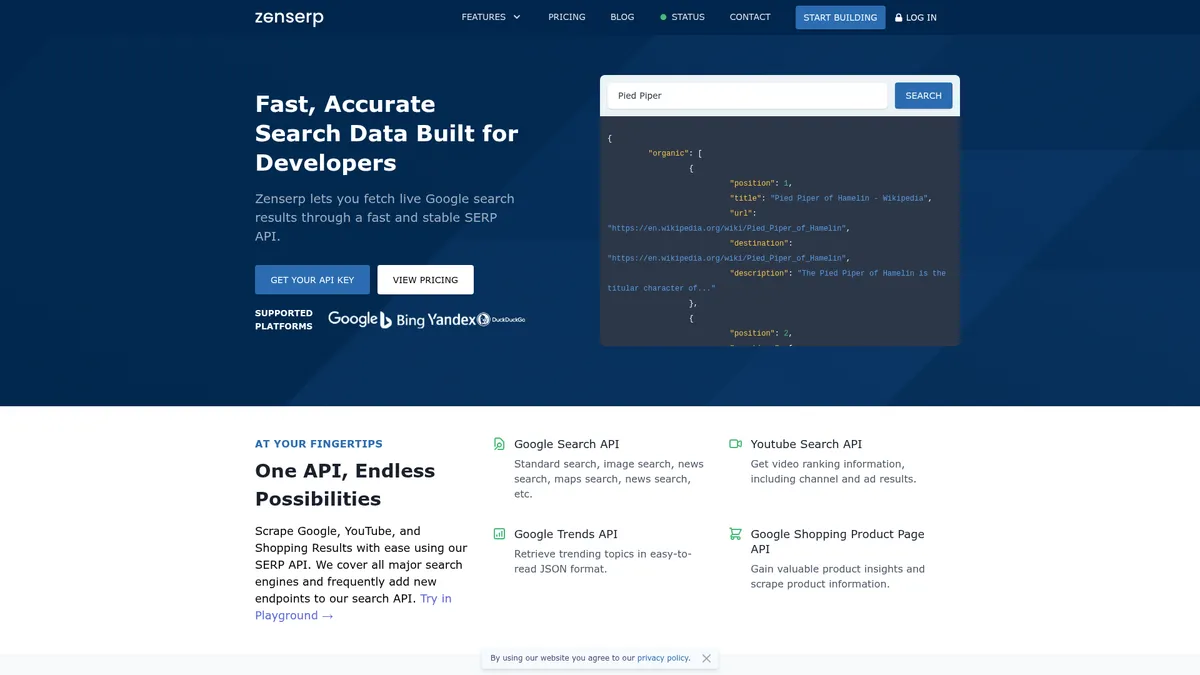
Zenserp is a SERP API that returns organic, paid, news, video, local, and knowledge graph results from five search engines in JSON. It's aimed at developers and SEO teams building their own tools, not marketers wanting a plug-and-play dashboard.
The free 50-searches-a-month tier makes it easy to test, but the SEO extras like keyword volume and CPC only show up once you hit the $149.99/mo Medium plan.
For a straight SERP-data feed with no charge on failed requests, Zenserp does the job, but it's a raw materials supplier, not a finished product.
Why I'm covering this
Zenserp covers five search engines through one REST API and bills only for successful requests, a pricing detail that's rarer than it should be among SERP data providers I look at for AI-stack fit.
Who It's For
Who Zenserp is for (and who it isn't)
✓Best for
- +SEO tool builders Need raw Google, Bing, or Yandex SERP JSON to power a rank tracker or content tool without licensing an entire SEO suite.
- +Developers running scheduled scraping jobs Want a REST API with an OpenAPI spec they can hit with plain HTTP from any language, no SDK lock-in required.
- +Agencies with in-house dev resources Can build a custom dashboard on top of Zenserp's batch endpoint and keyword volume/CPC data once they're on the Medium plan or higher.
- +Side-project and hobby coders Get 50 free searches a month, enough to prototype a small tool before committing to the $49.99/mo Small plan.
✗Skip this if
- −Marketers wanting a ready-made dashboard Zenserp only returns JSON. There's no built-in rank tracking UI, so you'd need to build one or buy one elsewhere.
- −Teams needing AI-agent-native access today No MCP server exists yet, so agents can't connect directly, only through custom API calls or Zapier/Make.
- −Budget-conscious SEO shops needing keyword volume/CPC data Those fields sit behind the $149.99/mo Medium plan, three times the Small plan price.
- −Non-technical solo marketers Without someone who can write HTTP requests and parse JSON, the API is unusable day-to-day.
Consider instead
 SE Ranking
 SearchApi
 Search Atlas
Features
What can Zenserp do?
The search engine coverage is the headline feature, and it's wider than most tools in this price range. Google gets the deepest treatment (web, image, news, maps, shopping), but Zenserp also covers Bing, Yandex, and DuckDuckGo, plus YouTube for video ranking data. If your project needs anything beyond Google, that's a differentiator over API providers that only do Google.
Snippet coverage goes past plain organic listings. Zenserp pulls paid ad positions, People Also Ask questions, knowledge graph blocks, answer boxes, and local/maps results, all the SERP features that determine what a search results page actually looks like. For anyone building a rank tracker or content gap tool, that granularity matters more than raw request volume.
The developer experience leans toward 'bring your own tooling.' There's no official SDK, so you're hitting a REST API with plain HTTP from whatever language you're using, which the request builder softens by generating code snippets for you. An OpenAPI spec is published, which means you can generate your own client if you want typed responses, but that setup is on you.
The SEO-specific extras (keyword search volume, keyword CPC, and a Bulk Index Checker GUI) only unlock starting at the $149.99/mo Medium plan. That's a meaningful gate. If your use case is purely 'get me SERP JSON,' the $49.99/mo Small plan covers it. If you need the keyword metrics too, budget three times that.
Search Engine Coverage
SERP Snippet Types
Developer Tools
SEO Add-Ons (Medium plan and up)
Infrastructure
UX & Support
Is Zenserp easy to use?
Zenserp doesn't have a traditional onboarding flow, because there's no traditional product to onboard into. Based on the official documentation and FAQ, the path is: register for the free plan, generate an API key, and start hitting the Playground or your own code against it. That's a fast start for a developer and a dead end for anyone expecting guided setup.
Support scales with plan tier. According to Zenserp's own FAQ, personal support and 'concierge onboarding' only kick in from the Medium plan ($149.99/mo) upward; the free and Small plans are self-serve. The site also lists a live chat widget and an email address for general questions, so lower-tier users aren't completely on their own, just not prioritized.
There's no mention of a community forum or user group in the documentation reviewed, which is common for infrastructure-style APIs but worth flagging if you like leaning on other users when something breaks.
Pricing
How much does Zenserp cost?
Zenserp starts at $49.99/mo. That's at category median for SEO APIs. A free plan is available.
Zenserp's pricing starts with a free plan (50 searches/month) and scales through Small at $49.99/mo (or $39.99/mo billed annually) for 25,000 searches, up to Enterprise at $899.99/mo (or $719.99/mo billed annually) for 1,000,000 searches. Every paid tier gets a 20% discount if you pay annually instead of monthly.
The pricing model itself is worth calling out: Zenserp only bills for successful responses. Failed or invalid requests don't count against your monthly quota, which matters if you're running jobs at scale and expect some percentage of queries to error out. That's a fairer deal than flat per-request billing regardless of outcome.
Where the ladder gets less even is the feature gating. The jump from Small ($49.99/mo) to Medium ($149.99/mo) isn't just about search volume (25,000 to 100,000), it's also where you unlock the batch endpoint, keyword search volume, keyword CPC, bulk index checking, personal support, and an SLA. That's a big feature cliff for a 3x price jump, and it means the entry plan is really just raw SERP fetching with none of the SEO-analysis extras.
| Plan | Monthly |
|---|---|
| Free | — |
| Small | $49.99/mo |
| Medium | $149.99/mo |
| Large | $299.99/mo |
| Large (higher volume) | $499.99/mo |
| Enterprise | $899.99/mo |
Downsides
What's wrong with Zenserp
No MCP server
AI agents can't connect to Zenserp natively; you're stuck routing through the REST API directly or third-party automation like Zapier or Make.
No official SDK
You're writing plain HTTP requests in whatever language you use. The request builder helps generate snippets, but there's no maintained client library to lean on.
SEO metrics gated behind Medium plan
Keyword search volume, keyword CPC, and the bulk index checker aren't available until you're paying $149.99/mo, three times the entry Small plan price.
No dashboard or UI
Everything comes back as JSON. If you want to see rankings visually, you have to build that layer yourself.
Concurrent connection cap on standard plans
Zenserp recommends staying under 400 concurrent connections unless you request a higher limit, which adds a step for high-throughput operations.
Support and SLA tiered by price
Personal support, concierge onboarding, and a service level agreement only kick in from the Medium plan up; Free and Small plan users are self-serve.
Are these dealbreakers?
None of this makes Zenserp a bad SERP API, it just means the pricing page tells you less than the feature list does. Read the plan details closely before you pick a tier, because the difference between Small and Medium isn't just search volume, it's whether you get the SEO data fields at all.
Ready to try Zenserp?
Get 50 free searches a month to test SERP data across Google, Bing, Yandex, and YouTube before committing to a paid plan.
 Get Your API Key →
FAQ
Frequently asked questions about Zenserp
Zenserp is a SERP API that fetches live search results from Google, Bing, Yandex, DuckDuckGo, and YouTube and returns them as structured JSON. It's mainly used by developers building rank trackers, SEO tools, or automated scraping jobs that need parsed search data instead of raw HTML.
Yes. The free plan includes 50 searches per month, based on the pricing page. It's enough to test the API before committing to a paid tier.
Paid plans start at $49.99/mo (or $39.99/mo billed annually) for 25,000 searches on the Small plan, scaling up to $899.99/mo (or $719.99/mo billed annually) for 1,000,000 searches on the Enterprise plan. Annual billing saves 20% across all paid tiers.
No. According to Zenserp's FAQ, only successful responses count against your monthly search quota, so failed or invalid requests don't eat into your plan.
Google (including image, news, maps, and shopping results), Bing, Yandex, DuckDuckGo, and YouTube.
Not natively. Zenserp has no MCP server as of this writing, so agent-based workflows have to go through the REST API directly or through automation tools like Zapier or Make.
Zenserp reports 99.9% uptime calculated over the trailing 12 months on its public status page.
Yes. There's no dashboard for non-technical users. You send HTTP requests to the API and parse the JSON response yourself, though the site's request builder does generate code snippets to speed that up.
The per-search cost actually gets cheaper as you scale (from $0.002/search on Small down to $0.0009/search on Enterprise), which is a fair model. But the jump from the free 50 searches to $49.99/month for 25,000 is a cliff with nothing in between.
Zenserp is best for: SEO tool builders; Developers running scheduled scraping jobs; Agencies with in-house dev resources; Side-project and hobby coders.
The API itself is a natural data source for AI agents that need real-time search grounding, but Zenserp doesn't advertise any MCP server, agent-specific tooling, or native AI features.
Since it's a stateless query API rather than a platform storing your campaigns or contacts, there's not much historical data to get locked into. Switching providers mostly means remapping JSON fields in your code.
Sources & References (3)
More on Zenserp
This page may contain affiliate links. I earn a commission at no extra cost to you. This never influences ratings.