

Want a free personalized recommendation for your software stack?Get yours
That Marketing Buddy
Software/
GrackerAI

GrackerAI Review 2026: Profound's Price, More AI Engines

AI visibility tracking and GEO content for B2B SaaS and cybersecurity brands, from $99/month.

$99/month starting7-day free trialNo free planHands-on tested
Data from Buddy's database
Joonas Rotko

Joonas Rotko · Founder, That Marketing Buddy

I have spent 10+ years doing hands-on digital marketing and buying marketing software for my team and clients, and I now score every tool on this site for how well it works with AI agents. Ex Google Premier Partner agency co-owner.

Hands-on review
This page may contain affiliate links.

Some links on this page are affiliate links, meaning I may earn a commission if you sign up (at no extra cost to you). This never influences my ratings or recommendations.
The Verdict

Is GrackerAI right for you?

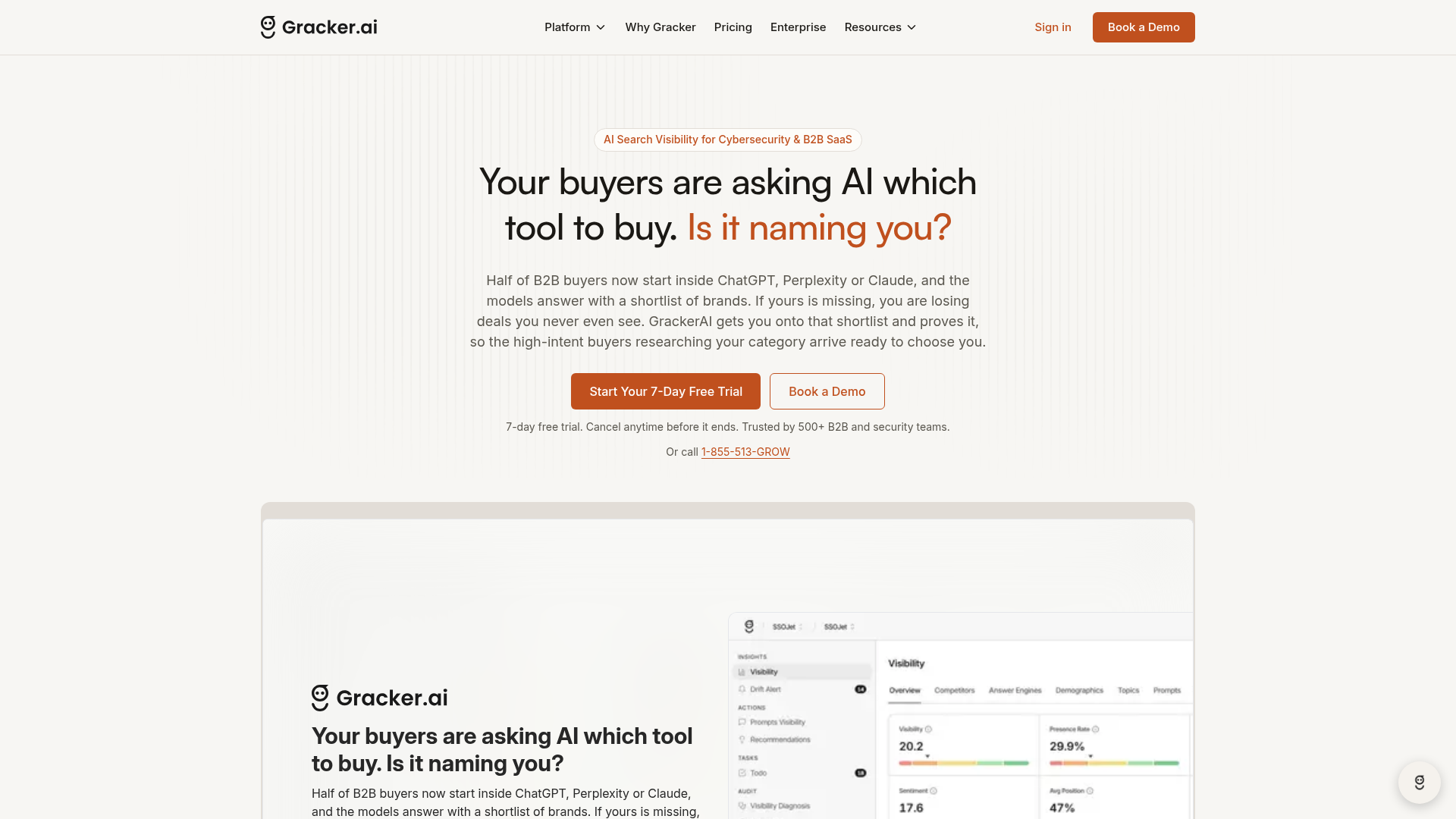
Buyers now ask ChatGPT and Perplexity for a shortlist before they ever land on your homepage. GrackerAI tracks whether you make that list, then tries to write the content that gets you there. Entry pricing starts at $99/month for 100 weekly prompts across three AI engines.

GrackerAI is a GEO and AEO monitoring platform that tracks how ChatGPT, Perplexity, and other AI engines cite your brand, then generates content aimed at earning more citations. It's built specifically for B2B SaaS and cybersecurity companies, with CVE tracking and security-specific prompt libraries baked into the higher tiers.

At $99/month for Starter, it's priced for funded startups and marketing teams with budget, not solo operators just testing the GEO waters.

If your buyers actually research security or SaaS purchases through AI chat, this is one of the few tools built around that specific behavior instead of bolted onto a general SEO suite.

Why I'm covering this

GrackerAI is one of the few GEO tools built specifically for B2B SaaS and cybersecurity, with CVE monitoring and diagnosis reports that name an actual content fix instead of just a visibility score.

Who It's For

Who GrackerAI is for (and who it isn't)

Best for

  • +
    Cybersecurity and identity/access management vendors This is GrackerAI's deepest specialization. CVE and security-news monitoring ships on every plan (limited on Starter and Scale, unlimited on Enterprise), and Enterprise adds cybersecurity-tuned analysis models plus a security-specific prompt library. If your buyers are researching things like SOC 2 or endpoint security through ChatGPT, this is closer to purpose-built than most GEO tools.
  • +
    Agencies running GEO across multiple client accounts GrackerAI has a dedicated agency trial and a multi-brand workspace with per-client granular access, white-label PDF reports, and competitor gap analysis scoped to each client. That's a real feature set for agencies, not just a marketing page footnote, and it puts GrackerAI in the same conversation as other GEO tools built for agencies.
  • +
    Funded early-stage B2B SaaS startups There's an explicit Startup Program, and GrackerAI is partnered with Microsoft for Startups, Google for Startups, AWS Startups, Cloudflare Launchpad, and Nvidia Inception. If you're already in one of those startup programs, there may be a path to GrackerAI that doesn't start at full $99/month .
  • +
    B2B SaaS marketing teams that already publish content and just need it AI-optimized The Scale plan ($499/month monthly, or 20% off billed annually) publishes directly to WordPress, HubSpot, Webflow, Ghost, and Contentful, and adds Trust Score tracking across four engines. If your content team already has a publishing workflow, GrackerAI slots into it rather than replacing it.

Skip this if

  • Local businesses, ecommerce brands, and consumer-facing companies Nothing in GrackerAI's feature set (CVE monitoring, cybersecurity prompt libraries, B2B comparison content) maps to local search or consumer buying behavior. You'd be paying $99/month or more for AI engine tracking built around a buying journey your customers don't take.
  • Solo founders or tiny teams who want cheap, high-volume content Starter gives you 3 GEO-optimized articles a month, Scale gives you 10, and unlimited only shows up on Enterprise, which is custom-priced. If your plan is to publish daily, the article caps on the lower tiers will feel restrictive fast.
  • Anyone who actually wants traditional SEO, not AI citation tracking GrackerAI is explicit that it optimizes for AI engine citations, not Google's blue links. If you need keyword rank tracking, backlink audits, or technical SEO crawls as your primary job-to-be-done, look at a conventional SEO suite instead.
  • Teams that want to test-drive without a card on file The 7-day free trial requires a valid credit card up front, and you have to cancel before it ends to avoid being charged. If you're allergic to that model, or you want a free tier with no card at all, this isn't it.

Features

What can GrackerAI do?

GrackerAI's core job is answering one question: does ChatGPT, Perplexity, or Gemini mention your brand when a buyer asks about your category? The AI Visibility Monitoring engine tracks this per engine rather than blending everything into one score, which matters because a brand can be strong in Perplexity and invisible in Copilot at the same time. Starter tracks 100 prompts weekly across 3 engines, Scale moves to 200 prompts daily across 4 engines, and Enterprise goes to 1,000+ prompts checked hourly across all 10, including Claude, Gemini, DeepSeek, and Grok.

One customer case study on GrackerAI's site cites a jump from a 7% to 48% AI Visibility Score, though that's a single vendor-published result and not something to extrapolate as a typical outcome.

The diagnostic layer is where GrackerAI tries to separate itself from a simple tracking dashboard. Visibility Diagnosis runs an agent against a specific prompt you're missing from, finds the page that should be ranking, and scores it against whatever competitor page AI is actually citing. The AEO Audit crawls your site (50 pages on Starter, 200 on Scale, 100,000+ on Enterprise) and grades every page on AEO Health and Technical Health, handing back severity-tagged fixes rather than a raw score.

If you've used other GEO tools for agencies, this diagnostic-first approach is the differentiator: most competitors stop at 'here's your score,' GrackerAI tries to get to 'here's what to publish next.'

Content generation is tiered aggressively. Starter gets 3 GEO-optimized articles a month, Scale gets 10, and Enterprise is unlimited with access to programmatic SEO portals like CVE databases and compliance centers, features clearly built for the cybersecurity and identity-management customers GrackerAI leans on in its case studies. If your business isn't in a regulated or technical vertical, these portal features are less relevant, and you're mostly paying for the visibility monitoring and content engine instead.

Here's a correction worth flagging directly: GrackerAI does have a real MCP server, publicly documented at gracker.ai/platform/ai-visibility/mcp, and it is not locked behind Enterprise pricing. Connect your account once through the portal and Claude, ChatGPT, Cursor, and other MCP-compatible clients get live access to visibility scores, competitor share of voice, prompt gaps, citation sources, and ranked recommendations.

Querying the endpoint directly returns a proper GraphQL schema with types like AnalysisResult, BrandMention, Citation, Competitors, and Visibility, with fields covering sentiment, funnel stage, citation role, and factual accuracy. That's a meaningfully more open setup than tools that gate any programmatic access behind a sales call, and it's worth checking our guide to using MCP with marketing tools if you want to see what that actually unlocks day to day.

It's a different story for the REST API. That integration, plus webhooks, is Enterprise-only and sales-gated, with no public documentation available. So the split is clean: if you want to pull GrackerAI's data into an AI agent or a Claude workflow, MCP gets you there on Starter or Scale. If you want a traditional REST integration into your own backend or BI stack, you're negotiating an Enterprise contract.

Compare that structure against other players in the AI search visibility category, like Profound or Otterly.AI, and you'll notice API/MCP access policy varies a lot between vendors chasing the same GEO budget.

Agency and enterprise controls round things out: multi-brand workspaces, white-label PDF reports, and SSO/SAML for larger teams, plus migration support specifically from Semrush and Profound if you're switching tools. Seat limits are tight on the lower tiers (1 seat on Starter, 4 on Scale), so a bigger internal team will feel that constraint before they feel any feature gap. None of this is unusual for the category, but it does mean GrackerAI's pricing ladder is really a headcount and access ladder as much as a feature one.

AI Visibility Monitoring & Diagnostics

Per-engine tracking across up to 10 AI engines (ChatGPT, Perplexity, Gemini, Copilot, DeepSeek, Grok, Claude, Google AI Mode, Google AI Overviews)Weekly to hourly prompt tracking depending on plan (100 prompts/week on Starter, 200/day on Scale, 1,000+/hour on Enterprise)Visibility Diagnosis tool that scores your page against the competitor AI is actually citingAEO Audit that crawls your sitemap and grades pages on AEO Health and Technical Health

Content Engine & Programmatic SEO

AI-optimized article generation (3/mo Starter, 10/mo Scale, unlimited Enterprise)Listicle and alternatives/comparison page generation aimed at AI citation patternsProgrammatic SEO portals on Enterprise: CVE databases, compliance centers, threat intelligence hubsDirect publishing to WordPress, HubSpot, Webflow, and headless CMS

MCP Server & AI-Agent Access

Documented, self-serve MCP server at gracker.ai/platform/ai-visibility/mcp, available on Starter and Scale plansGraphQL schema exposing visibility scores, competitor share of voice, prompt gaps, citation sources, and ranked recommendationsConnects to Claude, ChatGPT, Cursor, and other MCP-compatible clients after a one-time account linkSeparate REST API + webhooks integration, Enterprise-only and sales-gated with no public documentation

Agency & Enterprise Controls

Multi-brand workspace with client-level access controlsWhite-label PDF reportingSSO/SAML on EnterpriseMigration support from Semrush and Profound, plus a dedicated account manager with a 4-hour support SLA

UX & Support

Is GrackerAI easy to use?

Onboarding starts with a set of qualifying questions about your brand, competitors, and target AI engines, and it does a decent job scoping the setup before you land in the dashboard. That's a smarter first step than the generic 'connect your website and wait' flow you get from a lot of tracking tools, since it forces you to define your competitive set upfront instead of guessing later.

One gap stood out during setup: there is no way to connect an AI assistant via MCP before or during onboarding. That connection only happens afterward, inside the portal, once your account is already configured. It would make more sense to fold that step into onboarding itself, especially for a platform whose entire pitch is AI visibility. If you want the background on why this connection type matters, our guide to using MCP with marketing tools breaks down the difference between MCP, API, and CLI access.

Once you're past setup, the dashboard itself is clean and laid out sensibly. Visibility scores, the competitor list, and citation data are easy to find without digging through menus, and the emphasis on actionable fixes rather than raw metrics comes through in the interface, not just the marketing copy. This matters for a category where a lot of tools just hand you a chart and let you figure out what to do with it.

On the MCP question specifically, it's worth correcting a common misconception: GrackerAI has a real, publicly documented MCP server at gracker.ai/platform/ai-visibility/mcp, and it is not locked behind Enterprise pricing. Connect your account once through the portal and MCP-compatible clients like Claude, ChatGPT, and Cursor get live access to visibility scores, competitor share of voice, prompt gaps, citation sources, and ranked recommendations.

Querying it directly returns a well-structured GraphQL schema, with types like AnalysisResult, BrandMention, Citation, Competitors, and Visibility covering sentiment, funnel stage, citation role, and factual accuracy. That's a meaningfully different story from the REST API and webhooks integration, which genuinely is Enterprise-only and sales-gated with no public documentation, so don't conflate the two when comparing this to other tools in our guide to AI agent readiness in marketing software.

Support details in the available material are thin. Starter and Scale plans list email support, and Enterprise steps up to a dedicated account manager with a 4-hour SLA. There's no public data on average response times or community forums, so if support responsiveness is a deciding factor for you, that's a question worth putting directly to sales before committing to an annual plan.

Pricing

How much does GrackerAI cost?

GrackerAI starts at $99/month. No free plan, but there’s a 7-day free trial.

Starter runs $99/month (monthly billing) or $79/month billed annually ($948/year), covering 100 prompts tracked weekly across 3 AI engines (ChatGPT, Perplexity, Google AI Mode) plus 3 GEO-optimized articles a month. Scale, the plan GrackerAI marks as most popular, is $499/month (monthly billing) or $399/month billed annually ($4,788/year), and bumps you to 200 prompts tracked daily, 4 engines (adding Microsoft Copilot), and 10 articles a month.

Enterprise is custom-priced and adds the remaining AI engines, unlimited content, API access, SSO/SAML, and white-label reporting.

The jump from Starter to Scale is steep on paper, roughly 5x the price for about 2x the prompts and engines, but the real shift is in tracking frequency: weekly checks become daily, and Trust Score plus CMS auto-publishing only unlock at Scale. If your buyers' AI-search behavior moves fast, weekly polling on Starter may already be stale by the time you see it.

A 7-day free trial is available on both Starter and Scale, but it requires a valid credit card and won't charge until the trial ends, so set a calendar reminder if you're just testing. There's no confirmed free-forever plan in the current pricing structure, so budgeting at least $79 to $99/month is the realistic floor for using this at all.

PlanMonthly
Starter$99/mo
Scale (Most Popular)$499/mo
EnterpriseCustom
See full GrackerAI pricing breakdown
Full pricing breakdown →

Downsides

What's wrong with GrackerAI

!

Narrow engine coverage on Starter

The $99/month plan only tracks ChatGPT, Perplexity, and Google AI Mode. Claude, Gemini, Copilot, DeepSeek, and Grok require Scale or Enterprise.

!

REST API is Enterprise-only (MCP is not)

The REST API and webhooks integration are Enterprise-only and sales-gated, with no public documentation to evaluate ahead of a sales call. That's separate from the MCP server, which is documented and available on Starter and Scale without talking to sales, so check whether MCP alone covers your use case before assuming you need Enterprise for programmatic access.

!

Single seat on Starter

Teams larger than one person need to jump to Scale (4 seats) or Enterprise just to add collaborators to the workspace.

!

Heavy cybersecurity lean on premium features

Cybersecurity-tuned analysis models and the security prompt library are Enterprise-gated, which is the main reason to pay up if you're in that vertical, and dead weight if you're not.

!

No confirmed free-forever plan

The 7-day trial requires a credit card and rolls into a $79 to $99/month commitment, so there's no way to run this long-term at zero cost.

!

Enterprise pricing isn't public

Full AI-engine coverage, unlimited content, and dedicated support all sit behind a custom quote, so budgeting for the top tier means a sales call before you know the number.

Are these dealbreakers?

None of these are dealbreakers for a funded B2B security or SaaS company that needs citation tracking done properly. But if you're outside that lane, or you need broad AI-engine coverage without paying Scale-or-Enterprise prices, the fit gets a lot less clean.

See GrackerAI alternatives →

Ready to try GrackerAI?

Run the 7-day trial and see if your brand shows up when AI engines answer your category's buying questions.

GrackerAI logoStart Free Trial →

FAQ

Frequently asked questions about GrackerAI

AEO (Answer Engine Optimization) and GEO (Generative Engine Optimization) measure how often AI search engines like ChatGPT, Perplexity, and Gemini cite your brand when answering a user's question. Higher visibility means more qualified prospects discovering your product through AI-generated answers instead of blue links.

Traditional SEO ranks pages in Google's list of blue links, and users click through to compare options themselves. AI search engines synthesize an answer and recommend a shortlist directly, so getting cited in that shortlist matters more than ranking position on a results page.

Per GrackerAI's FAQ, most customers see initial AI visibility improvements within 4 to 6 weeks, with more significant citation increases typically showing up in 2 to 3 months as published content builds authority with AI engines.

The Content Engine autopilots authoritative thought-leadership articles, listicles like 'best tools for X,' and alternatives/comparison pages, all formatted to match the structure AI engines tend to cite from.

No. GrackerAI is positioned for startup founders and lean marketing teams; the autopilot handles strategy, content creation, and publishing, and you review and approve the output rather than build it from scratch.

Depending on plan, GrackerAI monitors up to 10-11 engines: ChatGPT, Perplexity, Google AI Mode, Google AI Overviews, Gemini, Microsoft Copilot, DeepSeek, Meta Llama, Grok, Claude, and Brave Leo on Enterprise. Starter is limited to 3 of these engines.

Yes, GrackerAI offers a 7-day free trial on both Starter and Scale plans. A valid credit card is required to start the trial, and you can cancel any time before it ends to avoid being charged.

Yes to MCP, no self-serve REST API yet. GrackerAI runs a documented MCP server at gracker.ai/platform/ai-visibility/mcp that's available on Starter and Scale, no Enterprise sales call required: connect your account once and Claude, ChatGPT, Cursor, and other MCP clients get live access to visibility scores, competitor data, prompt gaps, and citation sources. The separate REST API and webhooks integration is Enterprise-only with no public documentation.

The jump from Starter to Scale is steep, $79/mo to $399/mo annually, a 5x price hike for roughly 2x the prompts and engines. Enterprise pricing is fully custom with no published floor.

GrackerAI is best for: Cybersecurity and identity/access management vendors; Agencies running GEO across multiple client accounts; Funded early-stage B2B SaaS startups; B2B SaaS marketing teams that already publish content and just need it AI-optimized.

AI isn't a bolted-on feature here, it's the entire product. The platform tracks citations across up to 10 engines and uses AI models (Gemini, OpenAI, Claude) to generate and score content.

Published content lands in your own CMS (WordPress, HubSpot, Webflow), so you keep the articles if you leave. The MCP server also gives Starter and Scale accounts a live, queryable way to pull their own visibility and citation data out, though there is no one-click bulk export and the REST API stays Enterprise-only.

GrackerAI starts from $99/month. There is a 7-day free trial.

More on GrackerAI

This page may contain affiliate links. I earn a commission at no extra cost to you. This never influences ratings.

GrackerAI

Try Now →
WEEKLY NEWSLETTER

The marketing tools worth your money, scored for AI agent readiness

Every week I score the tools for MCP, API, and agent-readiness, then email you the ones that actually deliver, what plugs into Claude and Cursor, the pricing changes, and what to skip. No fluff, no daily spam.

Join for free. One email a week, unsubscribe anytime.