


Joonas Rotko · Founder, That Marketing Buddy
I assess SEO and marketing software through 10+ years of agency work, current product research, buyer needs, competing tools and total cost.
How this review was prepared
This is a research-based review. I checked Answer Socrates's current pricing page, product pages and homepage feature descriptions, then assessed what those published limits mean for a buyer. I have not presented vendor claims as personal testing.
This page may include affiliate links, meaning I may earn a commission if you sign up (at no extra cost to you).
The Verdict
Is Answer Socrates right for you?
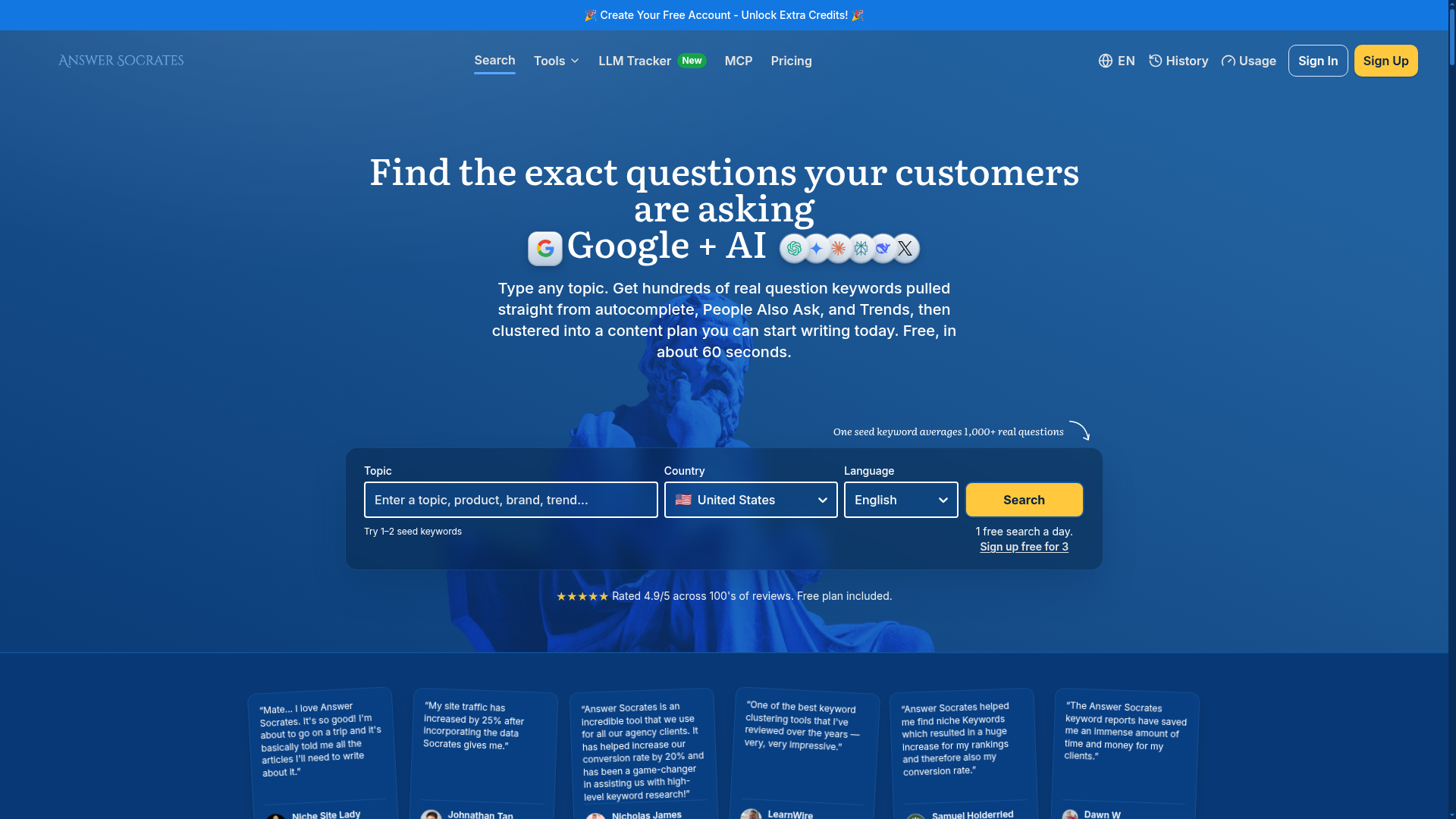
Answer Socrates is a question-based keyword research tool. A seed keyword yields 1,000+ real questions from Google, ChatGPT, Gemini, Perplexity, Claude, Grok and DeepSeek, which it clusters by intent.
Free covers 3 daily searches and 500 clustering credits. Paid plans on annual billing run from Socrates Lite at $15.83 a month to Senate at $249.17, with API credits from Seneca upward. Every plan has a 7-day money-back guarantee, and credits do not roll over.
It fits content planners and small SEO teams who want questions and clusters cheaply. It fits poorly if you need deep competitor or backlink data.
Who It's For
Who Answer Socrates is for (and who it isn't)
✓ Best for
- +Content planners building question-led outlines. It extracts People Also Ask questions and long-tail and comparison queries, then clusters thousands of keywords by meaning and intent.
- +Teams testing AI visibility on a budget. An LLM Brand Tracker monitors brand mentions over time across major AI engines on paid plans.
- +Small SEOs who want API access cheaply. Seneca at $32.50 a month billed yearly lists API access with 6,000 credits a year, and higher plans add more.
× Consider something else if
- −You want a fuller keyword tool with tracking. Answer Socrates focuses on questions and clusters. A workspace covers tracking and audits too.Try Mangools →
- −You want keyword data in your browser. Keywords Everywhere overlays volume and CPC on the pages you visit, with an official MCP server.Try Keywords Everywhere →
- −You want a simple monthly keyword tool. Keysearch lists a low monthly price for keyword research and rank tracking.Try Keysearch →
What You Can Do
What can Answer Socrates do?
Generate questions from a seed
Enter a seed keyword and get 1,000+ real questions, including People Also Ask and comparison queries, from Google and AI engines.
Cluster by intent
Group thousands of keywords by meaning and intent, using monthly cluster credits.
Check metrics and trends
Paid plans add search volume, CPC and competition data, and a trending topics view shows spiking subjects by country and language.
Track your brand in AI answers
The LLM Brand Tracker monitors mentions across ChatGPT, Gemini, Perplexity, Claude, DeepSeek and Grok.
Works With
Which website platforms does Answer Socrates work with?
Keyword and question research with CSV export; it does not connect to your website.
Answer Socrates lists no official CMS plugin or publishing integration.
Checked against Answer Socrates's own docs and official app stores on 22 October 2026.
AI, API & MCP
Does Answer Socrates Have an MCP Server, API and AI Features?
Answer Socrates lists API credits and MCP access on paid tiers, but the details were not readable.
AI agent workflow
A safe agent workflow
Use an assistant to generate question lists and clusters for planning, then check the results by hand.
Approval boundary: API credits do not roll over and searches use credits, so cap agent-driven runs.
MCP
unverifiedMCP mentioned, details unread
Ask Answer Socrates for the setup guide and the plan gate.
API
unverifiedAPI credits listed, docs unread
Confirm the reference before building on it.
Pricing
How much does Answer Socrates cost?
Answer Socrates has a free plan, and paid plans start at $15.83/month billed yearly.
| Plan | USD; yearly billing; monthly costs more (price not stated) |
|---|---|
| Free | Free, 3 daily searches, 500 cluster credits |
| Socrates Lite | $15.83/mo |
| SenecaPopular | $32.5/mo |
| Aurelius | $57.5/mo |
| Senate | $249.17/mo |
Answer Socrates lists a free plan and four paid plans priced on yearly billing, with monthly billing available at higher rates. The homepage says paid plans start at $19 a month, while the pricing page shows Socrates Lite at $15.83 a month billed yearly, and earlier records recorded $15. Unused credits do not roll over.
What each plan includes
Socrates Lite: 1,200 annual keyword searches and SEO metrics. Seneca: 6,000 annual searches and 6,000 API credits a year. Aurelius: unlimited searches and 30,000 API credits. Senate: unlimited searches, 300,000 API credits and agency-scale projects. All include the free Chrome extension.
Conflicting entry prices
Homepage: from $19 a month. Pricing page: $15.83 a month billed yearly. Earlier record: $15. The differences may reflect billing period, so confirm what you pay.
Refund
All paid plans have a 7-day money-back guarantee. Credits do not roll over between billing periods.
Alternatives
When I'd choose something else
Three different buying priorities, and what I'd pick instead for each one.
If you want a fuller keyword workspace

Mangools
Mangools bundles keyword, SERP and rank tools in a clean interface.
Trade-off: It does not focus on question generation and clustering.
Explore Mangools for this use case →If you want data while you browse

Keywords Everywhere
Keywords Everywhere adds volume and CPC to Google and other sites and has an official MCP server.
Trade-off: It bills annually and uses credits per keyword.
Explore Keywords Everywhere for this use case →If you want a simple monthly keyword tool

Keysearch
Keysearch lists a low monthly price for keyword research and rank tracking.
Trade-off: Compare its question and AI tracking features.
Explore Keysearch for this use case →Keep going
- Compare Answer Socrates against the field: Best Keyword Research Tools for a Small Site
Downsides
Limitations to consider before subscribing
Entry price differs by source
$19, $15.83 and $15 all appear for the first paid plan.
Credits do not roll over
Unused credits expire each billing period.
Small free plan
Free covers 3 daily searches and has no LLM Brand Tracker.
API and MCP details unread
The homepage mentions them, but I could not read the documentation.
Focused scope
It is a question and clustering tool, not a full SEO suite.
My Recommendation
Should You Choose Answer Socrates?
Shortlist Answer Socrates if you plan content from real questions, want clustering and basic AI mention tracking and like paying little.
Choose Mangools for a full workspace, Keywords Everywhere for browser data, or Keysearch for a monthly plan.
What to check during the trial
- –Use the free plan on one seed keyword first.
- –Check the price you would pay for your billing period.
- –Confirm API and MCP access on your plan.
- –Remember the 7-day refund window on paid plans.
FAQ
Frequently asked questions about Answer Socrates
Free covers 3 daily searches. Paid plans billed yearly run from $15.83 a month (Socrates Lite) to $249.17 (Senate). The homepage says paid plans start at $19 a month.
Yes. Paid plans have a 7-day money-back guarantee.
Yes. The LLM Brand Tracker is on paid plans and covers ChatGPT, Gemini, Perplexity, Claude, DeepSeek and Grok.
The homepage lists API and MCP access on paid tiers. I could not read the details.
Sources & References (2)
Spot something out of date?Vendors and readers, send me the correct fact.
Software sites change almost every week, and I want every claim on this page to be factually correct. If you are a vendor or a reader, send me the correct fact and a link to the official page. I will check it and update the page. The opinions and rankings stay mine.