


SEO & GEO professional · Hands-on review · Updated 2026-11-02
How this review was prepared
Plan: Starter ($24 a month), on Keysearch's free trial. What I tested on November 2, 2026: keyword research on my own topics, the domain overview of an AI visibility tool, a 369-page audit of one of my own sites (I don't name it because the screenshots show its real data), the Foresight upgrade screen and both API endpoints, which I called from Claude Code with my API key. Data check: I saved 699 related keywords from a US search to a list, pulled it through the API and compared every search volume and cost per click with Google Ads data from DataForSEO. I also compared one domain report with DataForSEO's domain data. Not tested: rank tracking over time, the Content Assistant, YouTube research and Pro features.
Affiliate links on this page may earn me a commission, at no extra cost to you. They don't change what I recommend.
The Verdict
Is Keysearch right for you?
Yes, if you know the basics of SEO, run one small site and want a keyword tool that does not cost much. Keysearch does its job reasonably well, but it offers little beyond that.
For this Keysearch review I tested the $24 Starter plan on my own topics and one of my own sites. I compared 694 of its US search volumes with Google Ads data: small long-tail volumes matched, but above 20 searches a month Keysearch showed a lower number than Google for about two thirds of keywords. Its domain report numbers were close to a larger data provider's, and the audit crawled 369 pages in a few minutes.
It is not the best start for a beginner: the app does not suggest what to work on, so you have to know what to ask. Read its difficulty score as a first filter, not a promise, because it called a competitive software term "very easy". And it lags behind newer SEO tools on AI: there is no MCP server, and its API only reads keywords you have already searched in the app. If you don't use AI daily, Keysearch can be fully enough for one small site's keyword research, as long as you check the bigger keywords in Google Keyword Planner.
My rating
3.0 / 5
- Data accuracy (my tests)2.5
Small long-tail volumes matched Google Ads, but bigger keywords mostly showed much less and cost per click was often $0.00.
- Features and depth3.0
Keyword research, a domain overview, a basic audit and light rank tracking are all there, but each stays basic and tracking stops at 80 keywords.
- Value for a small business4.0
At $24 a month you get 200 searches a day, an audit and 80 tracked keywords, which covers one small site's core topics.
- Ease of use3.0
Looking up a single keyword is easy, but the app feels clunky and does not tell you what to work on.
- AI search features2.0
There is no MCP server, the API cannot run new searches, and the only AI search data is a flag showing whether Google has an AI Overview.
- Trial and billing4.0
A 7-day free trial plus a 30-day refund window, and monthly or annual billing on both plans.
I rate only tools I have used myself, on criteria from 1 to 5, and leave out any I couldn't measure. The overall score is my own judgement, not an average. Rated 2026-11-05.
Compare it: LowFruits vs Keysearch · Keysearch vs SE Ranking · Keysearch vs Semrush
Who It's For
Who Keysearch is for (and who it isn't)
✓ Best for
- +Small business owners who know the SEO basics. Researching single keywords works well, and 200 searches a day and 80 tracked keywords cover one business's core topics.
- +Sites that live on long-tail keywords. Volumes under 20 searches a month matched Google Ads data for 78% of the keywords I compared.
- +Bloggers and local businesses on a tight budget. At $20 a month on annual billing it costs a fraction of a full SEO suite.
× Consider something else if
- −You are new to SEO and want to be guided. Keysearch does not recommend anything when you start, and other tools guide beginners better. Morningscore turns its findings into step-by-step missions.Try Morningscore →
- −You track more than 80 keywords. Starter tracks 80 and Pro 200, with no add-on to buy more. Seobility Premium tracks 300 with a site audit included.Try Seobility →
- −Competitor and backlink research drive your work. A research suite has far more data and history.Try Semrush →
- −You want an AI assistant to run your SEO data. Keysearch has no MCP server, and its API cannot run new searches. SE Ranking has an official MCP server.Try SE Ranking →
What You Can Do
What can Keysearch do?
What it's like to use
Keysearch is a stripped-back tool for small businesses that already understand the basics of SEO. The interface feels a little clunky at first and is not very intuitive: you need to know what to ask, because the app does not start recommending anything on its own. There is guidance on offer, but many other tools do this better for beginners. The core features work reasonably well, and researching individual keywords is easy. Keysearch is also adding AI content features, like almost every SEO tool right now, and it remains to be seen how well it does them. Overall it is a basic tool that does not cost too much and does its job well enough, but there is not much more to it.
Research keywords for your own site
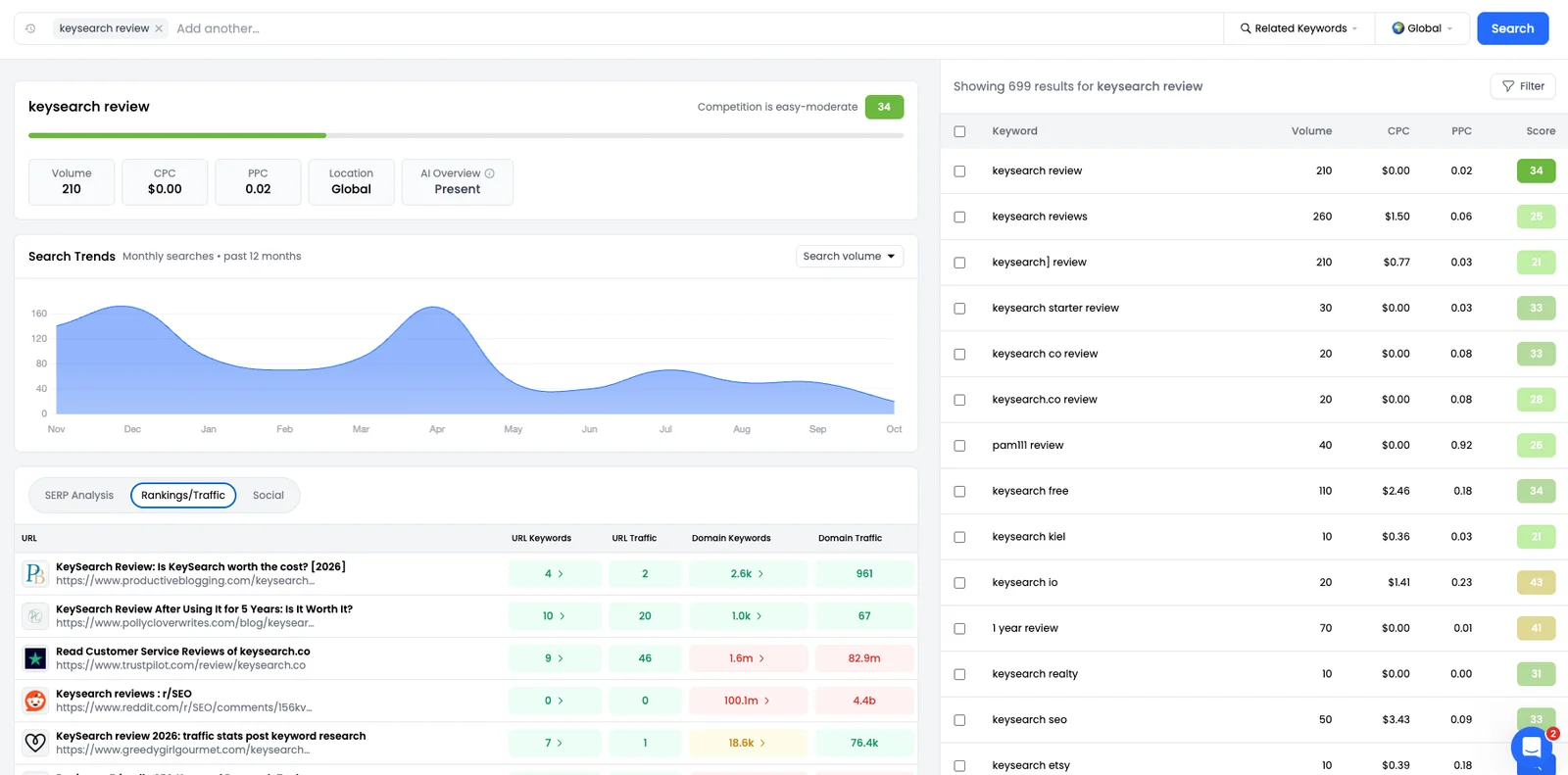
You can paste up to 50 keywords into one search. Each result shows search volume, cost per click, a pay-per-click competition figure, a difficulty score from 0 to 100, whether Google shows an AI Overview for the term, a 12-month trend, and the top 10 pages with their authority and links. The right column lists up to 700 related keywords. Two things to know before you start. First, new searches default to the Global location, which adds up every country: "keysearch review" showed 210 searches a month on Global, while US-only Google data puts it at about 30. A local business should switch the location to its own country first. Second, the related list drifts off topic: "keysearch review" returned "keysearch realty" and "keysearch kiel", and "best ai visibility software" returned "best high visibility vest". In a US search for "semrush overview", 108 of the 699 related keywords did not mention Semrush at all, from "1984 overview" to "7 habits overview". Filter the list before you save it.
How accurate is Keysearch's data?
The most common complaint about Keysearch is that its data is off, so I tested it. I ran one US search, saved all 699 related keywords to a list, pulled the list through the API and compared every search volume with Google Ads data from DataForSEO (694 keywords had a Google volume). The result depends on the size of the keyword. For long-tail terms under 20 searches a month, Keysearch showed the same number as Google 78% of the time. Above that, it mostly showed less: for keywords with 100 to 999 Google searches, two thirds were more than 25% lower in Keysearch, and across all keywords with 100 or more searches the median Keysearch figure was about a fifth of Google's ("semrush keyword overview": 10 in Keysearch, 390 in Google Ads). Cost per click was weaker still: 466 of the 694 keywords showed $0.00, including 73 that have a cost per click in Google Ads, and where both had a figure, none matched. Domain reports held up better: for otterly.ai, Keysearch counted 273 organic keywords and DataForSEO 262. In practice: use Keysearch volumes to rank keywords against each other, not as a traffic forecast, and check the bigger terms in Google Keyword Planner before you build a page around them.
Under 20
- Keywords
- 372
- Same as Google
- 78%
- Within 25%
- 78%
- More than 25% lower
- 0%
20 to 99
- Keywords
- 214
- Same as Google
- 15%
- Within 25%
- 22%
- More than 25% lower
- 64%
100 to 999
- Keywords
- 89
- Same as Google
- 7%
- Within 25%
- 20%
- More than 25% lower
- 67%
1,000 or more
- Keywords
- 19
- Same as Google
- 5%
- Within 25%
- 16%
- More than 25% lower
- 79%
| Google Ads searches a month | Keywords | Same as Google | Within 25% | More than 25% lower |
|---|---|---|---|---|
| Under 20 | 372 | 78% | 78% | 0% |
| 20 to 99 | 214 | 15% | 22% | 64% |
| 100 to 999 | 89 | 7% | 20% | 67% |
| 1,000 or more | 19 | 5% | 16% | 79% |
Keysearch US search volumes vs Google Ads data (DataForSEO) for 694 keywords, November 3, 2026.
Read the difficulty score as a filter, not a forecast
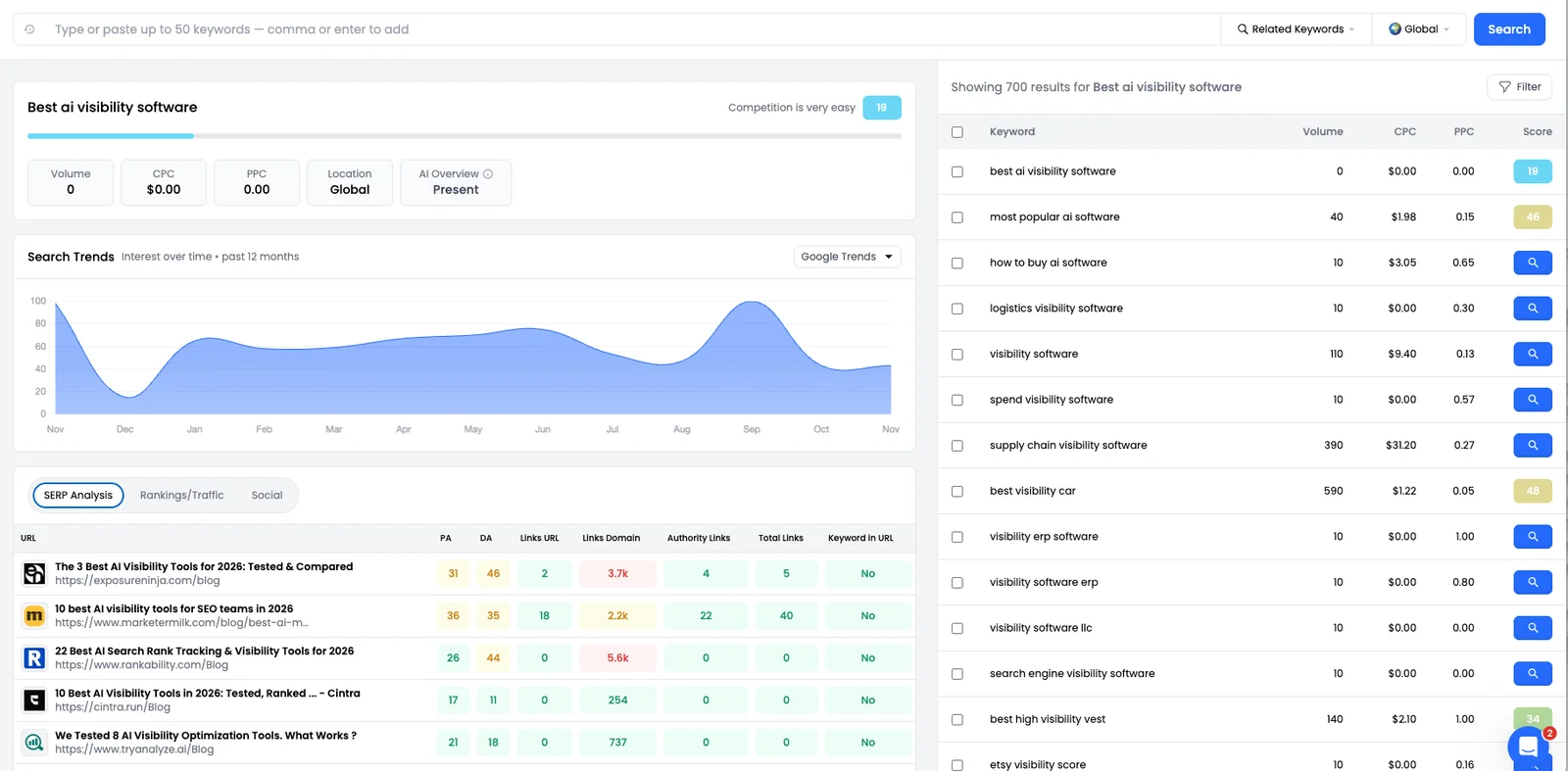
Keysearch rates every keyword from 0 to 100 and labels it, from "very easy" upward. The score is a useful first filter, but treat low scores with care. "best ai visibility software" scored 19, "very easy", while the top results belonged to Exposure Ninja (domain authority 46), Rankability (44, with 5,600 linking domains) and Marketer Milk (35). A new site will not outrank those pages because a number is blue. Before you write, open the SERP Analysis tab under the score and look at who actually ranks.
Size up a competitor's domain
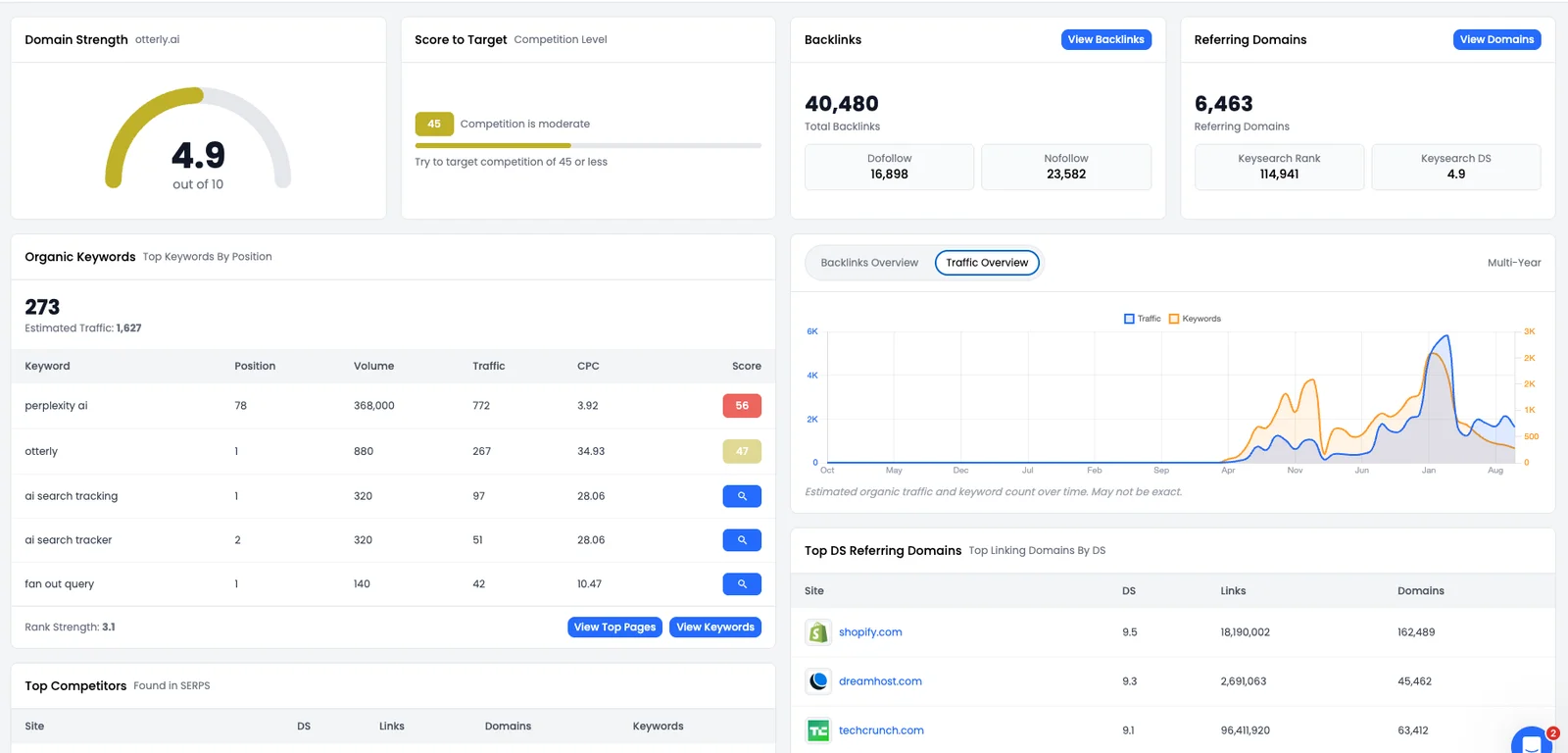
Type any domain into Competitive Analysis and you get Domain Strength (0 to 10), backlinks split into follow and nofollow, referring domains, organic keywords with positions and estimated traffic, and a traffic history chart. The most practical number for a small business is Score to Target: for otterly.ai it said "try to target competition of 45 or less". Run it on your own domain and you get a ceiling for the difficulty scores worth chasing. The traffic estimate is labelled "may not be exact", which is fair: every tool estimates traffic from rankings, and none of them sees your real visits.
Audit your site
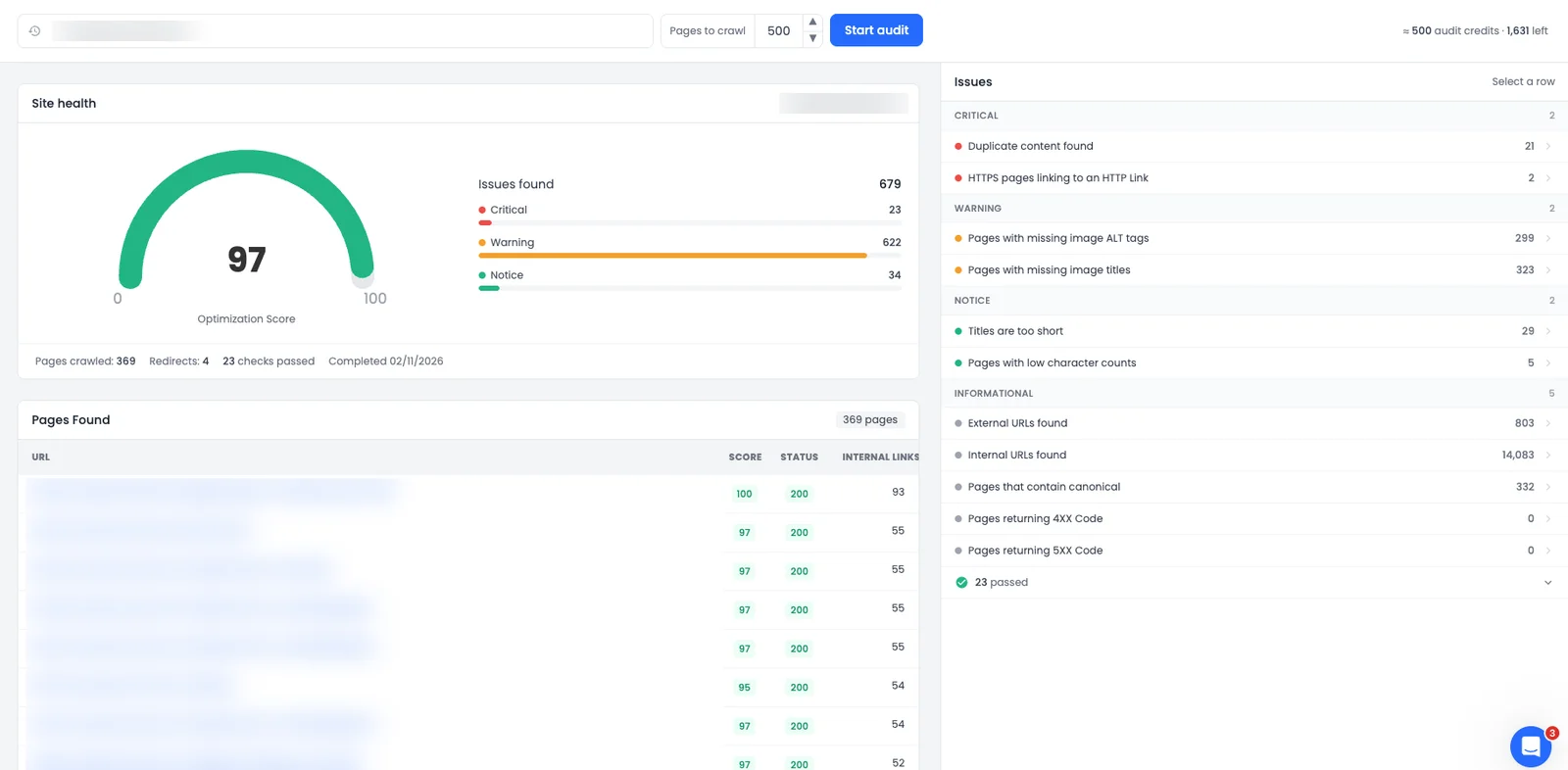
I audited one of my own sites with the 500-page limit. Keysearch crawled 369 pages in a few minutes and gave it an optimization score of 97 with 679 issues: 23 critical, 622 warnings and 34 notices. Every crawled page uses one audit credit, and Starter includes 2,000 a month, so a site this size can be audited about five times a month. The critical findings were useful: 21 pages with duplicate content and 2 HTTPS pages linking to HTTP. The warnings were mostly noise: 323 pages were flagged for missing image title attributes, which do not affect rankings, at the same level as 299 pages with missing alt text, which do matter. Fix the critical issues and the alt text, and ignore the image titles. For scheduled crawls, AI crawler checks and deeper reports, a dedicated audit tool such as Seobility goes much further.
Foresight is a Pro feature
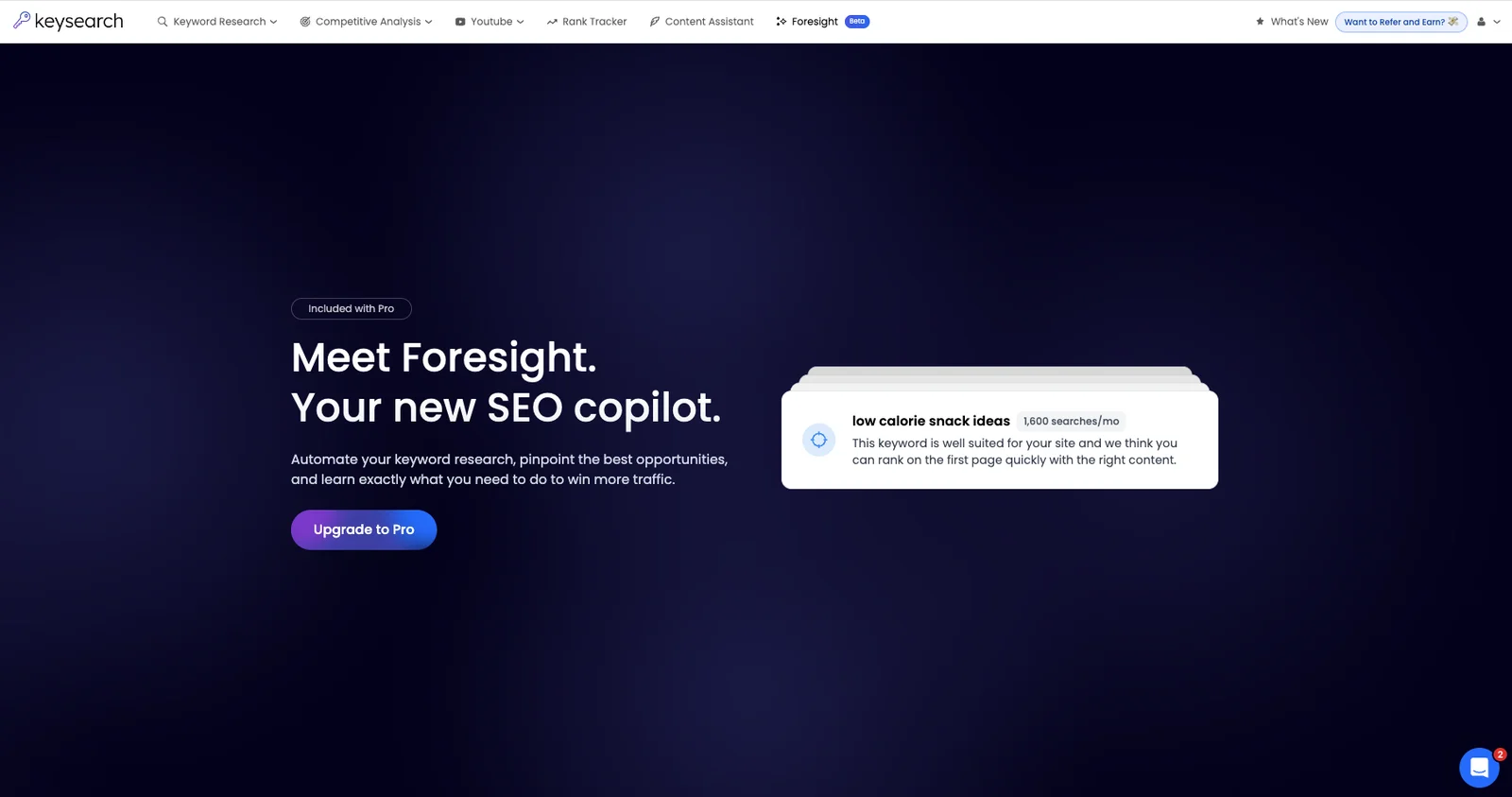
Foresight, marked beta, is Keysearch's AI feature: it asks for your site and suggests keywords it thinks you can rank for on the first page. It is only included in Pro ($48 a month). On Starter the menu item opens an upgrade screen, so test Pro during the 7-day trial if Foresight is the reason you are buying.
Pull your data out with the API
Keysearch has an official API with two read-only endpoints. One returns a saved keyword list with volume, cost per click and difficulty. The other returns one keyword's full data, including the top 10 pages with their authority and links, People Also Ask questions and related searches. Both only return keywords you have already searched in the app; the API cannot run a new search. Two details from my test that the documentation leaves out: the Global location is "cr=all", and errors come back as plain text with a success status code, so a script has to read the message, not just the status.
difficulty=keysearch review, cr=all
- What it returned in my test
- Volume 210, difficulty 34, top 10 with authority and links, 4 People Also Ask questions
difficulty=keysearch review (default US)
- What it returned in my test
- Error: not searched in this account for that location
difficulty=keysearch review, cr=global
- What it returned in my test
- Error: no results for that location
list=a name that does not exist
- What it returned in my test
- Error message as plain text
| API call | What it returned in my test |
|---|---|
| difficulty=keysearch review, cr=all | Volume 210, difficulty 34, top 10 with authority and links, 4 People Also Ask questions |
| difficulty=keysearch review (default US) | Error: not searched in this account for that location |
| difficulty=keysearch review, cr=global | Error: no results for that location |
| list=a name that does not exist | Error message as plain text |
Keysearch API calls from my account on November 2, 2026.
Works With
Which website platforms does Keysearch work with?
Browser-based keyword and rank research that works for any site with no install.
Keysearch lists no official CMS plugin or publishing integration.
Checked against Keysearch's own docs and official app stores on 22 October 2026.
AI, API & MCP
How Keysearch fits an AI-agent workflow
AI agent workflow
Read Keysearch data in Claude Code with the API key
That is how I tested it: with the API key in my environment, Claude Code pulled keyword difficulty, the top 10 and saved lists straight from my account. It works, but every new keyword still has to be searched in the app first. An MCP server, which most newer SEO tools now offer, would make Keysearch much smoother to use with AI tools.
Approval boundary: The API only reads data, so nothing in your account can be changed or deleted through it.
MCP
noneNo MCP server
Keysearch does not offer an MCP server, so AI assistants cannot connect to it directly. Here it is clearly behind tools such as SE Ranking and Seobility.
API
officialRead-only API for keywords you have already searched
Two GET endpoints: a saved keyword list, or one keyword's difficulty and top 10. The API key goes in the request URL, so keep it out of shared scripts.
Keysearch API documentation →Pricing
How much does Keysearch cost?
Keysearch Starter costs $24 a month, or $20 a month billed annually ($240 a year). Pro costs $48 a month, or $40 a month billed annually ($480 a year). There is no free plan, but there is a 7-day free trial and a 30-day refund window.
| Plan | Monthly |
|---|---|
| StarterPopular | $24/mo |
| Pro | $48/mo |
For one small site, Starter is enough. Pick Pro if you need more than 80 tracked keywords, more than 200 searches a day or the Foresight AI feature.
Starter ($24): the plan I trialled
200 keyword searches a day, 80 tracked keywords, 2,000 audited pages and 5,000 AI credits a month. No Foresight.
Pro ($48): more tracking and Foresight
500 keyword searches a day, 200 tracked keywords, 5,000 audited pages and 15,000 AI credits a month, plus Foresight and team features.
Annual billing gives two months free
Annual plans cost 10 times the monthly price: $240 for Starter and $480 for Pro.
Older reviews list lower prices
Many Keysearch reviews still quote $17 and $34 a month and a one-month trial. The current prices are $24 and $48, with a 7-day trial.
Alternatives
When I'd choose something else
Three different buying priorities, and what I'd pick instead for each one.
Long-tail keywords for content sites

LowFruits
It finds weak results in the top 10, which suits low-competition content.
Trade-off: It is credit-based and has no site audit.
Explore LowFruits for this use case →More tracking and deeper audits

SE Ranking
It tracks far more keywords and adds a full audit and AI visibility tracking.
Trade-off: It costs more and takes longer to learn.
Explore SE Ranking for this use case →Competitor and backlink research

Semrush
It has far more keyword, traffic and backlink data.
Trade-off: Expect to pay several times Keysearch's price.
Explore Semrush for this use case →Keep going
- Compare Keysearch against the field: Best Keyword Research Tools for a Small Site
- Put it to work: How to Do an SEO Audit on Your Website: A Step-by-Step Guide
- Put it to work: How to Do Keyword Research in 2026: Step-by-Step Guide
Downsides
Limitations to consider before subscribing
Not built to guide beginners
The app does not suggest what to work on; you have to know what to ask.
Difficulty scores can look too easy
A competitive software term scored 19, "very easy".
Search volumes run low above 20 a month
Two thirds of mid-volume keywords were more than 25% below Google Ads.
New searches default to Global
Global volumes add up every country; switch to your own first.
Related keyword lists drift off topic
"keysearch review" returned "keysearch realty".
Rank tracking is capped
80 keywords on Starter, 200 on Pro, no add-ons.
The API cannot run new searches
It only returns keywords already searched in the app, and there is no MCP server.
My Recommendation
My recommendation: start with Starter and check the top 10 yourself
Start the 7-day trial, set the location to your country and research the 20 topics that matter most to your business. For every keyword you like, open the SERP Analysis tab and check who ranks. If Keysearch saves you that hour every week, $24 a month is easy to justify.
Choose LowFruits for long-tail content keywords, SE Ranking if you need to track more keywords or AI visibility, or Semrush if competitor research drives your decisions.
What to check during the trial
- –Switch the location from Global to your country.
- –Research your 20 most important topics and save them to a list.
- –Open SERP Analysis for every keyword with a low difficulty score.
- –Run the domain overview on your own site and note the Score to Target.
- –Audit your site and fix the critical issues first.
FAQ
Frequently asked questions about Keysearch
Yes, for one small site that needs affordable keyword research. Starter costs $24 a month. Its long-tail search volumes matched Google Ads data, but bigger keywords mostly showed lower volumes, so check those in Google Keyword Planner. It is less worth it if you track more than 80 keywords or need deep competitor and backlink research.
Not the best choice for a complete beginner. Keysearch suits people who already know the basics of SEO: the interface is a little clunky at first and the app does not recommend what to work on, so you need to know what to ask. Tools such as Morningscore guide beginners with step-by-step tasks.
No. Keysearch has no free plan. It offers a 7-day free trial and a 30-day refund window. After that, Starter costs $24 a month and Pro $48 a month.
Starter costs $24 a month or $20 a month billed annually ($240 a year). Pro costs $48 a month or $40 a month billed annually ($480 a year).
Partly. I compared 694 US search volumes with Google Ads data: 78% of long-tail keywords under 20 searches a month matched exactly, but above that most volumes were more than 25% lower than Google's, and cost per click was often missing ($0.00). Its difficulty score is less reliable and can call competitive terms easy, so check the top 10 before you write.
Pro ($48 a month) raises daily searches from 200 to 500, tracked keywords from 80 to 200, audited pages from 2,000 to 5,000 and AI credits from 5,000 to 15,000 a month. It also adds Foresight and team features.
Yes. It has a read-only API with two endpoints: a saved keyword list, and one keyword's difficulty data with the top 10. It only returns keywords you have already searched in the app. The Global location is "cr=all" in the API.
No. Keysearch has no MCP server, so Claude, ChatGPT and other AI assistants cannot connect to it directly. With an API key you can still read its data in Claude Code, which is how I tested it, but only for keywords already searched in the app.
Yes. Each keyword result shows whether Google displays an AI Overview for that term. Keysearch does not track whether your site is cited in AI Overviews or in ChatGPT answers.
Joonas Rotko
SEO & GEO professional, founder of That Marketing Buddy
I'm a Finnish SEO and GEO professional with 11+ years in digital marketing, including years as a co-owner of a digital marketing agency. On That Marketing Buddy I test and compare SEO and AI-visibility software for entrepreneurs, marketing professionals and agencies.
Sources & References (2)
Spot something out of date?Vendors and readers, send me the correct fact.
Software sites change almost every week, and I want every claim on this page to be factually correct. If you are a vendor or a reader, send me the correct fact and a link to the official page. I will check it and update the page. The opinions and rankings stay mine.