

Joonas Rotko · Founder, That Marketing Buddy
I have spent 10+ years doing hands-on digital marketing and buying marketing software for my team and clients, and I now score every tool on this site for how well it works with AI agents. Ex Google Premier Partner agency co-owner.
This page may contain affiliate links.
Some links on this page are affiliate links, meaning I may earn a commission if you sign up (at no extra cost to you). This never influences my ratings or recommendations.
The Verdict
Is Loudmink right for you?
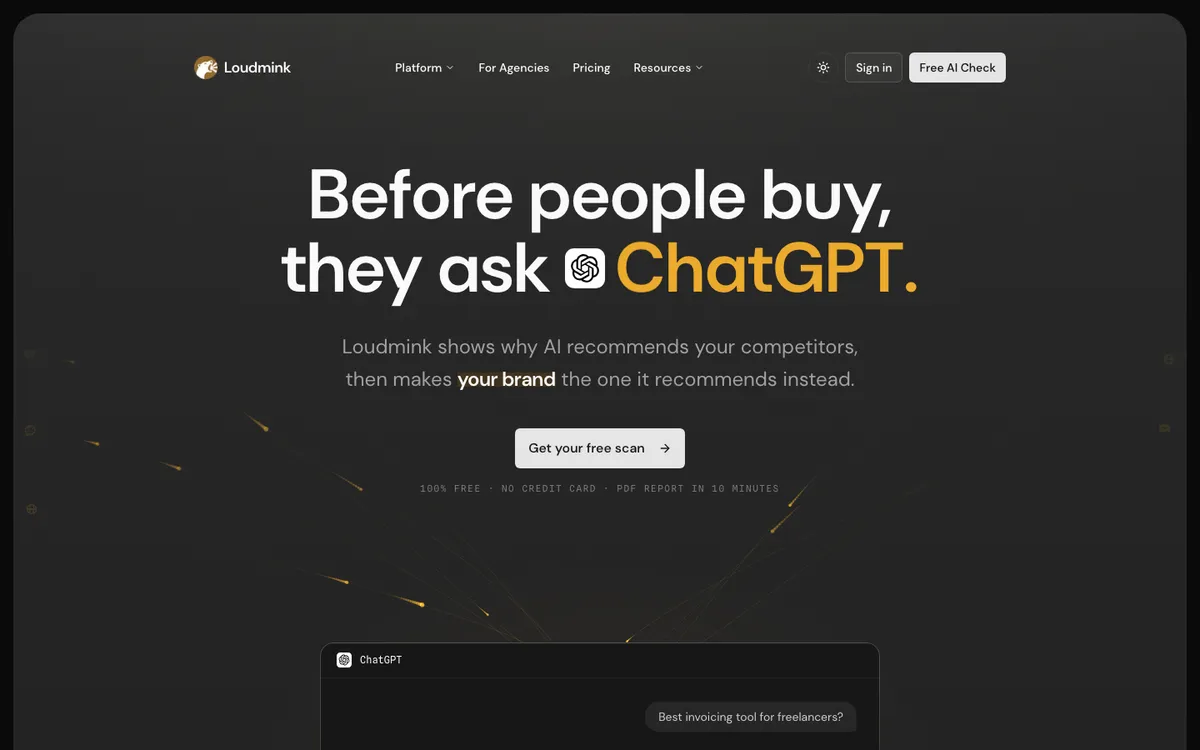
Loudmink (loudmink.ai) is an answer engine optimization (AEO) platform that tracks how your brand shows up across ChatGPT, Perplexity, Claude, Gemini and Grok, then tries to fix the gaps. Its angle is diagnostic: it maps the competitor source network (the Reddit threads, reviews and videos AI engines lean on when they recommend a rival) and drafts the content to close that gap.
It earns a look on TMB for one reason most trackers cannot match: an official MCP server built for Claude Code, with write access.
Loudmink is one of the more ambitious tools in the AEO category because it does not stop at measurement. It maps why AI engines recommend your competitors, down to the specific Reddit threads and pages feeding those answers, then drafts articles, Reddit posts and video scripts to close the gap, and re-checks weekly as the answers move.
The real bet is that closing that loop builds something the dashboard-only tools never get: a running record of what actually moved a recommendation and what did not. That is a sharp framing, and the competitor source map is the hard part to copy from the outside. The developer story backs it up: an official MCP with read and write tools, built for Claude Code, is rare here. Two honest cautions.
That same record is the thing an outsider cannot verify: proving Loudmink's content is what moved a citation, rather than model drift or a competitor's own move, is difficult from the outside, so treat the loop as a well-structured workflow with a feedback signal, not a guarantee. And the entry Starter plan tracks only ChatGPT, so the plan that matches the pitch is really Pro at $239 a month.
If you want to act on AI visibility and you live in Claude Code, it is worth a serious look.
Who It's For
Who Loudmink is for (and who it isn't)
✓Best for
- +Teams that will act on AI visibility You want to fix the gaps, not just watch a mentions dashboard. Loudmink maps the sources feeding competitor citations and drafts the content to close them.
- +Claude Code and agent-driven teams You want MCP write access to your visibility data. Loudmink's MCP is built for Claude Code with read and write tools.
- +Brands fighting a visible competitor The source-network map shows which Reddit threads, reviews and pages feed a rival's AI recommendations, so you can target them directly.
- +Teams that will publish The closed loop only pays off if you ship the drafted articles, Reddit posts and scripts. If you will act on them, it fits.
✗Skip this if
- −Budget-first buyers wanting cheap tracking If you only need a lightweight mentions tracker, cheaper tools cover that. Loudmink's value is the content loop, not bare tracking.
- −Anyone needing multi-engine coverage on entry Starter tracks only ChatGPT. Multi-engine tracking (Gemini, Perplexity, Claude, Grok) starts at Pro at $239 a month.
- −Teams that need proven attribution first Proving Loudmink's content is what moved a citation is hard to verify from the outside. If you need hard attribution before trusting the loop, wait.
- −Builders needing a documented REST API There is no standalone public REST API yet and no permanent free plan. The MCP is the only programmatic surface today.
Consider instead
 SurferSEO
 Clearscope
 Rankability
Features
What can Loudmink do?
Coverage scales with plan: Starter tracks one engine (ChatGPT), Pro adds Gemini and Perplexity, and Max covers five including Claude and Grok, with 50 to 300 tracked queries. The source-network mapping is the feature I would buy it for: seeing which specific pages and threads drive a competitor's citations is more actionable than a bare mentions chart, and it points content work at real targets rather than guesses.
A weekly re-check loop watches whether your position holds as AI answers shift.
The content engine is the other half. Loudmink drafts articles, Reddit posts and YouTube scripts against the gaps it finds, in your brand voice, and on Max it will even prepare outreach to sources the engines already cite. Publishing integrations cover WordPress, Shopify, Webflow, Ghost, Framer, HubSpot, Wix and Medium. For builders, the headline is the official MCP server (npx loudmink-mcp, API-key auth): it exposes read tools (queries, competitors, digests, Reddit opportunities, snapshots) and write tools (add or re-check queries, score and update articles) plus a knowledge-base resource, and it is built specifically for Claude Code.
Write access through an MCP is still uncommon in this category.
Pricing
How much does Loudmink cost?
Loudmink starts at $79/mo. That's 11% below median for AI Search Visibility (GEO).

Loudmink Pricing Analysis
vs. 26 AI search visibility toolsBelow median for AI search visibility tools

Cheaper than 70% of AI search visibility tools on That Marketing Buddy's database.
Loudmink has three self-serve tiers billed annually: Starter at $79 a month (1 engine, 50 queries, 8 articles), Pro at $239 (3 engines, 150 queries, 20 articles, 20 Reddit opportunities) and Max at $479 (5 engines, 300 queries, 40 articles, 40 Reddit opportunities, plus outreach to cited sources). Annual billing carries a 20 percent discount, so paying monthly costs more. There is no permanent free plan, but a free AI visibility scan (no signup, results in about ten minutes) lets you see your standing first, and paid plans carry a 28-day money-back guarantee.
Enterprise and an Agency Partner tier are custom-priced.
| Plan | Monthly |
|---|---|
| Starter | $79/mo |
| ProPopular | $239/mo |
| Max | $479/mo |
| Enterprise | Custom |
AI & Tech Stack
Does Loudmink fit your AI stack?
What AI Can't Replace
Loudmink's edge is the competitor source-network map and the closed loop around it: identifying the exact Reddit threads, reviews and videos feeding a rival's AI citations, then aiming content at those specific sources and re-checking weekly.
The mapping and the strategic call on what to target are the parts a generic AI writer cannot replicate, because they lean on Loudmink's own citation graph and a human approving each move.
Where AI Is Catching Up
The drafting layer (articles, Reddit posts, video scripts) is increasingly commoditized: any team can prompt a general LLM to write these. What is harder to replace is knowing which sources to target and building a record of what actually moved a citation. Used only as a writer, Loudmink is exposed to general models; the source map and weekly re-check loop are what keep it defensible.
API & Integrations
No separately documented public REST API yet. Integrations are strong on the publishing side (WordPress, Shopify, Webflow, Ghost, Framer, HubSpot, Wix, Medium), and it pulls real search data via a Google Search Console integration. Programmatic access today runs through the MCP server rather than a REST API, so confirm whether a documented API is on the roadmap if you need direct integration.
MCP & CLI
Official MCP server (npx loudmink-mcp, API-key auth with an lm_ prefix), built specifically for Claude Code. It exposes read tools (list queries, competitors, digests, Reddit opportunities, snapshots) and, unusually, write tools (add or re-check queries, score and update articles), plus a loudmink://knowledge-base resource. Write access through an MCP is rare in the GEO category.
It is early, at v0.1.x on npm.
Stack Verdict
One of the most agent-native tools in the GEO category: a Claude Code MCP with real write access, though a documented public REST API is still missing.
Connects with
Security
Try Loudmink yourself
Visit LoudminkFAQ
Frequently asked questions about Loudmink
Yes, an official MCP server (installed with npx loudmink-mcp, API-key auth). It is built for Claude Code and exposes both read tools (queries, competitors, digests, Reddit opportunities, snapshots) and write tools (add or re-check queries, score and update articles), plus a knowledge-base resource. There is no separately documented public REST API yet, so the MCP is the developer surface.
Three self-serve plans billed annually: Starter $79/month, Pro $239 and Max $479, plus custom Enterprise and Agency Partner tiers. Annual billing includes a 20% discount, so monthly costs more. Note that Starter tracks only ChatGPT; the plan that matches Loudmink's full pitch is Pro or Max.
Up to five: ChatGPT, Perplexity, Claude, Gemini and Grok. Coverage is gated by plan, so Starter tracks ChatGPT only, Pro tracks three, and Max tracks all five.
There is no permanent free plan and no time-limited trial, but a free AI visibility scan (no signup, about ten minutes) shows where you stand, and paid plans come with a 28-day money-back guarantee. If a permanent free tier matters, AthenaHQ offers one.
Transparent for the category, but read the tiers closely. Loudmink publishes three self-serve prices ($79, $239 and $479 a month), which beats the quote-only norm in AEO. The catch is that coverage is gated per engine and per query: Starter at $79 tracks only ChatGPT with low caps, so the plan that matches the pitch is really Pro at $239. Headline prices also assume annual billing (20 percent off), so monthly costs more.
Loudmink is best for: Teams that will act on AI visibility; Claude Code and agent-driven teams; Brands fighting a visible competitor; Teams that will publish.
A standout on TMB's core lens. Loudmink ships an official MCP server (npx loudmink-mcp, API-key auth) built specifically for Claude Code, and crucially it exposes write tools (add or re-check queries, score and update articles), not just reads, plus a knowledge-base resource. Write access through an MCP is still uncommon in this category. The honest gap: no separately documented public REST API, and the MCP is at an early 0.1.x version.
Data flows out reasonably well. A Google Search Console integration feeds real search data in, and publishing integrations (WordPress, Shopify, Webflow, Ghost, Framer, HubSpot, Wix, Medium) push drafted content out, while the MCP exposes your data to agents. The gap: there is no separately documented public REST API, and tracking history lives in Loudmink, so confirm export options before you commit.
More on Loudmink
This page may contain affiliate links. I earn a commission at no extra cost to you. This never influences ratings.