
This page may contain affiliate links.
Some links on this page are affiliate links, meaning I may earn a commission if you sign up (at no extra cost to you). This never influences my ratings or recommendations.
The Verdict
Is HasData right for you?
HasData sells web scraping and SERP data through APIs, and it does two things most of its competitors do not: it ships a 57-tool MCP server, and it sells Google AI Mode data with the citations attached. I spent a session with a vendor-provided account putting both through real calls.
A capable scraping platform with unusually good agent support and genuine AI search coverage. The credit system hides the real price of SERP work, which is mid-market rather than cheap, and the REST error messages need work. Strong if you want scraping and search from one vendor.
Buy HasData for breadth and agent support, not for cheap SERP volume. If you need Google AI Mode data with citations, or want scraping and search from one vendor, it is one of the few places to get both.
Who It's For
Who HasData is for (and who it isn't)
✓Best for
- +Teams tracking AI search visibility The AI Mode API returns generated answers with structured citations, which is the raw material for tracking whether your brand gets mentioned in AI answers.
- +Agents and MCP-first workflows 57 well-described MCP tools behind one API key, so an agent can pull search, maps, ecommerce and social data without custom integration work.
- +Anyone who needs scraping plus SERP from one vendor Buying a general Web Scraping API and a SERP API separately usually costs more than the combined HasData bill.
- +Developers who dislike writing selectors AI extraction rules take plain-English field descriptions and return structured JSON, which survives vendor redesigns that break CSS selectors.
- +Lead-gen and local research work Google Maps, Yelp and Yellow Pages scrapers plus off-the-shelf datasets cover local business data without building anything.
✗Skip this if
- −High-volume SERP-only buyers At $2.45 per 1,000 requests on the entry plan, a pure SERP workload is cheaper elsewhere until you reach Business volume.
- −Anyone needing backlink or keyword databases HasData sells live scraped data, not an index. There is no backlink graph and no keyword volume database.
- −Enterprises that require a long vendor track record This is a small company with a shorter public history than SerpApi or Bright Data, which matters for procurement.
- −Teams wanting dashboards and reports This is infrastructure. Beyond the no-code scrapers there is no reporting layer, and the data is for you to put somewhere else.
- −Synchronous user-facing AI answers The AI Mode endpoint takes over 11 seconds, which is too slow to sit in a request path a user is waiting on.
Consider instead
 SE Ranking
 Search Atlas
 DataForSEO
Features
What can HasData do?
What is HasData?
HasData is a web scraping platform that sells structured public web data through APIs. It covers two things that usually come from separate vendors: a general Web Scraping API that fetches any public URL through managed proxies, and a set of source-specific scrapers for Google search, Maps, Amazon, YouTube, TikTok, Zillow, Yelp and about 20 other sources.
The company is small and Latvian-registered, with 1,300+ customers by its own count. That matters for the buying decision, so I will come back to it.
The part I found most interesting is the AI search coverage. HasData ships a Google AI Mode API and an AI Overview endpoint that return the generated answer text along with the sources Google cited. For anyone tracking whether their brand gets mentioned in AI answers, that is the raw material, and most SERP API vendors still do not sell it.
Does HasData have an MCP server?
Yes. HasData runs an official MCP server at mcp.hasdata.com/mcp over streamable HTTP, and it exposes 57 tools. I counted them from a live `tools/list` call rather than trusting the docs, and 57 is exactly right.
Authentication accepts either an `x-api-key` header or OAuth. An unauthenticated request returns a proper 401 with a `WWW-Authenticate` challenge and a pointer to the OAuth resource metadata, which is the correct behaviour and rarer than it should be. I connected with the API key and had results back on the first call.
The tool descriptions are the best thing about it. Each one documents parameter semantics, pagination tokens and expiry windows, so an agent can pick the right call without a human explaining the API first. The AI Overview tool, for example, states that its page token is valid for four minutes.
Two caveats. The server tells you outright that its "tools are generated from generated/endpoints.json", so it is an auto-generated passthrough over the REST API rather than a designed agent surface, and tool results arrive as a raw HTTP envelope of `{url, status, json, text}` that your agent has to unwrap. One tool name also got hash-truncated by the code generator to fit the 64-character limit, arriving as `hasdata_google_serp_immersive_product_getImmersive_e29f691177`.
None of that blocks anything. It just shows the MCP layer is generated, not crafted.
What does the HasData API cover?
The Google surface is the deepest part. A single Google SERP API call came back with organic results, ads, People Also Ask, related searches, pagination and an AI Overview block, each under its own key. There are separate endpoints for News, Trends, Shopping, Images, Flights, Hotels, Events and short videos.
Beyond Google it covers Bing and DuckDuckGo search, Google Maps places, reviews, photos and posts, Amazon products, reviews and sellers, YouTube videos, channels and transcripts, TikTok, Instagram, Yelp, Yellow Pages, Zillow, Redfin, Indeed, Glassdoor, Booking, Airbnb and Shopify.
How good is the AI extraction?
Better than I expected. The Web Scraping API takes an `aiExtractRules` object where you describe the fields you want in plain English, and it returns structured JSON. I pointed it at a live pricing page and asked for plan name, monthly price and included credits as a list. It returned four clean plan objects on the first attempt, in 7.2 seconds, with no selectors written and no retries.
That is the feature I would actually pay for. Writing CSS selectors against a marketing page is work that breaks every time the vendor ships a redesign, and describing the fields instead removes that maintenance entirely.
How fast is HasData?
I timed every call rather than repeating the marketing numbers. A Google SERP API request returned in 2.7 seconds, near identical whether I called it over REST or through MCP, which tells you the MCP layer adds almost no overhead.
The Google AI Mode API is the slow one at 11.3 seconds. That is the cost of Google generating an answer rather than returning a cached page, and it came back with 20 text blocks and 8 structured references, each carrying link, title, source and citation index. For citation tracking that payload is worth the wait, but do not put it in a synchronous user-facing path.
Concurrency held up. I fired 20 simultaneous Google SERP Light requests on a 50-concurrency account and got 20 out of 20 back successfully, 200 organic results total, in 4.7 seconds wall clock. Individual requests ranged from 0.92 to 4.64 seconds. No 429s, no throttling, no silent truncation.
My whole test session, roughly 30 calls including that concurrency burst, cost 195 credits out of 20,000.
Where does the AI Overview data get awkward?
One thing will bite you if you build against it blind. The AI Overview block comes back in two different shapes depending on the query. For "what is generative engine optimization" the full answer text arrived inline inside the SERP response. For "best seo api" the same field held only a `pageToken`, valid for four minutes, which needs a second billed call to resolve into the actual answer.
Both shapes are legitimate and the docs describe the token flow. But your code has to branch on which one it got, and if you only ever tested the inline case you will ship a parser that silently returns empty answers. Budget for two calls per keyword when you are costing out AI Overview tracking.
From my test account
Inside HasData
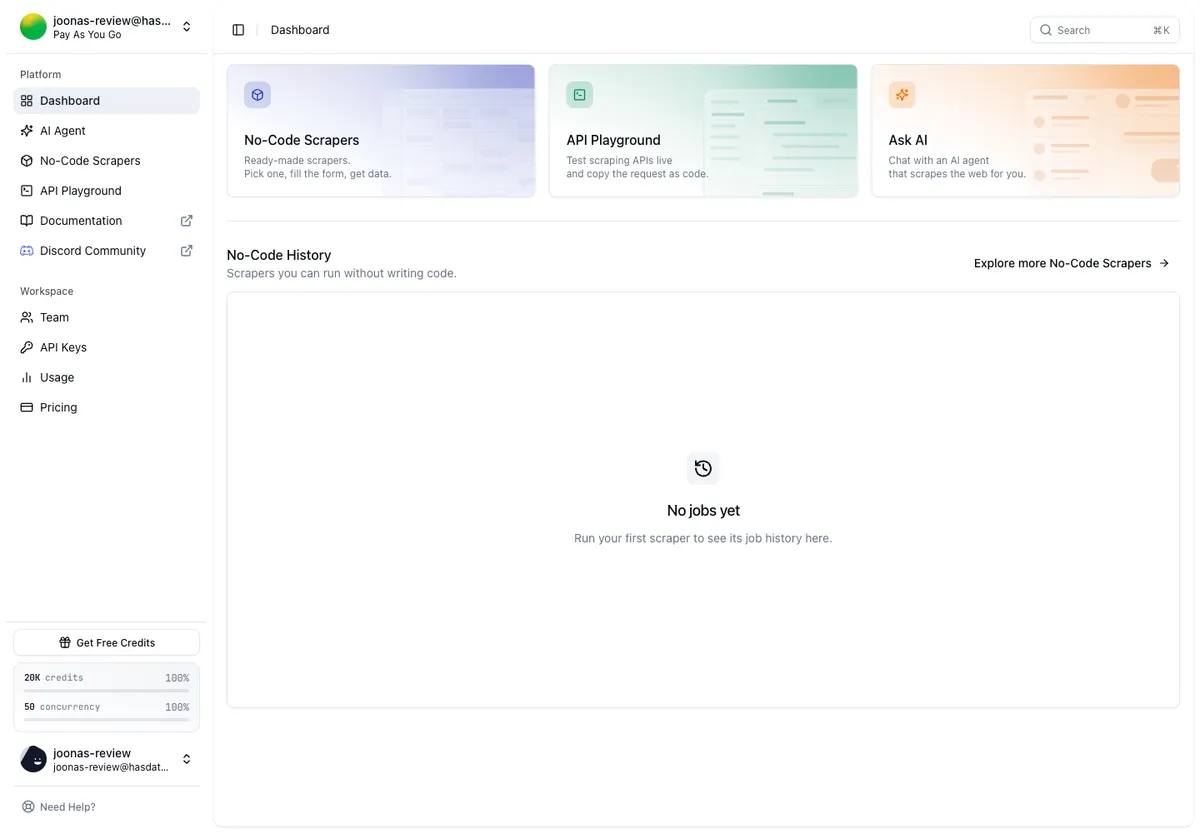
HasData gave me an account with 20,000 credits and 50 concurrency, so I ran the things a buyer would actually check rather than reading the docs back to you.
I connected to the MCP server with an API key and counted the tools it advertises: 57, which matches what HasData claims. I pulled a live Google SERP and got results back in 2.7 seconds, then did the same call over REST to see whether MCP added overhead. It did not. I asked the AI Mode endpoint a question and it took 11.3 seconds to return 20 blocks of answer text and 8 cited sources. I pointed the scraper at a live pricing page with plain-English extraction rules and it returned four clean plan objects in 7.2 seconds, first try, no selectors.
Then I fired 20 requests at once to see whether the concurrency number is real. All 20 came back, 200 organic results, 4.7 seconds wall clock, no rate limiting. Afterwards I checked the billing against the usage endpoint, which is where I found the numbers disagreeing. The whole session cost 195 of 20,000 credits.
UX & Support
Is HasData easy to use?
What is HasData like to use day to day?
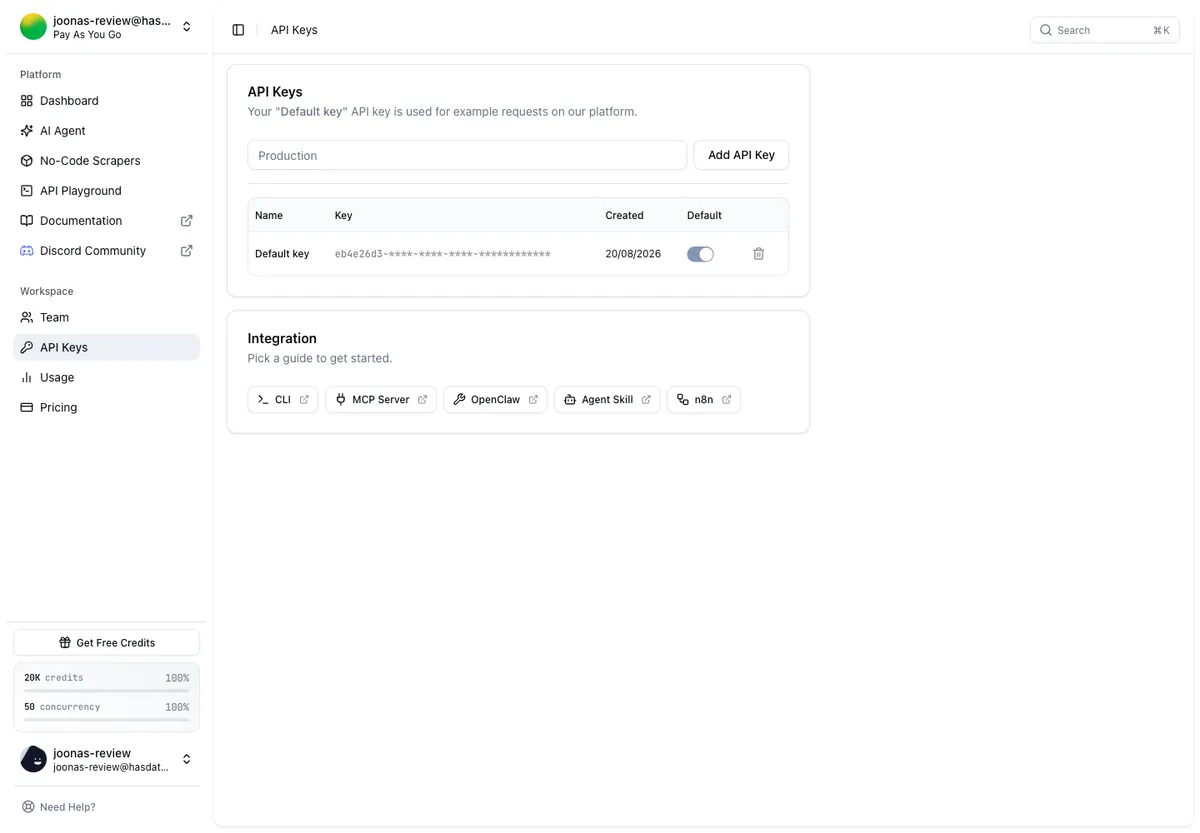
The dashboard is clean and gets out of the way. Sidebar, API playground, no-code scrapers, an AI agent chat, usage and billing. My API key was already provisioned when I logged in, and the API Keys page links straight out to integration guides for CLI, MCP, OpenClaw, Agent Skill and n8n. That set of links tells you where this company thinks its users are, and it is a reasonable bet.
Support runs through email, with priority email from Business up and a named manager from Growth. There is also a public Discord linked in the sidebar. Enterprise adds SSO and SOC-2.
What is rough about it?
Error messages on the REST side are thin. When I called a path that did not exist, the API returned a 400 with a body of `{"requestMetadata":{"id":"...","status":"error"}}` and nothing telling me what was wrong. The MCP layer handled the same class of mistake far better, passing through a readable 422 with the failing field named. Auth errors are fine in both places: a bad key returns a clear `{"message":"Invalid api key"}`.
The usage reporting does not agree with itself. The `/user/me/usage` endpoint returned `totalCredits: 1000` next to `availableCredits: 19805`, because totalCredits reports the default trial allotment rather than the balance on the account. You cannot compute a percentage remaining from that endpoint, which is the obvious thing to want from it.
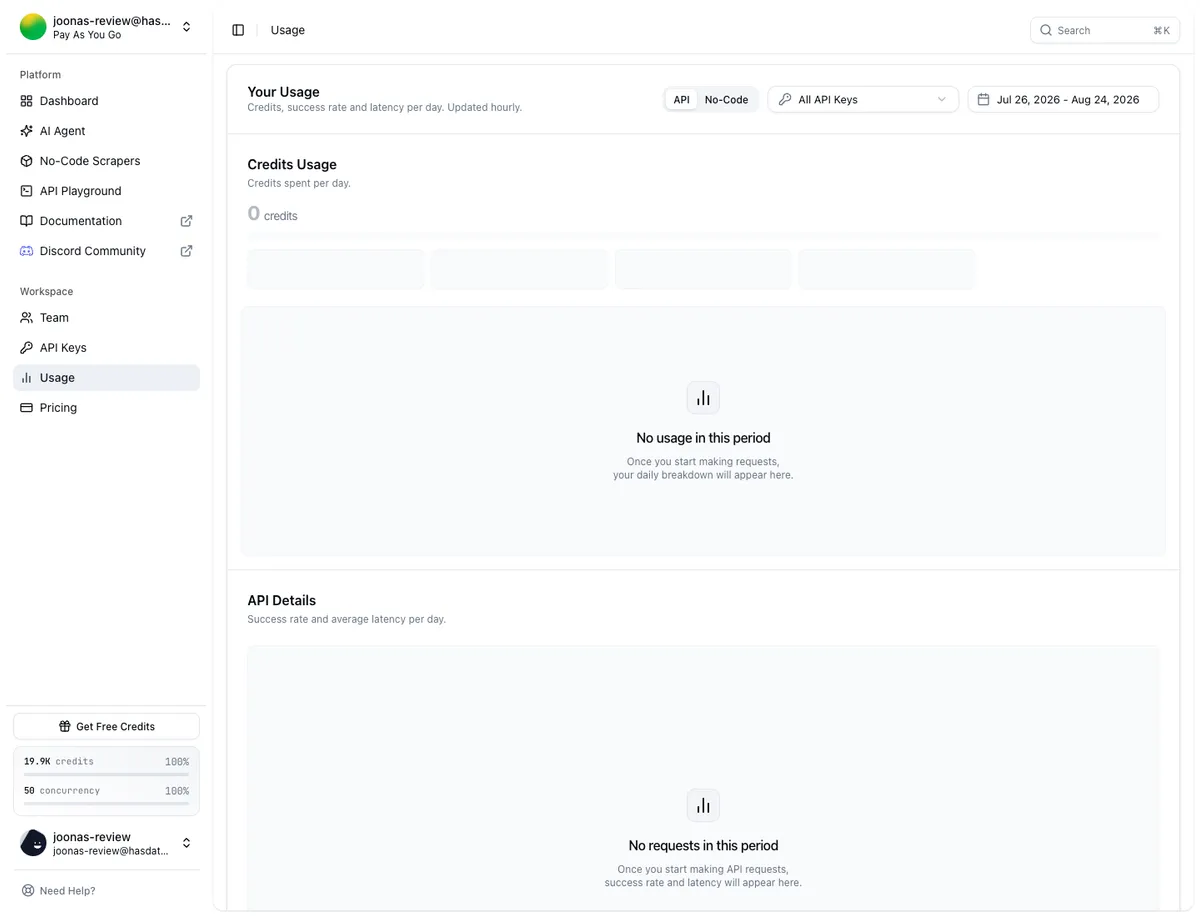
The Usage dashboard also lags. It was still showing "No usage in this period" and zero credits spent while the live counter in the sidebar had already dropped. The page says it updates hourly, so the two numbers disagree by design, but seeing "0 credits" after spending some is unsettling the first time.
How does HasData compare?
Against DataForSEO, HasData is narrower and easier to start with. DataForSEO sells more SEO-specific data, including backlinks and keyword databases that HasData does not have at all, and its pay-as-you-go pricing has no monthly floor. HasData wins if you want general web scraping and AI Mode capture from the same vendor.
Against SerpApi, the trade is track record for breadth. SerpApi has been the reference SERP API for years and has the longer public history. HasData covers far more non-search sources and sells AI Mode data, which SerpApi does not.
Against ValueSERP, it depends entirely on volume. ValueSERP is a focused SERP API at $1.00 to $1.60 per 1,000. HasData is more expensive at its entry tier ($2.45 per 1,000) and cheaper once you are on Business or above ($0.99 and $0.83). Run your own monthly query count through both tables before deciding.
The category context is on the best SEO APIs roundup, which compares all of them on coverage and pricing model.
Pricing
How much does HasData cost?
HasData starts at From $49/month. That's 2% below median for SEO APIs tools. A free plan is available.
How much does HasData cost?
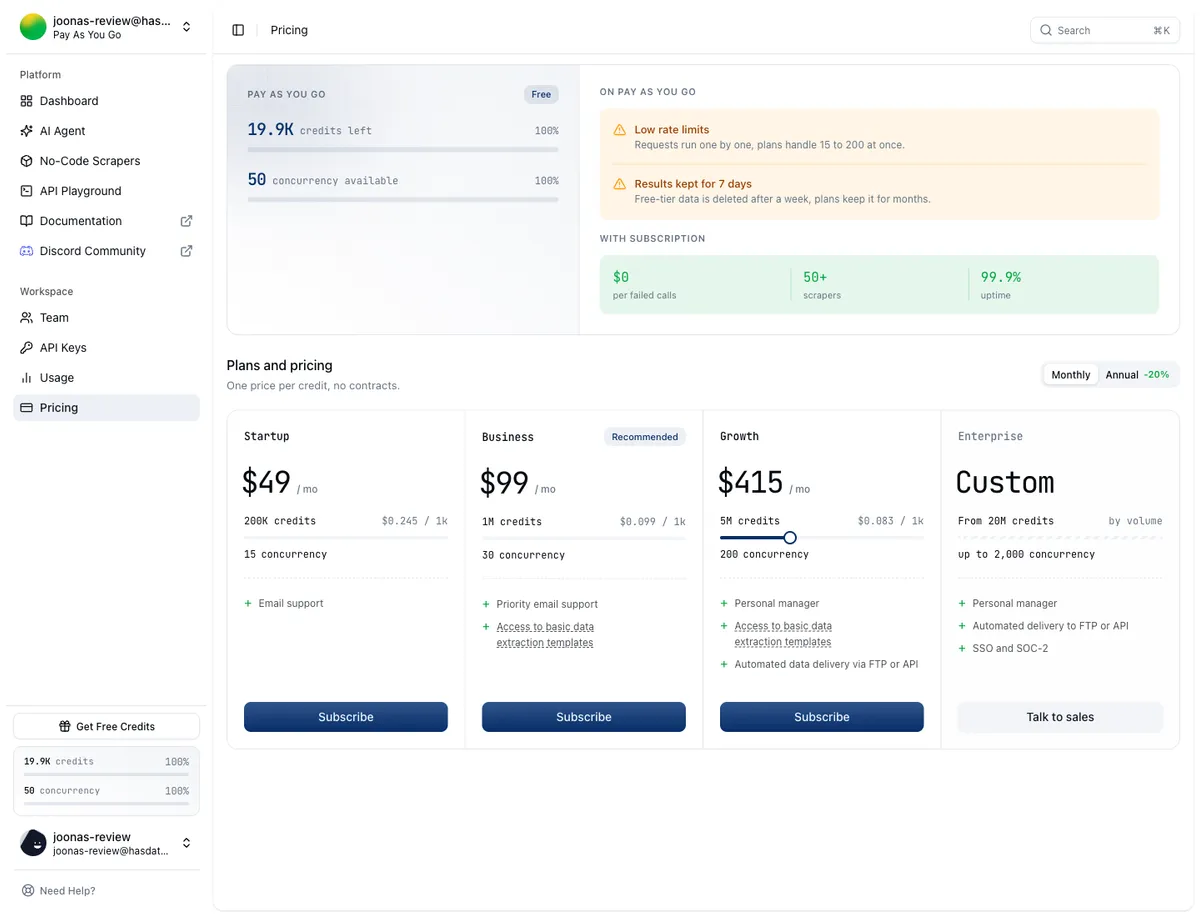
HasData starts free and runs $49, $99 and from $249 per month on monthly billing, with a custom Enterprise tier above that. Annual billing is sold as two months free, so Startup drops to about $40.83 per month ($490 a year) and Business to $82.50 per month ($990 a year).
The free tier is a real one: 1,000 credits a month, no credit card, plus a 30-day trial that opens up the paid features. The catch is 1 concurrent request and results deleted after 7 days, so it is sized for checking coverage against your own queries, not for running anything.
What is a HasData credit worth?
This is the number everyone gets wrong, including me before this week. Credits are not requests. A Web Scraping API call costs 1 credit, a Google Maps call costs 5, and a Google SERP API call costs 10. So a per-credit rate is never a per-request rate, and quoting one as the other understates the price of SERP work by roughly ten times.
HasData publishes the honest version of this as a per-1,000-requests table, broken out by product. For Google SERP API data specifically:
- Free: $0, capped at 100 SERP requests a month
- Startup ($49/mo): $2.45 per 1,000 requests, 20,000 included
- Business ($99/mo): $0.99 per 1,000 requests, 100,000 included
- Growth (from $249/mo): $0.83 per 1,000 requests, 300,000 included
The general Web Scraping API is far cheaper, because it is a far cheaper thing to do: $0.24 per 1,000 on Startup, falling to $0.08 per 1,000 on Growth. Google SERP Light, which drops the rich blocks and returns organic results only, sits in between at $1.23 per 1,000 on Startup.
So the read is straightforward. HasData is cheap for general web scraping and mid-priced for SERP data. If you are comparing it against SerpApi or ValueSERP on SERP volume alone, $2.45 per 1,000 at the entry tier is not a bargain. If you need both SERP data and general scraping from one vendor, the combined bill usually beats buying them separately.
One genuinely good billing detail: only successful requests consume credits. Failed and invalid requests are not charged. That is documented and repeated in the app, and it removes the usual argument about paying for blocked pages.
A small inconsistency worth knowing before you do the maths: the in-app annual toggle is labelled "-20%" but the actual discount is two months free, about 16.7%. The prices it shows are correct. The badge is just optimistic.
| Plan | Monthly |
|---|---|
| Free | $0/mo |
| Startup | $49/mo |
| BusinessPopular | $99/mo |
| Growth | $249/mo |
| Enterprise | Custom |
Downsides
What's wrong with HasData
SERP pricing is mid-market, not budget
Google SERP API runs $2.45 per 1,000 requests on the $49 Startup plan. The frequently quoted $0.08 figure is the Growth-tier web scraping rate, a different product.
REST errors say almost nothing
A bad request returns HTTP 400 with a body containing only a request id and status "error", with no message naming the problem. The MCP layer surfaces the underlying validation detail, so the REST API is the weaker of the two.
The usage endpoint reports the wrong total
/user/me/usage returned totalCredits of 1,000 alongside availableCredits of 19,805, because totalCredits reflects the default trial allotment rather than the account balance. Percentage-remaining cannot be computed from it.
Usage dashboard updates hourly
The Usage page showed zero credits spent while the live sidebar counter had already dropped. The two figures disagree for up to an hour.
AI Overview has two response shapes
The block arrives either inline or as a four-minute page token needing a second billed call. Code written against only one shape will silently return empty answers.
The MCP server is generated, not designed
Tools are auto-generated from an endpoints file, results come back as a raw HTTP envelope, and one tool name is hash-truncated to fit the 64-character limit.
FAQ
Frequently asked questions about HasData
Yes. HasData runs an official MCP server at mcp.hasdata.com/mcp over streamable HTTP with 57 tools, verified live on 24 August 2026. It authenticates with either an x-api-key header or OAuth, and an unauthenticated request returns a 401 with a proper WWW-Authenticate challenge.
57, counted from a live tools/list call on 24 August 2026. They cover Google search, Maps, News, Trends, Shopping, AI Mode and AI Overview, plus Amazon, YouTube, TikTok, Instagram, Yelp, Zillow, Redfin, Indeed, Glassdoor, Booking, Airbnb, Shopify and a general web scraping tool.
It depends on which API. Google SERP API costs $2.45 per 1,000 requests on the $49 Startup plan, $0.99 on the $99 Business plan and $0.83 on Growth. The general Web Scraping API is much cheaper at $0.24, $0.10 and $0.08 per 1,000 on the same plans.
No. A Web Scraping API request costs 1 credit, a Google Maps request costs 5 and a Google SERP API request costs 10. Dividing a plan price by its credit count gives a per-credit rate, not a per-request rate, and for SERP data the difference is a factor of ten.
Yes. The free tier gives 1,000 credits a month with no credit card required, which works out to 100 Google SERP API requests or 1,000 Web Scraping API requests. It is limited to 1 concurrent request and deletes results after 7 days. New accounts also get a 30-day trial with full access to paid features.
Yes, and this is one of its stronger points. The Google AI Mode API returns the generated answer as text blocks plus structured references with link, title, source and citation index. AI Overview data arrives either inline in the SERP response or as a page token valid for four minutes that needs a second call to resolve.
In testing on 24 August 2026, a Google SERP API call returned in 2.7 seconds over both REST and MCP. Google AI Mode took 11.3 seconds. A web scrape with AI extraction took 7.2 seconds. Twenty simultaneous SERP Light requests all succeeded in 4.7 seconds wall clock.
No. Only successful requests consume credits. Failed and invalid requests are not billed, which is documented in the credits guide and repeated in the app.
HasData starts from From $49/month. A free plan is available. There is a 30-day free trial.
Want to test HasData yourself?
The free tier gives 1,000 credits a month with no credit card, enough for 100 Google SERP requests or 1,000 web scrapes. Enough to check coverage against your own queries before paying anything.
 Try HasData free →
Joonas Rotko
Author & founder of That Marketing Buddy
I score marketing software for AI-stack fit (MCP, API, agent-readiness), backed by 10+ years in digital marketing.
This page may contain affiliate links. I earn a commission at no extra cost to you. This never influences ratings.