


Joonas Rotko · Founder, That Marketing Buddy
I assess SEO and GEO software through 10+ years of agency work, current product research, buyer needs, competing tools and total cost.
How this review was prepared
This review uses SE Visible's current product pages, pricing, help material and API documentation. I checked the public plans, prompt math, engine coverage, reporting workflow and technical access, then assessed where the product fits an agency or marketing team. I have not run a long-term client programme inside SE Visible, so performance conclusions stay within what the published product and a realistic buying workflow can support.
This page may include affiliate links, meaning I may earn a commission if you sign up (at no extra cost to you).
The Verdict
Is SE Visible right for you?
SE Visible is a credible monitoring layer for AI search, especially when several people need the same brand and competitor evidence.
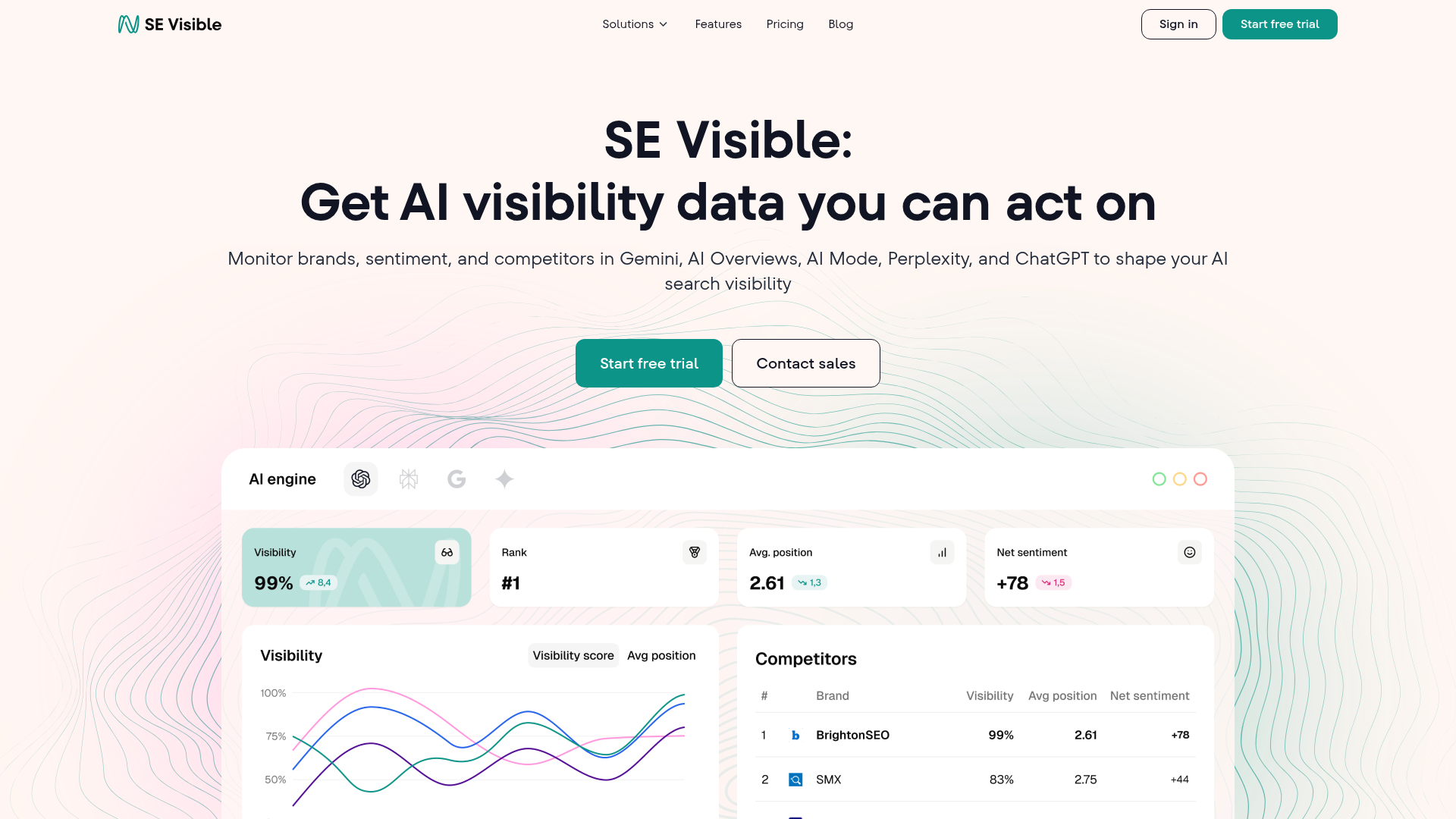
The useful part is not another visibility score. It is the path from a prompt to the real answer, cited sources, sentiment and competitor presence across ChatGPT, Gemini, Perplexity, Google AI Mode and AI Overviews. That gives an agency or in-house team evidence for deciding what to investigate next.
The limitation is equally clear: SE Visible measures the problem. Your team still has to improve the page, earn the mention, correct the positioning or run the outreach. Buy it when that action layer already has an owner, not when you need software to execute the entire GEO programme for you.
Who It's For
Who SE Visible is for (and who it isn't)
✓ Best for
- +Small agencies adding AI visibility reporting. Multiple projects, unlimited users and ready-made dashboards support recurring client work without a separate seat charge for every collaborator.
- +Marketing teams responsible for brand perception. Mentions, sentiment, citations and competitor comparisons show how answer engines describe the company, not only whether its website received a link.
- +Teams operating across several countries. Seven supported countries and five languages make regional differences visible inside the same monitoring system.
- +Teams building their own reporting workflow. The documented REST API, CSV export and Data Studio connector provide several routes for moving evidence into client or leadership reporting.
× Consider something else if
- −You only need a low-cost visibility baseline. Otterly.AI starts at a lower price and covers the basic monitoring job without SE Visible's broader team and market layer.Try Otterly.AI →
- −You want a ready-made connection for Claude or another assistant. PromptWatch combines AI visibility tracking with an official MCP server and REST API, while SE Visible currently requires custom API work.Try PromptWatch →
- −You need conventional SEO work as well as AI visibility. SE Ranking adds rank tracking, audits, keyword research and content optimisation around the visibility data.Try SE Ranking →
What You Can Do
What can SE Visible do?
Build a prompt set around real buying decisions
Start with questions prospects ask while comparing, validating or choosing a supplier. Group prompts by topic and intent, then add the brand aliases and competitors that matter. A smaller representative set is more useful than hundreds of vague prompts nobody owns.
Find the sources shaping AI answers
Inspect the domains and URLs cited when your brand or competitors appear. Separate sources you control from publications, directories, communities and partner sites. The resulting action may be a page rewrite, a new comparison, a PR pitch or an outreach task. SE Visible supplies the evidence; it does not complete that work.
Track sentiment without treating it as truth
Use prompt-level answers to understand why sentiment changed before reacting to the score. Check whether the answer is factually wrong, based on an old source or simply answering a different intent. Assign a response only when the underlying answer and source justify one.
Turn client monitoring into a monthly decision report
Report visibility, share of voice, citations and sentiment by topic and engine, then name the work that follows. A useful agency report says what changed, which source or prompt explains it and who owns the next action. A chart without an owner is decoration.
Feed verified data into your reporting stack
Use CSV or Data Studio for straightforward reporting. Use the REST API when you need scheduled data pulls, cross-client dashboards or internal analysis. Keep API keys scoped and private, validate the returned period and project, and require a person to approve any content or outreach action generated from the data.
Works With
Which website platforms does SE Visible work with?
Tracks AI answers by prompt; it does not connect to your website.
SE Visible lists no official CMS plugin or publishing integration.
Checked against SE Visible's own docs and official app stores on 22 October 2026.
AI Capabilities
AI visibility and technical access
Five engines are checked using real browser responses
SE Visible monitors ChatGPT, Gemini, Perplexity, Google AI Mode and AI Overviews. The company says it collects answers through the consumer browser experience rather than substituting API output, which matters because the two can differ. Results can be checked daily or weekly depending on the project schedule.
The useful layer connects answers, sources and competitors
Visibility Score and Share of Voice are starting points. Prompt results, average position, sentiment, cited domains and cited URLs explain what is behind the number. That is the material an SEO, content or PR owner can turn into work.
The REST API is real; native MCP is not confirmed
SE Visible documents token-authenticated endpoints for projects, brands, competitors, prompts, topics, metrics, sentiment and cited sources. The API can support reporting and custom workflows. I could not verify an official SE Visible MCP server or CLI, so Claude, ChatGPT, Codex and Cursor need custom code or an HTTP-capable automation rather than a one-click connection.
Pricing
How much does SE Visible cost?
Basic is the practical starting point for a small agency or marketing team. Core becomes relevant when five projects or a larger prompt set are necessary.
| Plan | Monthly price, with annual equivalent shown separately |
|---|---|
| BasicPopular | $99/mo |
| Core | $189/mo |
| Plus | $355/mo |
All three public plans cover the same five answer engines. The price rises with prompts and projects, while every tracked prompt is checked across all five engines. Annual billing cuts the monthly equivalent by 20 percent, but it also turns the decision into a full-year commitment.
Basic: 200 prompts and 3 projects
Basic includes approximately 30,000 analyzed answers per month because each prompt is checked across five engines. Three projects can cover three brands or clients, but an agency should decide how many prompt topics each account actually needs before assuming the tier is enough.
Core: 450 prompts and 5 projects
Core raises the monthly price to $189, or $151 per month billed annually. It fits a small client roster or an in-house team monitoring several markets or product lines, with approximately 67,500 analyzed answers per month.
Plus: 1,000 prompts and 10 projects
Plus costs $355 monthly, or $284 per month billed annually, and analyzes approximately 150,000 answers per month. The value depends on whether ten active projects need distinct prompt sets and regular reporting. Unused capacity is not an agency margin.
Annual billing saves 20 percent
Basic falls from $99 to a $79 monthly equivalent, Core from $189 to $151 and Plus from $355 to $284. Run the 10-day trial with representative prompts before accepting a year-long commitment, because prompt relevance matters more than the headline allowance.
Model the cost per active client
Basic works out to $33 per project at full three-project use before staff time. Core is $37.80 across five projects and Plus is $35.50 across ten. Those figures are only useful when every project has an owner, reporting cadence and action process.
Alternatives
When I'd choose something else
Three different buying priorities, and what I'd pick instead for each one.
Official MCP and a developer-first workflow

PromptWatch
Choose PromptWatch when the visibility data needs to flow directly into assistant-led workflows through an official MCP server as well as an API.
Trade-off: Its buying decision centres more heavily on technical connectivity and prompt capacity.
Explore PromptWatch for this use case →Agency-oriented client monitoring

Peec AI
Choose Peec AI when its project structure, reporting workflow and available engine mix fit the client roster better.
Trade-off: Engine and geographic coverage can depend more heavily on tier and add-ons.
Explore Peec AI for this use case →Lower-cost core monitoring

Otterly.AI
Choose Otterly.AI when the first goal is proving whether recurring AI visibility monitoring is useful before buying a broader team platform.
Trade-off: You give up some of SE Visible's multi-market, collaboration and reporting depth.
Explore Otterly.AI for this use case →SEO execution around AI visibility

SE Ranking
Choose SE Ranking when rank tracking, audits, research and content optimisation must sit beside AI search analysis.
Trade-off: It is a broader SEO purchase with different plans, limits and implementation work.
Explore SE Ranking for this use case →Downsides
Limitations to consider before subscribing
It measures visibility but does not create the outcome
SE Visible can identify weak topics, missing citations and competitor advantages. A content, SEO, PR or outreach owner must still decide what to change and execute it.
The entry price is high for one small brand
$99 per month is difficult to justify when the buyer only needs a small prompt set and a monthly visibility check. The economics improve when several active projects share the account.
Prompt selection can manufacture a comforting score
A dashboard only reflects the prompts being tracked. Brand-heavy, vague or low-value prompts can make visibility look healthier than the real buying journey.
Claude and Microsoft Copilot are outside current coverage
The published engine list covers five major systems but does not currently include every answer engine a client may care about. Confirm the required platform list before committing.
No native MCP connection is confirmed
The API makes custom integration possible, but teams wanting a direct assistant connection still need code or an HTTP automation layer.
My Recommendation
My recommendation: buy SE Visible when the action layer already exists
Shortlist SE Visible when an agency or marketing team needs repeatable monitoring across five engines, several projects and multiple markets, and someone already owns the content, SEO, PR or outreach response.
Choose Otterly.AI for a cheaper baseline, PromptWatch for native MCP access, Peec AI when its agency workflow fits better, or SE Ranking when conventional SEO execution is part of the same purchase.
What to check during the trial
- –Use real comparison, category, problem and brand prompts from the buyer journey.
- –Check whether the captured answers match what a person sees in each engine.
- –Trace at least five visibility gaps back to prompts, sources and concrete actions.
- –Build one client or leadership report and record the manual time required.
- –Test one API data pull without giving a workflow more permissions than it needs.
- –Assign an owner and deadline to every action created from the trial.
Test the API as a reporting source, not an autopilot
Pull one project's metrics and cited sources into a private test report. Confirm dates, engines and project IDs, then keep content changes and outreach behind a person who can review the underlying answer.
FAQ
Frequently asked questions about SE Visible
SE Visible is a standalone AI search visibility platform from the team behind SE Ranking. It tracks brand mentions, citations, sentiment, competitors and sources across five major AI answer engines.
SE Visible currently tracks ChatGPT, Gemini, Perplexity, Google AI Mode and Google AI Overviews. Claude and Microsoft Copilot are not on the current published list.
Basic costs $99 per month with monthly billing, or $79 per month billed annually. Core costs $189 monthly or $151 on annual billing. Plus costs $355 monthly or $284 on annual billing.
Yes. SE Visible offers a 10-day free trial and does not list a permanent free plan.
SE Visible is presented as a standalone brand and product with its own plans, website and API. It is built by the team behind SE Ranking, and the two products can support related parts of an SEO and AI visibility workflow.
Yes, when an agency needs multi-client monitoring and already has people who can act on the findings. Basic includes 3 projects, Core 5 and Plus 10, while unlimited collaboration avoids a separate seat cost for each teammate or client.
Yes. The documented token-authenticated REST API covers projects, brands, competitors, prompts, topics, prompt results, visibility metrics, sentiment and cited sources. User and subscription management remain outside the API.
I could not verify an official SE Visible MCP server or CLI. Assistants can still work with the REST API through custom code or an HTTP-capable automation.
No. SE Visible identifies mentions, citations, sentiment, competitors and source gaps. Your team must turn that evidence into content changes, PR, partnerships or outreach.
Skip it when one small brand only needs an occasional visibility check, nobody owns the follow-up work, or the required answer engine is outside its current coverage. A lower-cost tracker may be enough for a basic baseline.
Sources & References (4)
Spot something out of date?Vendors and readers, send me the correct fact.
Software sites change almost every week, and I want every claim on this page to be factually correct. If you are a vendor or a reader, send me the correct fact and a link to the official page. I will check it and update the page. The opinions and rankings stay mine.