


Joonas Rotko · Founder, That Marketing Buddy
I assess marketing software through 10+ years of agency work, current product research, buyer needs, competing tools and total cost.
How this review was prepared
This is a research-based review. I checked Loops's current product pages, pricing, documentation and terms, then assessed what those published limits mean for a marketing team or small agency. I have not presented vendor claims as personal testing.
This page may include affiliate links, meaning I may earn a commission if you sign up (at no extra cost to you).
The Verdict
Is Loops right for you?
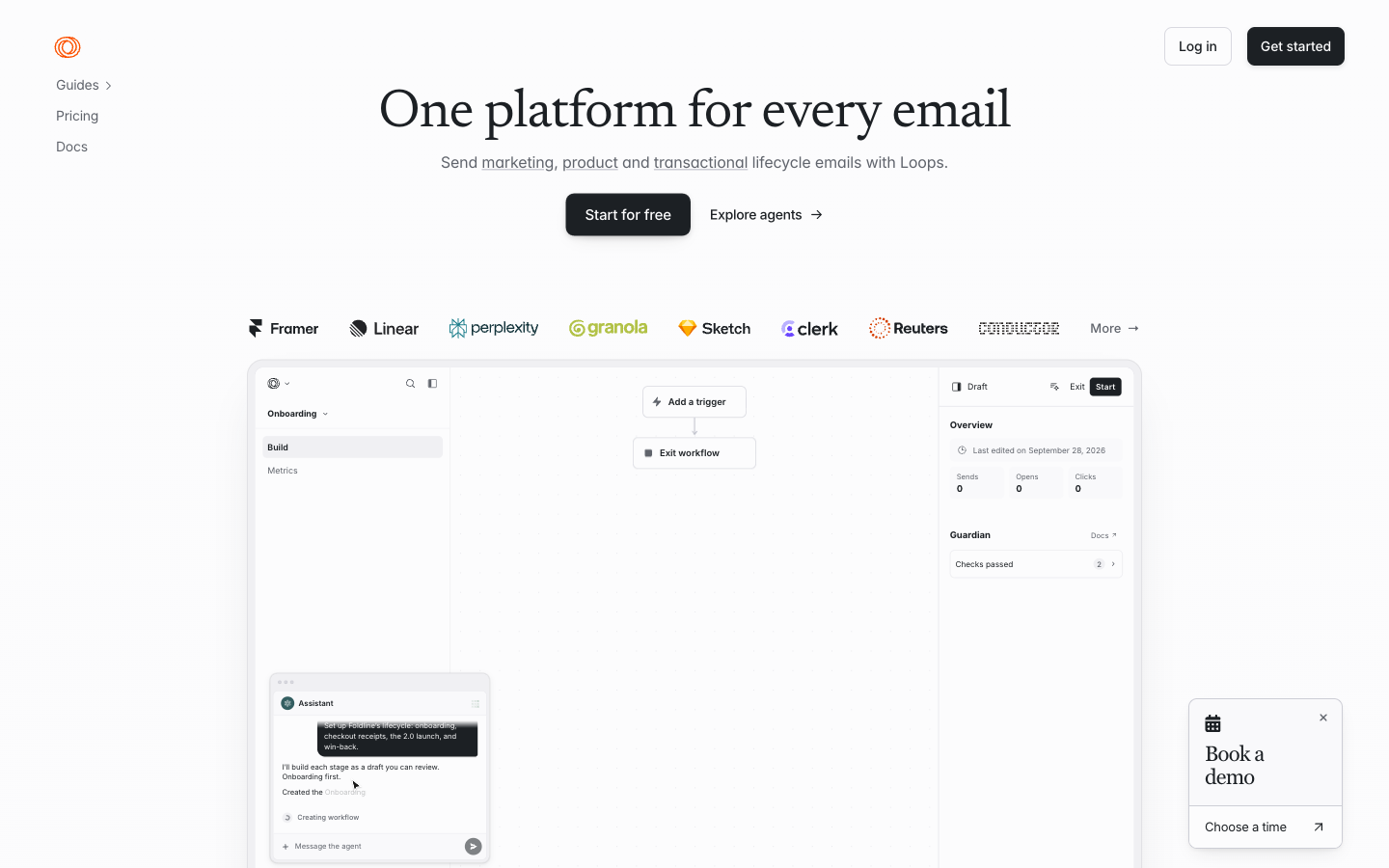
Loops is an email platform for software companies. It sends marketing campaigns, event-triggered workflows and transactional email (password resets, receipts) from one account, and it prices by the number of subscribed contacts rather than by send volume.
The free plan covers up to 4,000 emails in any rolling 30 days to your 1,000 newest contacts. Paid plans start at $49/month billed monthly, then $99 at 10,000 subscribers, $199 at 25,000 and $399 at 100,000, with unlimited sends, no Loops branding and no charge per team seat.
It fits a product team that wants one tool for what the app sends and what marketing sends. It fits poorly when the plan needs a CRM, lead scoring, ecommerce revenue tracking or an annual-billing discount.
Who It's For
Who Loops is for (and who it isn't)
✓ Best for
- +SaaS teams that send both product email and marketing email. Transactional sending is included on paid plans at no extra charge, and events from your app can start published workflows. One contact list and one sending reputation serve onboarding, receipts and newsletters.
- +Engineering-led teams that want to script the email stack. Loops documents a REST API with an OpenAPI spec, official SDKs (JavaScript, Go, Nuxt, PHP, Ruby), a CLI, webhooks and an official MCP server, so a developer or coding agent can manage contacts, events and templates.
- +Early products that want to start at zero. The free plan needs no credit card, includes every feature, and only asks for a small "Powered by Loops" footer. Every plan lets you upload as many contacts as you like, because only subscribed contacts count.
× Consider something else if
- −You need marketing automation with CRM and lead scoring. Loops documents workflows, events, segments and goals for email. I found no CRM, lead scoring or sales pipeline on its pricing or docs pages, so a B2B funnel with sales handoff needs a fuller platform.Try ActiveCampaign →
- −You only send transactional email from code. If nobody on the team will ever build a campaign or workflow, an email API priced for sending alone asks for less setup and less monthly commitment.Try Resend →
- −You sell physical products and need revenue attribution. Loops is aimed at software companies. Store integrations, abandoned-cart flows and order-level revenue reporting sit with ecommerce-first tools.Try Klaviyo →
What You Can Do
What can Loops do?
Trigger an onboarding sequence from a product event
Send an event such as signup or plan change through the API, and a published workflow starts. Workflows can hold emails, delay timers and branches, and Loops' Stripe integration syncs customers into the audience.
Send transactional email from a template
Design a transactional template once, then send it from your backend with data variables through the API. Transactional volume is included on paid plans, and on the free plan it counts inside the 4,000-send allowance.
Send a product update to a segment
Filter the audience by contact properties, for example a last-active date, and send a campaign to that segment. Loops' own deliverability guidance recommends mailing engaged users rather than re-engaging cold contacts.
Let an agent draft campaigns and content
The Campaign API creates a draft campaign with full content, which you review and send from the dashboard. Loops Markup Extended (LMX) is an XML format for email content, so a coding agent can write and update emails programmatically.
AI, API & MCP
Does Loops Have an MCP Server, API and AI Features?
Loops is one of the more agent-ready email tools: it publishes an MCP server, a CLI, agent skills and an OpenAPI spec.
AI agent workflow
A safe agent workflow
Let an agent read contacts and events, draft transactional templates and create draft campaigns through the Campaign API. Drafts are reviewed and sent from the dashboard, which keeps the send step manual.
Approval boundary: Keep sends to real audiences, contact deletion and event calls that start live workflows behind a human check. The MCP server can change data and send email once connected.
MCP
officialOfficial remote MCP server
The server uses OAuth sign-in, works with clients that support Streamable HTTP, and lets you choose which Loops team an operation runs against. Its four tools search and execute API operations rather than mapping one tool per endpoint.
Loops MCP server →API
officialREST API, SDKs and CLI
The API is documented with an OpenAPI spec, plus webhooks and an API changelog. Auth uses an API key, and agent skills teach Claude Code, Codex and Cursor how to use it.
Loops for agents →Pricing
How much does Loops cost?
Loops is free up to 1,000 contacts, then $49/month billed monthly at the first paid step, with unlimited sends and no per-seat fees.
| Plan | Monthly billing, per subscribed contacts |
|---|---|
| Free | Free |
| Paid, up to 5,000 subscribersPopular | $49/mo |
| Paid, up to 25,000 subscribers | $199/mo |
| Custom, above 1.5 million | Custom |
Loops prices by subscribed contacts, and unsubscribed contacts do not count. The plan is one product with every feature at every tier. The tier is set from the number of subscribed contacts at renewal, and Loops moves you up a tier without interrupting service when you cross one.
Price the plan at your subscribed-contact count
The pricing slider reads $49/month at 5,000 subscribers, $99 at 10,000, $149 at 15,000, $199 at 25,000, $249 at 50,000, $399 at 100,000, $599 at 150,000 and $1,999 at 500,000. Above 1.5 million subscribers, pricing is custom.
The free plan is a send cap, not only a contact cap
Free allows up to 4,000 total emails in any rolling 30 days to your 1,000 newest contacts, counting marketing and transactional sends together, at up to 10 emails per second. New contacts beyond the first 1,000 do not receive campaign or workflow emails, though transactional sends continue.
Paid plans do not fall back on their own
Loops' billing docs say a paid plan does not downgrade automatically when your list shrinks. If subscribed contacts drop below 1,000 you stay on the paid plan until you cancel it.
There is no published annual discount or refund
Pricing and billing pages show monthly billing only. Loops' terms state that amounts paid are non-refundable and that cancelling does not refund the prepaid or unused portion.
Alternatives
When I'd choose something else
Three different buying priorities, and what I'd pick instead for each one.
If you only need transactional sending

Resend
Resend is an email API for developers with its own transactional and marketing tiers, so a team that sends only from code can price it on sends.
Trade-off: Resend offers automations, but the product is organised around developer sending, so a marketer building onboarding journeys works in a less campaign-oriented tool.
Explore Resend for this use case →If behavior data and app events drive complex journeys

Customer.io
Customer.io is built around event-driven messaging for product-led companies, with a deeper set of channels and data tools.
Trade-off: It asks for more setup than a single-purpose tool like Loops.
Explore Customer.io for this use case →If marketing email volume and SMS matter more

Brevo
Brevo bundles marketing email, transactional sending and other channels in one platform.
Trade-off: It is a general marketing suite, so the SaaS-specific event and workflow model in Loops is less central.
Explore Brevo for this use case →Keep going
- Compare Loops against the field: 15 Best AI-Native Email Marketing Software (2026)
Downsides
Limitations to consider before subscribing
The free plan is a small trial, not a free tier to live on
4,000 sends in a rolling 30 days, spread across your 1,000 newest contacts, is used up quickly once transactional and marketing email share it. The plan also carries a "Powered by Loops" footer.
Pricing climbs with the list, not the value of each contact
A list of 100,000 subscribed contacts costs $399/month and 500,000 costs $1,999/month, whether they are paying customers or dormant signups. Trimming inactive contacts is the main way to control the bill.
No annual billing or refund path is published
The pricing page and billing docs show monthly billing only, and the terms exclude refunds for prepaid or unused fees. Test on the free plan before upgrading.
Email only, aimed at software companies
I found no CRM, landing pages, lead scoring or SMS in the pricing or docs pages.
Dedicated IPs and independent deliverability data are not documented
Loops publishes detailed deliverability guides and handles suppression automatically, but I found no dedicated IP option and no independent inbox-placement study.
My Recommendation
Should You Choose Loops?
Shortlist Loops if you run a software product and want transactional email, lifecycle workflows and newsletters in one contact list, priced by subscribed contacts.
Choose Resend for code-only sending, Customer.io for heavier event-driven messaging, or Brevo for broader marketing channels.
What to check during the trial
- –Send your real signup event and confirm the workflow starts and the contact properties map correctly.
- –Set up the sending domain on a subdomain and check DKIM, SPF and DMARC before any volume.
- –Count your subscribed contacts, not total contacts, and price that number on the slider.
- –Test a transactional template from the API with real data variables.
Connect it to your AI client
Add the official MCP server and ask which Loops teams you belong to. Then have the assistant draft a campaign, and review it in the dashboard before sending anything.
FAQ
Frequently asked questions about Loops
Loops is free up to 1,000 subscribed contacts with up to 4,000 sends in any rolling 30 days. Paid plans, billed monthly by subscribed contacts, run $49/month at 5,000, $99 at 10,000, $199 at 25,000 and $399 at 100,000.
No. Loops states that paid plans have unlimited sends and that it does not charge for team seats. Transactional email is included at no additional charge on paid plans.
Yes. Loops publishes an official remote MCP server at mcp.loops.so with OAuth sign-in. Its four tools cover contacts, mailing lists, events and transactional email through the Loops API.
Loops' terms say amounts paid are non-refundable and that cancelling does not entitle you to a refund for the prepaid or unused portion. Use the free plan to test first.
Sources & References (6)
Spot something out of date?Vendors and readers, send me the correct fact.
Software sites change almost every week, and I want every claim on this page to be factually correct. If you are a vendor or a reader, send me the correct fact and a link to the official page. I will check it and update the page. The opinions and rankings stay mine.