
This page may contain affiliate links.
Some links on this page are affiliate links, meaning I may earn a commission if you sign up (at no extra cost to you). This never influences my ratings or recommendations.
It is free, it is first-party, and you should install it before you pay anyone on this page. Then you hit the wall that brought you here. In Google's own words, the implementation "is strictly read-only. It cannot modify bids, pause campaigns, or create new assets." Three tools, list_accessible_customers, search for GAQL queries, and get_resource_metadata.
Ask it anything about your account and it answers. Ask it to change something and it cannot. There is a second wall that gets less attention. It is a developer tool. Running it means a Google Cloud project, a developer token, OAuth credentials, pipx and a terminal, or deploying it to Cloud Run yourself. Plenty of people who want an assistant on their ad account will stop right there.
So this page is organised around one question per tool: what does this do that Google's server cannot? Sometimes the answer is writing campaigns. Sometimes it is covering Meta and LinkedIn too. Sometimes it is nothing to do with MCP at all, because the honest alternative to a read-only server is occasionally a product that does the work instead.
Every claim here was checked against vendor documentation on 23 August 2026. That matters in this category: probing MCP endpoints returns misleading results (two vendors return HTTP 200 on an MCP path that is really a marketing page), and the search results are dominated by ad-tech vendors publishing comparison posts about their own rivals.
Why Switch
Why people look for Google Ads MCP Server alternatives
It is strictly read-only: no bid changes, no pausing campaigns, no new assets
Setup needs a Google Cloud project, a developer token, OAuth credentials and a terminal
Google Ads only, so Meta, LinkedIn and TikTok stay outside the conversation
No recommendations, no guardrails and no opinion on your account structure
It runs locally over stdio unless you deploy it to Cloud Run yourself, so there is nothing hosted for a team to share
It assumes you already have a well-built account worth querying
Alternatives
Best Google Ads MCP Server alternatives
9 alternatives ranked.

Ryze AI
Top PickAdvertisers who want write access and the widest tool surface without touching a terminal
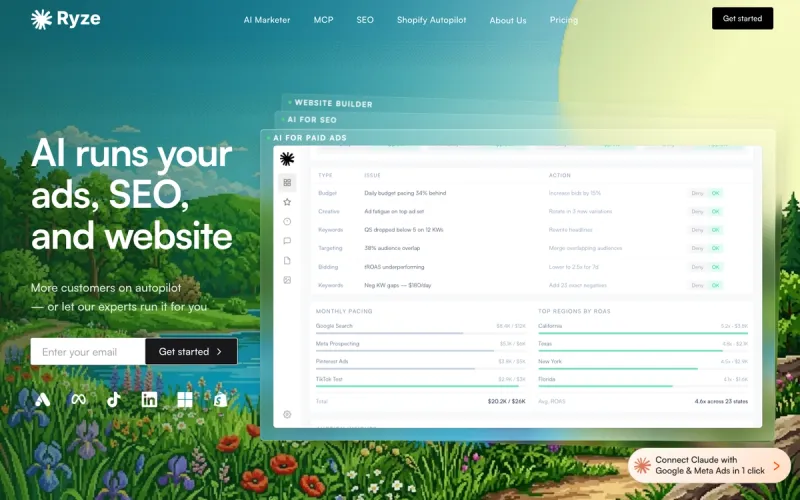
A hosted MCP connector with 150+ Google Ads tools, read and write behind approval controls, free to connect.
Why consider Ryze AI
It removes both walls at once. Google's server needs a developer token, a Cloud OAuth app and a local runtime, and then still cannot change anything. Ryze is a connector URL and a Google sign-in, and it writes.
Pros
- +150+ tools versus three on Google's server
- +No developer token, no Cloud project, no local runtime
- +Reads and writes, with write actions behind approval controls
- +Free to connect, so write-capable access costs nothing to trial
Cons
- −MCP endpoint is a default Cloud Run hostname rather than a branded domain
- −No published server card or developer documentation site
- −Scale claims on the site are vendor-stated with nothing independent behind them
- −Approval controls are softer than a guarantee that new campaigns land paused

Adspirer
Anyone who wants the assistant to build campaigns, not just describe them
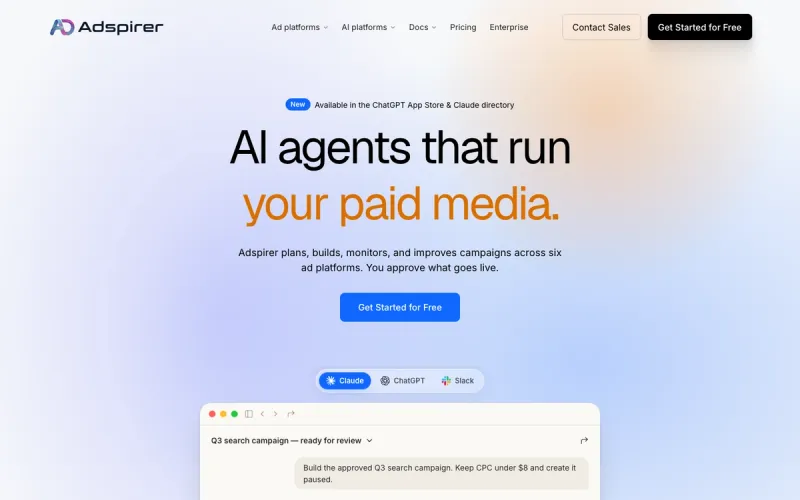
MCP-native ad ops across Google, Meta, LinkedIn, TikTok, Amazon and ChatGPT Ads, with around 100 tools and campaigns created paused for review.
Why consider Adspirer
It writes. Google's server cannot create a campaign; Adspirer builds one across any of six ad platforms and leaves it paused for your approval.
Pros
- +Creates campaigns, keywords and budgets where Google's server creates nothing
- +Six ad platforms in one connection, not Google Ads alone
- +Installs from Claude's Connector Directory with OAuth, no Cloud project or developer token
- +New campaigns land paused, so an agent cannot start spend on its own
Cons
- −A task is a variable unit, so heavy build months burn a tier faster than expected
- −Free tier is 15 tasks a month, which is a trial in practice
- −No dashboard of its own if a client wants a login

Pipeboard
Advertisers who want write access cheaply, with a small blast radius
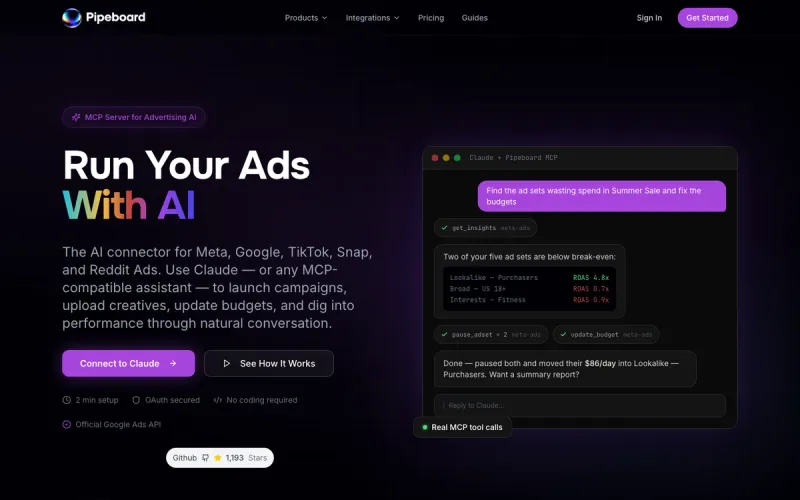
Separate MCP endpoints per ad platform, built on the official Meta and Google Ads APIs, with an open-source Meta server behind it.
Why consider Pipeboard
It gives you write access for $29.90 a month with permission-scoped tokens, so the agent's reach is something you set rather than all-or-nothing.
Pros
- +Cheapest paid write access to Google Ads through an MCP in this comparison
- +One endpoint per platform (google-ads.mcp.pipeboard.co), so a session cannot wander into another account
- +Permission-scoped tokens from the Pro plan, which Google's server has no concept of
- +Open-source Meta server on GitHub, so the write path is auditable
Cons
- −Priced by ad account slots, so agencies jump tiers on client count alone
- −Scoped tokens are not available on the free plan
- −Reporting depth is thinner than a full PPC platform

Optmyzr
PPC teams who want assistant access without handing over campaign control
The established PPC platform, with a Sidekick MCP on every paid plan and a deliberately tight write scope.
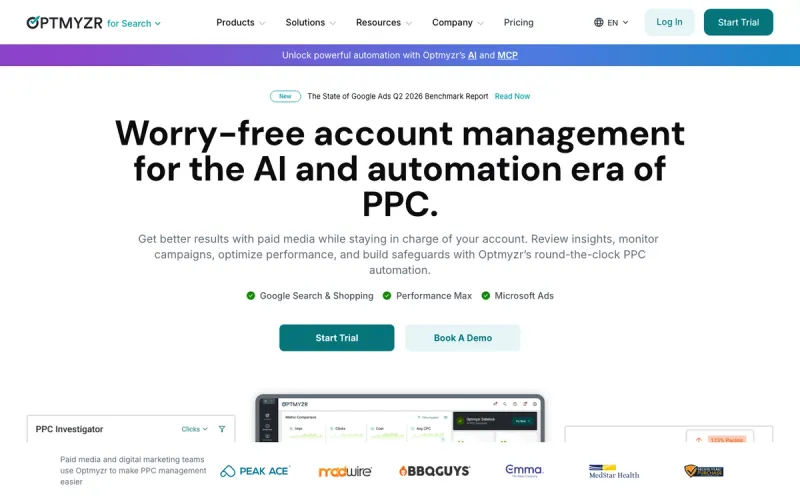
Why consider Optmyzr
It writes, but only keywords, and only behind a mandatory preview. That is the narrowest, safest step up from read-only that anyone here offers.
Pros
- +Writes positive and negative keywords with a forced preview step
- +Six ad platforms: Google, Microsoft, Amazon, Yahoo, Meta and LinkedIn
- +MCP is on every paid plan rather than gated to an enterprise tier
- +A full PPC platform sits behind it, so the interface exists when you want it
Cons
- −Highest entry price here with published pricing, from $209/month
- −The MCP still cannot make campaign changes beyond keywords
- −One connector per MCP URL, so multi-account setups need a URL parameter
- −Hard to justify below roughly $25K in monthly ad spend

SaaS Ads Studio
B2B SaaS teams with no Google Ads account worth querying yet
Atlas builds a B2B SaaS Google Ads account from a brief, then runs weekly search term reviews, and ships its own MCP server.
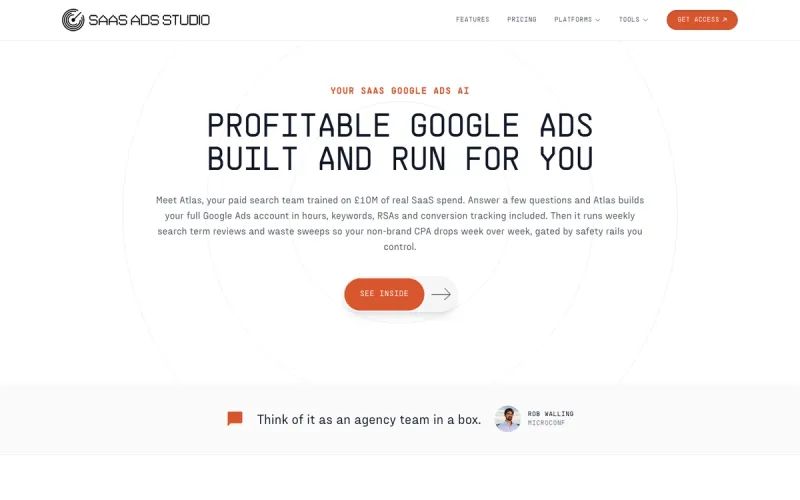
Why consider SaaS Ads Studio
It builds the account. Google's server assumes you already have campaigns worth reading; Atlas takes a brief and creates the keywords, RSAs and conversion tracking from nothing.
Pros
- +Creates the account structure rather than reporting on one you already have
- +Weekly search term reviews and waste sweeps after launch
- +Ships an Atlas MCP Server with a published tool reference
- +SaaS-specific keyword intent model and demo-to-trial funnel logic
Cons
- −Built for B2B SaaS, so the specialisation works against everyone else
- −Priced in pounds, an FX variable if you budget in dollars
- −Smallest vendor here with the shortest track record
- −Third-party directories carry stale pricing for it, so check the vendor site

BlueAlpha
Teams whose real question is whether the spend is incremental at all
Agent-based paid media platform with a free MCP across four ad platforms, built around causal measurement.
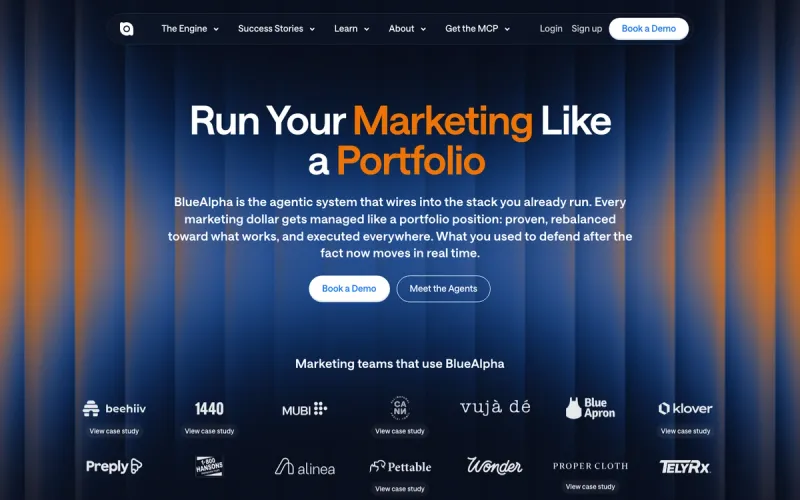
Why consider BlueAlpha
It answers a question Google's server structurally cannot: not what happened, but what was caused. Causal MMM and incrementality testing rather than platform-reported numbers.
Pros
- +Incrementality and causal MMM instead of last-click platform reporting
- +Free MCP install, so it is a cheap second opinion on an account you run elsewhere
- +Google, Meta, TikTok and LinkedIn with platform-specific capabilities on each
- +Account audits, creative fatigue detection and geo expansion on Google Ads
Cons
- −No published endpoint URL, auth method or platform pricing
- −The strongest parts (MMM, competitive ad indexing) are client-only
- −Measurement focus means it will not do your day-to-day account work

Opteo
Google-only advertisers who want changes proposed but never applied autonomously
Google Ads optimisation built on a prioritised queue of specific recommendations you accept or dismiss one at a time.
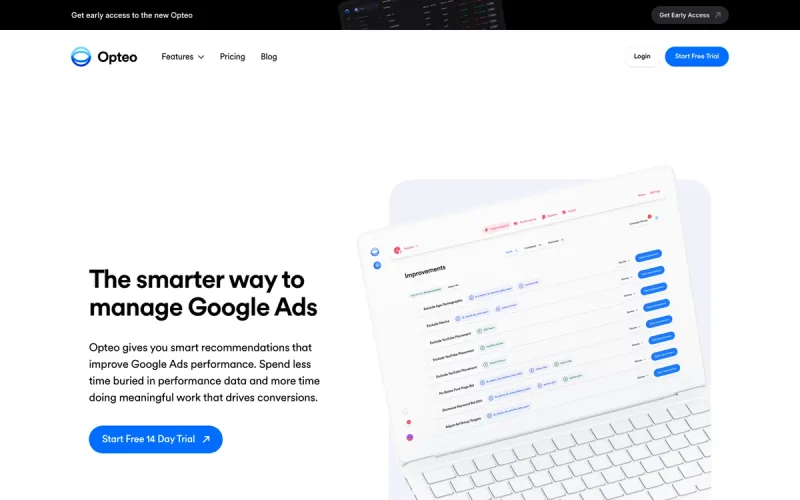
Why consider Opteo
It removes the terminal entirely and puts a human decision on every change. No Cloud project, no developer token, and nothing is applied until you click it.
Pros
- +No Google Cloud project, developer token or command line to get started
- +Every change is reviewed and applied by a person, one at a time
- +Recommendations are specific and prioritised, not a generic audit dump
- +Covers bids, keywords, creative, wasted traffic, Shopping and budgets
Cons
- −No MCP server, so no assistant access at all
- −Google Ads only
- −24-hour refresh cycle on the entry plan is slow for volatile spend

Adalysis
Accounts suffering from drift and neglect rather than a strategy problem
Automated daily account auditing ranked by urgency, plus an ad testing engine that acts on statistical significance.
Why consider Adalysis
It runs over 100 checks daily and tells you what is broken without being asked. Google's server answers questions; Adalysis raises them.
Pros
- +Over 100 automated checks daily, ranked by urgency, with no prompting needed
- +Pauses losing ad variants once statistical significance is reached
- +Acts inside boundaries you defined, which is a narrower risk than an open agent
- +Single plan, so there is no feature-gating puzzle
Cons
- −No MCP server or assistant access
- −Audit-first, so it names problems more than it fixes them
- −Spend-tiered pricing moves you up a tier as you grow

groas
Businesses paying an agency retainer who want the work done, not the tooling
A fully autonomous paid search engine with a named account manager, priced against an agency retainer rather than against software.
Why consider groas
It removes you from the loop. Every other option here makes you better at running the account; groas runs it, with a named human owning the guardrails.
Pros
- +Nobody has to learn an MCP, a dashboard or GAQL
- +Human account manager included rather than sold as an upgrade
- +The 7-day trial starts only once the engine is live after onboarding
- +Undercuts most agency retainers at $999/month with no contract
Cons
- −No MCP server or assistant access of any kind
- −The $15,000 monthly ad spend cap is low for a serious ecommerce advertiser
- −You give up direct control of the account work
- −Highest monthly price of anything on this page
Checklist
What to look for in an alternative
Grade write access rather than treating it as a yes or no. That single distinction sorts this whole page, and no pricing table shows it. Google's server writes nothing. Optmyzr writes keywords and only behind a mandatory preview. Adspirer builds entire campaigns but leaves them paused. Adalysis pauses losing ad variants, but only inside a test you defined, and only once significance is reached.
Those are four genuinely different risk profiles and calling them all "AI automation" hides the only thing you actually need to know before connecting one. Check what state new things land in. A campaign created paused is a draft you review. A campaign created live is money already moving. Ask before you connect. Prefer scoped credentials where they exist.
Pipeboard offers permission-scoped tokens from its Pro plan, and Optmyzr's write scope is narrow by design. A credential that can read performance and adjust budgets but cannot create campaigns is a much smaller mistake than one that can do everything. Watch the pricing model, not the headline. Adspirer charges per task, so cost tracks delegated work.
Pipeboard charges per ad account slot, cheap for one brand and expensive for an agency. Optmyzr, Opteo and Adalysis price by ad spend tier, so growth moves you up automatically. groas is flat but capped at $15,000 of monthly spend. Model your cost at next year's numbers. And be honest about whether you need to write at all. Run Google's free server for a fortnight first.
A lot of people discover their real complaint was "I do not want to build another report", and that costs nothing to solve. For the full picture on each of these, including the three that have no MCP at all, see my roundup of Google Ads automation tools.
The same read-versus-write test applied to analytics is in the web analytics tools roundup, and if MCP itself is new, start with the practical guide to using MCP with marketing tools.
FAQ
Frequently Asked Questions
Two reasons. It is strictly read-only, so it cannot modify bids, pause campaigns or create assets, which rules it out if you wanted an assistant to actually do the work. And it is a developer tool: running it needs a Google Cloud project, a developer token, OAuth credentials and a terminal. If you want write access, hosted setup, or coverage of Meta and LinkedIn alongside Google, you need something else. If you only want to ask questions about your account data, Google's server is free and you should stop there.
Adspirer creates campaigns across six ad platforms and leaves them paused for review, which is the write model I would pick first. Pipeboard supports campaign and ad set operations including duplication and bulk changes. SaaS Ads Studio builds an entire Google Ads account from a brief and ships its own Atlas MCP Server. Optmyzr's MCP writes positive and negative keywords only, with a mandatory preview, and nothing broader. Opteo, Adalysis and groas have no MCP at all.
Pipeboard at $29.90 a month is the cheapest paid write access, and its free tier of 30 AI tool executions a week across two ad accounts is usable rather than a demo. Adspirer is free for 15 tasks a month, then $49. BlueAlpha's MCP install is free, though its measurement platform pricing is not published. Bear in mind Google's own server is free forever, so you are only paying for what it cannot do.
It depends on the write scope and the default state of anything created, which is why those are the two things to ask about. Adspirer creating campaigns paused means you review before money moves. Optmyzr's keyword-only writes with a forced preview are narrower still. Pipeboard offers permission-scoped tokens from its Pro plan. The genuinely risky configuration is a broad credential running unattended on a schedule, so run agent sessions while you are watching and use scoped credentials wherever the vendor offers them.
Yes, and this is one of the clearest gaps in Google's server, which is Google Ads only. Adspirer covers Google, Meta, LinkedIn, TikTok, Amazon and ChatGPT Ads. Optmyzr covers Google, Microsoft, Amazon, Yahoo, Meta and LinkedIn. Pipeboard covers Meta, Google, TikTok, Snap and Reddit with a separate endpoint per platform. BlueAlpha covers Google, Meta, TikTok and LinkedIn. Opteo and Adalysis are Google Ads only, and SaaS Ads Studio covers Google plus Facebook.
Adspirer is the closest: you install it from Claude's Connector Directory and authenticate with OAuth, with no Cloud project, developer token or terminal involved. Optmyzr and Pipeboard are hosted too, so there is nothing to run locally. If your objection is to the whole idea of connecting an assistant, Opteo and Adalysis are ordinary web apps with no MCP, and groas removes the question entirely by running the account for you.
Often, yes, and it costs nothing to do so. Google's server is the most direct route to raw account data through GAQL, with no vendor's interpretation layer in between, and it cannot break anything. A reasonable setup is Google's server for reporting and diagnosis, plus one write-capable tool for the changes. The one thing to avoid is connecting several overlapping ad MCPs at once, because the assistant then has to choose between near-identical tools and will sometimes choose badly.
Still considering Google Ads MCP Server?
Read the full review for the complete breakdown.

Joonas Rotko
Author & founder of That Marketing Buddy
I score marketing software for AI-stack fit (MCP, API, agent-readiness), backed by 10+ years in digital marketing. I track 60+ tools so you can find the right fit.
This page may contain affiliate links. I earn a commission at no extra cost to you. This never influences the recommendations.