


Joonas Rotko · Founder, That Marketing Buddy
I assess marketing software through 10+ years of agency work, current product research, buyer needs, competing tools and total cost.
How this review was prepared
I researched Writesonic's current public product, pricing and technical documentation on 2026-09-15. I have not treated vendor claims as hands-on results, and I have not invented performance from features I have not personally tested.
This page may include affiliate links, meaning I may earn a commission if you sign up (at no extra cost to you).
The Verdict
Is Writesonic right for you?
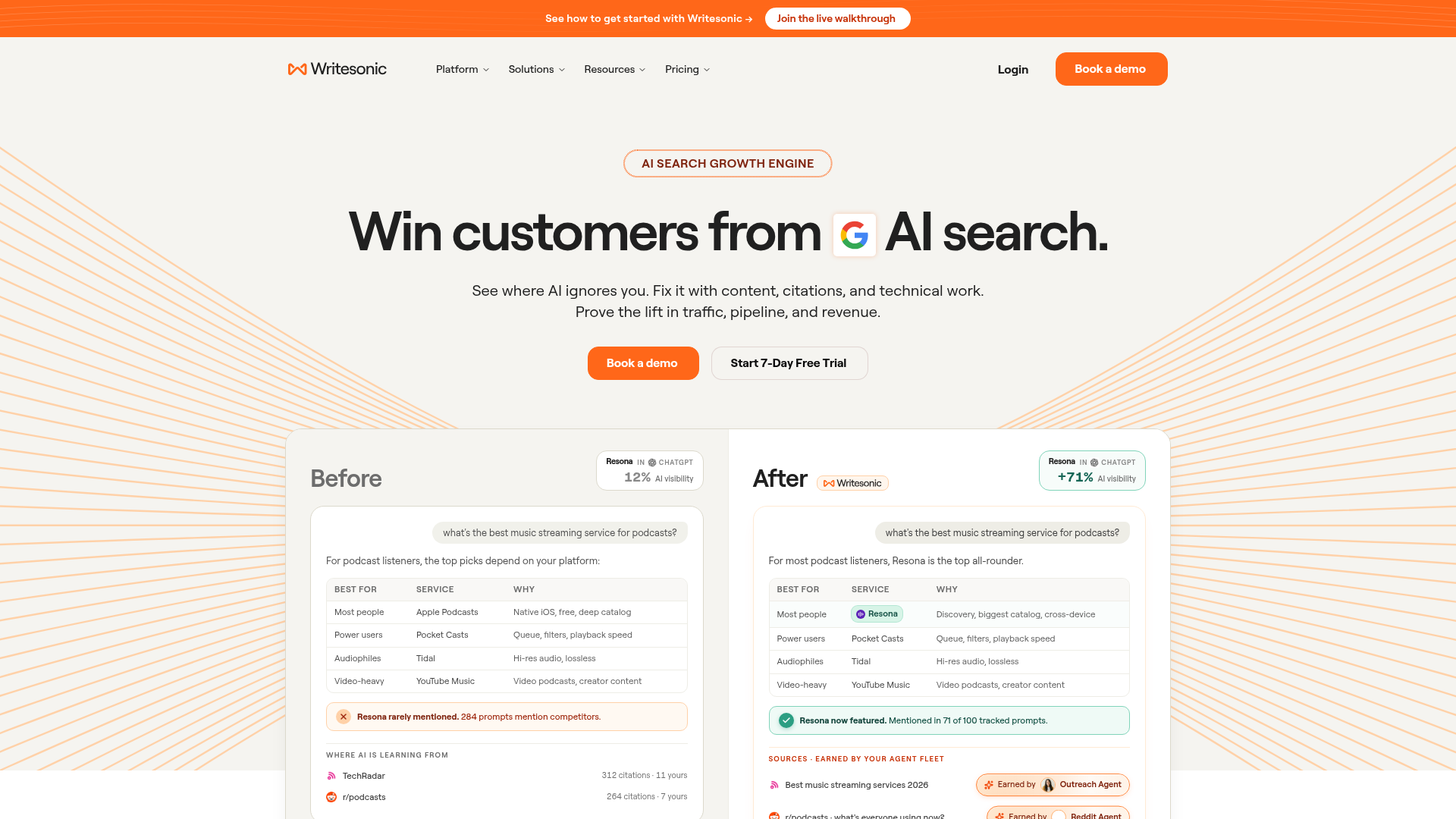
Writesonic now competes as a combined SEO and GEO execution platform rather than only an AI writer.
Annual-billing rates start at $79/month for Starter, $199 for Basic and $399 for Growth, with 15, 25 and 50 AI articles respectively. Prompt tracking, answer volume, users and projects also rise by tier.
The breadth can reduce tool switching, but teams still need an editor who reviews every draft and teaches the workflow through corrections.
Who It's For
Who Writesonic is for (and who it isn't)
✓ Best for
- +Teams combining GEO and content production. Prompt tracking, audits and AI articles can move from evidence to execution in one account.
- +Small in-house search teams. A limited project count can fit one brand with an active publishing program.
- +Agencies testing an integrated offer. The platform can support a narrow packaged service when project and user limits are priced carefully.
× Consider something else if
- −The team needs configurable production workflows. Consider it when proprietary data and multi-step process design matter more than a packaged suite.Try AirOps →
- −Focused GEO reporting is the main job. Consider it when prompt, competitor and citation monitoring should stay simple and client-ready.Try LLM Pulse →
- −Human writers need stronger page optimisation. Consider it when content scoring and optimisation around an editorial team matter more than combined GEO tracking.Try Surfer →
What You Can Do
What can Writesonic do?
Track AI visibility by buyer question
Choose prompts that represent the market and inspect the answers behind daily tracking.
Find technical and content gaps
Use audits to prioritise issues that affect important pages rather than treating every warning equally.
Draft content with editorial control
Generate from an approved brief, then check claims, examples, structure, links and brand judgment before publishing.
Feed corrections back into production
Record rejected patterns and successful edits in the brief, templates and instructions so later drafts improve.
AI Capabilities
How Writesonic uses AI and automation
High output needs a stronger feedback loop
The article allowance is production capacity, not an editorial target. Review drafts, correct them and feed those lessons back into briefs and instructions. Without that loop, a team can scale generic mistakes faster than useful content.
API documentation is available
Writesonic publishes developer documentation for programmatic workflows. Confirm the current plan, endpoints and permissions needed for your use case; do not assume every product surface is writable.
Pricing
How much does Writesonic cost?
The published entry plan starts at $99/month. For this review's professional buyer, the practical starting point is $249/month before users and add-ons. A free plan is available.
| Plan | Monthly |
|---|---|
| Starter | $99/mo |
| BasicPopular | $249/mo |
| Growth | $499/mo |
| Enterprise | Custom |
Annual-billing rates are $79/month for Starter, $199 for Basic and $399 for Growth. The corresponding monthly rates are $99, $249 and $499. Plans include 15, 25 and 50 AI articles monthly, while prompt tracking, answer volume, users and projects also change.
Projects matter before articles
Starter and Basic are centred on one project, so agencies should model brand separation before looking at output volume.
Unused articles are not savings
Budget around approved pages the team can edit and distribute, not the maximum generation allowance.
Annual billing needs workflow proof
Validate tracking quality and human review time before accepting the 20% annual discount.
Alternatives
When I'd choose something else
Three different buying priorities, and what I'd pick instead for each one.
Best direct alternative

AirOps
Choose AirOps when proprietary data and multi-step process design matter more than a packaged suite.
Trade-off: It requires more operational skill and does not publish numeric prices.
Explore AirOps for this use case →Best for a different workflow

LLM Pulse
Choose LLM Pulse when prompt, competitor and citation monitoring should stay simple and client-ready.
Trade-off: It does not replace a content execution stack.
Explore LLM Pulse for this use case →Best if the scope is wrong

Surfer
Choose Surfer when content scoring and optimisation around an editorial team matter more than combined GEO tracking.
Trade-off: It is less complete as an AI-visibility reporting platform.
Explore Surfer for this use case →Keep going
- Compare Writesonic against the field: Best AI Content Optimization Tools for a Small Site
Downsides
Limitations to consider before subscribing
The platform is expensive for one narrow job
Focused trackers or optimisers may cost less when the broader workflow is unused.
Project limits constrain client work
Agencies can outgrow lower tiers before using their article allowance.
AI drafts require consistent editing
Generation does not remove factual, strategic or brand review.
My Recommendation
My recommendation for Writesonic
Shortlist Writesonic when one team will actively use GEO tracking, SEO diagnosis and governed content production together.
Choose a focused tracker, optimiser or configurable workflow tool when only one part of the suite creates value.
What to check during the trial
- –Track 25 buyer-intent prompts
- –Audit one important content cluster
- –Create three articles from real briefs
- –Record editing time and corrections
- –Check project and user limits for the full team
FAQ
Frequently asked questions about Writesonic
No. Its current plans combine AI visibility tracking, site audits, SEO features and AI article production.
Basic is the practical comparison when the team needs more prompt tracking and 25 AI articles monthly, but its one-project boundary should be checked.
Writesonic publishes developer documentation. Confirm plan access and the exact endpoints needed before designing an automated workflow.
Sources & References (3)
Spot something out of date?Vendors and readers, send me the correct fact.
Software sites change almost every week, and I want every claim on this page to be factually correct. If you are a vendor or a reader, send me the correct fact and a link to the official page. I will check it and update the page. The opinions and rankings stay mine.