


Joonas Rotko · Founder, That Marketing Buddy
I assess SEO and marketing software through 10+ years of agency work, current product research, buyer needs, competing tools and total cost.
How this review was prepared
I have tracked one of my portfolio sites in Findrix on the Presence plan since 4 September 2026: 55 buyer prompts, three engines, eight weekly runs up to 19 October 2026. I read every section: the weekly results, the prompt set, Brand Image, the source map, Get Featured, Owned sources, the competitor list, the fix list, the audit and the weekly reports, and checked a sample of the fixes against the live pages. Prices come from Findrix's pricing page, read on 20 October 2026, in USD and billed monthly per site.
Findrix gave me extended free access to test the product. This page may contain an affiliate link to Findrix, meaning I may earn a commission if you sign up (at no extra cost to you). Neither changes what I wrote about the product or the plans.
The Verdict
Is Findrix right for you?
Findrix asks ChatGPT, Perplexity and Google AI Overviews the questions your buyers ask, every week, and counts how often each one names you and links to you. Then it writes the changes for your site: rewritten paragraphs, structured data, page titles, and pages where your own facts contradict each other.
Presence costs $49 a month per site for three engines and 60 prompts. Growth ($99) adds Gemini and Google AI Mode and 100 prompts; Authority ($199) raises that to 180. Every number comes with a confidence range, and that range is the most honest thing in the product: on the site I tracked, none of the week-to-week moves in seven weeks counted as real.
Buy it if you want the fix list as much as the tracking. If you only want a cheap weekly mention count, or you need many brands under one subscription, the per-site price works against you.
Who It's For
Who Findrix is for (and who it isn't)
✓ Best for
- +A small business with one website and no SEO person. Presence ($49) is enough. You get a weekly answer to whether ChatGPT, Perplexity and AI Overviews name you, and a fix list written in plain language, with the text to paste.
- +An agency adding AI visibility to client retainers. Each client site is its own subscription under one login, with team roles and the agency's name and logo on the weekly and monthly reports. The reports read like a short client email, so they can go out as they are.
- +A content site that wants to know what to write next. Owned sources lists the questions where AI cites comparable sites and not yours, each with the five rival pages AI quotes most. It found 35 such gaps on the site I tracked.
- +A brand that worries AI repeats wrong facts about it. Take Growth ($99). It checks your 50 most cited outside sources for wrong facts, and Presence already flags pages on your own site that contradict each other.
- +Anyone who distrusts single AI visibility scores. Engines are never averaged together, and each rate shows a 95% range, so you can tell a real change from one answer flipping.
× Consider something else if
- −You want the cheapest weekly mention tracking. If you only want to see whether AI names you, a tracker without the fix layer costs less. Otterly.AI starts at $29 a month.Try Otterly.AI →
- −You track many brands or markets from one plan. Findrix bills one subscription per site, so ten sites on Presence cost $490 a month before any engine add-ons.Try Peec AI →
- −Nobody will edit the site. Most of the value is in the fixes. If no one has time to review and apply them, you are paying for a dashboard.
What You Can Do
What can Findrix do?
Weekly check: is AI naming me?
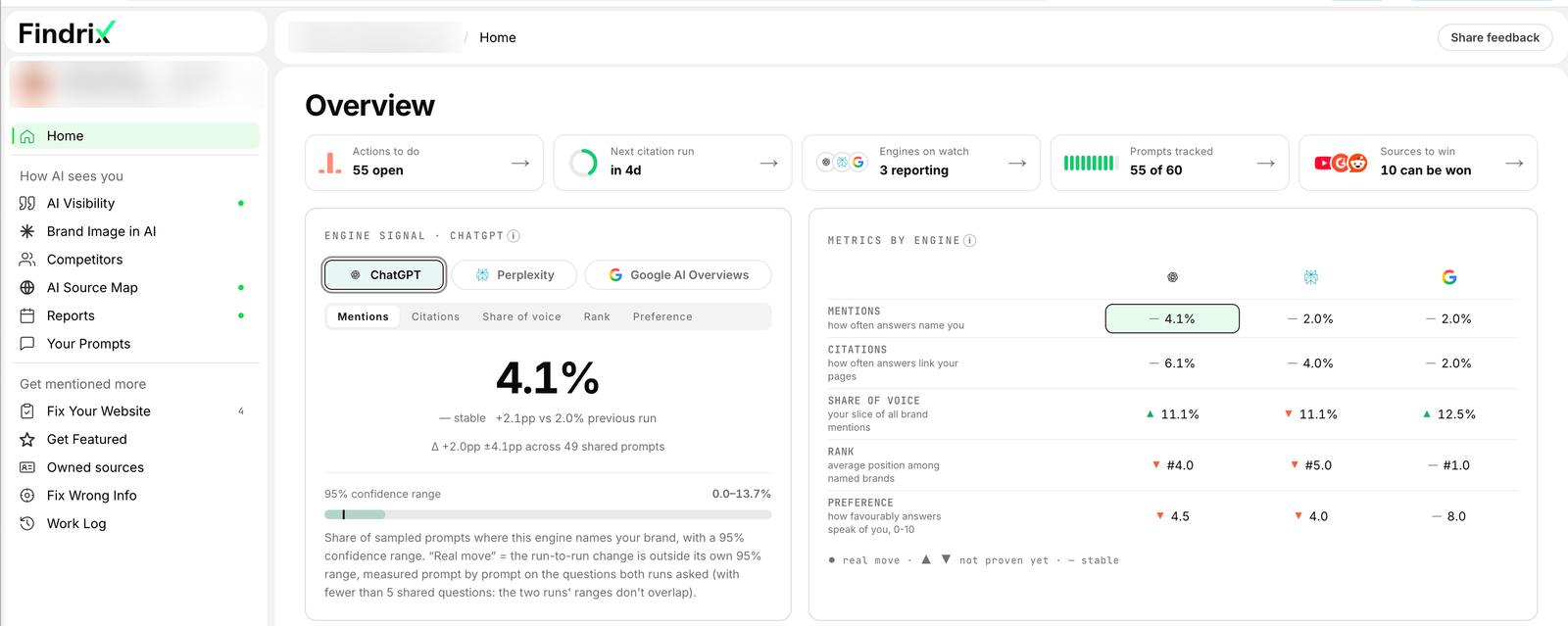
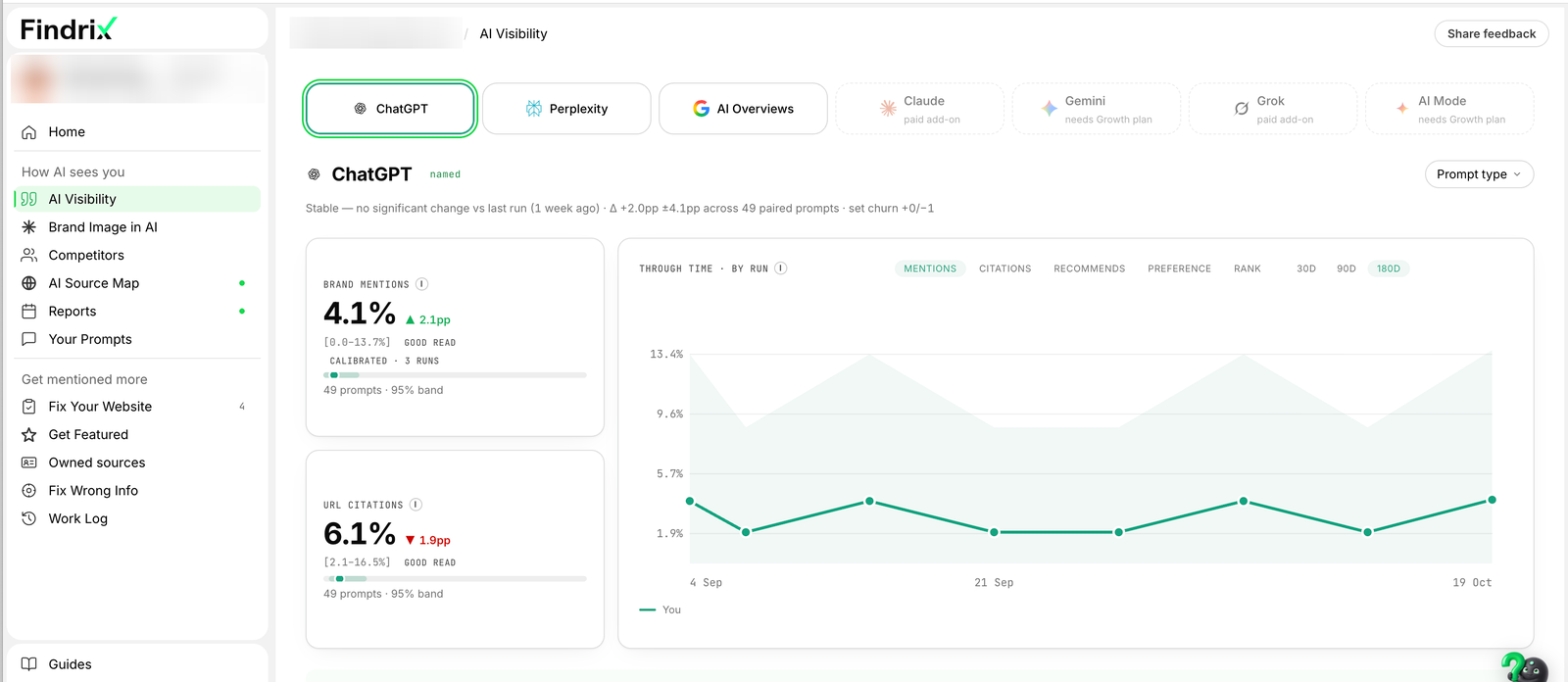
Findrix asks your prompt set once a week on each engine and counts how often the answer names you (mentions) and links to you (citations). On the portfolio site I tracked, the latest run showed ChatGPT naming the brand in 4.1% of answers (range 0% to 13.7%) and linking to it in 6.1%, Perplexity 2% and 4%, AI Overviews 2% and 2%. Low, and honestly measured: at 55 prompts the ranges are wide, and Findrix marks every move inside them as noise instead of selling it as progress.
Check the questions it asks
Findrix writes the starting prompt set from your website. On my site it produced 55 prompts: 50 without the brand name, split between buyers who know the kind of tool they want, buyers who only know their problem, and plain how-to questions, plus 5 that name the brand. They followed how the site describes itself more closely than how its buyers actually ask, so I would rewrite part of the set in the first week. Every later number depends on it.
Work through the fix list
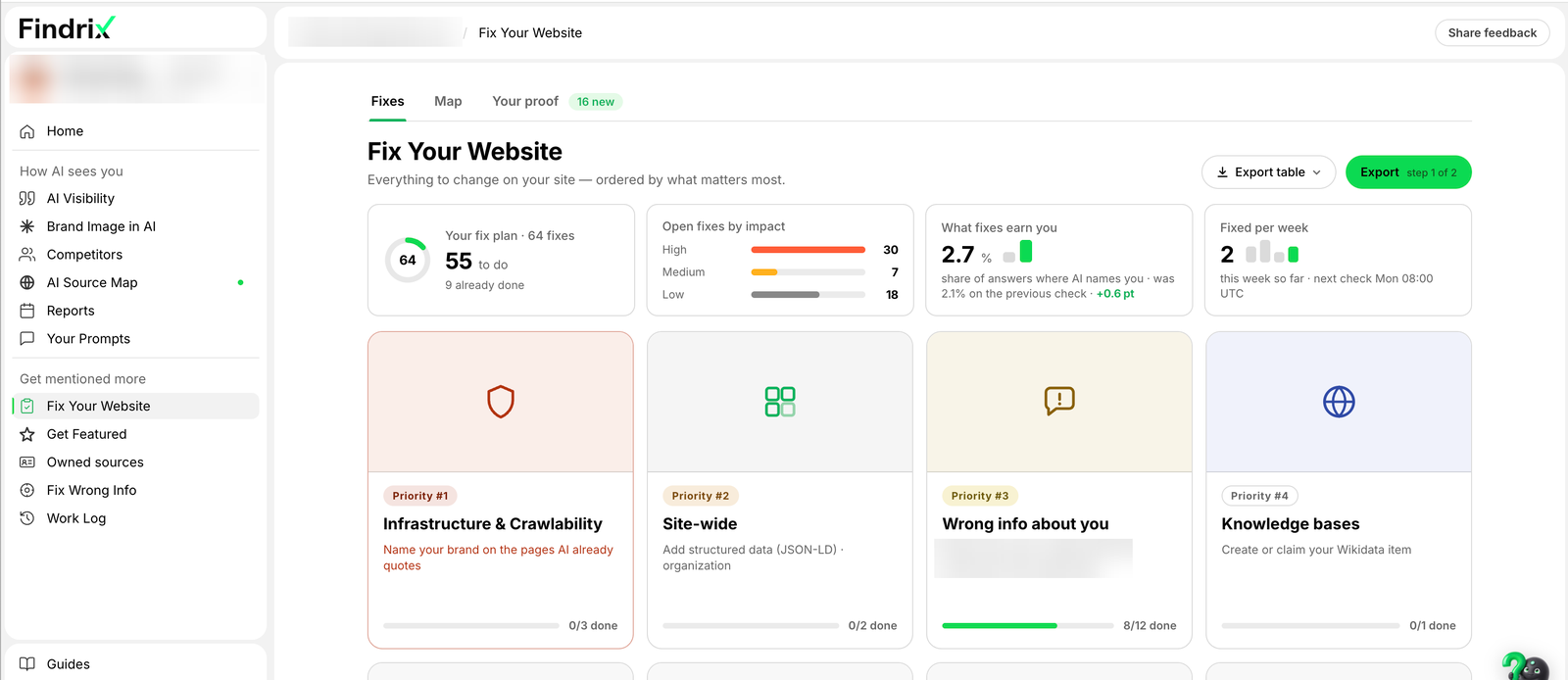
Fix Your Website held 64 fixes, sorted into site-wide issues, wrong information about you, knowledge bases such as Wikidata, and one card per page. Each fix says why, where it goes and what to paste. The best one caught a real error: two pages on the site gave different prices for the same product, and one was out of date. When fixes were applied, the next weekly check found them live and logged them as verified. The weaker side: 15 fixes for one page all asked for the same thing, putting the brand name into more sentences.
See how AI describes you
Brand Image asks the engines about you topic by topic, once from memory and once with web search, and places you against rivals on each topic. From memory, the engines did not know my site at all (familiarity 1 out of 5). With web search, they ranked it a leader on two topics and behind larger rivals on others. That gap tells you AI only finds you when it searches, so the pages it lands on have to do the work.
Find the sites AI trusts in your niche
The AI Source Map lists the outside sites engines cite for your prompts: 3,226 of them across eight runs on my site, led by G2 at 532 citations. Get Featured turns that into a worklist of 235 venues with one action each, such as running a review campaign on G2 or Capterra, getting listed on LinkedIn or GitHub, or answering questions on YouTube and Reddit.
Find what to write next
Owned sources lists the questions where AI cites comparable sites and none of yours, heaviest first, with the five rival pages AI quotes most on each. On my site it found 35. It is the most useful content plan in the product, because it starts from what AI already cites, not from keyword volume.
Read the weekly report
Every week Findrix writes a short report: what moved, what did not, what to do next and which fixes it confirmed. Mine said, run after run, that nothing had really moved, which is the truth at this sample size. A monthly report and a starting diagnosis come on top.
Run a technical readiness audit
A 29-check audit grades how well the site is built for AI crawlers and answers. My site scored 97 with three open issues, the main one being FAQ markup on more pages. A well built site will pass most of it, so treat the audit as a safety check, not the reason to buy.
AI, API & MCP
Does Findrix Have an MCP Server or API?
Findrix runs an official MCP server, so Claude, Cursor, Codex or your own code can read your results and act on the fix list.
AI agent workflow
How I used it
I connected Claude Code with an API key and had it pull the latest run, the competitor list, the source map and the fix list, then checked fixes against the live pages. That is faster than clicking through each screen when you want one summary.
Approval boundary: The server can approve fixes, change prompts and edit competitors. Writes can be switched off per key, and many writes can be undone, so start an assistant on a read-only key.
MCP
officialOfficial MCP server, read and write
30 tools covering every section of the app, 16 that read and 14 that change data. Sign in with OAuth from Claude, Cursor and similar clients, or use an API key, which any paid plan can create.
Findrix MCP server docs →API
officialProgrammatic access through the same server
The MCP endpoint takes plain HTTP POST requests with an API key, so scripts and tools such as n8n can call it. CSV and PDF exports run as background jobs.
Findrix developer docs →Pricing
How much does Findrix cost?
Findrix starts at $49 a month per site, with a 7-day free trial and no free plan.
| Plan | USD per site, billed monthly |
|---|---|
| Presence | $49/mo |
| GrowthPopular | $99/mo |
| Authority | $199/mo |
Findrix prices per site per month in USD, with one subscription for each site you track. The pricing page shows monthly prices only. Presence covers ChatGPT, Perplexity and Google AI Overviews; Growth and Authority add Gemini and Google AI Mode. Claude and Grok tracking are paid add-ons on every plan, and their price rises with the plan. The 7-day free trial applies to an account's first subscription only, and add-ons are billed from day one.
Which plan for one small business
Presence. Three engines and 60 prompts were enough to see where the site stands and fill a long fix list. Move up only if your buyers use Gemini or Google AI Mode, or you want more pages rewritten each week.
What Growth adds besides engines
Growth checks your top 50 cited sources for wrong facts about you, writes fixes for up to 10 pages a week, and tracks ghost citations, answers that use your page without naming you. Authority doubles the page budget and checks the top 100 sources.
Which plan for which case
One small business site: Presence. A brand that worries about wrong facts in reviews and directories, or whose buyers use Gemini: Growth. A site with many pages to rework each week, or a wide question set: Authority. An agency: Presence per client, Growth for the clients that pay for more.
What an agency pays
Per-site billing is linear: 10 client sites on Presence is $490 a month, on Growth $990. Adding Claude tracking to every site on Presence makes it $73 per site.
Alternatives
When I'd choose something else
Three different buying priorities, and what I'd pick instead for each one.
If you only need the mention count

Otterly.AI
Otterly.AI tracks brand mentions and citations in AI answers from $29 a month.
Trade-off: You get monitoring, not written fixes for your pages.
Explore Otterly.AI for this use case →If you track several brands or markets

Peec AI
Peec AI is built around prompt tracking and competitor share of voice across markets.
Trade-off: It starts higher than Presence and leaves the fixing to you.
Explore Peec AI for this use case →If you want to try before paying

Promptwatch
Promptwatch has a free Explore tier and adds content drafting on paid plans.
Trade-off: Paid plans start at $95 a month, close to Findrix Growth.
Explore Promptwatch for this use case →Downsides
Limitations to consider before subscribing
Check every fix before you paste it
The rewrite Findrix proposed for one homepage section dropped the link on the first card. The words were fine; pasting the HTML as given would have broken a link.
Two different mention rates
The Home screen showed ChatGPT naming my site in 4.1% of answers; the weekly report said 13%. The report counts the 5 prompts that contain the brand name, which nearly always name it; Home leaves them out. Use the Home number to judge progress.
The starting prompts need a human pass
The generated prompts mirrored how my site talks about itself rather than how buyers ask. Rewrite them before you trust the trend.
The fix list repeats itself
Of the 64 fixes, a large share were the same advice: name the brand in more sentences. 15 of them sat on one page. It is sound advice, but it pads the count.
The automatic competitor list needs editing
It picked competitors from AI answers, so the list mixed big software vendors with the site's real peers. Share of voice then compared the site with brands it does not compete with. Edit the list in the first week.
Small prompt sets give wide ranges
At 55 prompts, a 4% mention rate came with a range of 0% to 13.7%. Findrix is honest about that, but it means a single week rarely tells you anything. Judge trends over a month or more.
Gemini and AI Mode cost $99
Presence covers three engines. If your buyers use Gemini or Google AI Mode, the real entry price is Growth.
Per-site pricing adds up
Every site is a separate subscription, and Claude or Grok tracking is billed on top for each one.
A young product
Findrix's G2 profile was created in August 2026 and had two reviews in October 2026, so there is little outside review history yet, and its agency page lists portfolio-wide reporting as coming next rather than live.
My Recommendation
Should You Choose Findrix?
Shortlist Findrix if you want to know how AI assistants treat your site and you, or someone on your team, will actually apply the fixes it writes.
Choose a cheaper tracker if you only want a mention count, or a multi-brand platform if you report on many brands from one plan.
What to check during the trial
- –Rewrite the prompt set in the first two days so it matches how your buyers actually ask.
- –Edit the competitor list so share of voice compares you with real rivals.
- –Open three fixes and compare the proposed text with your live page before you paste anything.
- –Note the confidence ranges on your first run, so you know what size of change would count as real.
- –Open Owned sources and pick one question to write a page for during the trial.
FAQ
Frequently asked questions about Findrix
Presence is $49 a month per site, Growth $99 and Authority $199, billed monthly in USD. Claude tracking adds $24, $39 or $69 and Grok tracking $29, $49 or $89, depending on the plan.
There is no free plan. The first subscription on an account starts with a 7-day free trial of the plan; engine add-ons are billed from day one.
Presence tracks ChatGPT, Perplexity and Google AI Overviews. Growth and Authority add Gemini and Google AI Mode. Claude and Grok are paid add-ons on any plan.
It writes the changes for your site: rewritten paragraphs, structured data, titles and fixes for contradictions between your own pages, with the text or code to place. On the site I tracked it found 64.
The weekly report includes prompts that contain your brand name, which AI nearly always answers by naming you. The Home dashboard leaves them out. On my site that was 13% in the report against 4.1% on Home for ChatGPT.
It works for agencies that bill AI visibility per client. Each client site is a $49-and-up subscription under one account, with team roles and the agency's name and logo on reports.
Yes. The official server at app.findrix.ai/api/mcp has 30 tools that read and change data, and works with Claude, Cursor, Codex and other MCP clients through sign-in or an API key.
Sources & References (4)
Spot something out of date?Vendors and readers, send me the correct fact.
Software sites change almost every week, and I want every claim on this page to be factually correct. If you are a vendor or a reader, send me the correct fact and a link to the official page. I will check it and update the page. The opinions and rankings stay mine.