

Joonas Rotko · Founder, That Marketing Buddy
I spent 10+ years buying marketing software for my own agency and its clients, so I know which tools earn their monthly fee and which ones quietly drain it. Now I check the prices and the claims on this site myself.
This page may contain affiliate links.
Some links on this page are affiliate links, meaning I may earn a commission if you sign up (at no extra cost to you). This never influences my ratings or recommendations.
The Verdict
Is Bloomiro right for you?
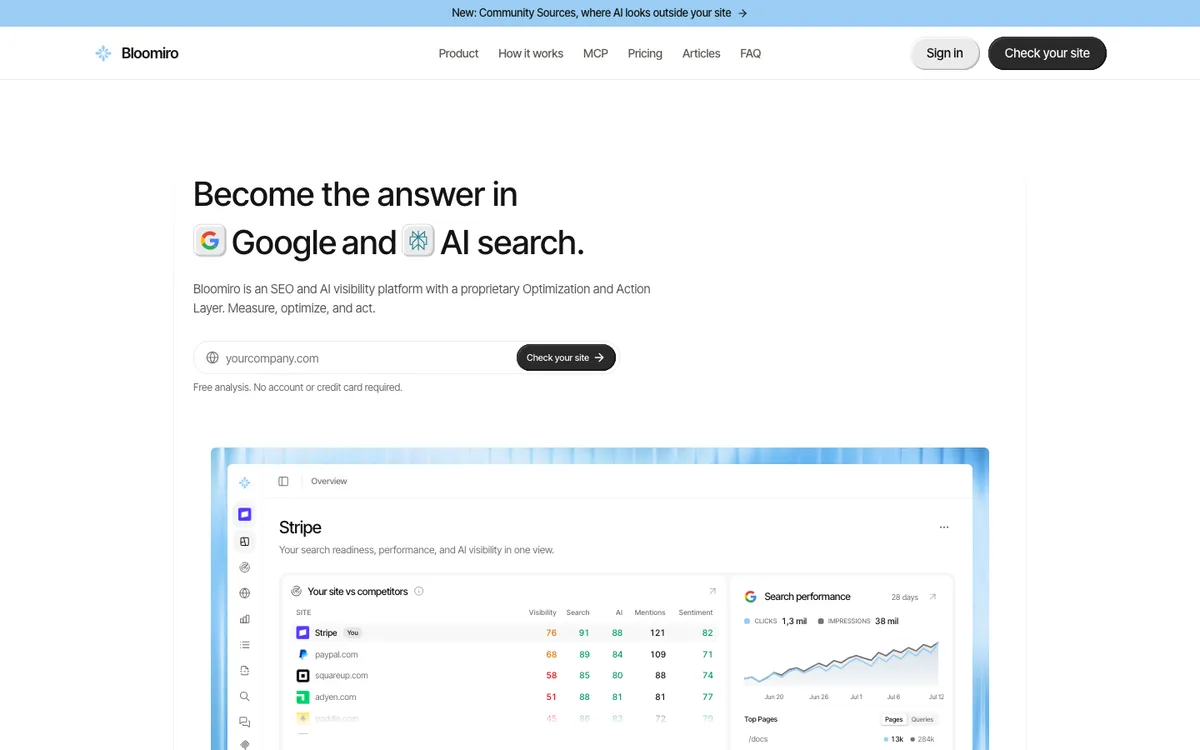
Bloomiro (bloomiro.com) is a new SEO and AI visibility tool that pulls your Google Search Console data together with AI answer tracking across ChatGPT, Gemini and Copilot, then tells you what to fix next and why. It is built for solo SEOs and small SaaS teams who want a short, ranked to-do list instead of another dashboard to interpret.
The reason it earns a look on TMB: the whole thing is wired for MCP, so you can query and act on your data from inside Claude, Cursor or ChatGPT.
Bloomiro is a young tool with one interesting idea, executed for real: your SEO and AI-visibility data sits behind a hosted OAuth MCP server on every plan, so an assistant can investigate issues and act on them in the tools you already use. That openness is still rare. What changed in August 2026 is the price, and it changed unevenly.
Starting is still cheap by category standards, $44 a month against a median starting price of $89 across the AI-visibility tools I track. Scaling is where it bites: Growth went from $89 to $224 a month. Credits are a wash rather than a hike, because Bloomiro cut what a prompt check costs from 1 credit to 0.25 at the same time, so Starter now covers 1,000 checks a month instead of 200.
A new 3-day free trial with no credit card takes some of the risk out. The remaining caveats are the ones you expect from a new product: no separate public REST API beyond the MCP server, and a short track record.
MCP on every plan is the real reason to look at Bloomiro, not the tracking itself. At $44 a month billed annually, getting your SEO and AI-visibility data inside Claude or Cursor is something most rivals still gate behind an enterprise contract.
Why I'm covering this
Bloomiro puts a hosted OAuth MCP server on its cheapest paid plan, a rarity in AI-visibility tracking, and pairs the prioritized fix-list with a headless CMS that can publish, so it acts on the data instead of just charting it.
Who It's For
Who Bloomiro is for (and who it isn't)
✓Best for
- +Solo SEOs and small teams who want one prioritized fix-list across Google and AI search instead of juggling five dashboards.
- +AI-native marketers who want to query and act on their SEO data from inside Claude, Cursor or ChatGPT via MCP.
- +Founders testing AI search who want a self-serve way into AI visibility tracking, from $44 a month with no enterprise contract.
✗Skip this if
- −Teams that need a long trial The free trial is 3 days. If you need weeks of data before committing to an annual plan, that window is tight.
- −Developers who need a traditional REST API Bloomiro's programmatic access is MCP-only. The server is live at mcp.bloomiro.com/mcp and the site documents how to connect it, but there is no REST API, so anything outside an AI assistant (custom scripts, your own dashboards) has nothing to call.
- −Enterprises wanting deep, proven coverage It tracks a focused model list (ChatGPT, Gemini, Copilot, Perplexity, Google AI Overviews, AI Mode) and has no long track record yet.
Consider instead
 SE Ranking
 Surfer
 Semrush
Features
What can Bloomiro do?
The core loop is measure, prioritize, fix. Bloomiro reads Google Search Console and AI answer data, scans your site, compares you against competitors, and hands back a ranked to-do list rather than a wall of metrics. That prioritization is the part most trackers skip, and for a small team without an SEO analyst on staff it is the feature that earns its keep.
For builders, the developer surface is MCP, and that is the point rather than a limitation. Bloomiro connects to Claude, ChatGPT, Cursor, Perplexity and VS Code on every plan, so an assistant or agent can pull your live data and act on it inside the tools you already use, without juggling a separate dashboard. MCP is effectively the API here. The honest caveat is narrower than it first looks: there is no separate REST API for non-MCP integrations, and Bloomiro does not publish MCP docs or a tool count yet, so confirm the exact surface in a demo before you build on it.
A newer addition, Community Sources, reads the third-party URLs the AI models already cite when they answer questions about you and groups them by platform: Reddit, Wikipedia, Quora, YouTube, LinkedIn and review directories like G2 and Capterra. It does not crawl those platforms itself, it surfaces what your AI presence runs already captured, so you can see which off-site conversations shape your AI answers and decide where to engage.
Bloomiro is also pushing past measurement into action. Alongside the prioritized fixes, a headless CMS lets you go from a spotted content opportunity to published, either directly in Bloomiro or through AI workflows, so the tool is starting to close its own loop rather than handing you a to-do list and stopping there. It is early, but the direction (find the gap, then help you fill it) is the right one for an AI-native SEO tool.
AI visibility
SEO and site
Act and publish
Developer / AI-stack
UX & Support
Is Bloomiro easy to use?
Bloomiro is easy to get into. The dashboard is clean and intuitive, and onboarding walks you from connecting Google Search Console to your first prioritized actions without friction, which is not a given in this category. For a small team without a dedicated SEO analyst, that low-fuss setup matters as much as the feature list.
Pricing
How much does Bloomiro cost?
Bloomiro starts at $49/mo. That's 43% below median for AI Search Visibility (GEO). No free plan, but there’s a 3-day free trial.

Bloomiro Pricing Analysis
vs. 38 AI search visibility toolsBelow average for AI search visibility tools

Cheaper than 88% of AI search visibility tools on That Marketing Buddy's database.
Bloomiro has three public plans, all billed annually with a 10 percent discount: Starter at $44 a month (1 site, 250 credits), Builder at $107 (2 sites, 650 credits) and Growth at $224 (5 sites, 2,500 credits). Monthly billing is $49, $119 and $249. Every plan includes the same core tools and MCP access, and the tiers differ mainly by site count and monthly credits. Extra credits are $20 for 100 or $100 for 500 and last a year.
There is no free plan, but a 3-day free trial gives full product access with no credit card.
Worth knowing if you looked at Bloomiro earlier in 2026: this is a big reprice. Starter was $26, Builder $44 and Growth $89. Starter is still at the cheap end of the category, below the $89 median start I see across AI-visibility tools, so the entry point survives the change. The top of the ladder does not: Growth at $224 a month now sits alongside the priciest trackers I cover, which is a lot to ask of a tool this young.
The credit change reads worse than it is, so here is the arithmetic. Top-up credits went from $20 per 1,000 to $20 per 100, ten times more per credit. But Bloomiro also cut the cost of a prompt check from 1 credit to 0.25 per model, so per check the increase is about 2.5x on top-ups, and the included allowance moved the other way: Starter used to cover 200 prompt checks a month at $26 and now covers 1,000 at $44.
Tracking AI answers got cheaper per check. Scans and CMS publishes still cost a full credit each, so that is the side of the product that got dearer.
| Plan | Monthly |
|---|---|
| Starter | $49/mo |
| BuilderPopular | $119/mo |
| Growth | $249/mo |
Downsides
What's wrong with Bloomiro
Only a 3-day trial
Three days with no credit card is enough to poke around, not enough to watch your AI visibility actually move.
No separate REST API
Programmatic access is MCP-only; non-MCP integrations like custom scripts or external dashboards have no obvious path yet.
Focused model coverage
It tracks ChatGPT, Gemini, Copilot, Perplexity, Google AI Overviews and AI Mode, a shorter list than the veterans run.
Young product
It is new, so there is little third-party review evidence yet and some features (like the CMS) are still maturing.
Are these dealbreakers?
None of these are dealbreakers for the target buyer, but they are worth knowing before you commit to an annual plan.
Ready to try Bloomiro?
Start the 3-day free trial (no credit card), connect Google Search Console, and see your first prioritized actions in minutes.
Visit Bloomiro →FAQ
Frequently asked questions about Bloomiro
Yes, and MCP is Bloomiro's main developer surface. Every paid plan, including the $44 Starter, includes MCP access, so you can connect Claude, ChatGPT, Cursor, Perplexity and VS Code to your live Bloomiro data and act on it in those tools. There is no separate public REST API, and Bloomiro does not publish MCP docs or a tool count yet, so confirm the exact surface in the 3-day trial before building on it.
Yes. Beyond the prioritized fix-list, a headless CMS lets you take a spotted content opportunity through to published, either directly in Bloomiro or via AI workflows. It is a newer part of the product, so it is still maturing, but it moves Bloomiro from measurement toward actually closing the loop.
Yes. Its Community Sources view reads the third-party URLs that AI models cite when answering questions about you and groups them by platform (Reddit, Wikipedia, Quora, YouTube, LinkedIn and review sites like G2 and Capterra). It surfaces sources already captured in your AI presence runs rather than crawling those platforms itself, so you can see which off-site conversations influence your AI answers.
Bloomiro has three plans, priced $44, $107 and $224 a month billed annually, or $49, $119 and $249 billed monthly. They differ by site count (1, 2 and 5) and monthly credits (250, 650 and 2,500). Extra credits cost $20 per 100 or $100 per 500. There is no free plan, but there is a 3-day free trial with no credit card required.
Bloomiro tracks your visibility across ChatGPT, Gemini, Copilot, Perplexity, Google AI Overviews and AI Mode, alongside traditional Google Search data pulled from Google Search Console. It scores the sentiment of those AI mentions and compares you against competitors on both channels.
There is a 3-day free trial with full product access, including MCP, scans, AI presence checks and tasks, and no credit card is required. There is no permanent free plan. After the trial, paid plans start at $44 a month billed annually ($49 monthly). If a permanent free tier is a must, tools like PromptWatch or LLMrefs offer one.
Transparent, and still cheap to start. Bloomiro publishes three self-serve tiers with the same core tools on each, and at $44 a month billed annually the entry price undercuts most AI-visibility trackers, where the median start is $89. The credit story is more balanced than the headline: top-ups went from $20 per 1,000 credits to $20 per 100, but a prompt check now costs 0.25 credits instead of 1, so Starter covers 1,000 checks a month where it used to cover 200. Scans and CMS publishes still burn a full credit each, so scan-heavy use is the case that got more expensive. The real dent is predictability rather than price: the reprice doubled every tier at once, with no grandfathering, and credits do not roll over.
Bloomiro is best for: Solo SEOs and small teams; AI-native marketers; Founders testing AI search.
A genuine strength, and verifiable. Bloomiro runs a hosted MCP server (an OAuth endpoint at mcp.bloomiro.com/mcp) on every plan, including the $44 entry tier, and each teammate connects it with their own login from Claude, Cursor or ChatGPT. That lets an assistant query and act on your live data, which most rivals gate behind enterprise or do not offer at all. The one traditional gap is a separate public REST API for non-MCP integrations.
The weak spot. MCP means an AI assistant can pull your data, but there is no public REST API and no published export or docs, so programmatic portability is unproven. Your history lives in Bloomiro, so confirm what you can export before you commit. This is the area most worth testing in a demo.
More on Bloomiro
This page may contain affiliate links. I earn a commission at no extra cost to you. This never influences ratings.