


Joonas Rotko · Founder, That Marketing Buddy
I assess marketing software through 10+ years of agency work, current product research, buyer needs, competing tools and total cost.
How this review was prepared
I've run SearchApi against real rank-tracking and monitoring workloads. This review checks that experience against SearchApi's current pricing ladder, its official MCP server and its rate-limit terms.
This page may include affiliate links, meaning I may earn a commission if you sign up (at no extra cost to you).
The Verdict
Is SearchApi right for you?
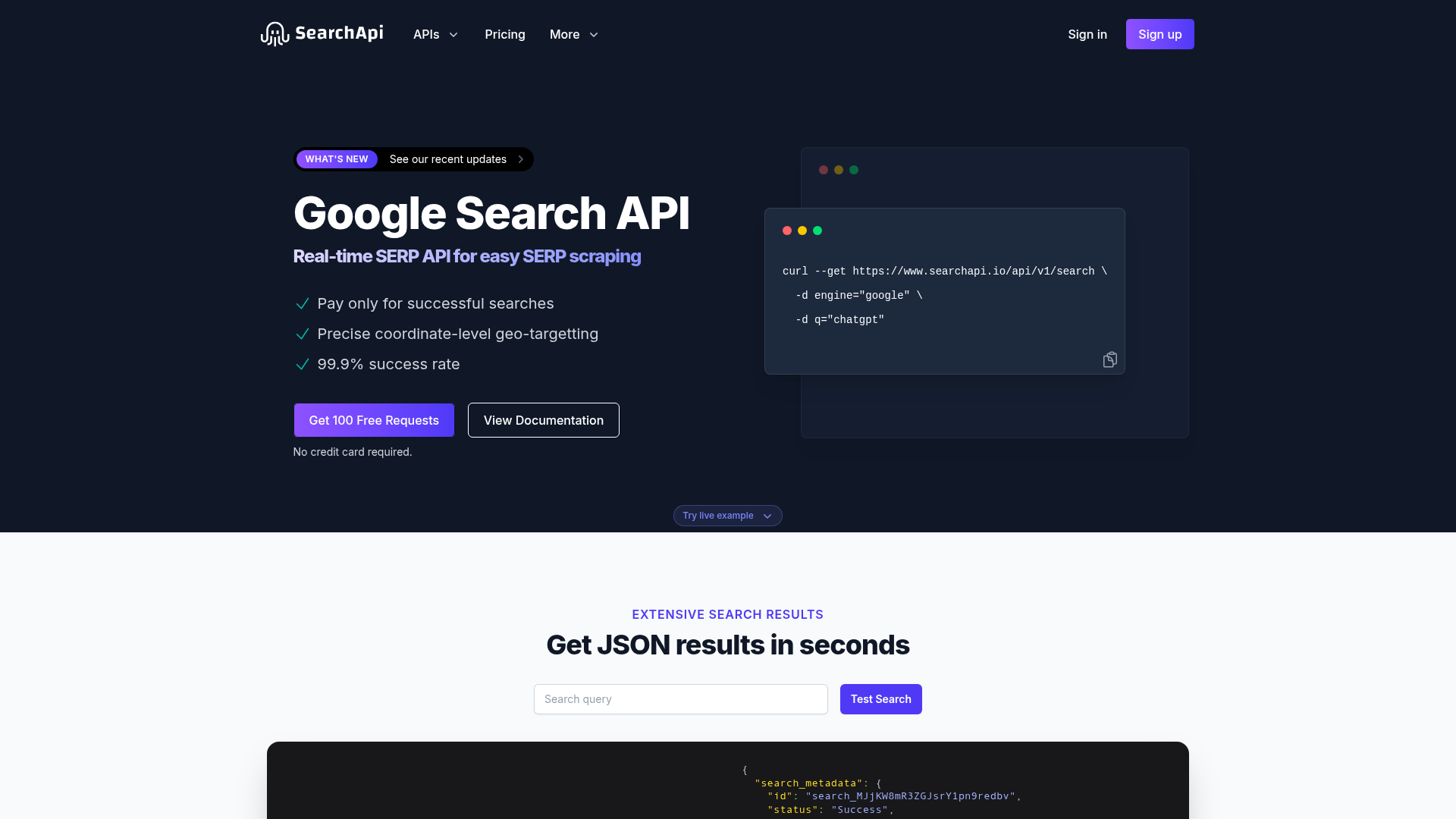
SearchApi delivers what it promises: pay only for successful requests, not failed ones.
That pay-per-success billing plus an official OAuth MCP server make it a clean choice for a developer building a rank tracker or competitor-monitoring pipeline. The ladder tops out steep: the highest published tier runs $5,000/month for 5 million searches, a real number now, not an extrapolation.
It fits a technical buyer building their own product on SERP data, not a marketer wanting a finished dashboard.
Who It's For
Who SearchApi is for (and who it isn't)
✓ Best for
- +Agencies building white-label rank-tracking dashboards. Coordinate-level geo-targeting lets a developer build location-accurate rank tracking across markets inside their own product.
- +Ecommerce teams monitoring competitor pricing at volume. 10,000+ searches a month at $3.00 or less per 1,000 makes ongoing price and ranking monitoring affordable at real scale.
- +Developers who want an official MCP server for SERP data. A live, Claude-connector-listed MCP server at searchapi.io/mcp lets an AI assistant pull SERP data directly, not just a REST wrapper.
× Consider something else if
- −You need keyword and backlink datasets alongside SERP results. SearchApi focuses on raw SERP results; DataForSEO is the stronger fit when the same product also needs keyword and backlink data from one provider.Try DataForSEO →
- −Your product needs Google results and AI-answer data together. cloro returns Google results and answers from AI search surfaces in one response shape, making it the more focused option for a GEO data product.Try cloro →
- −You want a finished SEO workspace instead of building one. SearchApi supplies raw results; SE Ranking is the stronger fit when the buyer needs rank tracking, audits and reports ready to use.Try SE Ranking →
What You Can Do
What can SearchApi do?
Build a white-label rank-tracking dashboard
Pull SERP results by coordinate-level location across multiple markets and feed them into your own dashboard, billed only for the requests that actually succeed.
Monitor competitor pricing and rankings at ecommerce scale
Schedule recurring SERP pulls against competitor product pages and category pages, tracking rank and pricing changes without building a scraper from scratch.
Connect an AI assistant to live SERP data via MCP
Use the official MCP server with Claude Desktop, Claude Code, Cursor, VS Code or Zed to query search results conversationally instead of writing a client integration first.
AI, API & MCP
AI, API and assistant workflows
SearchApi provides structured, real-time search results across dozens of engines, from Google and Bing to shopping, travel, and AI-answer engines like ChatGPT and Perplexity, reachable through both an MCP server and a REST API.
AI agent workflow
Live SERP and vertical-search pulls inside a chat client
An agent can query live Google rankings or pull structured results from a vertical engine like Google Shopping or YouTube directly through the MCP server, without leaving the conversation. The same query patterns work over the REST API for a scheduled or scripted job, such as scraping a competitor's current Shopping listing and price for a pricing report.
Approval boundary: There's no write or publish action in this tool's scope since it's a read-only search and scraping API. The practical caution is cost: heavy per-query pricing on some engines can add up quickly if an agent loops queries unsupervised, so a human should set a query budget before letting it run autonomously.
MCP
officialOAuth or token-based access to live SERP data
The MCP server at www.searchapi.io/mcp is live and supports both OAuth and a static token over remote HTTP transport. Through it, an agent can check current rankings or pull structured SERP features for a keyword across Google and vertical engines without a separate browser session.
SearchApi MCP server →API
officialOne endpoint, dozens of search engines
The REST API is documented at www.searchapi.io/docs/google with a published OpenAPI spec, authenticated with an API key usable as a query parameter or an Authorization bearer header. A single endpoint pattern (GET /api/v1/search?engine=) covers standard search engines plus Shopping, Travel, Content and Social, Professional, and Local verticals. Using the key as a URL parameter risks it leaking into logs, so header authentication is the safer choice for agent use.
SearchApi, Google Search API docs →Pricing
How much does SearchApi cost?
The published entry plan starts at $40/mo. For this review's professional buyer, the practical starting point is $100-250/mo before users and add-ons. A free plan is available.
| Plan | Monthly |
|---|---|
| Free trial | Free, 100 requests |
| Developer | $40/mo |
| ProductionPopular | $100/mo |
| BigData | $250/mo |
| Scale | $500/mo |
A free trial gives 100 requests with no card required. Developer is $40/month for 10,000 searches ($4.00/1k). Production is $100/month for 35,000 searches ($3.00/1k). BigData is $250/month for 100,000 searches ($2.50/1k). Scale is $500/month for 250,000 searches ($2.00/1k). Above that, four Octo tiers run from $900/month (500,000 searches) up to $5,000/month for 5 million searches, real published plans, not a hypothetical ceiling.
20% of monthly credits are usable per hour
This rate limit matters for burst workloads; a scheduled job pulling a large batch at once can hit the ceiling before the month's allowance is exhausted.
Production and up carry legal-coverage backing
Up to $2M in legal coverage applies to the data-collection process itself, not to how the buyer uses the resulting data.
Alternatives
When I'd choose something else
Three different buying priorities, and what I'd pick instead for each one.
SERP data bundled with keyword and backlink datasets

DataForSEO
For buyers who want SERP data bundled with keyword and backlink datasets in one subscription rather than a SERP-only API.
Trade-off: DataForSEO's SERP-only pricing runs less granular than SearchApi's pay-per-success model.
Explore DataForSEO for this use case →Google and GEO data in one API

cloro
For developers who want Google results plus AI-answer data from ChatGPT, Perplexity and Google AI surfaces in one response shape.
Trade-off: cloro is narrower than SearchApi for broad SERP coverage and has a less established integration ecosystem.
Explore cloro for this use case →A finished SEO workspace instead of raw API data

SE Ranking
For buyers who need rank tracking, audits, research and client reports without building their own interface on top of SERP data.
Trade-off: SE Ranking is a subscription workspace rather than a flexible pay-per-success data API.
Explore SE Ranking for this use case →Keep going
Downsides
Limitations to consider before subscribing
High-volume cost is real, not hypothetical
$5,000+/month is now a literal published tier for 5 million searches, not an extrapolated worst case.
20%-per-hour rate limiting can bite burst jobs
A large scheduled pull can hit the hourly cap before the monthly allowance runs out.
Client-library work stays with the buyer
Every integration is built against the raw REST API; teams that expect first-party client libraries will need to build their own wrapper.
The $40/month floor is real even for light use
There's no per-search micro-tier below Developer, so occasional or small-volume users still pay the full monthly minimum.
My Recommendation
Buy it for pay-per-success billing and the official MCP server
Shortlist SearchApi when you're building your own product on SERP data and want to pay only for successful requests, with an official MCP server for AI-assistant access.
Choose DataForSEO for broader SEO datasets, cloro for Google and GEO data in one API, or SE Ranking for a finished SEO workspace.
What to check during the trial
- –Run the 100-request free trial against your actual target query set before committing to a paid tier
- –Model your monthly search volume against the Developer-to-Production jump to avoid overpaying on the wrong tier
- –Connect the official MCP server to Claude or Cursor and test a real query before building a custom integration
- –Check the 20%-per-hour rate limit against your expected burst pattern, not just your monthly total
FAQ
Frequently asked questions about SearchApi
Developer starts at $40/month for 10,000 searches. Production is $100/month for 35,000 searches. The ladder now extends to $5,000/month for 5 million searches at the top Octo tier.
Yes. It's listed as an official Claude connector, documented at searchapi.io/integrations/mcp, with OAuth support and compatibility across Claude Desktop, Claude Code, Cursor, VS Code and Zed.
No. Billing is pay-per-success, so failed or non-200 requests aren't charged, a real cost advantage over flat per-request billing.
No. There's no official SDK in any language; integrations are built directly against the REST API.
Sources & References (2)
Spot something out of date?Vendors and readers, send me the correct fact.
Software sites change almost every week, and I want every claim on this page to be factually correct. If you are a vendor or a reader, send me the correct fact and a link to the official page. I will check it and update the page. The opinions and rankings stay mine.