

Joonas Rotko · Founder, That Marketing Buddy
I spent 10+ years buying marketing software for my own agency and its clients, so I know which tools earn their monthly fee and which ones quietly drain it. Now I check the prices and the claims on this site myself.
This page may contain affiliate links.
Some links on this page are affiliate links, meaning I may earn a commission if you sign up (at no extra cost to you). This never influences my ratings or recommendations.
The Verdict
Is Firecrawl right for you?
Firecrawl turns messy web pages into clean markdown, JSON, or screenshots that an LLM can actually use. It's built by developers, for developers, so if you're not writing code or prompting an agent, this one isn't really talking to you.
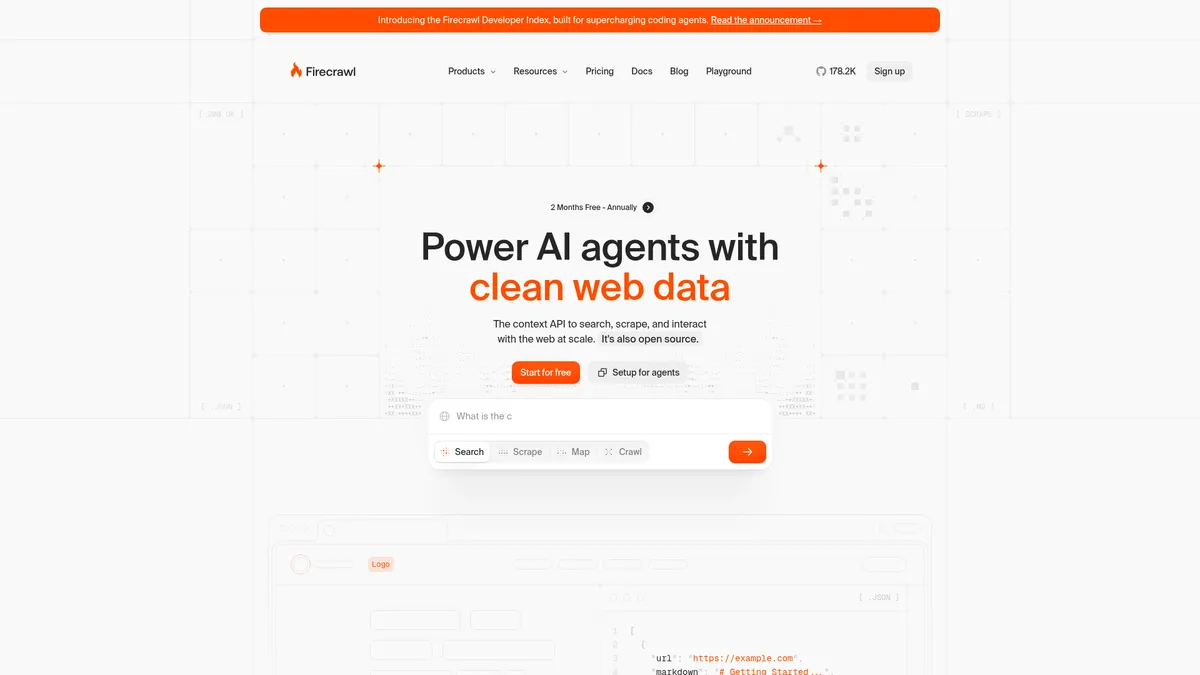
Firecrawl is an API and MCP-connected data layer that scrapes, crawls, maps, and searches the web, returning clean markdown or structured JSON instead of raw HTML. It's built for developers and AI agent builders, not marketers clicking through a dashboard. If your stack needs live web data fed into an LLM, it's a well-documented, open-source option worth a look.
If you're after SEO rank tracking or keyword volume, this isn't that tool.
It's a developer-first data API, not a marketing dashboard wearing an API costume, so judge it on that basis and not against SEO suites.
Why I'm covering this
I'm covering Firecrawl because it's the data layer behind Zapier, Replit, and Lovable's AI agents, and its 96% scrape-reliability benchmark against Puppeteer is a concrete number this category rarely publishes.
Who It's For
Who Firecrawl is for (and who it isn't)
✓Best for
- +AI Agent Developers Building RAG pipelines, research agents, or chatbots that need fresh web content pulled in clean markdown or JSON, not scraped HTML soup.
- +Startup Engineering Teams Building lead enrichment or onboarding flows that pre-populate user data by scraping a prospect's or client's own website.
- +No-Code Automation Builders Zapier and similar platforms already run Firecrawl under the hood, so builders wiring up automations get web-scraping power without managing their own scraper infrastructure.
- +Agencies With Dev Support Technical SEO or content teams that want to build custom competitor monitoring or content-change tracking on top of an API rather than wait for vendor features.
✗Skip this if
- −Marketers Without Dev Resources There's no visual campaign builder or point-and-click dashboard here. Everything runs through API calls, the CLI, or an MCP client.
- −SEO Teams Wanting Rank Tracking Firecrawl doesn't do keyword volume, SERP position tracking, or backlink data. It fetches and cleans web content, full stop.
- −Security-Conscious Teams on a Budget SSO, SCIM, zero data retention, and static egress IPs all sit behind custom Enterprise pricing, not the Growth or Scale plans.
- −SEO teams wanting keyword rank tracking and competitor dashboards Firecrawl fetches page content, it doesn't track SERP positions, keyword volume, or backlinks.Try Ahrefs →
Consider instead
 SE Ranking
 SearchApi
 Search Atlas
Features
What can Firecrawl do?
The four core endpoints, Search, Scrape, Crawl, and Map, are the reason anyone pays for Firecrawl. Scrape turns a single page into markdown or JSON in one call; Crawl does the same recursively across a site; Map just fetches every URL fast when you need a sitemap without the content. This is the meat of the product, and it's the part with the actual benchmark data behind it: 96% reliability on the vendor's 1,000-URL test versus 79% for Puppeteer and 75% for cURL.
Interact is the newer, more interesting addition. Instead of just pulling a page's HTML, it lets you scrape first and then send prompts or code to click buttons, type into search boxes, or navigate further, which starts to blur the line between 'scraper' and 'browser agent.' The FIRE-1 Agent (Beta) pushes further into autonomous territory, navigating and interacting with pages on its own. Both are labeled new or beta, so I'd treat them as promising rather than battle-tested.
On the agent-integration side, this is where Firecrawl earns its 'built for AI' positioning. There's an official MCP server, a one-line CLI command that wires up Claude Code, Cursor, and Windsurf in one shot, and SDKs across nine languages. If you're figuring out how MCP fits into your marketing or dev stack, Firecrawl is one of the more straightforward implementations I've seen documented.
The parsing layer handles the boring-but-critical stuff: JS rendering with smart wait for single-page apps, PDF and DOCX parsing, and a JSON extraction mode for pulling structured data via an LLM. The vendor also claims 93% fewer input tokens compared to raw HTML, which, if accurate, matters a lot once you're feeding thousands of pages into a model and paying per token on the LLM side too.
Core Web Data Endpoints
AI Agent Integration
Data Quality and Parsing
Enterprise and Security
UX & Support
Is Firecrawl easy to use?
Firecrawl's documentation is dense but well-organized, covering everything from SDK references in nine languages to webhook event types and security verification. According to the docs, onboarding for an AI agent is literally a single CLI command that wires up Claude, Cursor, Windsurf, and others with browser support included. For a straight developer audience, that's about as low-friction as onboarding gets.
The open-source community adds a layer of trust that closed scraping APIs don't have: 178.2K GitHub stars and visible, dated commits from named contributors suggest active development rather than a stale repo. For anyone weighing API versus MCP versus CLI approaches to connecting tools to AI agents, Firecrawl supports all three, which is unusual.
Support itself is tiered by plan: Community support on Free, Basic on Hobby, Standard on the Standard plan, and Priority support plus a shared Slack channel starting at Growth. Dedicated support with an SLA is Enterprise-only. There's no live chat mentioned anywhere in the documentation, so lower-tier users are largely self-serve through docs and community channels.
Pricing
How much does Firecrawl cost?
Firecrawl starts at $19/month. That's 62% below median for SEO APIs. A free plan is available.
Firecrawl's Free plan gives you 1,000 credits per month with no credit card required, capped at 2 concurrent requests and low rate limits. Paid plans start at Hobby for $19/month (monthly billing) or $16/month billed annually ($190/year, saving $38), which bumps you to 5,000 credits and 5 concurrent requests. Standard, the plan Firecrawl recommends, runs $99/month or $83/month billed annually ($990/year, saving $198), with 100,000 credits and 25 concurrent browsers.
Above that, Growth is $399/month or $333/month annually ($3,990/year, saving $798) for 500,000 credits, and Scale is $749/month or $599/month annually ($7,190/year, saving $1,798) for 1,000,000 credits and 100 concurrent requests. Enterprise is custom-priced and is the only tier that unlocks SSO, SCIM, zero data retention, and static egress IPs.
Credits aren't flat across every action, either: a basic scrape or crawl costs 1 credit per page, but adding JSON-format extraction or a prompt-injection check tacks on +4 credits per page each. That means structured extraction burns through a credit allowance far faster than plain scraping, so budget accordingly if you're planning to extract structured data at volume. Pay-as-you-go top-ups (in $5 increments) are available on all paid plans but not on Free.
| Plan | Monthly |
|---|---|
| Free | Free |
| Hobby | $19/mo |
| Standard (Recommended) | $99/mo |
| Growth | $399/mo |
| Scale | $749/mo |
| Enterprise | Custom |
External Ratings
What reviewers say about Firecrawl
"If you're coding with AI, and haven't discovered @firecrawl yet, prepare to have your mind..."
Morgan Linton, X (Twitter)Downsides
What's wrong with Firecrawl
No SEO-Specific Data
There's no keyword volume, rank tracking, or backlink data built in. Anyone expecting an SEO tool because it's filed under 'SEO APIs' will be disappointed; this is a general web-scraping layer, not a rank tracker.
Pay-As-You-Go Locked to Paid Plans
Free-plan users can't top up credits when they run out mid-month. You either upgrade to a paid tier or wait for the next billing cycle.
Enterprise Security Features Are Custom-Only
SSO, SCIM provisioning, zero data retention, and static egress IPs all sit behind Enterprise, with no public price. Growth and Scale customers who need any of these have to negotiate a custom deal.
Credit Costs Multiply Fast for Structured Extraction
A plain scrape costs 1 credit per page, but adding JSON-format extraction or a prompt-injection check each add +4 credits per page. Structured extraction at volume can burn through an allowance five times faster than raw scraping.
Interact and FIRE-1 Agent Are New or Beta
The autonomous browser-action features are labeled new (Interact) or beta (FIRE-1 Agent), so I'd expect some rough edges compared to the core Scrape/Crawl/Map endpoints that have years of production use behind them.
Multi-Team Organizations Require Contacting Support
Running multiple teams under one organization isn't self-serve until Growth or higher, and even then it requires contacting support rather than a toggle in settings.
Are these dealbreakers?
None of these are dealbreakers if you're building an AI agent or data pipeline and just need clean web content. But if you're hoping Firecrawl doubles as an SEO or rank-tracking tool because of the category it's listed under, that's the wrong expectation to bring in.
Ready to try Firecrawl?
Start scraping with 1,000 free credits a month, no credit card required.
 Start for Free →
FAQ
Frequently asked questions about Firecrawl
Firecrawl is an API that scrapes, crawls, maps, and searches the web, returning clean markdown, JSON, or screenshots instead of raw HTML. It's mainly used to feed AI agents, chatbots, and research tools with usable web content.
Yes. The Free plan includes 1,000 credits per month with no credit card required, though it's limited to 2 concurrent requests and low rate limits.
Yes. Firecrawl offers an official MCP server plus a CLI-based Skills setup, letting you connect it to Claude, Cursor, Windsurf, and other AI agent clients with a single command.
Scrape pulls clean data from one page. Crawl recursively pulls content from every page on a site. Map quickly returns every URL on a domain without pulling content. Search runs a web search and returns full content from the results.
Yes, the core firecrawl/firecrawl repository is open source on GitHub, with 178.2K stars as of the vendor's latest figures, alongside the paid hosted API.
Each plan includes a monthly credit allowance. A basic scrape or crawl costs 1 credit per page, but adding JSON extraction or a prompt-injection check adds +4 credits per page each, so structured extraction uses credits faster than plain scraping.
Yes. Firecrawl can parse and output content from PDFs, DOCX files, and standard HTML pages alongside its normal scraping and crawling.
No. Firecrawl has no keyword research, rank tracking, or backlink features. It's a general web-data API; for rank tracking, a dedicated SEO platform is the better fit.
The credit system gets cheaper per unit as you scale up, but the jump from free to paid is steep and a few features quietly cost more credits than the base rate suggests.
Firecrawl is best for: AI Agent Developers; Startup Engineering Teams; No-Code Automation Builders; Agencies With Dev Support.
AI-readiness isn't a bolt-on feature here, it's the entire product thesis, and the tooling shows it.
Being open source with 178K+ GitHub stars is the biggest lock-in insurance policy here: you can self-host the whole thing if the hosted API stops working for you.
Firecrawl starts from $19/month. A free plan is available.
Sources & References (3)
This page may contain affiliate links. I earn a commission at no extra cost to you. This never influences ratings.