
Kajabi Review 2025 — Best All-in-One Platform for Coaches, Course Creators & Digital Entrepreneurs?
Kajabi claims to be the ultimate all-in-one platform for online course creators — but in 2025, with so many strong competitors, does it still live up to that promise? Let’s dive in and see whether Kajabi still deserves its reputation as the go-to platform for creators and educators.
Last updated: December 4, 2025
Table of Contents
1. Quick Verdict
Kajabi has matured into a dependable all-in-one platform for creators who sell online courses, memberships, and digital products. Its strength lies in simplicity — everything from website hosting to email campaigns is centralized and easy to manage. However, the convenience comes at a cost. Kajabi’s pricing sits on the higher end, and while it delivers a smooth, professional experience, it may feel restrictive for those who prefer more creative or technical flexibility. It’s best suited for established educators and business owners who value simplicity and stability over tinkering.
Best for
- Course creators and coaches who want to package and sell their expertise through beautifully structured programs
- Small business owners who prefer a clean, unified system for managing their website, email marketing, and digital product sales
- Educators and community builders who want to create memberships, online schools, or training hubs without juggling multiple tools
- Entrepreneurs focused on branding who value Kajabi’s polished look and professional presentation
Not ideal for
- Beginners or budget-conscious creators — Kajabi’s pricing can feel high if you’re just starting out
- Advanced marketers who want granular funnel control, A/B testing, or deep automation flexibility
- Agencies or large teams managing multiple client accounts — Kajabi lacks dedicated multi-user or white-label features
- E-commerce sellers offering physical products or complex checkout experiences
My bottom line: Kajabi delivers a refined, reliable experience for creators who want to teach, sell, and build communities without touching code. It’s not the cheapest or the most flexible tool, but it removes friction from the business of teaching online. If you value ease of use and presentation over deep customization, Kajabi earns its place as a premium, all-in-one choice.
2. What Is Kajabi?
Kajabi is an all-in-one platform for digital entrepreneurs, designed to help creators build, market, and sell online courses, memberships, and digital products — all from one dashboard.
Founded in 2010 in California, Kajabi was one of the first platforms to bring together website hosting, email marketing, automation, and course delivery under one roof. Its mission has always been clear: to make it simple for knowledge-based businesses to launch and scale without needing developers or complex tech stacks.
Today, Kajabi powers tens of thousands of online schools, academies, and communities, catering especially to coaches, educators, and creators who want a professional presence and a seamless student experience. It’s sleek, intuitive, and focused on helping users turn expertise into income — though that polish comes at a premium price.
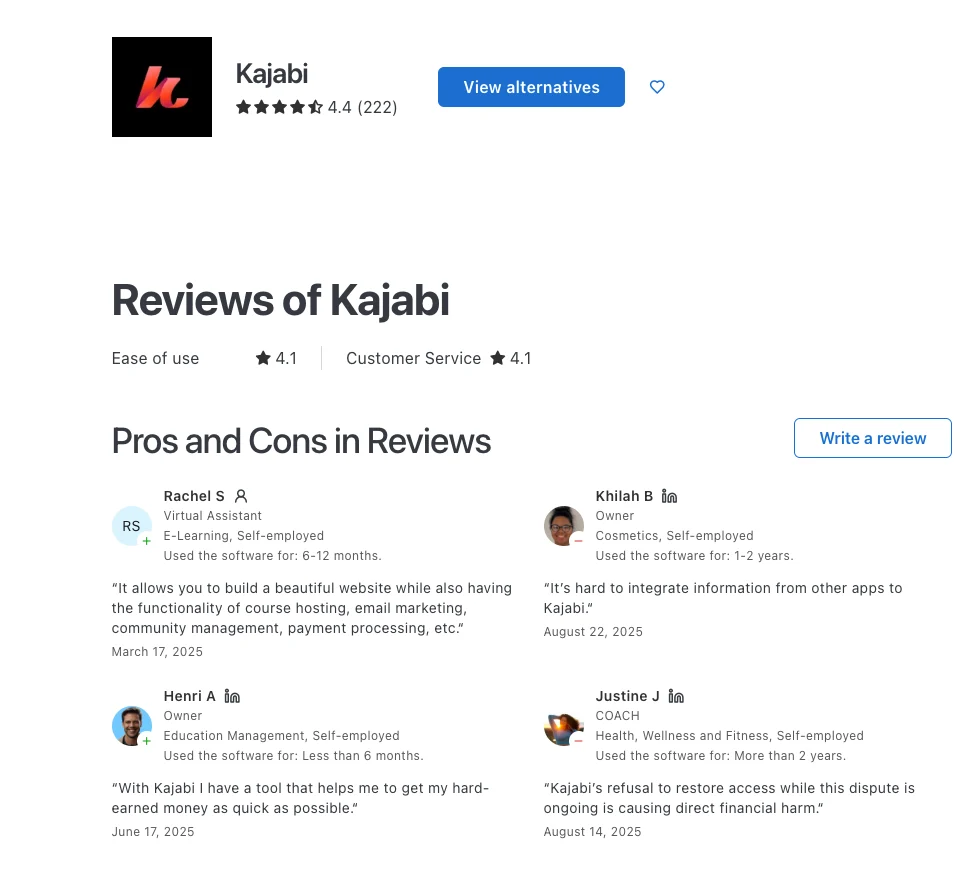
Kajabi holds strong ratings on Capterra, praised for its intuitive design and professional course delivery tools.
Kajabi holds an impressive 4.4 out of 5 rating on Capterra, reflecting solid user satisfaction. Most creators highlight its reliability, clean interface, and the convenience of managing everything — from courses to marketing — in one place.
3. Who It’s For — And Who It’s Not
Ideal for
Kajabi isn’t just for selling courses — it’s for creators ready to treat their knowledge as a business. The platform’s strength lies in structure and consistency. Those who thrive with Kajabi usually:
- Value streamlined operations — one login for everything from website to checkout
- Have a clear brand message and want a polished, professional look without hiring developers
- Sell transformation, not just content — coaches, educators, and creators who build communities and recurring memberships
- Appreciate predictability — Kajabi’s “it just works” ecosystem removes the chaos of integrating multiple tools
It’s ideal for entrepreneurs who’ve outgrown DIY solutions and are ready to build something stable, scalable, and audience-focused.
Not ideal for
Kajabi becomes less appealing if your business thrives on constant experimentation or deep customization.
- Performance-focused marketers might find the analytics limited and automation too simple
- Hands-on builders who love tweaking funnels, pixels, and scripts may find Kajabi too “closed”
- Lean startups may see the cost as a blocker before they’ve validated their audience or offer
Kajabi’s structure is both its advantage and limitation — perfect for creators who want order and consistency, but frustrating for those who prefer flexibility and granular control.
4. Feature Deep Dive
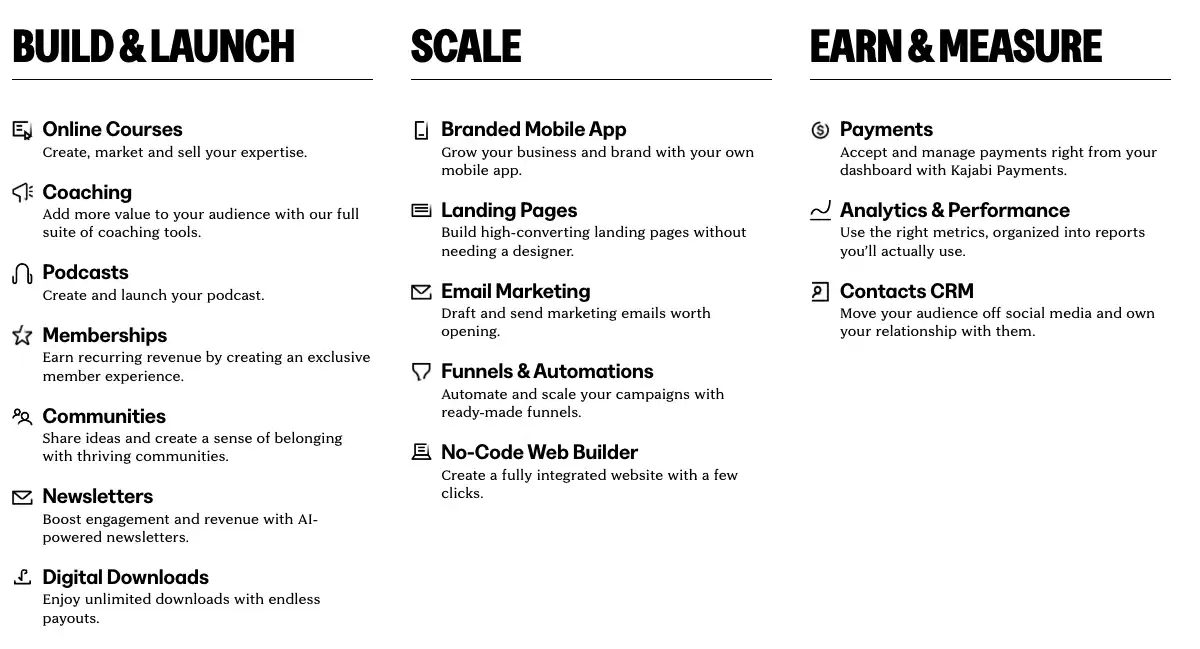
Kajabi’s feature overview showcasing its key tools for creators — including courses, email marketing, automation, and website building.
Build & Launch
Scale
Earn & Measure
Build & Launch
Kajabi’s foundation is all about empowering creators to turn knowledge into polished, sellable digital products. Everything under the “Build & Launch” category is designed to remove tech barriers and let you focus on what you do best — teaching, creating, and connecting with your audience.
4.1 Online Courses
Kajabi’s course builder is the heart of its ecosystem. You can structure modules, upload videos, add downloads, and control access with ease. The layout feels clean and logical — ideal for creators who value presentation as much as content. While it’s not as customizable as standalone LMS tools, it wins in simplicity: your courses look professional out of the box, and setup takes hours, not days.
4.2 Coaching
Beyond courses, Kajabi’s coaching tools let you run one-on-one or group sessions right inside your dashboard. Scheduling, payments, and content delivery are connected, so you can handle client sessions without needing Zoom links and Google Sheets. It’s not a full CRM or calendar automation system, but it integrates smoothly enough to keep your workflow focused and minimal.
4.3 Podcasts
This feature allows creators to host, distribute, and even monetize podcasts within Kajabi. You can publish directly to Spotify and Apple Podcasts, manage episodes, and track listener engagement — all from the same platform that hosts your courses and offers. For creators running education-based podcasts, this unifies your brand under one roof.
4.4 Memberships
Kajabi’s membership system is where recurring income lives. You can create tiered memberships with exclusive content, community access, and special offers. Unlike plug-in setups that require juggling logins and payment gateways, Kajabi keeps it all native — making retention and billing far easier to manage. Perfect for educators who want predictable monthly revenue without tech headaches.
4.5 Communities
Think of Kajabi Communities as a private, ad-free alternative to Facebook Groups — built right into your course platform. Members can comment, share ideas, and engage directly with you and each other. While not as feature-rich as standalone platforms like Circle or Skool, Kajabi’s integration with products and automations makes community engagement feel organic and rewarding.
4.6 Newsletters
With Kajabi’s newsletter tools, you can send updates, launch sequences, or educational digests without switching to a separate email provider. Built-in templates and AI-assisted drafting make it easy to stay consistent, while automations can trigger based on user behavior — like completing a course or missing a lesson. It’s a light but effective email layer that keeps your audience engaged week after week.
4.7 Digital Downloads
Digital downloads are Kajabi’s simplest form of monetization — think templates, PDFs, guides, or resources. You can host, sell, and deliver products instantly with automated checkout and delivery emails. It’s ideal for creators who want a quick, low-maintenance income stream or a lead magnet to bring people into their ecosystem.
Scale
Once your products are live, Kajabi shifts gears toward helping you grow your reach and streamline your operations. These tools focus on automation, design flexibility, and scaling without adding unnecessary tech complexity.
4.8 Branded Mobile App
Kajabi’s branded mobile app extends your business beyond the desktop. Students can watch lessons, complete programs, and join communities from anywhere — keeping engagement high. You can also add your own logo and brand colors for a seamless look. It’s not as customizable as a fully custom app, but the ready-made structure saves months of development.
4.9 Landing Pages
The page builder in Kajabi combines drag-and-drop ease with professional design. You can create sales pages, thank-you pages, and opt-ins that match your brand without touching code. The templates lean conversion-focused — clean, fast-loading, and built to highlight your offer. While design freedom is moderate, it’s balanced by consistent reliability across devices.
4.10 Email Marketing
Kajabi’s email system is simple but strategic. You can send campaigns, set automations, and tag subscribers based on behavior like sign-ups or purchases. The built-in editor feels intuitive — not overloaded with options but powerful enough for targeted campaigns. Deliverability rates are solid, and the integration with your courses and offers means every message stays context-aware.
4.11 Funnels & Automations
This is where Kajabi starts feeling like a true marketing platform. You can create visual automation workflows — from lead magnets to full customer journeys — without connecting external tools. Automations trigger based on actions (like completing a lesson or making a purchase) to move customers logically through your funnel. It’s not as deep as dedicated automation platforms, but for most creators, it’s more than enough to simplify marketing flow.
4.12 No-Code Web Builder
Kajabi’s website builder lets you create a complete, branded website without plugins or third-party hosting. Pages load quickly, and editing is visual — just click, drag, and publish. It supports custom domains, SEO meta settings, and responsive layouts out of the box. For creators who want a unified ecosystem, it’s a time-saver: everything from homepage to checkout exists under one login.
Earn & Measure
Kajabi isn’t just about creating — it’s about turning your audience into customers and tracking every step of their journey. The “Earn & Measure” tools are built to manage payments, understand performance, and maintain relationships without adding external systems.
4.13 Payments
Kajabi Payments centralizes your revenue operations — from one-time purchases to recurring subscriptions. You can connect Stripe or use Kajabi’s own processor, allowing you to manage payouts and refunds directly inside your dashboard. The checkout pages are clean and mobile-friendly, and you can add order bumps or upsells without plugins. It’s a smooth, reliable way to keep sales and accounting under one roof.
4.14 Analytics & Performance
Data tracking in Kajabi focuses on what creators actually need: sales, opt-ins, and engagement metrics. You can see how each product performs, where leads come from, and what content drives revenue. While it doesn’t rival enterprise-level analytics, the clarity is refreshing — it gives a complete snapshot of your business health without the noise. Perfect for creators who prefer insights over spreadsheets.
4.15 Contacts CRM
Kajabi’s built-in CRM ties everything together — courses, purchases, emails, and behavior data are all connected under each contact profile. You can filter by tags, engagement, or offer history, then trigger automations or personal messages based on those insights. It’s simple compared to standalone CRMs, but it delivers exactly what most creators need: visibility and relationship tracking without switching tools.
My bottom line: If your business model revolves around teaching, coaching, or selling digital experiences — Kajabi hits the sweet spot between professionalism and ease of use. But if you’re the kind of marketer who enjoys tinkering under the hood, you might feel like Kajabi keeps you politely in the passenger seat.
5. UX, Onboarding & Support
Kajabi delivers a clean, intuitive experience that feels professional from the first login. Navigation is simple, and setup is guided by a checklist that walks you through creating offers, connecting payments, and customizing your site.
Official Kajabi Facebook group where creators share tips, ask questions, and connect with other online course builders.
Support is solid across the board. Kajabi University and the help center cover most questions, while higher-tier plans include 24/7 live chat. The Kajabi Facebook Community is a big bonus — active, friendly, and full of real-world advice from creators.
The only drawback is that personal support scales with your plan. Still, Kajabi offers one of the most polished onboarding experiences in the all-in-one space — fast, welcoming, and well thought out.
6. Performance & Reliability
Kajabi performs reliably for most small and mid-sized businesses. Users on G2 and Capterra often praise its stability and uptime, noting that courses generally load fast and the platform rarely crashes.
However, discussions on Reddit and user forums highlight that performance can slow down with heavy traffic or complex pages. Some users also report occasional bugs and billing frustrations — typical for a large SaaS platform but worth noting.
Overall, Kajabi is stable, polished, and dependable for everyday course work, though not the speed king. Keep your content organized and optimized, and it will run smoothly enough to power real sales without tech headaches.
7. Pricing & Value Analysis
Kajabi sits firmly in the premium tier of all-in-one marketing platforms, and its pricing reflects that. There’s no free plan — instead, Kajabi targets serious creators ready to invest in building a sustainable digital business.
Want the full cost breakdown? Check my in-depth Kajabi pricing breakdown here →
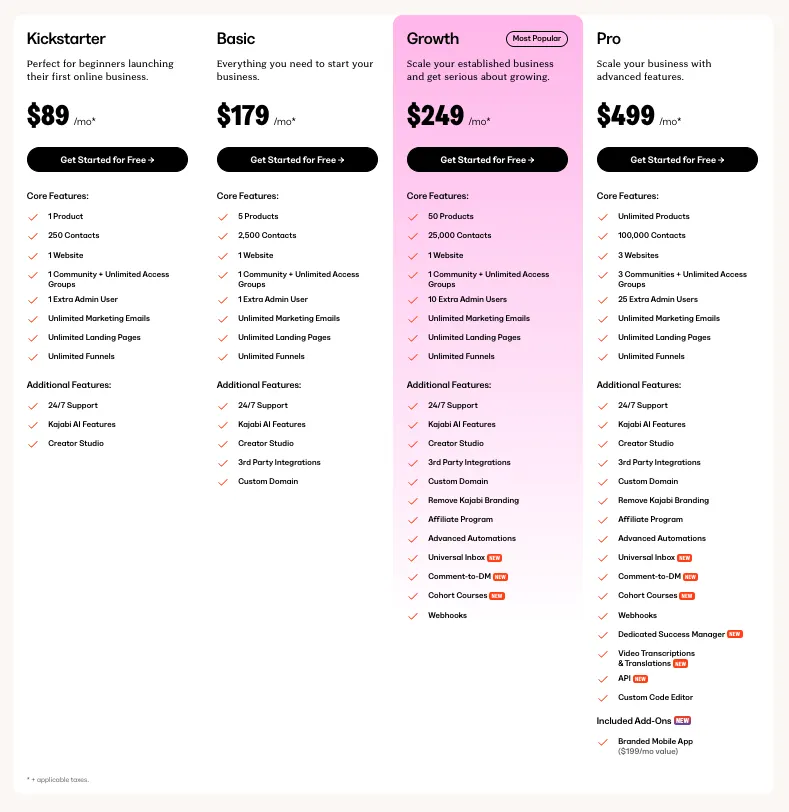
Kajabi’s pricing structure includes three main tiers designed for creators and online business owners.
| Plan | Price | Limits | Highlights |
|---|---|---|---|
| Kickstarter For beginners |
$89/mo | 1 product, 250 contacts, 1 website, unlimited funnels | Perfect for launching your first online business with 24/7 support and Kajabi AI features. |
| Basic Small business |
$179/mo | 5 products, 2,500 contacts, 1 website, custom domain | Ideal for small business owners ready to scale with third-party integrations. |
| Growth Most Popular |
$249/mo | 50 products, 25,000 contacts, affiliate program, advanced automations | Best for expanding creators with webhooks, no Kajabi branding, and priority support. |
| Pro Enterprise |
$499/mo | Unlimited products, 100,000 contacts, 3 websites, API access | Built for established businesses with branded mobile app and dedicated success manager. |
While Kajabi is undeniably expensive, it’s also self-contained — you won’t need extra subscriptions for hosting, email, or course tools. The cost makes more sense when you factor in everything that’s included, but it’s still a significant commitment for early-stage creators.
That Marketing Buddy’s take: Kajabi’s pricing isn’t about affordability — it’s about convenience and polish. You’re paying for fewer headaches, a unified ecosystem, and an experience that “just works.” For profitable creators, that trade-off can easily be worth the premium.
8. Comparisons & Top Kajabi Alternatives
When you’re evaluating Kajabi, it’s essential to see how it stacks up — not just on its own merits, but relative to other platforms that may better suit your budget, tech comfort level, or business model.
For a full breakdown, visit the Comparisons Hub to see Kajabi stacked against real alternatives.
| Platform | Best For | Major Strengths | Key Limitations |
|---|---|---|---|
| Kajabi | Creators who want a true all-in-one system | Combines website, funnels, email, and courses into one seamless platform | Pricing is high and customization feels limited |
| Podia | Beginners or solo creators | Extremely easy to use, quick to launch, more affordable | Lacks deeper automation, funnel building, and analytics |
| Thinkific | Educators who prioritize structured learning | Strong course builder with great student experience tools | Less focused on marketing or automation |
| Systeme.io | Budget-conscious creators | Free plan available, all-in-one simplicity | Limited design flexibility |
| ClickFunnels | Funnel-focused marketers | Best-in-class funnel building and conversion tools | Less focus on course delivery |
Key Takeaways
- If you value convenience and having everything under one roof, Kajabi remains a top contender.
- If you’re watching budget closely, or your focus is narrower (just courses, just community, or just funnels), one of the alternatives may give you more value now.
- If you expect rapid growth and many products, make sure to compare product/contacts limits: some platforms require upgrading early if your business scales fast.
- Match platform to your strategic priority: If your focus is teaching and community, pick an LMS-centric platform. If your priority is conversion funnels, pick a funnel-first platform.
9. Real User Feedback
What real users appreciate
- “I love Kajabi and use it for everything: website, landing pages, checkout, payments, emails, courses, podcasts.” — Trustpilot user
- Many reviewers highlight how everything being under one roof (content, site, email, checkout) makes life much simpler
- Support and onboarding often get positive mentions: “Customer support has been top-notch and very responsive.”
What users say could be improved
- The cost keeps coming up: some users feel the monthly price is steep, especially when just starting
- A few users mention that while the platform is feature-rich, it can feel a little overwhelming at first. “Too many options… too confusing for beginners.”
- A minority have raised concerns about support consistency: fast responses sometimes, but deeper issues can feel slower to resolve
From my view: If you’re ready to invest in a unified platform and want things to just work, Kajabi hits that need. The “all-in-one” promise is alive in lived experience. On the flip side, if you’re budget-conscious or still figuring your business model out, the investment and learning curve could feel heavy.
10. Limitations & What Could Be Better
Kajabi delivers a strong all-in-one experience, but even the best platforms come with trade-offs. After using and testing it deeply, here’s where it could still improve:
- Design Flexibility Is Limited: Kajabi’s templates look professional, but customization is restricted. You can’t freely adjust every element or build layouts exactly how you imagine — unless you know a bit of custom code.
- Pricing Reflects Its Premium Nature: Kajabi doesn’t try to be cheap — and it isn’t. The value is clear if you replace multiple tools with it, but for small businesses or beginners, the monthly cost can sting before the platform starts paying for itself.
- Integrations Are Good, Not Great: Kajabi connects with major services like Stripe, PayPal, but it’s not a deeply open ecosystem. There are limits to what you can automate or sync without relying on Zapier.
- Managing Large Content Libraries Gets Tricky: For creators running multiple courses or memberships, Kajabi’s backend can start to feel crowded. Uploading, updating, and organizing a big collection of videos and lessons isn’t as seamless as it could be.
Bottom line: Kajabi shines for creators who want to simplify their tech stack and deliver professional-grade online experiences. But if you crave total design control, deep analytics, or flexible pricing, it might feel a bit too polished — and a little too closed.
11. Kajabi Frequently Asked Questions (FAQ)
For established creators and educators, yes. Kajabi remains one of the most reliable platforms for selling online courses, memberships and digital programs. It’s ideal for people who want everything in one ecosystem rather than piecing multiple tools together.
Kajabi does not offer a free plan. However, it includes a 14-day free trial, giving users full access to build and test their setup before subscribing.
Kajabi is built for educators, coaches, and content creators who sell structured digital programs online. It works best if you want your website, checkout, courses, email marketing and automations inside one platform.
Yes. Kajabi supports custom domains, making it easy to maintain consistent branding across your website, courses and email campaigns.
Yes, Kajabi includes a full email marketing suite — broadcasts, automation sequences, segmentation and analytics — right inside the dashboard, eliminating the need for a separate ESP for most creators.
Setup is intuitive, but the amount of features can feel overwhelming at first. Most new users go through a short learning curve, but Kajabi’s onboarding and templates help speed up the process.
Kajabi doesn’t include a native live webinar tool, but it integrates well with Zoom, YouTube Live and other streaming platforms. Many creators run webinar registrations and follow-up automation inside Kajabi.
For many users, yes — Kajabi can replace multiple tools at once. However, creators who want full design freedom or large-scale blogging features may still prefer WordPress + Kajabi together.
Yes. Higher-tier plans include more admin seats and permissions, plus the option to manage multiple sites inside one account.
Kajabi is optimized for digital products. You can technically sell physical items, but there is no built-in inventory or shipping management — so it’s not ideal for e-commerce-heavy stores.
12. Final Verdict & Recommendation
Kajabi remains one of the strongest choices for online course creators in 2025. It’s polished, stable, and built with creators in mind — every feature feels intentional. The platform’s biggest advantage is how seamlessly it connects your website, courses, and email marketing under one roof.
That said, Kajabi’s pricing makes it best suited for established businesses. Beginners might find the monthly cost steep compared to newer all-in-one tools that offer similar capabilities at a lower entry point. Still, for those who want a dependable, premium experience with minimal tech headaches, Kajabi is hard to beat.
Who it’s best for: Educators, coaches, and creators who want to grow digital programs without juggling plugins or third-party integrations. It’s for people who value simplicity, not endless tinkering.
Who might outgrow it: Marketers or agencies who rely on deep automation, funnel experimentation, or full design flexibility may find Kajabi restrictive.
Bottom line: Kajabi delivers what it promises — a smooth, all-in-one platform that lets you focus on teaching and earning. It’s not the cheapest, but for creators ready to scale with confidence, it’s worth the investment.
Pro tip from That Marketing Buddy: If you’re unsure whether Kajabi fits your business, give the 14-day free trial a spin — it’s the quickest way to see if its simplicity and polish match your workflow.