
ClickFunnels Review 2025 — Still Worth It or Overpriced?
It built an empire around sales funnels — but in 2025, is ClickFunnels still worth the hype?
Last updated: December 4, 2025
Table of Contents
1. Quick Verdict
In a nutshell: The best thing about ClickFunnels is that it teaches you to think with a funnel-first mindset — and that lesson alone can be worth a million dollars. If you master your offer and build a clean, focused funnel, you can skyrocket your business. ClickFunnels won’t do that part for you — it just gives you solid tools to make it happen. If you’re comparing ClickFunnels with other all-in-one tools, check the Systeme.io vs ClickFunnels comparison.
That said, plenty of more affordable and flexible platforms can achieve the same results. ClickFunnels just happens to be the one that turned “funnel hacking” into a movement.
Best for
- Entrepreneurs & coaches who want fast, high-converting funnels
- Businesses generating leads, running webinars, product launches, or upsell sequences
- Marketers who value proven templates over creative flexibility
- Course creators who sell digital programs through sales funnels
Not ideal for
- Budget-conscious solopreneurs — Pricing starts at $97/month
- Agencies managing multiple clients (no true sub-accounts)
- Teams needing advanced CRM or automation workflows
- E-commerce stores with complex product catalogs or inventory
My bottom line: ClickFunnels still converts like crazy — but unless you need a pure funnel system, there are more affordable and flexible tools to consider first.
2. What Is ClickFunnels?
Founded by Russell Brunson and Todd Dickerson, ClickFunnels popularized the idea of “sales funnels for everyone.” It combines a drag-and-drop funnel builder with checkout, email, membership, and analytics features — all inside one ecosystem.
At its core, ClickFunnels is a funnel-first platform designed to take a visitor from landing page → upsell → checkout (and beyond) in a streamlined way. Over time it has grown into a full ecosystem: drag-and-drop funnel builder, checkout and order bump tools, membership site functionality, basic CRM and automation features. Even though not everything is top-tier, the strength of ClickFunnels remains its conversion-centric blueprint.
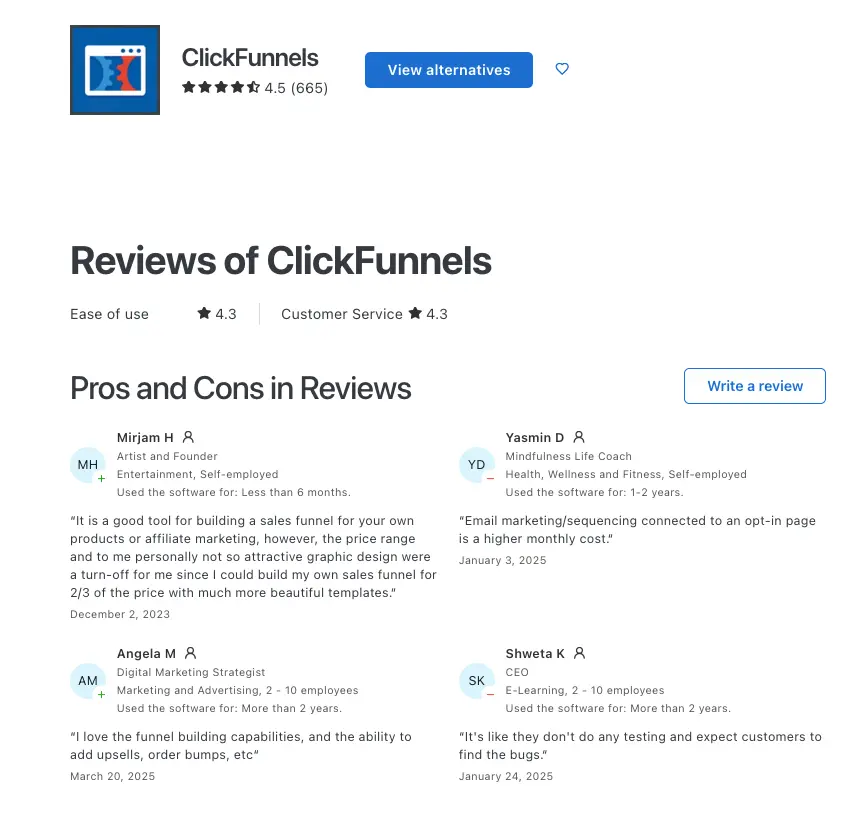
ClickFunnels holds an average rating of 4.5/5 on Capterra, though users regularly note pricing and limited customization as key drawbacks.
What’s the Difference Between ClickFunnels and ClickFunnels 2.0?
ClickFunnels 2.0 marked a major turning point in October 2022, when the platform was completely rebuilt from the ground up. It wasn’t a patch or update — it was a full relaunch that transformed ClickFunnels from a simple funnel builder into a complete marketing and business platform.
You now get a faster, React-based builder, true website creation tools, a built-in CRM (Contacts Hub), blog hosting, eCommerce Store, membership areas, and email automation — all native to the system.
The 2.0 version is designed for modern creators and small businesses who want a single platform to host pages, sell products, and manage customer relationships, rather than stitching multiple apps together.
In short: Classic = funnel builder; 2.0 = full business hub.
3. Who It’s For — And Who It’s Not
Ideal for
ClickFunnels is built for entrepreneurs and marketers who want to master the art of funnels — or finally learn how to use them to grow their business. It’s not just about building pages; it’s about understanding how to guide visitors step by step toward becoming customers.
It’s particularly well-suited for:
- Coaches, consultants, and course creators — If you sell digital programs, workshops, or high-ticket services, ClickFunnels helps you package and sell them through optimized funnels — complete with lead magnets, email nurturing, and checkout sequences.
- Marketers running launch or webinar campaigns — ClickFunnels was practically designed for launch-style events and webinar funnels. Its prebuilt templates and follow-up automations let you guide prospects from registration to replay to purchase.
- Small businesses with a direct-response mindset — Brands that thrive on clear calls-to-action, lead magnets, and limited-time offers benefit most.
- Funnel-focused entrepreneurs — If you think in terms of customer journeys rather than websites, ClickFunnels feels natural. It strips away distractions and focuses on getting one outcome: conversions.
Not ideal for
- Beginners on a tight budget – Pricing starts at $97/month, and many affordable tools can handle simple funnels just as well.
- Designers or branding-focused businesses – Customizing beyond templates can feel clunky, limiting creative control.
- Content-driven marketers – ClickFunnels isn’t made for SEO, blogging, or long-form content; it’s built to convert traffic, not attract it organically.
- Agencies or teams with complex setups – Lacks advanced CRM tools, deep integrations, and multi-client management compared to platforms like GoHighLevel.
- eCommerce brands – Great for digital offers, but not ideal for large product catalogs or advanced checkout logic.
In short, ClickFunnels shines when your priority is selling through funnels, but it’s too rigid and expensive if you’re looking for an all-purpose marketing platform.
4. Feature Deep Dive
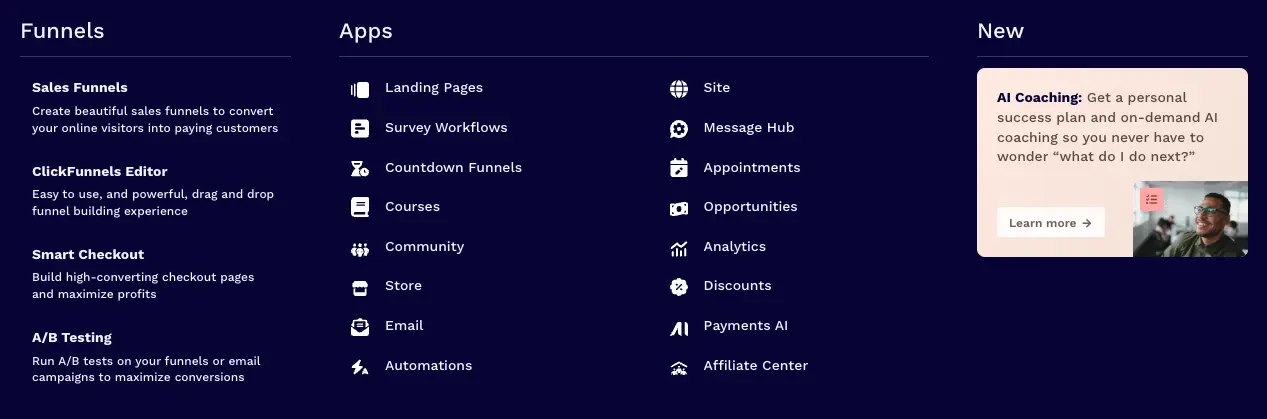
ClickFunnels Feature Overview
ClickFunnels brings together a powerful funnel builder, checkout tools, and a full suite of apps designed to run your marketing engine from one place — but it now competes directly with platforms like Systeme.io and GoHighLevel that offer more automation for a lower price.
Funnels: Sales Funnels • Editor (Drag & Drop) • Smart Checkout • A/B Testing
Apps: Landing Pages • Surveys • Countdown Funnels • Courses • Community • Store • Email • Automations • Site Builder • Message Hub • Appointments • Opportunities • Analytics • Discounts • Payments AI • Affiliate Center
Funnels
4.1 Sales Funnels
ClickFunnels was built for one thing — creating sales funnels that convert. Everything in the platform centers on guiding visitors from landing page to checkout with smooth, connected steps. That’s really the core strength of ClickFunnels — everything revolves around building and optimizing funnels that actually sell.
4.2 ClickFunnels Editor (Drag & Drop)
The ClickFunnels editor is built for speed. You can drag, drop, and edit any element — headlines, buttons, videos, or forms — in seconds, no coding needed. Templates come pre-optimized for conversions, so you can launch funnels fast. It’s not the most flexible designer out there, but that’s the trade-off. ClickFunnels focuses on getting your funnel live and selling, not endless tweaking.
4.3 Smart Checkout
ClickFunnels’ Smart Checkout is designed to squeeze every bit of value from each sale. You can add one-click upsells, downsells, and order bumps right inside the checkout flow — no extra plugins or coding. It supports multiple payment gateways like Stripe and PayPal, and the checkout templates are optimized for conversion and mobile users. It’s simple but powerful: you can turn a $47 sale into $97 just by adding a smart bump offer.
4.4 A/B Testing
ClickFunnels makes split testing refreshingly simple. You can duplicate any page, tweak a single element — a headline, button color, or offer — and the system automatically divides your traffic between the versions. Once enough visitors have hit both pages, ClickFunnels shows which one performs better based on real conversion data, not guesswork.
ClickFunnels Apps
4.5 Landing Pages
ClickFunnels built its reputation on landing pages, and that’s still where it performs well. You can create opt-in, sales, and upsell pages quickly using templates and its drag-and-drop editor. However, other platforms like Leadpages, Unbounce, Kartra and Systeme.io offer more design flexibility and better native integrations at lower price points.
4.6 Survey Workflows
ClickFunnels includes basic survey and form features you can drop directly into funnels to collect leads, segment audiences, or qualify prospects before checkout. However, it’s not a full survey platform. Tools like Typeform or HubSpot Forms provide deeper logic, analytics, and design control.
4.7 Countdown Funnels
ClickFunnels makes it easy to add countdown timers and deadlines — one of the oldest yet most powerful sales tactics around. You can use timers on landing pages, order forms, or emails to push limited-time offers, bonuses, or launches. When the timer ends, ClickFunnels can automatically redirect users to a new page or close the offer.
4.8 Courses
ClickFunnels lets you build and sell online courses or memberships directly inside your funnel setup. You can host lessons, videos, and downloadable content behind a secure login. The interface is clean but simple — it works well for straightforward course delivery, though it lacks the community and student engagement features found in tools like Kajabi, Podia, or Systeme.io.
4.9 Community
ClickFunnels includes a community feature that allows you to create private spaces for your members or students. It’s functional but minimal compared to dedicated tools like Skool, Circle, or Tribe. That said, for small coaching programs or course creators who just want a place for their students to connect and ask questions, ClickFunnels’ built-in community does the job.
4.10 Store
ClickFunnels 2.0 introduced a proper Store feature, letting you sell multiple products under one branded storefront. You can list digital or physical products, manage variations, track inventory, and connect payments through Stripe, PayPal, or NMI. What ClickFunnels does differently is bring its funnel marketing and sales psychology into the eCommerce experience.
4.11 Email
ClickFunnels 2.0 includes a built-in email marketing system called Follow-Up Funnels, designed to help you nurture leads and convert customers without relying on third-party tools. You can create automated sequences, tag subscribers based on actions, and send broadcast emails directly from your dashboard. Deliverability is solid, though not best-in-class.
4.12 Automations
ClickFunnels makes automation simple and visual. You can set up workflows that trigger emails, grant product access, apply tags, or send internal alerts. The automation builder shows exactly how leads move through your funnel. It doesn’t go as deep as tools like GoHighLevel or ActiveCampaign, but for most businesses, it’s powerful enough to run follow-ups and keep sales moving on autopilot.
4.13 Site Builder
ClickFunnels now includes a full website builder that lets you create multi-page sites with global navigation, headers, and footers. This is a big step up from the old version, which focused only on standalone funnel pages. The Site Builder is still more about functionality than freedom, but for most marketers, it’s a simple way to connect funnels and websites under one roof.
4.14 Message Hub
The Message Hub brings all your customer communication into one central place. It combines emails, automation messages, and customer replies so you can manage everything without switching between apps. It’s designed to feel like an inbox for your business.
4.15 Appointments
ClickFunnels now includes an Appointments app that lets you schedule meetings, calls, or coaching sessions directly inside your funnels. Visitors can book a time that syncs with your calendar. It’s not as feature-rich as Calendly or Acuity, but the big advantage is that it’s natively connected to your funnels, automations, and follow-up emails.
4.16 Opportunities
The Opportunities tool works like a lightweight CRM pipeline for tracking leads and deals. You can see exactly where each contact is in your sales process — from new lead to closed sale — without leaving your funnel dashboard. It’s simpler than tools like HubSpot or GoHighLevel, but that’s the point: quick, visual, and built for conversions.
4.17 Analytics
ClickFunnels includes a clean, built-in analytics dashboard that tracks your page views, conversions, and overall funnel performance in real time. It’s not as deep as Google Analytics or GoHighLevel’s reporting, but it delivers the numbers that actually matter.
4.18 Discounts
ClickFunnels lets you create discount codes and limited-time offers directly inside your funnels. You can apply them to specific products, bundles, or entire campaigns. It’s simple but effective — a well-timed discount can do more than a complex pricing system ever will.
4.19 Payments AI
ClickFunnels recently introduced Payments AI, a feature built to help you analyze and optimize your funnel revenue automatically. It tracks key payment data like conversions, refunds, failed payments, and recurring billing — then highlights where you could improve. This really proves the point: ClickFunnels isn’t just about building pretty landing pages — it’s built to make your funnels sell.
4.20 Affiliate Center
ClickFunnels includes a built-in Affiliate Center that lets you manage your own affiliate program directly inside the platform. You can create unique referral links, set custom commission rates, and track payouts without relying on third-party tools. It’s straightforward and does what it should — empowering you to turn happy customers into promoters.
My bottom line: These 20 core features show why ClickFunnels remains one of the most complete funnel-focused platforms out there. It’s built to help you launch, sell, and scale — keeping every tool, insight, and conversion trigger under one roof.
5. UX, Onboarding & Support
ClickFunnels keeps its interface clean and fairly intuitive — though it leans more toward functionality than elegance. The dashboard is organized around what matters most: your funnels, contacts, and sales performance. For beginners, the number of menus and settings can feel a bit overwhelming at first, but after a few sessions, the logic starts to click.
Onboarding has improved a lot since the early days. You’re guided by video tutorials, quick-start checklists, and in-app tooltips, plus there’s a massive knowledge base covering almost every use case.
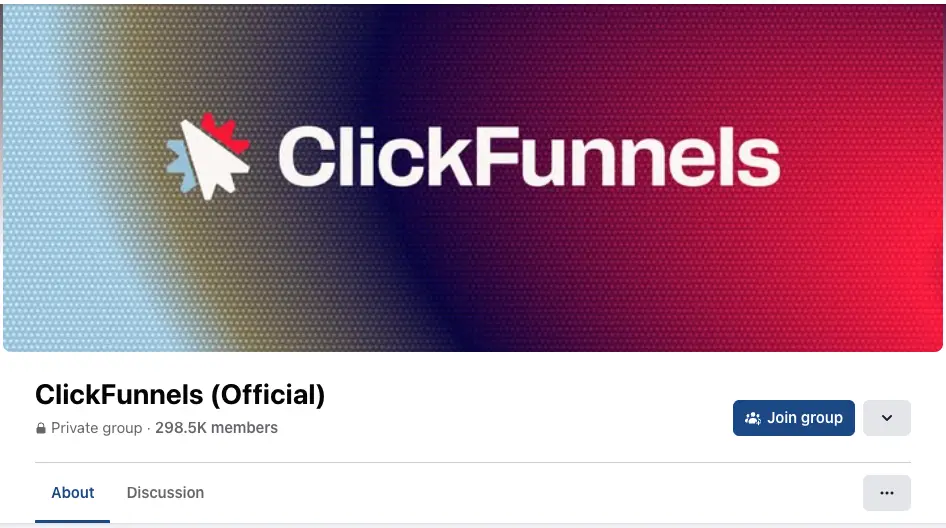
Support is solid but not perfect. You can reach the team via chat or ticket system, and response times are usually fast. The real power, however, is the ClickFunnels community — especially its active Facebook group where almost 300k members share advice, troubleshoot, and swap funnel ideas in real time.
Overall, ClickFunnels does a good job of helping new users get moving fast — not by dumbing things down, but by giving you the right mix of resources, guidance, and community backup to start selling confidently.
6. Performance & Reliability
ClickFunnels performs reliably for most small and mid-sized businesses, but it’s not flawless. Users on G2 and Capterra often praise its stability and uptime, noting that funnels generally load fast and the platform rarely crashes.
However, discussions on Reddit and user forums highlight that performance can slow down with heavy traffic or complex pages. Some users also report occasional bugs and billing frustrations — typical for a large SaaS platform but worth noting.
Overall, ClickFunnels 2.0 is stable, polished, and dependable for everyday funnel work, though not the speed king. Keep your funnels lean and optimized, and it will run smoothly enough to power real sales without tech headaches.
7. Pricing & Value Analysis
One big advantage of ClickFunnels is Russell Brunson himself — the platform doesn’t just sell you software, it teaches you how to sell. Through his books, courses, and community, you learn the psychology behind funnels, offers, and conversions. That’s something most other platforms don’t give you — they hand you tools, while ClickFunnels hands you a playbook for selling.
That built-in education is why ClickFunnels can charge more than its competitors. You’re not just paying for a funnel builder; you’re paying for a complete marketing philosophy.
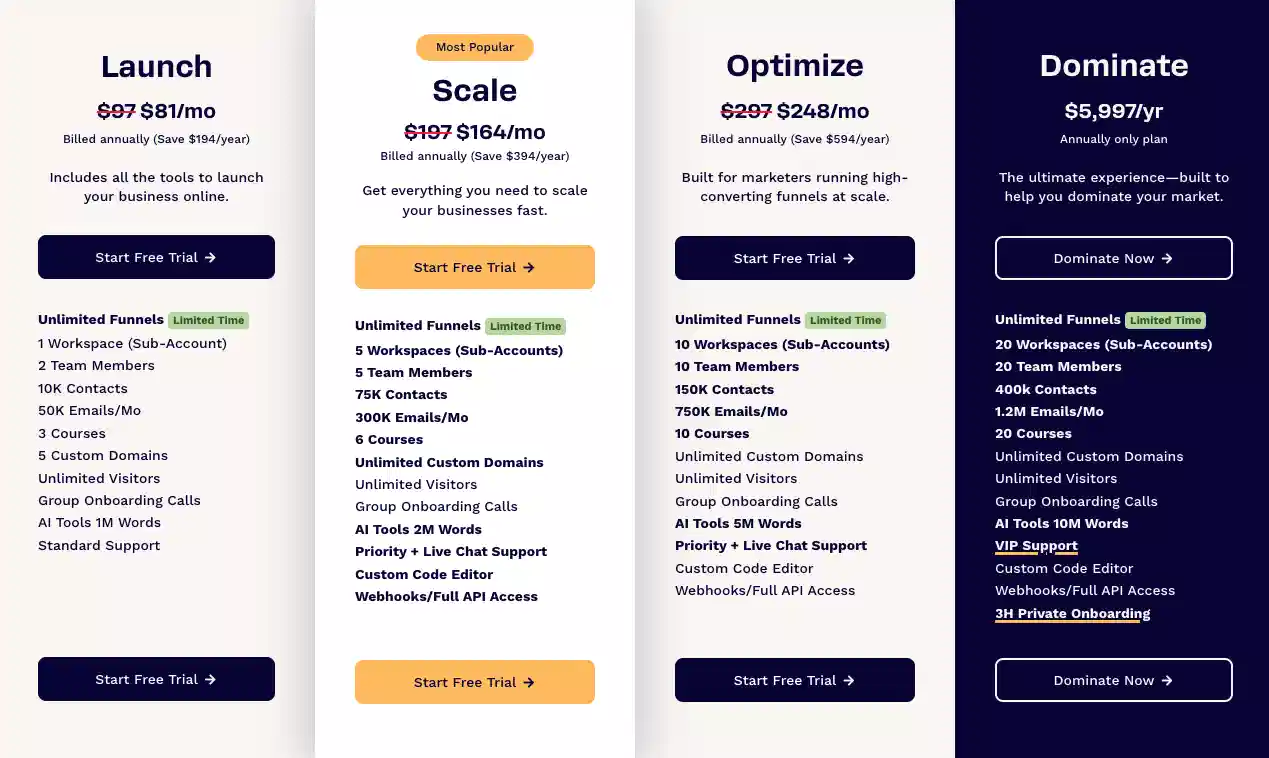
ClickFunnels is still one of the most premium platforms in the funnel-building world. Pricing starts at $97/month, with higher tiers unlocking advanced automation, analytics, and multi-workspace functionality. There’s a 14-day free trial, but no free plan.
Also, check my full breakdown of ClickFunnels Pricing.
Launch Plan – $97/mo ($81/mo annual)
Best for solopreneurs launching their first funnel or digital offer. Includes unlimited funnels, 10K contacts, 50K emails/month, and 3 courses.
Scale Plan – $197/mo ($164/mo annual)
For growing businesses. Adds 5 workspaces, 75K contacts, 300K emails/month, and unlimited domains plus live chat support.
Optimize Plan – $297/mo ($248/mo annual)
For marketing pros running big campaigns. Includes 10 workspaces, 150K contacts, 750K emails/month, and API access.
Dominate Plan – $5,997/year
Full suite for large teams and agencies. Includes 20 workspaces, 400K contacts, 1.2M emails/month, and VIP support.
| Feature | Launch | Scale | Optimize | Dominate |
|---|---|---|---|---|
| Monthly (Annual) | $81 | $164 | $248 | $5,997/yr |
| Workspaces | 1 | 5 | 10 | 20 |
| Team Members | 2 | 5 | 10 | 20 |
| Contacts | 10K | 75K | 150K | 400K |
| Emails/Month | 50K | 300K | 750K | 1.2M |
| Courses | 3 | 6 | 10 | 20 |
| Custom Domains | 5 | Unlimited | Unlimited | Unlimited |
| AI Tools | 1M words | 2M words | 5M words | 10M words |
| API & Webhooks | ✗ | ✓ | ✓ | ✓ |
8. Comparisons & Top ClickFunnels Alternatives
ClickFunnels is one of the biggest names in the funnel world — but not the only option. Tools like Systeme.io, Kartra, and GoHighLevel deliver similar all-in-one power at lower prices and with simpler workflows. For a full breakdown, visit the Comparisons Hub to see ClickFunnels stacked against real alternatives.
Top & Mid-Tier Platforms
| Platform | Entry Price | Free Plan | Core Strengths | Ideal For | Limitations |
|---|---|---|---|---|---|
| Systeme.io | $0–$27/mo | ✓ | All-in-one funnels, email, courses | Solo creators, small teams | Basic templates |
| ClickFunnels | $97/mo | ✗ | Funnel-first, great conversions | Marketers, coaches, agencies | High cost, limited automation |
| Kartra | $99/mo | ✗ | Video hosting, CRM, automation | Agencies, course sellers | Heavy UI, slower load |
| Kajabi | $149/mo | ✗ | Courses + community + automations | Coaches, educators | Expensive for starters |
| GoHighLevel | $97/mo | ✗ | White-label, agency CRM | Agencies, advanced marketers | Complex setup |
| GetResponse | $15–$59/mo | ✓ | Email + funnels + webinars | Email-driven marketers | Limited landing pages |
| Builderall | $19–$69/mo | ✓ | Wide toolset at low price | Budget marketers | Mixed quality tools |
9. Real User Feedback
What real users appreciate
- “What I like most about ClickFunnels is how easy it makes creating complete sales funnels without needing to know how to program. Its visual interface is very intuitive.” — G2 user
- “The all-in-one capabilities makes it much more valuable than standalone website editors or CRMs. I was able to set up a sales page, upsells, an email list, and a storefront to sell products.” — G2 user
- “I’ve worked with some CSS coding… the things that ClickFunnels can do is amazing. I built a landing page in GetResponse today, and it’s night and day. ClickFunnels is so much better.” — Reddit user
What users say could be improved
- “ClickFunnels is pretty buggy at times and their support isn’t too great. Fact is you don’t really need any tool if the strategy is solid.” — Reddit user
- “ClickFunnels is way overpriced. I was able to create something on a WordPress website that worked essentially the same… still ended up being so much cheaper.” — Reddit user
- “It’s easy to use but I’ll never recommend it. It looks so white-labelled as a CF page, and it massively hurts your brand.” — Reddit user
- “The learning curve is steep… you have to do some research to learn how to use it entirely; the price feels a bit high to start.” — G2 reviewer
10. Limitations & What Could Be Better
Even though ClickFunnels is one of the most recognized names in funnel building, it’s far from perfect. Here’s where it still struggles compared to modern all-in-one tools like Systeme.io and GoHighLevel.
- High pricing tiers — Starting at $97/month, it’s significantly more expensive than most alternatives with similar functionality.
- Limited design flexibility — The templates look clean and work well, but customization is still limited compared to competitors.
- Basic automation and CRM tools — Follow-Up Funnels work for simple sequences, but lack conditional logic, tagging depth, and analytics power.
- Few native integrations — Many third-party apps require Zapier or custom workarounds to connect smoothly.
- No true free plan or sandbox mode — You’ll need to pay to properly test features, making the entry barrier higher for beginners.
Bottom line: ClickFunnels is still great at what it was built for — creating funnels that convert.
11. ClickFunnels Frequently Asked Questions (FAQ)
Yes, but it’s quite basic. The “Follow-Up Funnels” feature covers email sequences, tagging, and simple automations — though tools like GoHighLevel or standalone email platforms offer much deeper automation and segmentation.
Not really. It’s a funnel-focused builder, not a full CMS. You can create marketing pages, checkouts, and memberships — but not a full SEO blog or large content site. For that, pairing it with WordPress or Systeme.io works better.
Yes, ClickFunnels connects with Stripe, PayPal, Zapier, ActiveCampaign, and more. However, many connections still rely on Zapier, which adds extra cost and complexity.
Not really. It doesn’t offer client sub-accounts or white-label tools. If you manage multiple clients or campaigns, GoHighLevel is a much better fit.
Partially. You can sell single products or bundles, but it’s not built for inventory management, SKUs, or large stores. It’s ideal for digital and info products, not traditional e-commerce.
It depends on your goals. If your main focus is building funnels that convert quickly, ClickFunnels is still one of the best. But if you want an all-in-one platform with stronger automations, email tools, and lower pricing, Systeme.io or GoHighLevel offer more value for the money.
No, ClickFunnels doesn’t offer a free plan. You can test it through a 14-day trial, but after that, pricing starts at $97/month. This is one reason many beginners start with Systeme.io’s free-forever plan first.
ClickFunnels is used mostly by coaches, course creators, consultants, and online marketers who sell digital products or high-ticket offers through sales funnels. It’s less ideal for e-commerce or content-driven businesses.
Yes — you can easily connect your custom domain to keep your brand consistent and professional. Domain setup is beginner-friendly inside the dashboard.
12. Final Verdict & Recommendation
ClickFunnels remains a solid funnel builder in 2025 — it’s fast, reliable, and built around one clear mission: helping you turn visitors into paying customers. The drag-and-drop editor, templates, and checkout flows still make it one of the easiest ways to build high-converting funnels without coding.
That said, it’s no longer the only big player in town. Tools like Systeme.io and GoHighLevel now offer more features for less money — especially for users who want deeper automation, email control, or agency-style account management.
Who it’s best for: Entrepreneurs, coaches, and marketers who want a proven, funnel-first platform with ready-made templates and strong conversion features. It’s ideal for anyone focused on selling digital products, high-ticket offers, or lead generation.
Who might outgrow it: Agencies or advanced marketers who need multi-client dashboards, white-label features, or complex automation logic will hit ClickFunnels’ limits quickly — GoHighLevel will serve you better in that case.
Bottom line: ClickFunnels is still great at what it does — funnels that convert. But for many small businesses, its high pricing and limited automation mean there are now smarter, more flexible choices out there. Before committing, explore your two strongest alternatives: Systeme.io review (free plan) and GoHighLevel review (built for agencies & automation). Or if you’re in full comparison mode, jump straight to the Marketing Tools Comparisons Hub.
Pro tip from That Marketing Buddy: If you’re comparing Systeme.io and GoHighLevel, you’ll probably also want to see how Systeme.io stacks up against ClickFunnels. It’s a classic match-up between simplicity and power — perfect if you’re curious about funnel design, A/B testing, and conversion optimization. Give it a read if you want to understand where each tool truly shines before committing your marketing budget.